Roman Corduba: a bridge, a buried temple and two writers
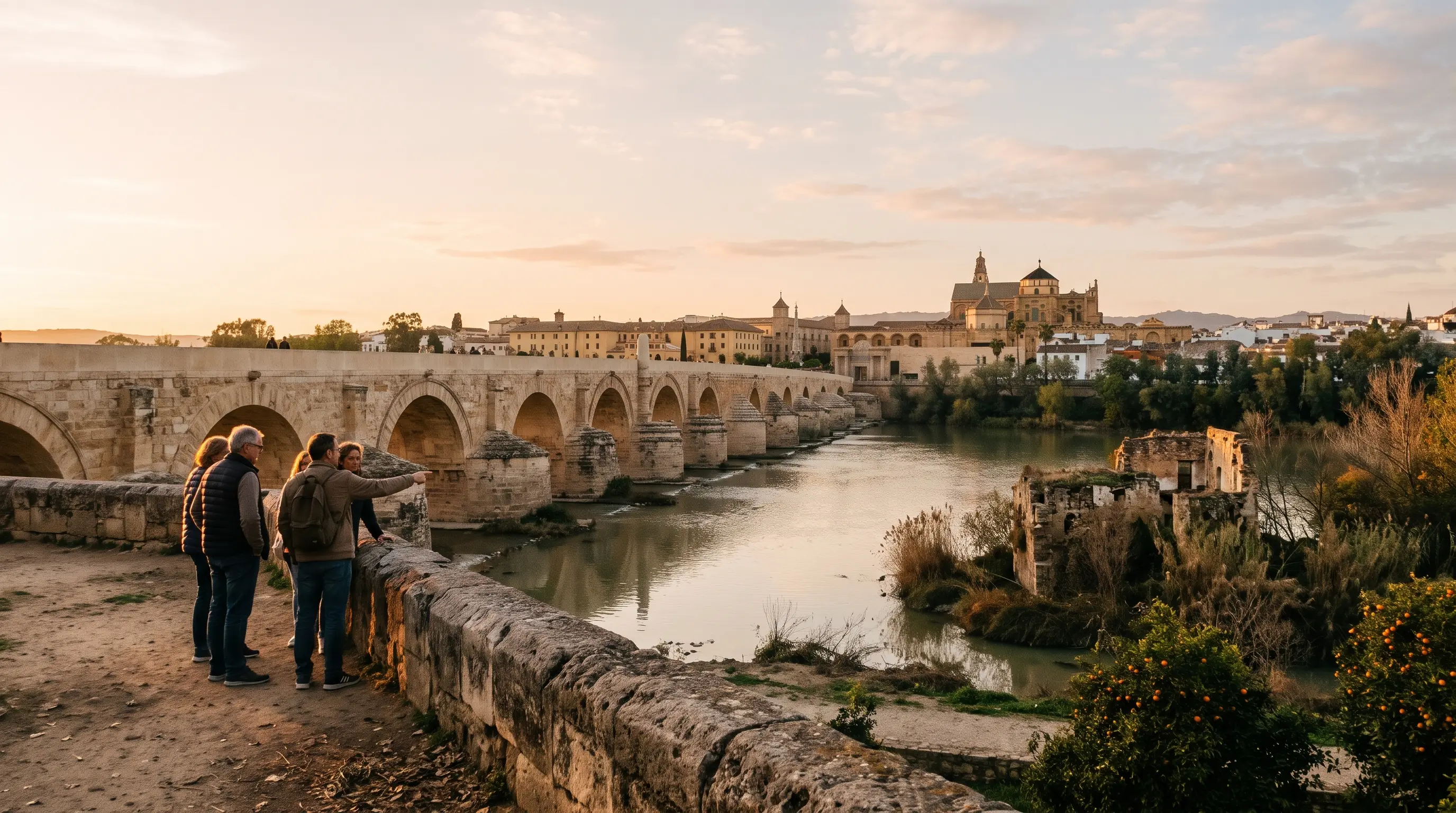
The Roman Bridge has sixteen arches, four of them pointed and the rest semicircular.[4] Pointed arches are not a Roman habit, so the count alone tells you the crossing has been repaired and rebuilt more than once. Corduba was a Roman city before it was anything else people visit it for, and the bridge is where that layer is easiest to touch. Walk it slowly, try to sort the round arches from the pointed ones, and only then read how much of it is truly Roman, which is a better argument than the arch tally.
The old city still surprises its own residents. On 30 January 1951 the newspaper Diario Córdoba announced the discovery of a Roman temple under the foundations of the town hall.[5] The modern centre sits directly on the Roman one, and building work there can turn into archaeology, so when you pass the town hall it is worth remembering what its foundations once hid.
The city also exported people. Lucan, born in Corduba, was the grandson of Seneca the Elder and the nephew of Seneca the Younger,[6] who with his friends was virtual ruler of the Roman world between AD 54 and 62.[7] A provincial town that produced one of Rome's leading intellectuals and, in Lucan, a Latin poet from the same family was punching well above its weight. Few European cities can claim an uncle and a nephew who both mattered in Rome.
That family tree explains why Roman Córdoba is easier to read than to see. The physical Corduba is mostly under your feet, with a bridge and a temple as its clearest witnesses, while the literary Corduba lives in books you can carry in a pocket. If you only have time for one layer, choose the one that matches how you like to travel: stone for walkers, Latin for readers.
If you want to test the bridge claim yourself, stand mid-span and look for the pointed arches among the round ones, then check the total against the city tourism office's count of sixteen.[4] The temple is harder to verify on foot: the 1951 announcement came from a local newspaper and the find was under the town hall's foundations, so read about it rather than queue for it.[5] The Seneca dates are firmer, because the 54 to 62 window comes from a standard reference work.[7]
The caliphal capital: how big was it, really?
Nobody can say exactly how big caliphal Córdoba was, which is itself the interesting part. Estimates of its size at its peak run from 90,000 to an unlikely 1,000,000, and even the low end towers over the 50,000 that, by one history's estimate, no other city in Europe exceeded.[9] A figure of some 100,000 inhabitants around the year 1000 sits comfortably inside that range,[1] so the claim that Córdoba was Europe's largest city then deserves a "probably" rather than a firm rank. Córdoba's population today is a matter of an official register rather than guesswork.
The earlier centuries are no tidier. Historians put the ninth-century population anywhere between 75,000 and 160,000,[10] so the high estimate is more than double the low one. A spread like that is a warning about method rather than a rounding error: medieval cities left no census, so every figure is a reconstruction. Use these numbers to compare scale, and distrust any guide who quotes one to the last thousand.
The reputation was not modest either. UNESCO's description of the historic centre credits the caliphal city with some 300 mosques and innumerable palaces and public buildings, built to rival Constantinople and Baghdad.[11] It is a description of grandeur rather than an audited inventory, so repeat it as UNESCO's wording. The listing itself began with the Great Mosque in 1984 and was extended in 1994 to include part of the historic centre,[12] which means the caliphal city is a protected district you can walk, not a single building.
For a reader deciding how far to trust any of this, the ranking is the weak link and the map is the strong one. The spread from 90,000 to 1,000,000 is wide enough that no single figure survives,[9] and UNESCO's line about some 300 mosques is a description of the city's grandeur.[11] What you can check today is the protected area itself: the Great Mosque was listed in 1984 and the centre was added a decade later.[12] Walk it with that in mind and the reputation matters less than the streets.
Medina Azahara and a library of uncertain size
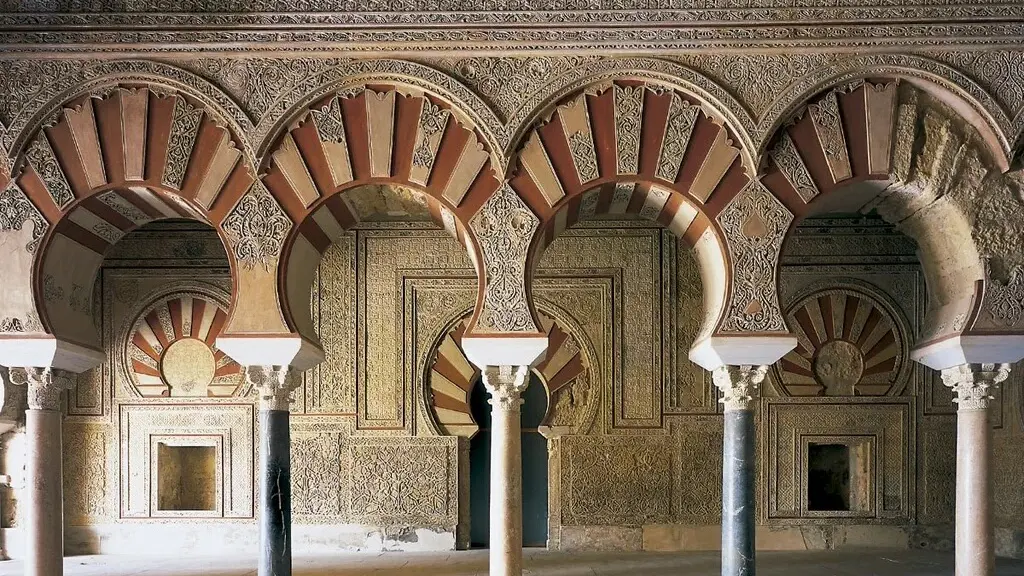
The palace-city of Medina Azahara was the caliphate's showpiece. Historical sources mention ten thousand people working daily on its construction,[13] yet the whole enterprise was wrecked after only seventy years.[14] That gap between effort and survival is what makes the lost palace-city of Medina Azahara such a haunting story, and it is the best argument for seeing the site with the background in your head rather than cold.
Set the two numbers side by side and the scale becomes clear. A workforce of that size was committed to one complex, which then lasted less than a lifetime: someone alive at its foundation could have watched both the building and the wrecking. The ruins you walk through today are what remains of an effort designed to impress, and they reward a visitor who arrives knowing what the caliphate was trying to say.
Explore nearby · Monument
Medina Azahara
Medina Azahara is Córdoba's UNESCO listed Caliphate City: a 10th century palace 8 km from town, with the Salón Rico and award-winning museum. Plan your visit.
The same ambition shows up in the book trade. Al-Hakam II is credited with a library that may possibly have held over 400,000 books, though that number cannot be substantiated.[15] Whatever the true count, the figure tells you how the caliphate wanted to be seen, and what became of the books is the sharper question.
Treat it as a case study in how to read medieval numbers. A round, enormous total repeated across centuries is a sign of reputation rather than inventory, and the hedge in the source is the honest part of the story. If a guide gives you the figure flat, you now know to ask where it comes from.
A simple ranking of certainty helps on site. The ten-thousand-worker figure is attributed to historical sources rather than a payroll,[13] the seventy-year span is stated flatly,[14] and the library total carries its own warning that it cannot be substantiated.[15] Arrive with that order in mind and each ruin reads as evidence rather than decoration.
Philosophers, a love treatise and a medieval synagogue
Medieval Córdoba produced thinkers who were read far beyond al-Andalus, and three birthplaces are enough to make a reader curious before arriving. Each of the three below is a different kind of fame, which is why they make a better trio than any single philosopher would.
- Averroes was born into a family of jurists in Córdoba and died in Marrakech,[16] a route that shows how far a Córdoba education could carry a man. The family of jurists is the part guidebooks skip.
- Maimonides was born in the city in 1138, while it was under Muslim rule.[17] The detail places a Jewish thinker's birth inside a Muslim-ruled Córdoba.
- Ibn Hazm produced around 400 works on subjects from jurisprudence to theology,[18] among them The Ring of the Dove, a treatise on love. The prolific writer credited with around 400 works is remembered for the book about love.
The synagogue is the stone counterpart to those names. Its founding inscription, found in 1884, dates it exactly to 1314-1315,[2] and it counts as one of the three best-preserved medieval synagogues in Spain.[19] That is a small building with a precise birth certificate, which is rarer than it sounds in a city where most monuments argue about their own dates, and Córdoba's synagogue has had a longer afterlife than its founders could have guessed.
Most Córdoba monuments have to be dated by argument, with competing chronicles and rebuilt walls to untangle. The synagogue is the exception, because the inscription settled the question, and a firm date makes a good counterweight to the estimates earlier in this list. It is one of the few places in the city where you can stand inside a dated medieval room and not have to qualify the number.
Check the size of each claim before you repeat it. Averroes's family of jurists[16] and Maimonides's 1138 birth year[17] are each stated plainly by standard reference entries, while the 400 works credited to Ibn Hazm is an approximate figure, so say "around 400".[18] The synagogue's 1884 inscription is what pins its date to 1314-1315,[2] and the city's own tourism office ranks it among the three best preserved in Spain.[19]
Living Córdoba: patios, a water wheel and a cold soup
Few cities can say that their ordinary domestic life is on UNESCO's list. The Fiesta of the Patios was inscribed on the Representative List of the Intangible Cultural Heritage of Humanity in 2012,[20] and UNESCO's listing describes twelve days at the beginning of May in which the city opens its courtyards to visitors.[3] The patios of Córdoba are heritage you experience at doorstep scale, which is why they feel so different from the monuments.
The competition is younger than the courtyards. Mayor Francisco Fernández de Mesa organised it for the first time in 1921.[21] The houses themselves are far older: Romans and later Muslims adapted the popular house type to Córdoba's dry, hot climate by turning it inward around a patio.[22] A courtyard here is a piece of climate engineering that happens to be pretty.
Recommended tours
Tours are selected for quality, not commission. We earn a small fee if you book — at no extra cost to you.
That is worth knowing before you go. The flowers are the visible part, but the layout of the house is the idea, and the festival is the moment the city chooses to share it. Plan around the early May window if the patios are your reason for coming.
A civic emblem works the same way. A water wheel has appeared on the city's coat of arms since the 14th century,[23] so a machine for lifting river water is part of how Córdoba pictures itself. The Albolafia water wheel rewards a closer look for that reason alone.
Deep dive · Article
An Andalusian Treasure Has Sat in the British Museum Since 1932
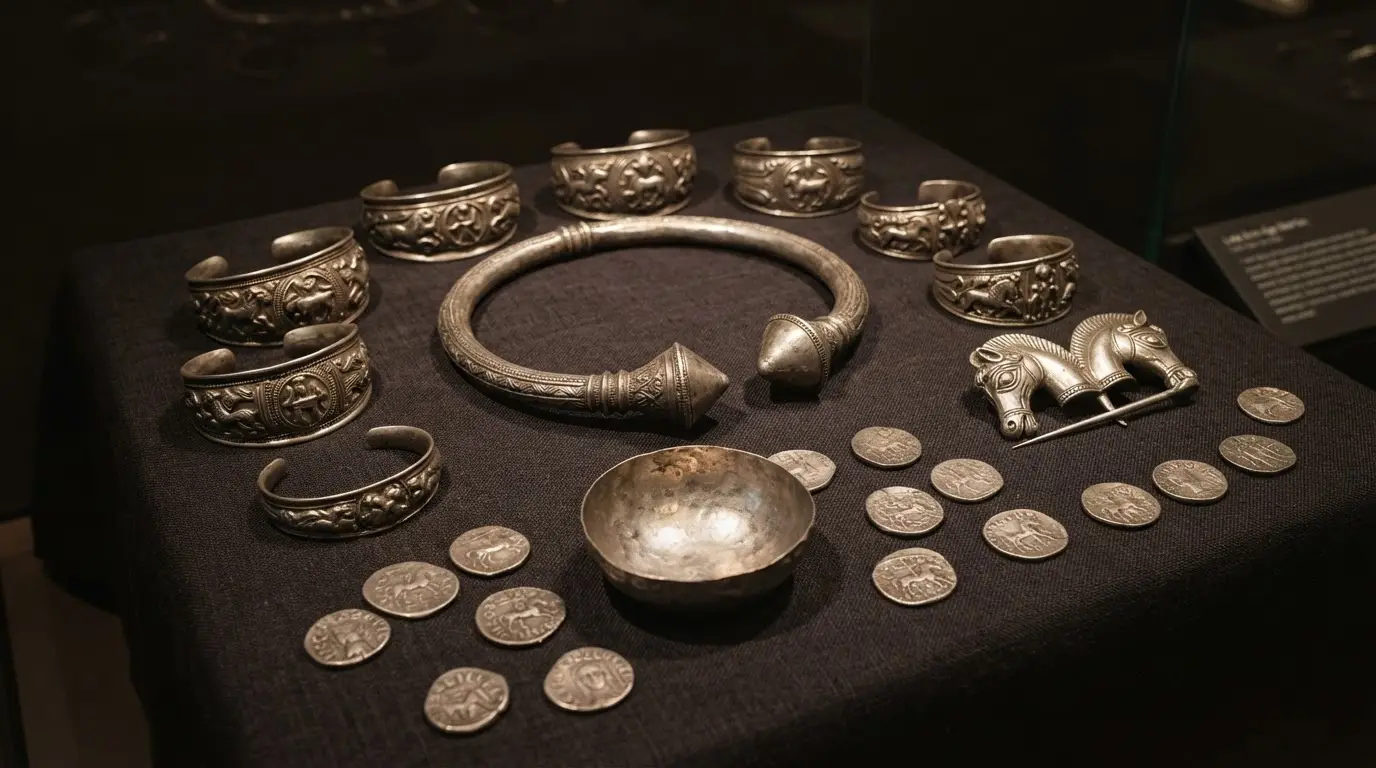
A silver hoard dug up in Córdoba in 1915 left Spain against the law and has been in the British Museum since 1932. Here is how, and what a 2026 study found.
Food carries the same long memory. Before tomatoes entered Spanish cooking, Andalusians were already making satiating soups of garlic, almonds and bread,[24] which is the older family that mazamorra cordobesa belongs to. Order the white soup once, if only to taste what the red versions replaced.
The dates in this section differ in how firm they are. UNESCO's 2012 inscription and its twelve-day description are institutional facts,[20][3] and the start of the competition in 1921 is recorded on the city's own patios site.[21] The coat-of-arms detail is dated only to the 14th century,[23] so expect no exact year, and the soup claim is a comparison with tomato-era cooking rather than a founding date.[24]