
Regional itinerary
7, 10 & 14-Day Andalusia Itinerary
Most people base themselves in Seville. That's one option. Córdoba sits at the centre of the Andalusian rail network, costs less, and puts the Mezquita, Granada, and Seville all within 2 hours by train. Pick your pace.

Written by
María Fernanda González Ten years covering Córdoba's UNESCO heritage sites, sourcing from Junta de Andalucía documentation.
Updated Published
In this guide
Jump to a section
Why use Córdoba as your Andalusia base?
The standard Andalusia trip follows a well-worn path: fly into Seville, spend three nights, take a day trip to Córdoba, finish in Granada. It works. But it puts you in the most expensive city for the longest stretch, and it treats Córdoba as a side note when it probably deserves equal billing.
Córdoba's advantage is logistical as much as cultural. The city sits at the intersection of the main Andalusian rail lines. Seville is 45 minutes away by AVE. Granada is 1h30. Madrid is 1h45. You can reach all three from a single hotel base, without hauling luggage across three cities. Hotels in the historic centre of Córdoba cost 20–40% less than comparable properties in Seville, and the Mezquita-Cathedral is a ten-minute walk from most of them.
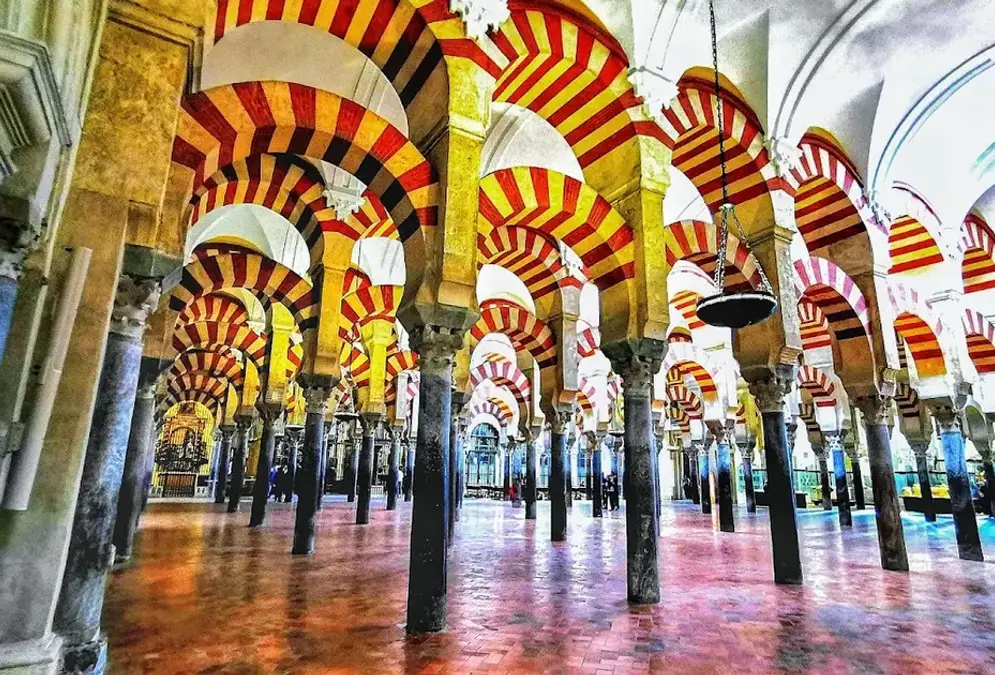
Most first-time visitors underestimate what Córdoba holds on its own. The Mezquita took three caliphs and 200 years to build. The Judería is one of the best-preserved medieval Jewish quarters in Europe. Medina Azahara, the ruined palace-city of Abd al-Rahman III, is 8 km outside the centre and gets a fraction of the Alhambra's crowds. Three days here is not padding: it's the minimum to do it properly.
Central rail hub
Seville 45 min, Granada 1h30, Madrid 1h45. No other Andalusian city has faster connections in all directions.
Lower costs
Mid-range hotels in Córdoba's historic centre run €70–110 per night versus €100–160 for the same quality in Seville.
Compact historic core
The Mezquita, Alcázar, Roman Bridge, and Judería all sit within 600 metres of each other. No local buses needed.
Andalusia route map
The map below shows all 9 destinations across the three itinerary variants. The 7-day route covers stops 3–5 (Seville, Córdoba, Granada). The 10-day adds Ronda and Málaga. The 14-day includes the full circuit from Madrid to Cádiz.
Interactive map — loads as you scroll (requires JavaScript)
Numbered markers correspond to the suggested order of visit for the 14-day itinerary.
Choose your trip length
Three lengths, three different trips. The 10-day version hits the balance point for most travellers: enough time to slow down in Córdoba and Granada without burning through leave. The 7-day is tight but doable for a first visit. The 14-day is for people who want to actually stop moving.
| 7 Days | 10 Days Recommended | 14 Days | |
|---|---|---|---|
| Cities | 3 | 5 | 8+ |
| Córdoba days | 3 | 3 | 3 |
| Route | SEV → COR → GRA | + Ronda, Málaga | + Madrid, Toledo, White Villages, Cádiz |
| Pace | Focused | Comfortable | Relaxed |
| Budget (excl. flights) | €800–1,200 | €1,200–1,800 | €1,800–2,800 |
| Best for | First-timers with limited leave | Most travellers | Deep exploration |
7
days
The essential circuit
Seville (2 nights) → Córdoba (3 nights) → Granada (2 nights). Covers the Mezquita, Alhambra, and Alcázar without any filler.
See 7-day itinerary Recommended
10
days
The complete south
Adds Ronda (dramatic gorge, 2,000-year-old bridge) and Málaga to the 7-day base. Enough time to breathe between cities.
See 10-day itinerary14
days
The full circuit
Starts in Madrid, adds Toledo, the White Villages, Cádiz, and a slower return. The itinerary for people who don't want to rush.
See 14-day itineraryGetting around Andalusia
The AVE network connects all major Andalusian cities quickly and cheaply if you book ahead. Walk-up prices are four to eight times higher than advance fares, so buy tickets the moment your dates are confirmed. For the White Villages and rural areas, a rental car is the only practical option.
Key routes and journey times
- Madrid → Córdoba
- AVE 1h45, from €8
- Seville → Córdoba
- AVE 45min–1h30, from €15
- Córdoba → Granada
- Renfe 1h30–1h40, from €17
- Granada → Ronda
- Bus ~2.5h, from €10
- Ronda → Málaga
- Regional train 2h, from €20
- Madrid → Toledo
- Renfe 30min, from €5
Rental car considerations: Driving between Córdoba, Seville, and Granada is slower than the AVE and puts you at the mercy of historic-centre parking. Andalusian cities have aggressive pedestrian zones and limited paid parking near the main sights. That said, a rental car opens up the Grazalema Natural Park, the Alpujarra villages south of Granada, and the Campiña countryside around Carmona. If your 14-day itinerary includes the White Villages route, pick up the car in Granada after the rail portion and drive from there.
Book trains on renfe.com, ouigo.com, or iryo.eu. Trainline and Omio aggregate all three operators and are useful for comparing departure times.
Best time to visit Andalusia
Andalusia has four distinct seasons and the timing of your visit changes the experience more than in most European regions. Summer is genuinely difficult in the interior cities.
Spring (March–May)
Best overall windowTemperatures between 18–28°C, orange blossom scenting the streets, long evenings. The main events cluster here: Semana Santa (Holy Week, late March or April) transforms Córdoba's streets with processions that have run since the 16th century. The Patio Festival in early May opens private flower-filled courtyards to the public, a tradition dating to 1921 that now draws visitors from across Europe.
Trade-off: this is also peak season. Prices for hotels rise 30–50% in April and May. The Mezquita and Alhambra have their highest visitor numbers. Book accommodation 2–3 months ahead.
Autumn (September–October)
Second best windowSeptember still feels like summer in coastal Andalusia (Málaga, Cádiz), but by mid-October the interior cities have cooled to 20–25°C. Crowds thin noticeably after school terms restart in early September. Hotel prices drop 15–25% from August peaks.
The olive harvest begins in late October across the Córdoba countryside. Winery tours and oil-tasting experiences around the Campiña are at their liveliest. No major festivals compete for accommodation, so last-minute booking is more viable than in spring.
Summer (July–August)
Avoid for interior citiesCórdoba regularly records 42–44°C in July. Walking the Judería's narrow streets at 2pm is genuinely unpleasant. The Mezquita feels like a furnace from midday onward. Serious visitors start at 9am and retreat indoors from noon to 5pm.
If you must travel in summer, coastal Andalusia (Cádiz, Tarifa, Nerja) is cooler by 6–10°C due to sea breezes. Keep inland city visits to early morning and late evening. Nights are warm but bearable, and the streets come alive after 9pm.
Winter (December–February)
Underrated, much cheaperMild at 12–18°C: cold enough for a coat in the morning, warm enough for a terrace lunch by noon. Hotels drop 40–50% from peak-season rates in Córdoba. The Mezquita has no queues before 11am. Medina Azahara is empty on weekday mornings.
Main trade-off: Semana Santa and the Patio Festival are gone. Mountain areas (Sierra Nevada near Granada, Ronda's hinterland) can see snow in January. Carry layers. Christmas week sees domestic tourism surge temporarily, pushing prices back up for a fortnight.
Budget overview
Andalusia is one of the more affordable regions for Western Europe travel. Córdoba and Granada are noticeably cheaper than Seville and Madrid. All budgets below are per person per day, excluding flights.
€50–70
per day / Budget
- Accommodation €15–25 (dorm bed)
- Food €15–20 (menú del día)
- Transport €8–12 (advance AVE)
- Activities €8–15 (Mezquita: €15)
€90–130
per day / Mid-range
- Accommodation €60–90 (private room)
- Food €25–35 (sit-down meals)
- Transport €12–20 (advance booking)
- Activities €15–25 (with guided tours)
€180–250+
per day / Luxury
- Accommodation €130–200 (boutique hotel)
- Food €50–80 (restaurants)
- Transport €20–40 (flexible fares)
- Activities €30–60 (private guides)
Money-saving tips
- The menú del día (lunch fixed menu) runs €12–15 at most restaurants, including bread, two courses, dessert, and a drink. Eating the main meal at lunch instead of dinner cuts food costs by a third.
- The Mezquita is free on weekday mornings from 8:30–9:30am for worshippers. Show up, join the queue, enter for free. Standard entry is €15 at all other times.
- Book AVE tickets on OUIGO or AVLO 3–6 weeks ahead for fares from €5–8 one way. The same journey costs €60–72 on the day of travel with Renfe.
- Stay in Córdoba rather than Seville for the middle nights of your trip. You'll pay less for a comparable room and still reach Seville in 45 minutes.
For a detailed breakdown of costs in Córdoba specifically, see the Córdoba on a budget guide.
Book your Córdoba tours before you go
Tours are selected for quality, not commission. We earn a small fee if you book — at no extra cost to you.
Guided tours handle the queues and the context — one less thing to organise on the road.
From Seville: Córdoba Full-Day Tour
Discover Córdoba on a guided full-day trip from Seville. Visit the Mezquita-Cathedral, stroll the Jewish Quarter, and explore the Alcázar with a knowledgeable guide. Transport included.
10 hours
From €55
4.6 (781 reviews)
Reserve Your Spot
✓ Verified GetYourGuide reviews
Córdoba Guided Tour: Mosque, Jewish Quarter & Alcazar
Three-hour circuit of the Mezquita's 856-column prayer hall, the Jewish Quarter's whitewashed lanes, and the Alcázar's Roman mosaics. Skip-the-line access included.
Skip the line 3 hours
From €45
4.5 (615 reviews)
Reserve Your Spot
✓ Verified GetYourGuide reviews
Mosque, Jewish Quarter and Alcázar 3-Hour Tour
The complete Córdoba experience in 3 hours: the Mosque-Cathedral, the Jewish Quarter, and the Alcázar, with an expert local guide and skip-the-line access.
Skip the line 3 hours
From €45
4.7 (490 reviews)
Reserve Your Spot
✓ Verified GetYourGuide reviews
Rent a car in Córdoba
We earn a small commission if you book a car through this search — at no extra cost to you.
Andalusia rewards self-driving: pueblos blancos, mountain passes and coastal stretches that public transport cannot reach.
Frequently asked questions
Frequently asked questions
Is 7 days enough for Andalusia?
Seven days covers the core circuit: Seville (2 nights), Córdoba (2 nights), Granada (2 nights), with one travel day. You'll see the Alhambra, the Mezquita, and the Alcázar de los Reyes Cristianos without rushing. What you skip: Ronda, the White Villages, Cádiz, and Málaga. If this is your only trip to Andalusia, consider 10 days instead.
Should I rent a car or take trains in Andalusia?
For the main cities (Seville, Córdoba, Granada), trains are faster and cheaper than driving. The AVE connects Madrid, Córdoba, and Seville in under 2 hours. Granada to Córdoba takes about 1h30 by Renfe. Rent a car only if you want to explore the White Villages, Alpujarra villages, or coastal routes that have limited bus service. Driving into historic centres is a nightmare: paid parking, pedestrian zones, one-way streets.
What is the best base city for Andalusia?
Córdoba sits at the geographic centre of Andalusia and has the fastest rail connections: 45 minutes to Seville, 1h30 to Granada, 1h45 to Madrid. Hotels here cost 20–40% less than Seville for the same quality. The historic centre is small enough to cover on foot in a day. For a 7- or 10-day trip, basing yourself in Córdoba for 3 nights and radiating outward saves time and money compared to moving hotels every 2 days.
Can I visit Andalusia in winter?
Yes, and January through February is genuinely good. Hotels in Córdoba drop 40–50% from peak-season rates. The Mezquita has no queues. Average temperatures sit around 14–16°C, cold enough for a jacket but not cold enough to ruin a day outdoors. The main trade-off: the Patio Festival and Semana Santa are spring events, so winter visitors miss them entirely. Ronda and the mountain villages can get snow in January.
Do I need to book trains in advance in Andalusia?
Yes for the best prices. OUIGO and AVLO seats at €5–8 go weeks before travel. Renfe's Básico fares are non-refundable but much cheaper than walk-up prices. Book on renfe.com, ouigo.es, or iryo.eu. Trainline and Omio aggregate all operators if you want to compare in one place. For the Alhambra, book separately at alhambra-patronato.es, at least 2–3 weeks out in high season.
How much does an Andalusia trip cost?
Budget travelers spending €50–70 per day can cover a 10-day trip for around €500–700 (dorms, menú del día, local buses). Mid-range (private rooms, sit-down meals, some activities) runs €90–130 per day, so roughly €900–1,300 for 10 days. Add flights and the Alhambra ticket (€22.27), and a comfortable 10-day trip costs €1,200–1,800 all-in for one person.
Is Córdoba worth 3 days?
Three days in Córdoba is the right amount for most visitors. Day 1: the Mezquita-Cathedral and the Judería. Day 2: the Alcázar de los Reyes Cristianos, Medina Azahara (8 km out), and an evening walk along the Roman Bridge. Day 3: a day trip to Seville (45 min by AVE) or a slower morning in the Judería with the patios and local markets. Two days feels rushed; four starts to feel like you've seen it all.
What should I pack for Andalusia?
Spring and autumn: layers. Mornings in March and October can be 10–12°C, but afternoons reach 22–25°C. Comfortable walking shoes are non-negotiable: the Judería's streets are cobblestone. In summer, a sun hat and a small water bottle are essential; Córdoba regularly hits 42–44°C in July and August. Entrance to the Mezquita and most churches requires covered shoulders and knees, so carry a light scarf. For a full checklist by season and activity, see the Córdoba packing list.
Book your Córdoba nights
We earn a small commission if you book a hotel through this search — at no extra cost to you.
Whichever length you choose, the Córdoba stop anchors the route. Check rates before you commit.