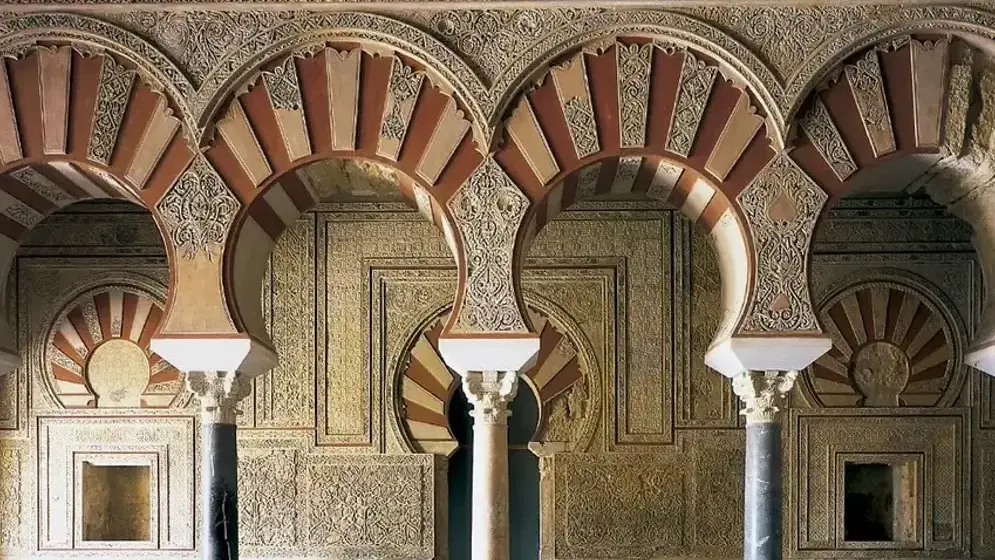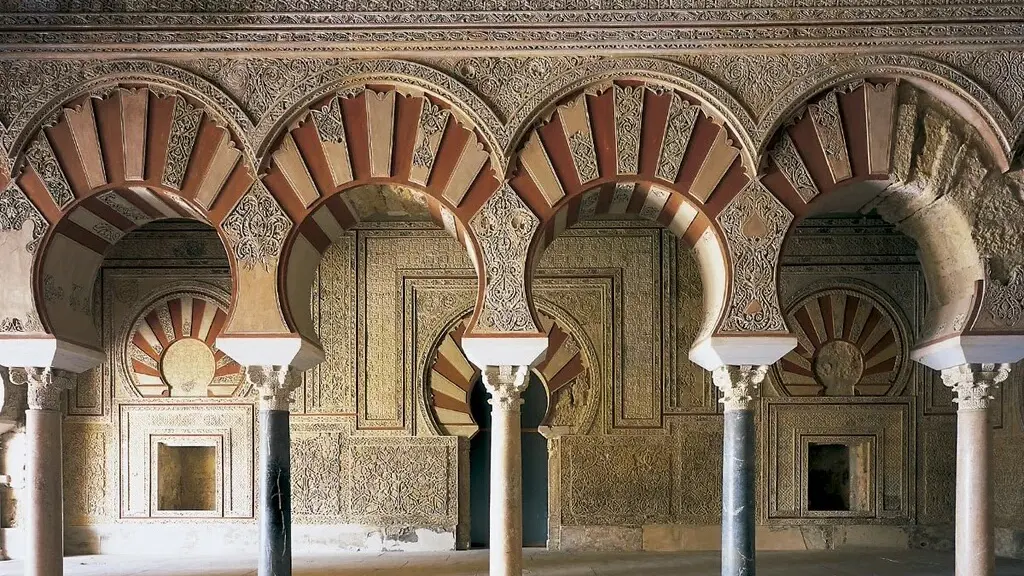

Medina Azahara (the Radiant City) was the administrative capital of the Córdoba Caliphate, built at the foot of the Sierra Morena 8 km west of the city. This UNESCO-listed complex includes the partly reconstructed Salon Rico, whose polychrome arches in pink and white marble give a clear sense of the original scale. An award-winning museum (Aga Khan Prize 2010) provides essential context before you walk the ruins.
When to Visit
Best season
October to May (avoid July–August: extreme heat, no shade on site)
Quietest hours
Opening (9:00) on weekdays
Visit duration
2 – 3 hours (museum + ruins + terraces)
A Lost Caliphal Capital
The caliph who built this palace city began constructing this capital in 936 to make the Umayyad Caliphate's power visible in stone. More than 10,000 workers spent 25 years building what was intended as the western world's most ambitious city. The palace complex ran its own royal silk workshops, producing robes for the court alongside carved ivory boxes and fine ceramics. His son Al-Hakam II later housed here the greatest library in the medieval western world — 400,000 manuscripts, destroyed within forty years of his death. The scholar who managed that collection was the librarian later celebrated as a mathematician and polyglot, an enslaved mathematician and chief secretary who classified its acquisitions, drafted royal correspondence, and worked on Arabic translations of Archimedes and Euclid from within these halls. Not every plan for the palace went unchallenged: the Córdoban jurist known for his independence from the caliph reportedly talked Abd al-Rahman III out of gilding one of the reception-hall ceilings in gold and silver. Seventy years after completion, civil wars reduced the palace to rubble. Plundered and forgotten, it disappeared beneath fields for nearly a thousand years before excavations resumed in 1911.
Visit the museum first — it transforms the ruins from rubble into architecture
The on-site museum shows reconstructions, carved panels and scale models of what the caliphal city looked like in the 10th century. Without this context, the excavated ruins are hard to read. Allow 45 minutes for the museum before walking the site.
The Salon Rico and the Museum
Excavations have uncovered the Salon Rico, a reception hall whose polychrome arches in pink and white marble show the ambition of the original design. The sculpted capitals are the most refined examples of Andalusian Caliphal stonework to survive. For those who want to understand how the Salon Rico's three vertical registers of decoration connect to the mihrab of the Mezquita, the Córdoba architecture guide traces the shared visual logic running through both monuments. The archaeological museum, awarded the Aga Khan Architecture Prize in 2010, holds ceramics, sculptures, and architectural fragments from the palace. The terraces look out over the ruins and the surrounding plain — at its peak, the city housed around 10,000 people.