Architecture
Córdoba architecture guide
In a single square kilometre, a Roman forum underlies an Islamic mosque that became a Christian cathedral. The layers are still visible — if you know how to read them.

Written by
María Fernanda González Ten years covering Córdoba's UNESCO heritage sites, sourcing from Junta de Andalucía documentation.
Updated Published
Córdoba is a city you read, not just see. The evidence accumulates in specifics. The granite column drums of the 1st-century Roman Temple are a different stone from the limestone of the Mezquita's arches. Inside the mosque, the seams where Abd al-Rahman I's original building meets his successors' extensions are still legible if you know where to look. A cathedral was inserted into the middle of the mosque in the 16th century without demolishing a single column.
Most visitors experience this as atmosphere. This guide is for the ones who want to understand it. Before you arrive, six terms will change what you see. Six periods of construction tell you who built what, when, and why. Five photography locations show you where the geometry pays off. And four questions answered plainly cover what guidebooks tend to bury in flowery prose.
Córdoba rewards close attention. The city does not need to be described as extraordinary. It simply needs to be read.
Six terms that will change what you see
Not jargon for architectural lectures, but working vocabulary for your eyes. Each term corresponds to something specific you will encounter on-site — a shape, a material, a spatial logic. Once you have the word, you will start noticing the thing everywhere.
Horseshoe Arch
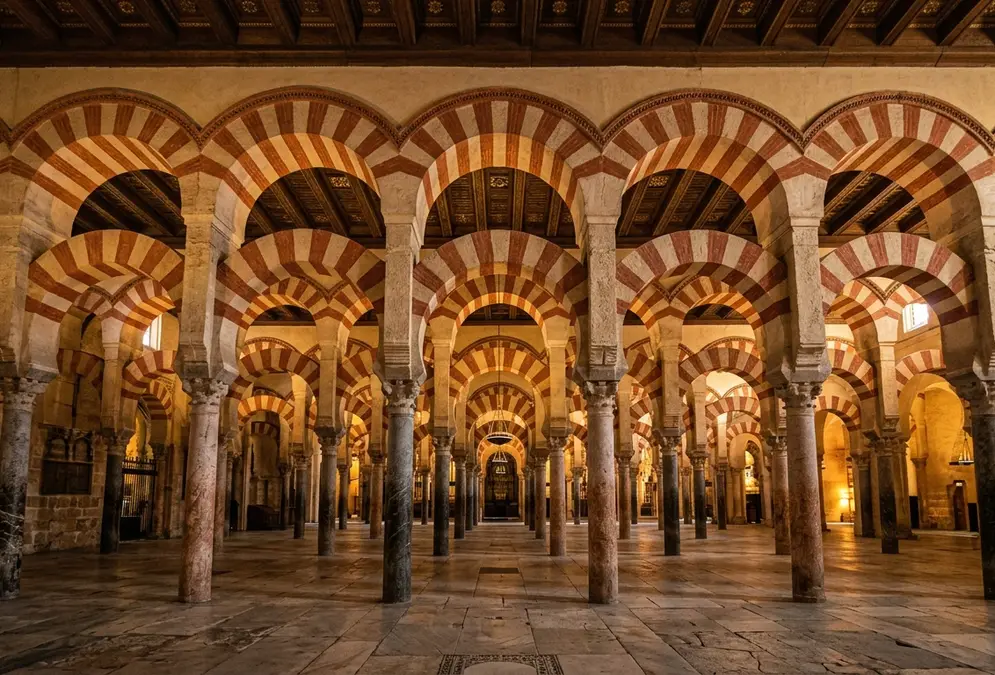
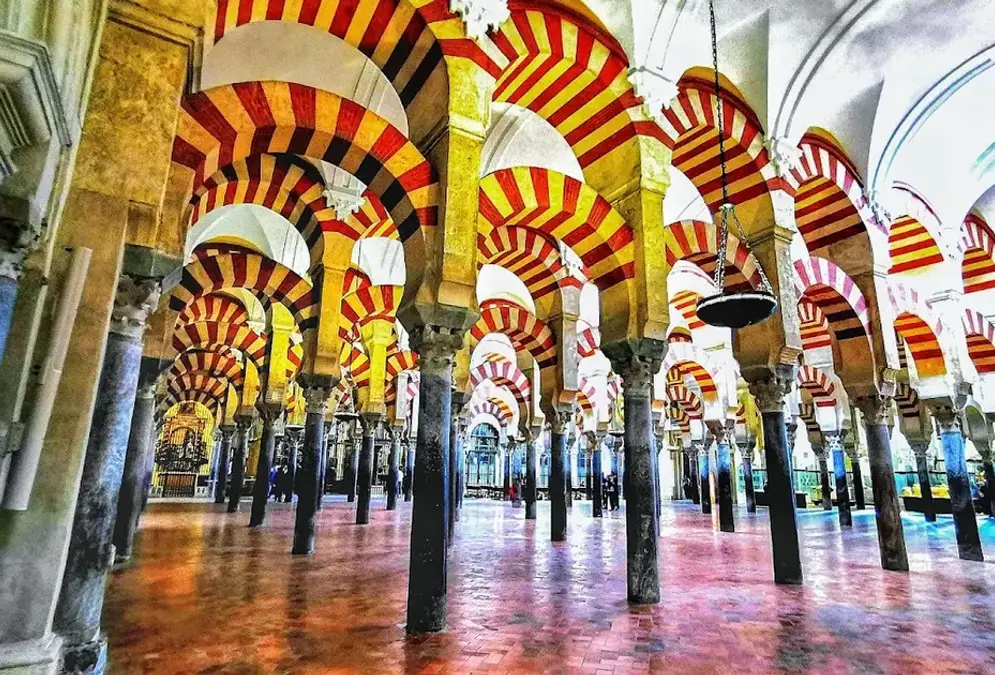
Visigothic builders used this form first, curving the arch heel inward below the springing line. The Umayyad engineers who built the Mezquita adopted it and added something new: double-tiered arches stacked on the same columns, with the lower tier carrying the weight and the upper tier opening the nave to light. Without the horseshoe arch's load-distributing geometry, the forest of 850 columns could not have supported the ceiling at that height and span.
Mihrab
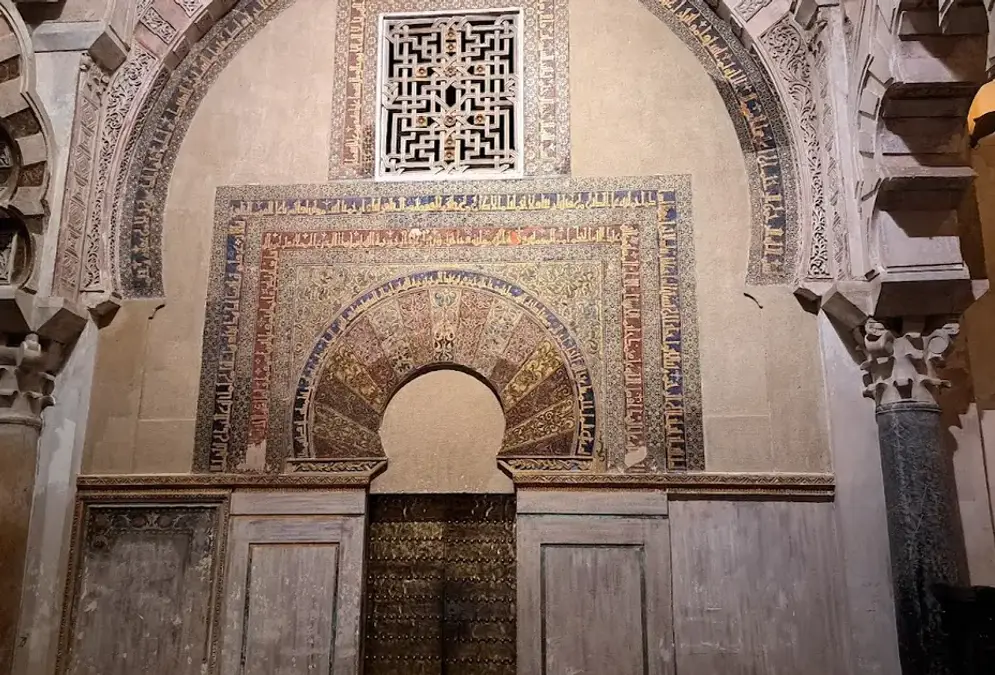
In most mosques, a mihrab is a niche cut into the qibla wall to indicate the direction of Mecca. Córdoba's, commissioned by Al-Hakam II between 965 and 971, is a full room. You step into it. Byzantine mosaicists from Constantinople covered the interior in gold and polychrome tesserae that the Caliph requested directly from the Emperor Nikephoros II Phokas. The shell dome above is not decoration but a deliberate signal of Caliphate ambition on a continental scale.
Patio/Courtyard
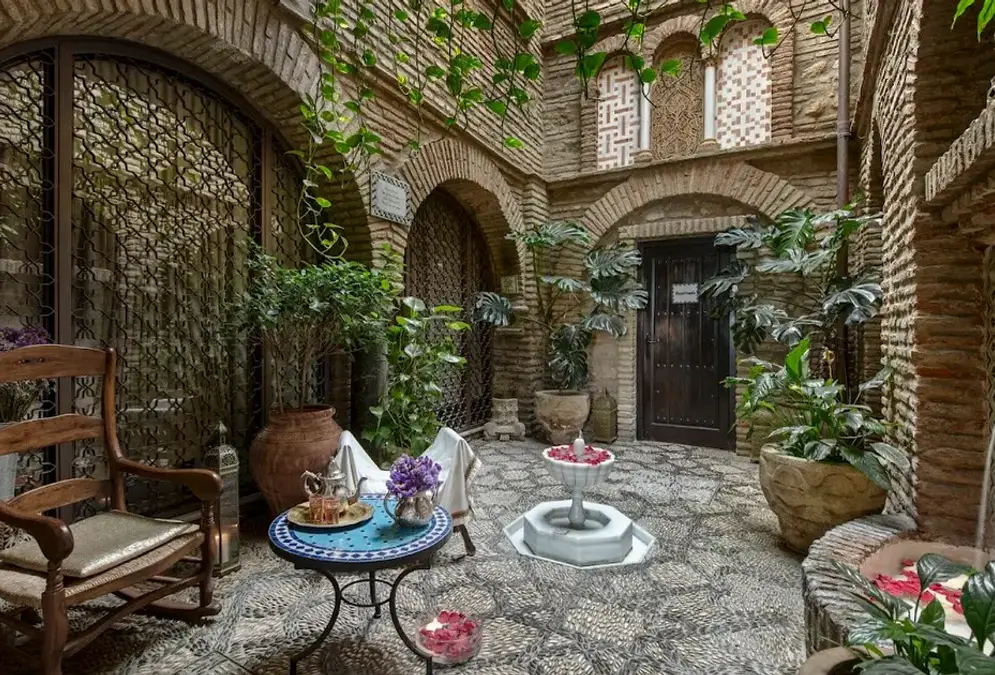
The form goes back 2,000 years: Roman atrium to Islamic riyad to Andalusian domestic patio, the same spatial logic in different hands. A central fountain creates evaporative cooling and masks street noise. Azulejo dados on the walls absorb and release heat slowly. An overhead pergola of jasmine or wisteria creates shade and modifies the microclimate. More than 4,000 Córdoba homes still organise their ground floors around this logic, which is why UNESCO inscribed the tradition as intangible heritage in 2012.
Azulejos
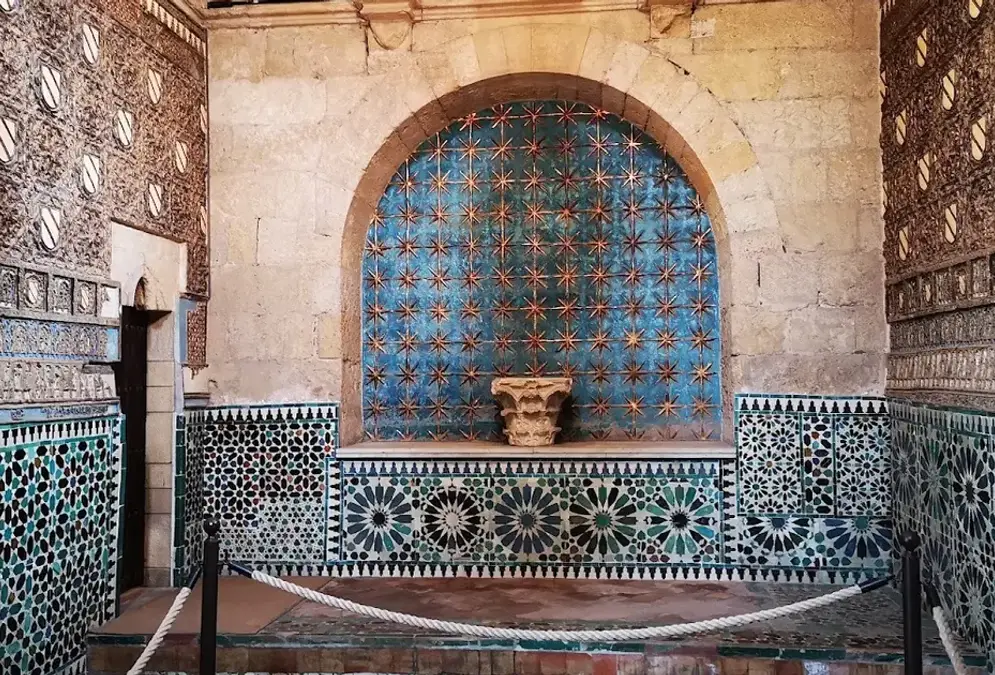
The geometric tilework you see at dado height everywhere in Córdoba is simultaneously practical and semantic. Fired ceramic resists heat and moisture better than plaster. The patterns, built from a small number of repeated geometric modules, can tile any surface without repeating: the mathematical property that makes them infinitely extensible references divine infinity in Islamic aesthetic philosophy. That is why you find them at exactly the height where the wall meets the most wear, and why the patterns never stop.
Mudéjar
After Ferdinand III took Córdoba in 1236, the city needed new churches fast. The craftsmen available were the same Islamic artisans who had worked on the mosque. Their vocabulary continued under Christian patronage: horseshoe arches, carved plasterwork, geometric tilework. The result is Mudéjar, a hybrid style that appears in 12 neighbourhood churches built over the following century. Capilla de San Bartolomé (1410) makes the coexistence visible: Christian iconography in the upper registers, Islamic geometric tilework on the lower walls. Two visual languages, one space, no resolution.
Palimpsest
A manuscript scraped clean so the parchment can be reused, but traces of the earlier writing remaining legible beneath. This is the organising concept for reading Córdoba. The Mezquita sits on a Visigothic church that sat on a Roman structure. The Roman Bridge's 1st-century BC foundations are still the bridge's foundations. Medina Azahara, buried for a thousand years, is surfacing slowly. When you walk the city, you are not moving through separate historical periods. You are reading one continuous document.
The Mezquita's double-tiered horseshoe arches: the lower tier carries structural load; the upper tier opens the nave to light. The red-and-white voussoir pattern is a pure Umayyad invention.
In this guide
Jump to a section
Roman Córdoba (45 BC – 8th century)
The Romans did not choose this spot casually. Colonia Patricia, founded around 45 BC on the Guadalquivir, was the administrative capital of Hispania Baetica: the city from which Rome managed the wealthiest province in Iberia. Seneca the Younger was born here. So was his nephew Lucan. The city's grid of roads, bridges, aqueducts, and forum established the spatial skeleton that every subsequent civilisation built over rather than removed.
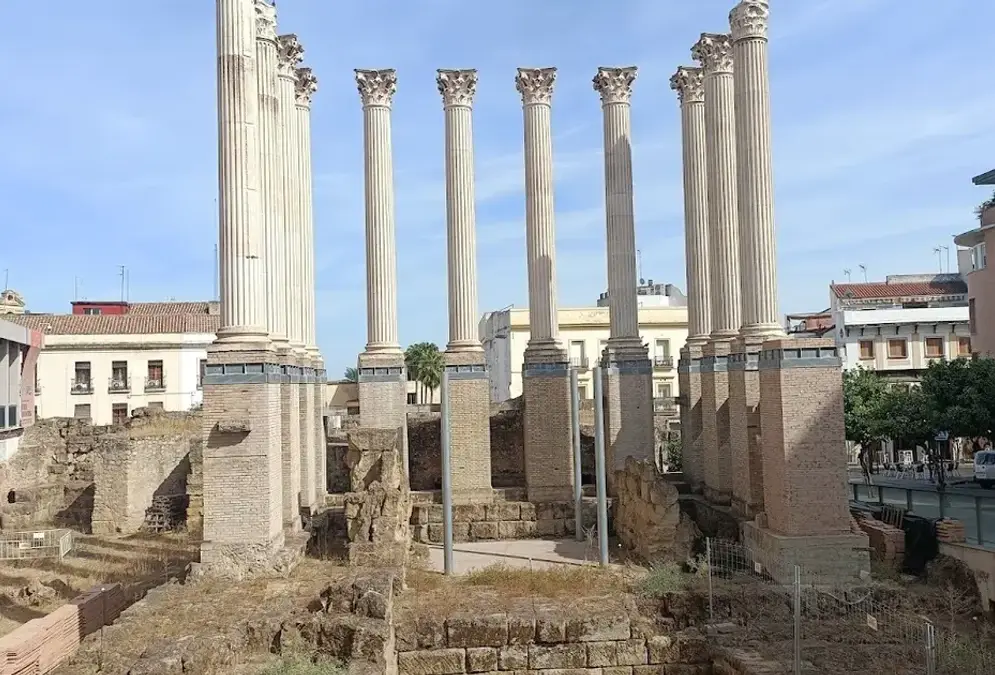
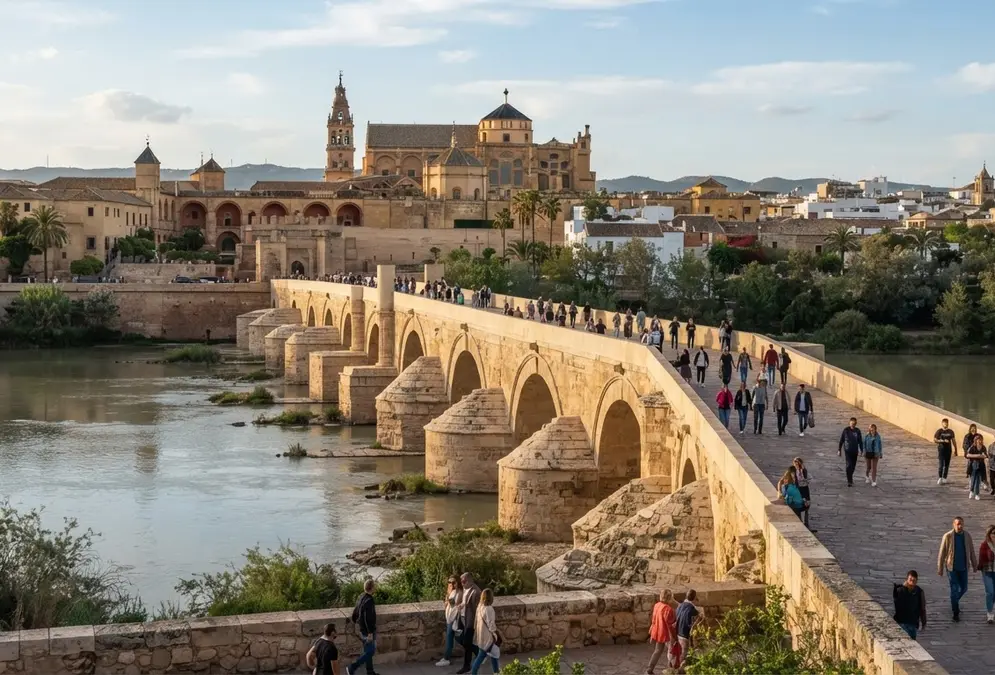
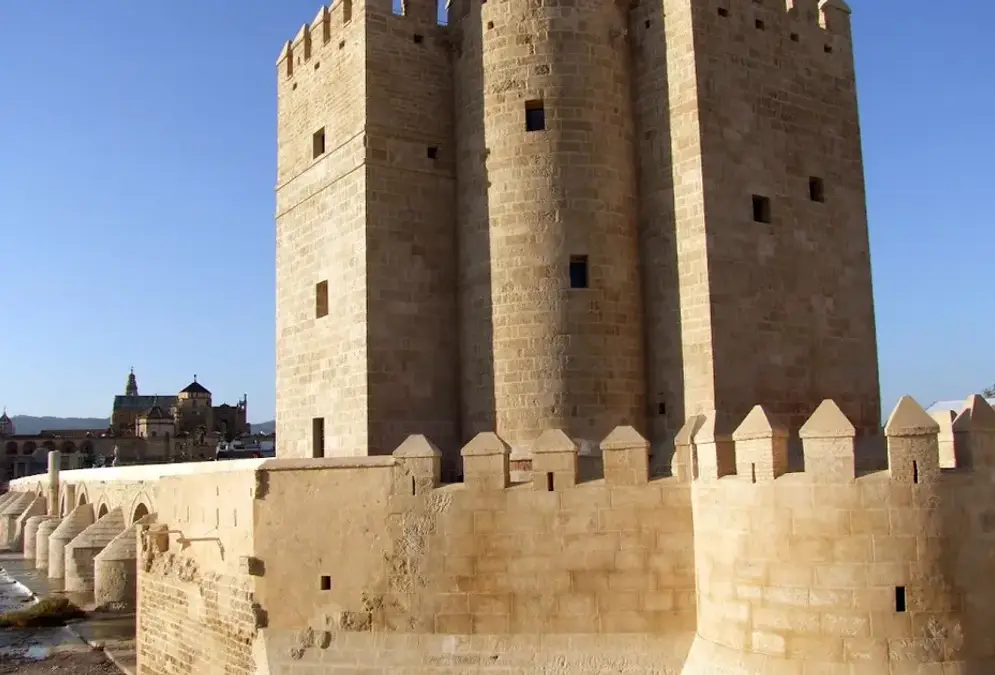
Three Roman structures survive in recognisable form. The Temple of Claudius or Domitian, 1st century AD, stands in the old forum area: ten Corinthian columns of granite, visually distinct from the limestone of later Moorish construction if you look at the stone colour. The Roman Bridge across the Guadalquivir, 16 arches and 1st century BC in its foundations, still carries foot traffic. The Calahorra Tower at the bridge's southern end has Roman foundations beneath its medieval exterior.
The critical thing to understand about Roman Córdoba is structural. When Abd al-Rahman I began the Mezquita in 786, the site already had Roman roads to its north, a Roman bridge to its south, and a Roman water system beneath the ground. The Islamic city did not replace Roman infrastructure. It used it.
Dive deeper into Roman Córdoba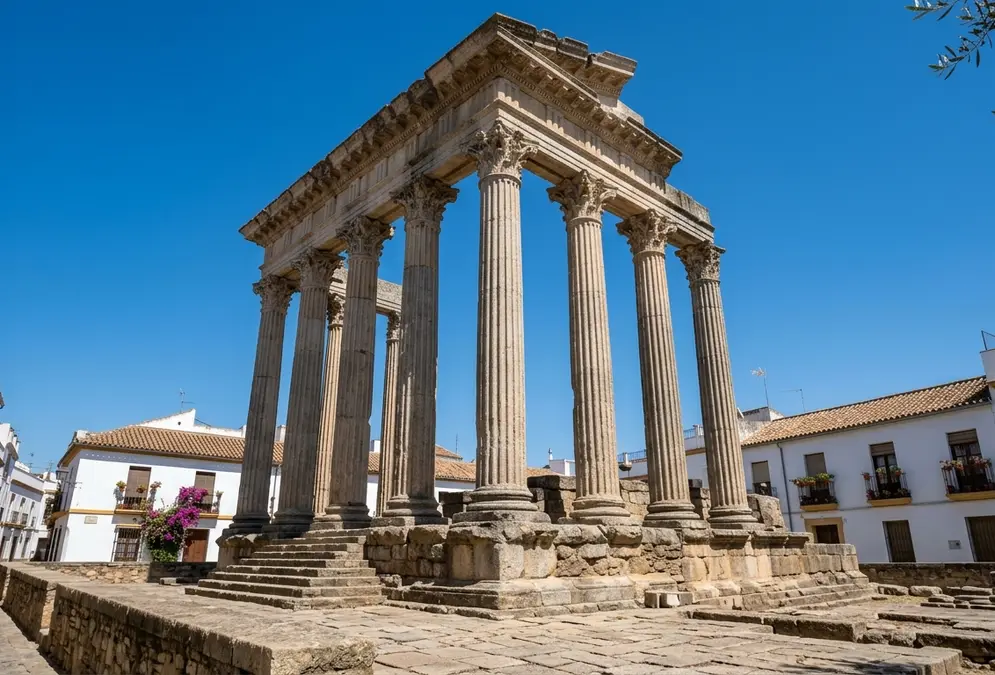
The Roman Temple on Calle Capitulares — granite Corinthian columns, free to visit at any hour. Lit from below after dusk, when the stone takes on a warmth entirely absent in daylight.
Roman monuments in Córdoba
Umayyad Córdoba (786 – 1031)
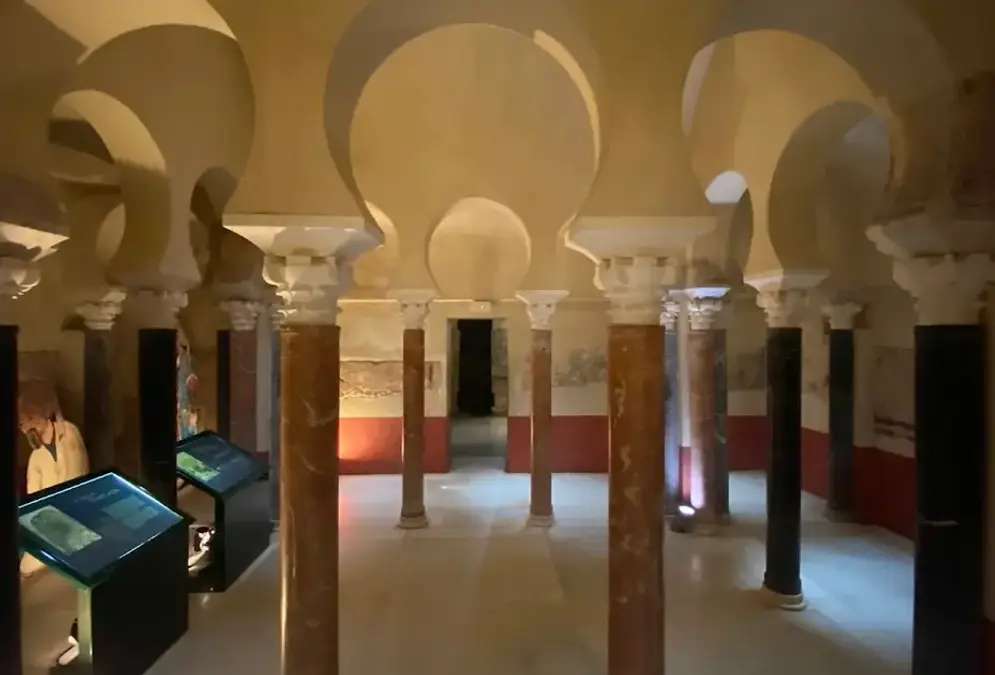
Abd al-Rahman I broke ground on the mosque in 786, on the site of a Visigothic church he purchased from the Christian community. He built the initial hall of 11 aisles with columns taken from Roman and Visigothic buildings across the city: shafts of marble, jasper, porphyry, granite, all recycled material, none of it matching in height. His engineers solved the height problem with the two-tiered arch system: lower horseshoe arches carry structural load, upper semicircular arches open the space visually. The red-and-white striped voussoirs are pure Umayyad invention, nowhere in architecture before this.
The mosque was expanded four times. Abd al-Rahman II pushed it south in 848. Al-Hakam II added the most technically ambitious section between 965 and 976, including the mihrab built as a full room rather than a niche, with Byzantine mosaics requested directly from Constantinople, and, in the bay directly in front of it, ribbed crossed-arch vaults that some architectural historians treat as a possible ancestor of the Gothic rib. Al-Mansur added the final eastern extension in 987, doubling the width of the building. Each phase is still legible as a distinct architectural section if you walk the length of the nave and watch the columns change.
Look for the expansion seams where one phase meets the next. Look up at the lantern above the original mihrab area. Then find the 16th-century cathedral inserted into the centre of the building, surrounded on all sides by mosque, and notice that Charles V, after seeing it completed, reportedly said he had destroyed something unique to build something ordinary.
Dive deeper into Moorish Córdoba Why is it called both mosque and cathedral? The full story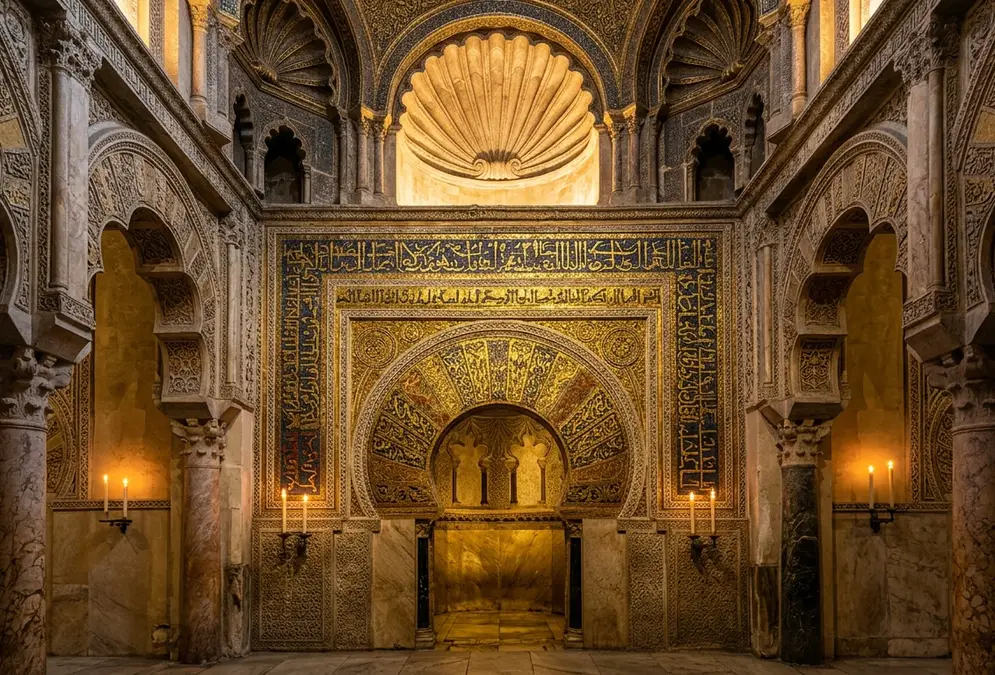
Al-Hakam II's mihrab (965–971): a full room, not a niche. Byzantine craftsmen from Constantinople applied the gold mosaics at the Caliph's request. The shell dome above signals Caliphate authority, not liturgical convention.
Umayyad monuments
Medina Azahara (936 – 1009)
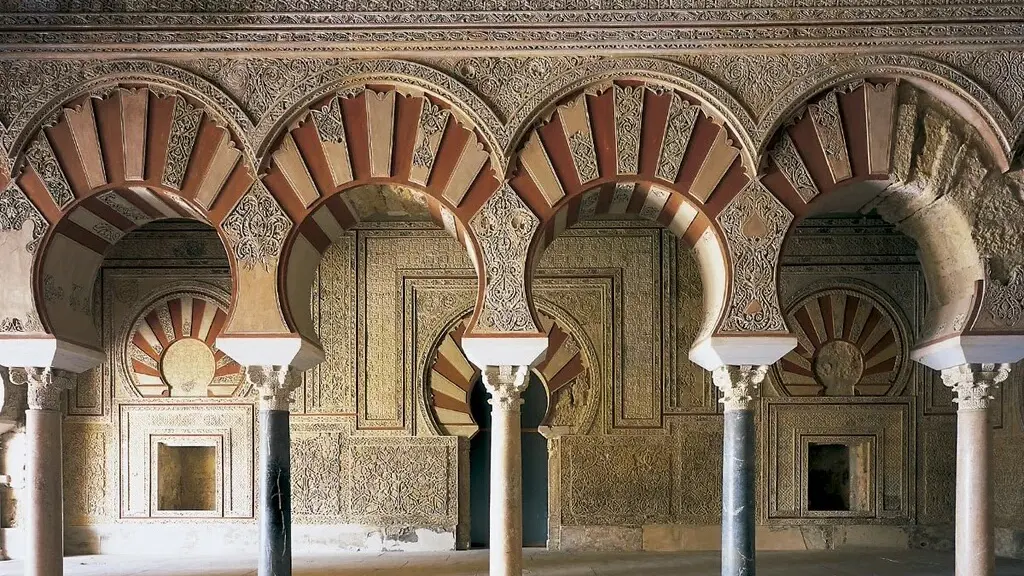
Abd al-Rahman III began Medina Azahara in 936 in the Sierra Morena foothills, 8 kilometres west of Córdoba, as a complete city in its own right: mint, armory, administrative departments, mosque, royal apartments, gardens. Construction lasted until his death in 961, and his son Al-Hakam II continued it. It was destroyed in the Berber uprising of 1009, buried, and forgotten for nearly a thousand years. Excavation began in 1910. Today, 10% of the site is uncovered.
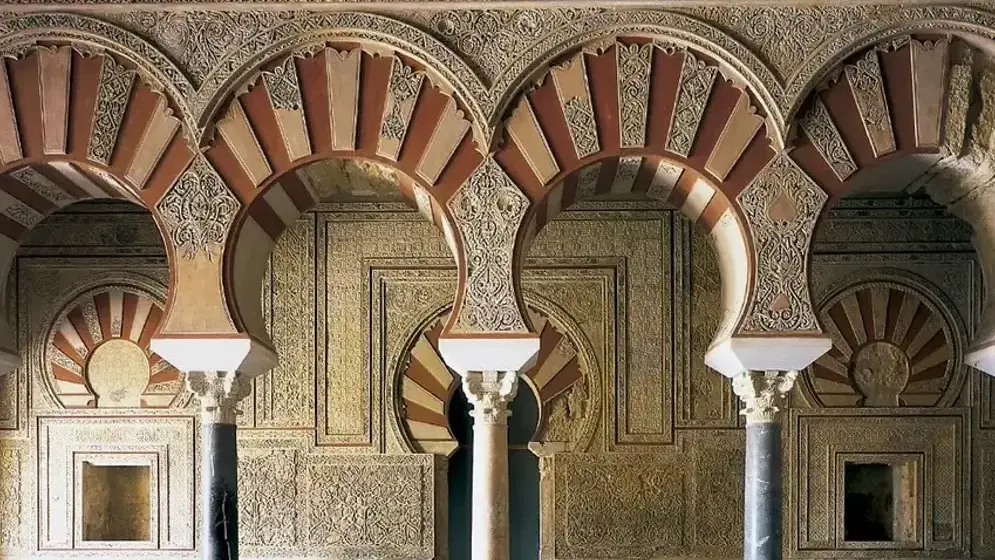
The Salon Rico, the throne room completed in 953, is the set piece. Carved marble covers every wall surface in three decorative registers: geometric base, vegetal mid-section, calligraphy cornice. The density of the surface ornament is not decoration for its own sake. It is a political argument in stone, designed to project absolute power to any ambassador who stood in that room. The water channels and sunken quadrant gardens in the Prince's Garden below were engineered to create the sound and reflection of water as heard from the throne room above.
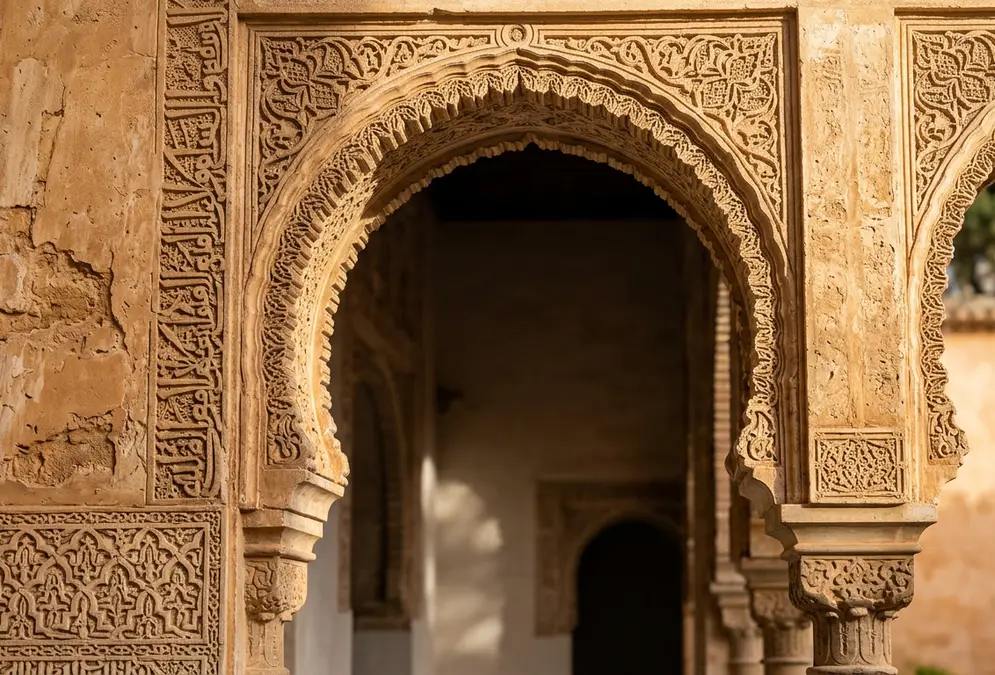
The three-register decorative system that covers the Salon Rico walls appears later in Al-Hakam II's mihrab in the Mezquita. Read the ruins as an architectural argument: the palace and the mosque were designed by the same culture, for the same caliphate, making the same claim about the centre of the world.
Dive deeper into the Umayyad Caliphate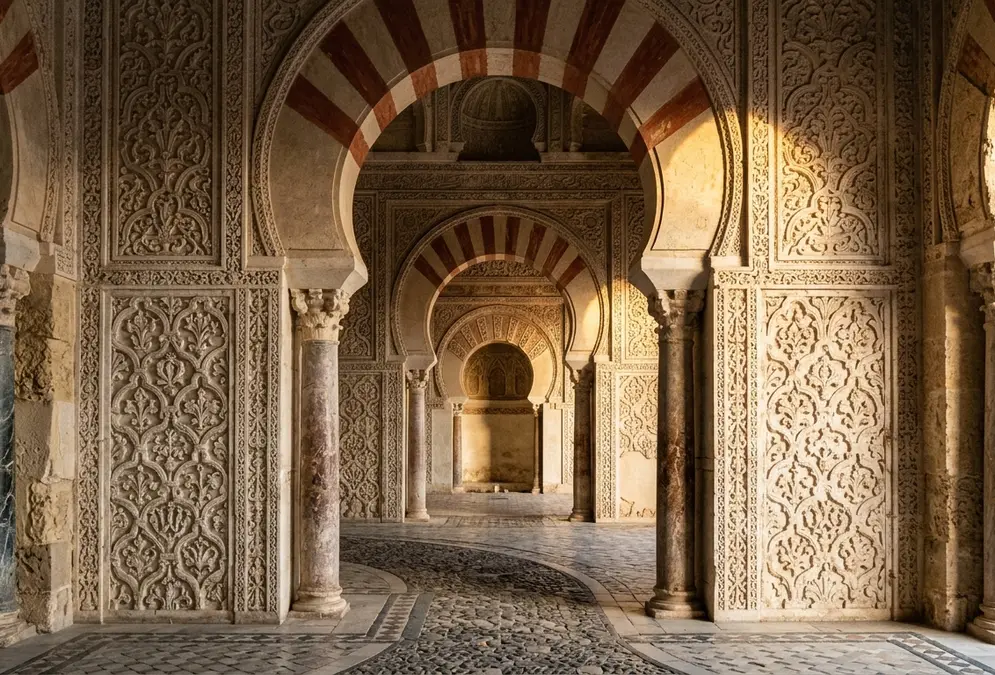
The Salon Rico at Medina Azahara (953): three decorative registers in carved marble across every wall surface — a political argument in stone, designed to project Caliphate authority to visiting ambassadors.
Medina Azahara
Medieval & Mudéjar (1236 – 16th century)
Ferdinand III took Córdoba on 29 June 1236. The city needed new churches quickly, to consecrate neighbourhood by neighbourhood, and the craftsmen available were the same Islamic artisans who had been working on Córdoba's buildings for generations. Their vocabulary did not disappear with the change of patron. Horseshoe arches, carved plasterwork, geometric tilework in brick and ceramic: all continued, now framing Christian iconography.
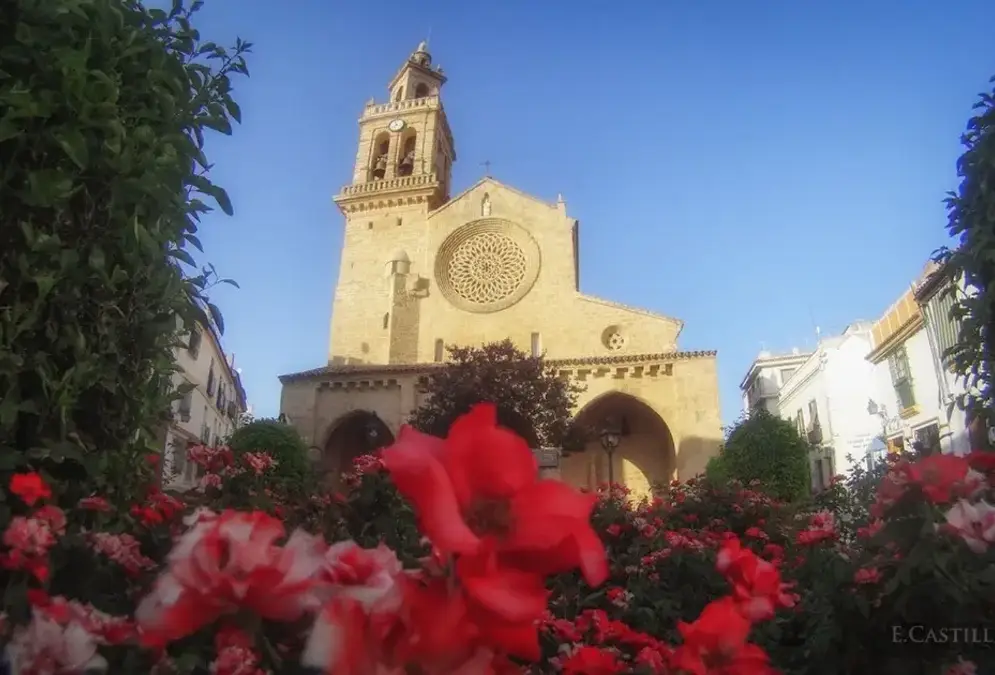
The resulting style, Mudéjar, appears in 12 churches built over the following century. Most combine Romanesque structural bones with Gothic window tracery and Islamic surface ornament on the same facade. San Lorenzo in the Axerquía district is the cleanest example: its Romanesque tower topped with Mudéjar brick arcading. The craftsmen are absent from the historical record by name. Their work is visible in every street of the old city.
Capilla de San Bartolomé (1410) makes the coexistence impossible to miss. Christian imagery in the upper wall registers. Islamic geometric tilework below. No attempt to resolve the visual argument between the two systems. The aesthetic logic is clear: the craft tradition outlasted the political conquest. What you see is the record of that fact.
Dive deeper into the three cultures of Córdoba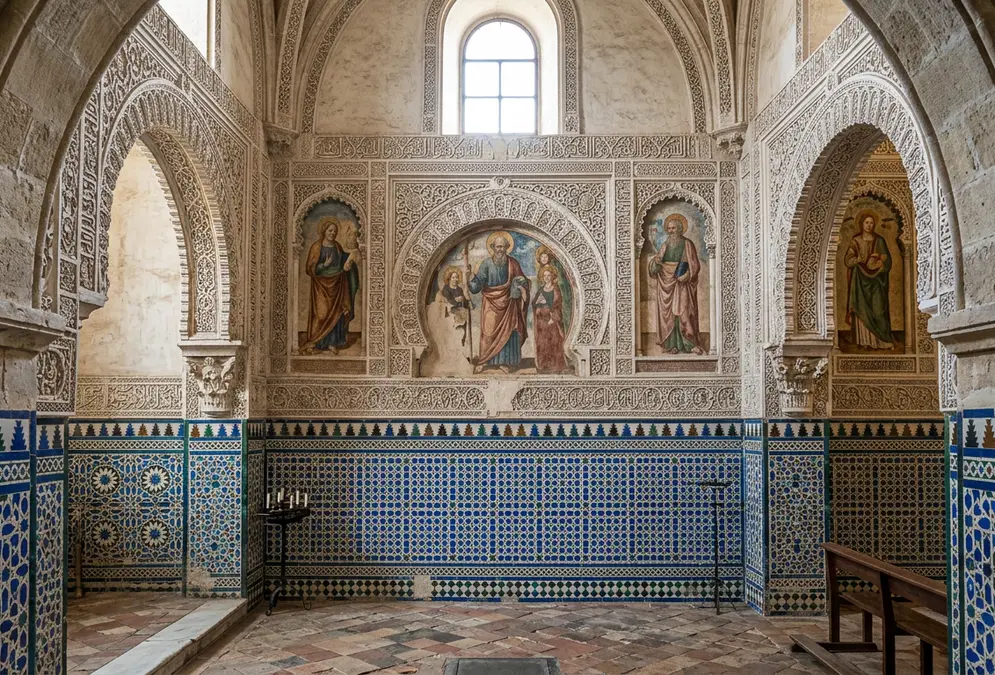
Capilla de San Bartolomé (1410): Christian iconography in the upper registers, Islamic geometric tilework on the lower walls. No resolution between the two systems. The craft tradition outlasted the political conquest.
Mudéjar & medieval sites
The Andalusian patio tradition
The Andalusian patio is not a feature of Córdoba's architecture. It is the operating system. Every traditional house in the old city organises itself around a central courtyard, and the spatial logic has not changed in 2,000 years: a fountain at the centre for evaporative cooling and sound, azulejo dados at dado height for thermal mass and moisture resistance, walls at a height-to-width ratio of roughly 1:2 that creates the characteristic enclosure and shade pattern through the hottest part of the day.
More than 4,000 Córdoba homes maintain working patios. UNESCO inscribed the tradition as intangible cultural heritage in 2012, not the patios themselves but the knowledge system that sustains them: the selection of plants by microclimate, the maintenance of the fountain and water channels, the seasonal rotation of potted geraniums. The Festival de los Patios every May opens private courtyards that are otherwise inaccessible. For a detailed account of how this spatial form came to exist — from Roman atrium to Andalusi bayt and how each element functions thermally — see Córdoba's patios: why they exist and endure.
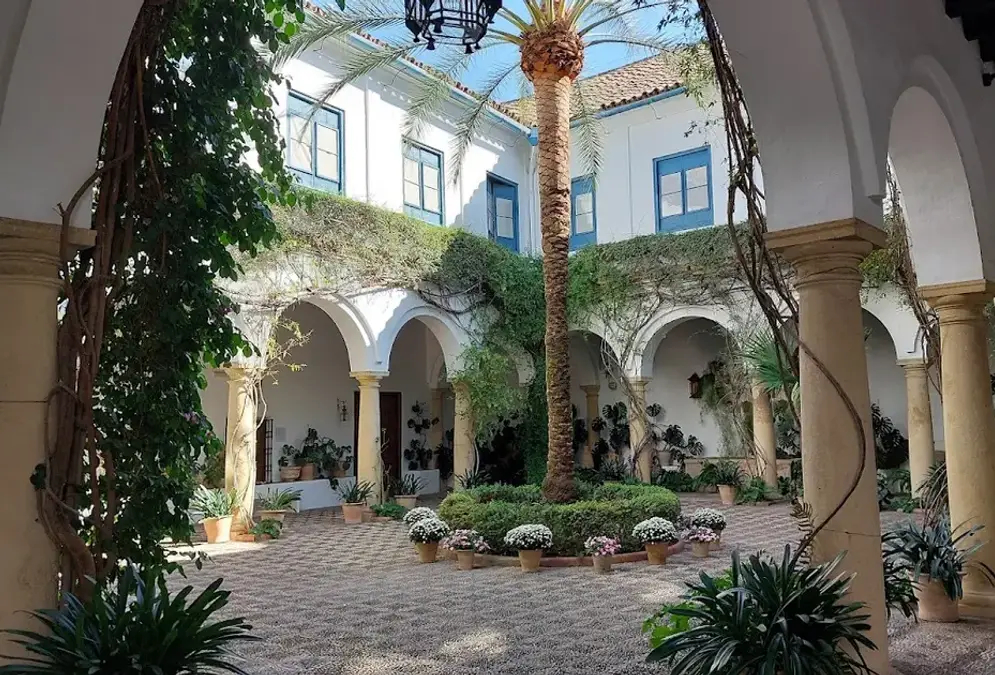
For architecture, the place to study the range is Palacio de Viana in the Judería. Twelve distinct patios, dating from different centuries between the 15th and 20th, are arranged within a single complex. Each one applies the same spatial logic differently. The variety is an argument for the tradition's flexibility.
Dive deeper into the Judería and patios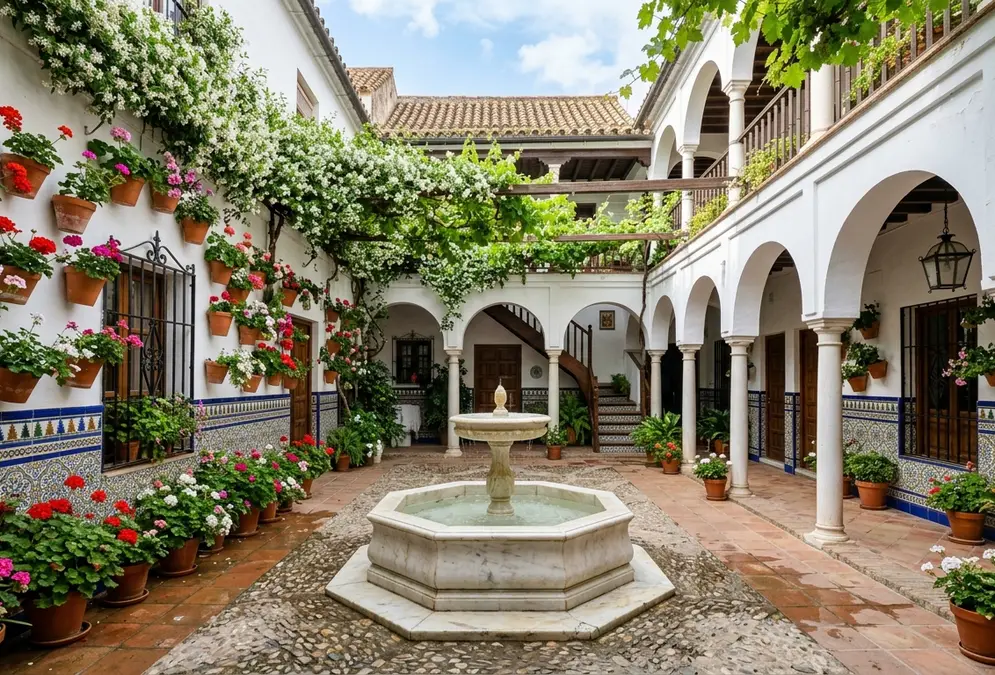
A working Córdoba patio: the central fountain provides evaporative cooling, the azulejo dado resists heat and moisture, the height-to-width ratio creates natural shade through the hottest part of the day. The spatial logic is 2,000 years old.
Patio architecture sites
Contemporary Córdoba (2016 – present)
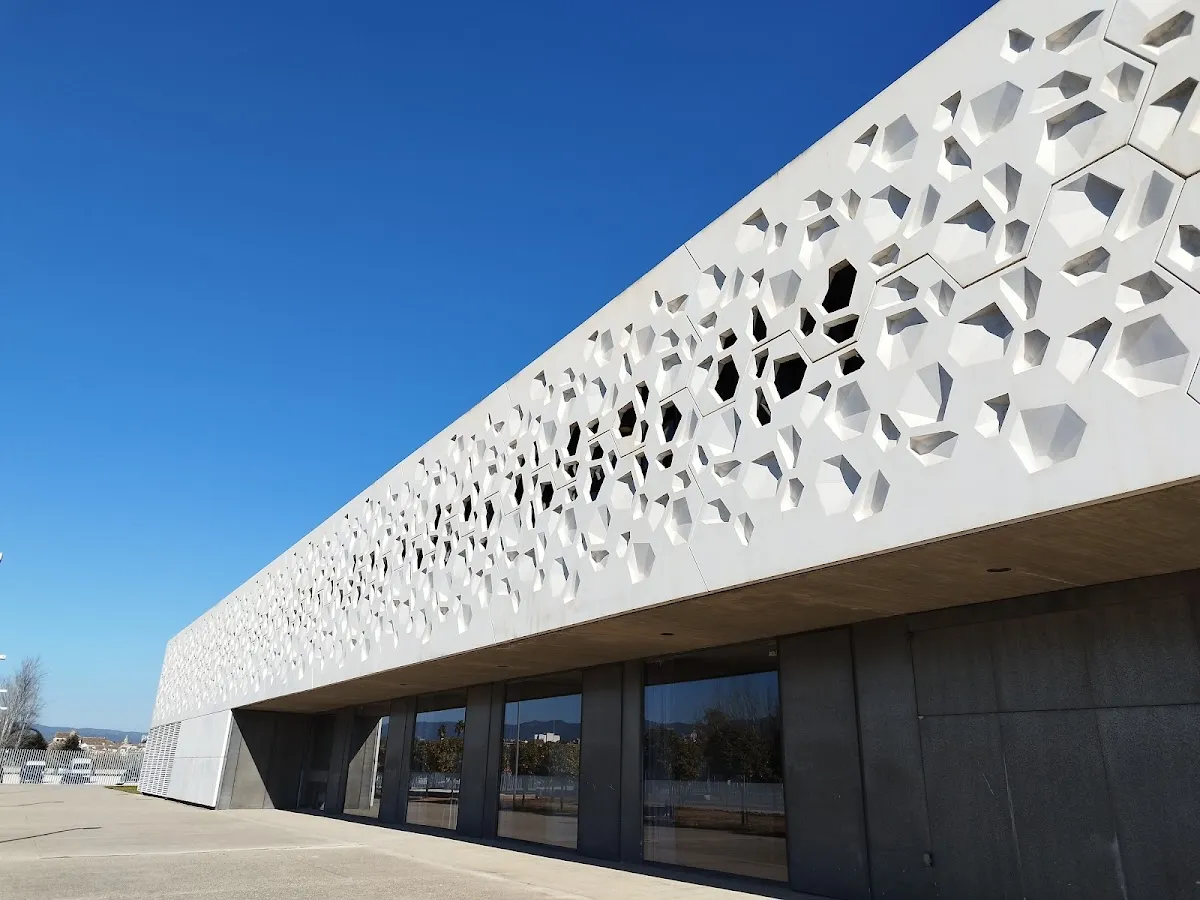
The Centro de Creación Contemporánea de Andalucía opened in 2016, designed by Madrid firm Nieto Sobejano Arquitectos on a site along the river south of the Mezquita. The brief included a planning constraint that determined the building's character: 15 metres maximum height, set to prevent any new construction from competing with the Mezquita's campanario on the skyline.
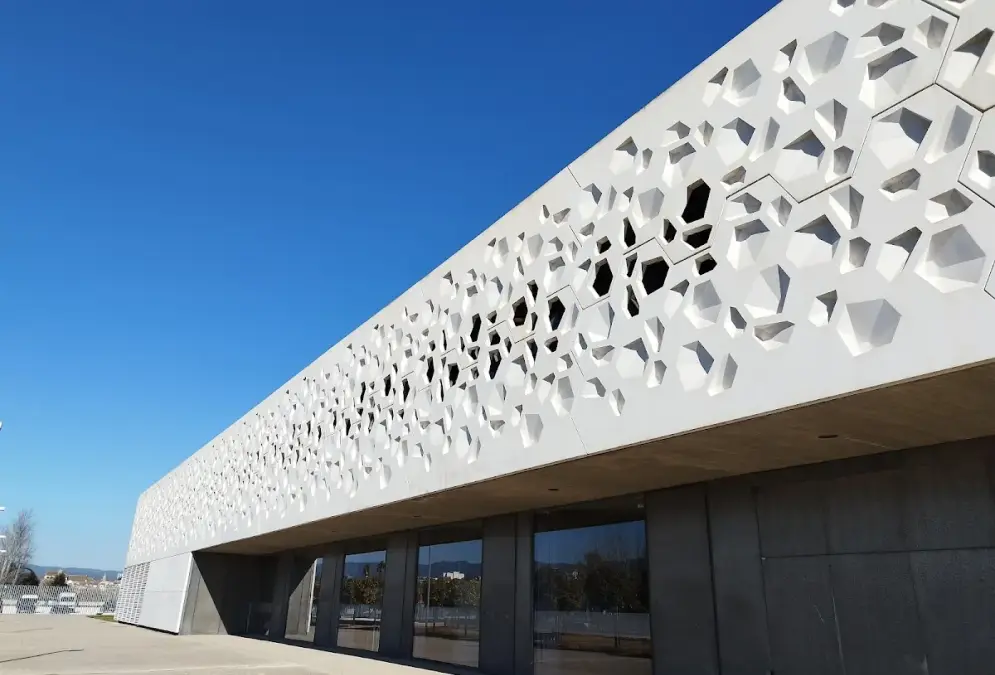
The architects responded with a horizontal building. The exterior system uses a hexagonal geometry in glass-fibre reinforced concrete, a reference to Islamic geometric pattern-making that does not quote a specific historical source. The building thinks about the same mathematical problems the Umayyad craftsmen were solving, in a contemporary material. At night, a media facade across the street-facing elevation operates as a moving-image surface.
Stand at the riverbank and look east. The Mezquita's campanario, built on the minaret shaft, rises against the hill of the old city. The C3A sits low along the water to the right. The relationship between them is not accidental. The city's skyline is still being curated.
The newest addition to that contemporary layer builds nothing permanent at all: Festival Córdoba Efímera turns six heritage sites across the historic centre into temporary architecture, structures meant to vanish rather than endure.
The C3A is open to the public with free general admission. c3a.es →
Contemporary Córdoba
Photography: where the geometry pays off
Architecture rewards photographers who know where to stand and when. Five locations where the geometry pays off, and the specific conditions that make each one work.
- Mezquita columns: Point the camera upward at 45 degrees to capture the arch-stacking effect: the double-tiered horseshoe arches receding into the nave are the shot that defines the building. Arrive at opening time, 10 a.m., for raking low-angle light through the nave before the morning tour groups arrive.
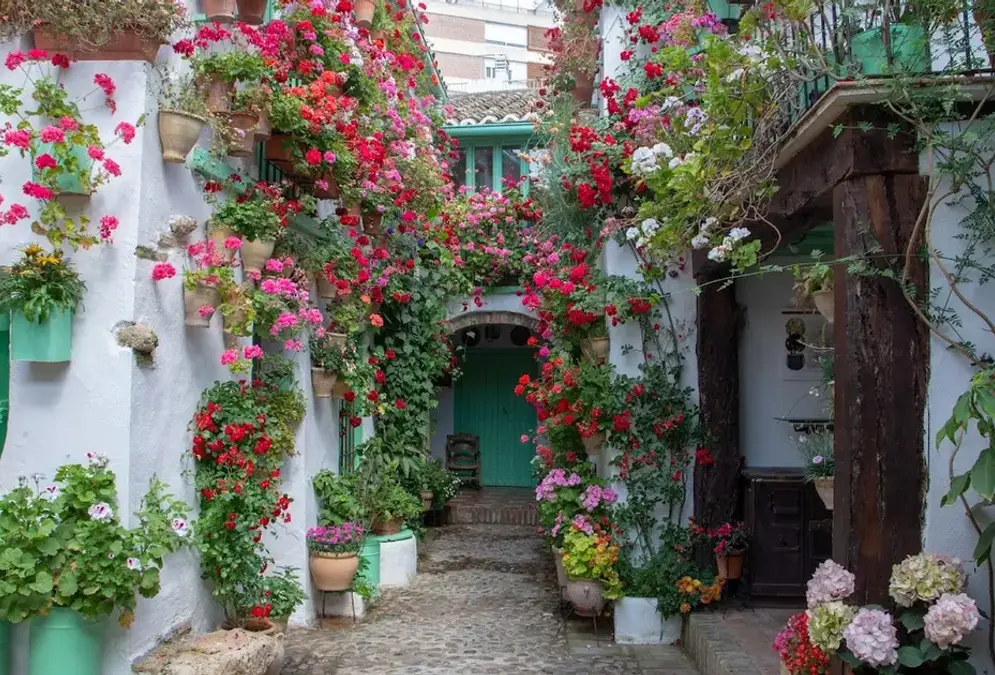
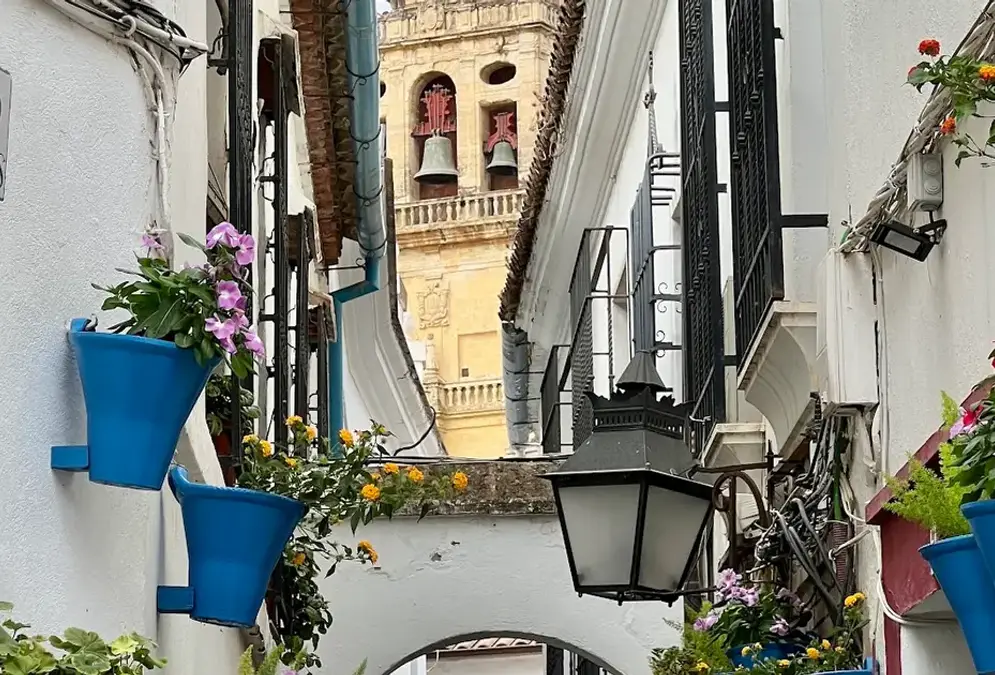
- Calleja de las Flores: Stand at the alley entrance and frame the Mezquita campanario at the end of the lane. The perspective compression brings the tower close, surrounded by white walls and flower pots. Morning light hits the tower directly from the east; by afternoon it falls into shadow and the shot loses its definition.
- Medina Azahara: Come in late afternoon, when raking light crosses the carved marble surfaces of the Salon Rico at an oblique angle. The three registers of geometric, vegetal, and calligraphic relief become legible in that light. Midday sun is perpendicular to the surface and flattens everything.
- Palacio de Viana: Overcast days are better than sunny ones. The diffused light lets you capture the full detail of the azulejo tilework in the fountain pool reflections without the hard shadows that direct sunlight throws across the geometric patterns. Spring mornings before 10 a.m. are quiet enough to shoot without other visitors in frame.
- Roman Temple: Return at dusk, after the upward lighting on the columns is activated. The granite takes on a warmth in artificial uplighting that it lacks entirely in flat daylight, and the darkening sky behind the Corinthian capitals gives the shot its contrast. This is a free-to-access site with no closing time.
Moorish Architecture Tour
Horseshoe arches, 10th-century caliphal baths, Moorish gardens, and Mudéjar tile work: a free 2.5km self-guided walk through Córdoba's Islamic heritage.
View the routeFrequently Asked Questions
What architectural styles are found in Córdoba?
Córdoba compresses 2,000 years of construction into a single walkable city. Roman infrastructure (bridge, temple, forum foundations) underlies everything. The Umayyad era produced the Mezquita and Medina Azahara, two of the finest surviving examples of Islamic architecture anywhere. After 1236, Mudéjar work dominated: Christian patrons, Islamic craftsmen, hybrid results visible in 12 neighbourhood churches. Renaissance and Baroque palaces and convents arrived from the 16th century onward. The C3A, opened 2016, is the most recent layer. The unusual thing about Córdoba is that most of these styles coexist within single buildings rather than occupying distinct districts. The Mezquita contains a 16th-century cathedral. A 1st-century Roman column supports a Moorish arch in the wall of a Mudéjar church. The city is its own palimpsest.
What is a mihrab and why is Córdoba's unusual?
A mihrab marks the qibla wall of a mosque, indicating the direction of Mecca for prayer. It also serves a practical acoustic function: the curved niche projects the imam's voice back into the congregation. In almost every mosque in the world, a mihrab is a niche cut into the wall. Al-Hakam II's decision at the Mezquita between 965 and 971 was different: he built the mihrab as a full room, large enough to step inside. The mosaics covering the interior were made by craftsmen sent from Constantinople at the Caliph's specific request from Emperor Nikephoros II Phokas, who also supplied the gold tesserae. The shell dome above the chamber is not standard mihrab form. Al-Hakam II was making an architectural statement about Caliphate authority, not simply fulfilling a liturgical requirement.
What does "Mudéjar" mean in architecture?
Mudéjar describes buildings produced after the 1236 Reconquista by Islamic craftsmen working under Christian patronage. The word comes from the Arabic mudajjan, meaning those permitted to remain. The craftsmen who had built and maintained Córdoba's Islamic monuments did not leave when Ferdinand III took the city. Their design vocabulary, geometric tilework, carved plasterwork, horseshoe arches, continued without interruption under new clients and new iconographic programmes. You can see this most clearly in Capilla de San Bartolomé: Christian imagery in the upper wall registers, Islamic geometric tilework below, no visual resolution between the two systems. Mudéjar architecture is common across 13th to 15th century Castile, but Córdoba's examples are among the earliest, built by craftsmen who had direct continuity with Umayyad workshop traditions.
Is Medina Azahara worth visiting for architecture?
Yes, and the incompleteness is the point. Only 10% of the site is excavated. What visitors see is not a ruin that was stripped down over centuries but a city that was destroyed suddenly in 1009, buried, and is being uncovered slowly. The Salon Rico, the throne room completed in 953, is intact enough to read as a full architectural argument: carved marble in three decorative registers across every wall surface, designed to project absolute Caliphate authority to anyone who stood in that room. The journey from central Córdoba requires transport, 8 kilometres west along the Sierra Morena foothills, and the site has its own bus service from the city. The site is rarely crowded compared to the Mezquita. The on-site guided tour is worth taking: the ruins are legible with context and genuinely difficult to read without it.
How much time do I need to appreciate Córdoba's architecture seriously?
Two full days covers the essentials without rushing: day one for the Mezquita-Cathedral (allow 2 to 3 hours minimum), the Roman Temple, and the historic centre; day two for Medina Azahara (half day, book transport in advance) and the Judería's Mudéjar churches and synagogue. A third day adds Palacio de Viana's twelve patios, the C3A and the lesser-known Mudéjar churches in the Axerquía. The Mezquita repays multiple visits at different times of day. The light through the nave changes entirely between morning and afternoon.
Is a guided architecture tour worth taking?
For the Mezquita, a specialist guide makes a significant difference. The building's four expansion phases, the seams where each caliph's work meets the next, and the logic of the 16th-century cathedral insertion are all but invisible without context. For Medina Azahara, the on-site guided tour is close to essential: the ruins are legible with explanation and genuinely difficult to read without it. For the rest of the city, the self-guided walk in the Moorish Architecture Tour covers the major sites efficiently. Private architecture-focused tours are available through the usual activity platforms for full-day programmes covering all periods.
What is the best order to visit Córdoba's architectural sites?
Start with the Mezquita-Cathedral. It is the centre of the city's architectural argument and everything else relates back to it. Then the Roman Temple, a five-minute walk away, which gives you the pre-Islamic baseline in stone colour and material. Medina Azahara is best as a half-day excursion on day two, when you already have enough context to read the Salon Rico as a political statement rather than decoration. The Judería's Mudéjar churches and Palacio de Viana work well on a third morning. The C3A, on the riverbank south of the Mezquita, closes the narrative: 2,000 years of construction in a fifteen-minute walk.
Can I visit most of Córdoba's architectural sites on foot?
Yes. The Roman Temple, Mezquita, Judería, synagogue, Capilla de San Bartolomé, Palacio de Viana, Alcázar, Roman Bridge, Calahorra Tower and C3A are all within the compact historic centre. The notable exception is Medina Azahara, 8 kilometres west along the Sierra Morena foothills. The site has a dedicated bus service from central Córdoba. Taxis and tour minibuses are the other options. Do not try to walk it: the approach road has no pedestrian infrastructure.