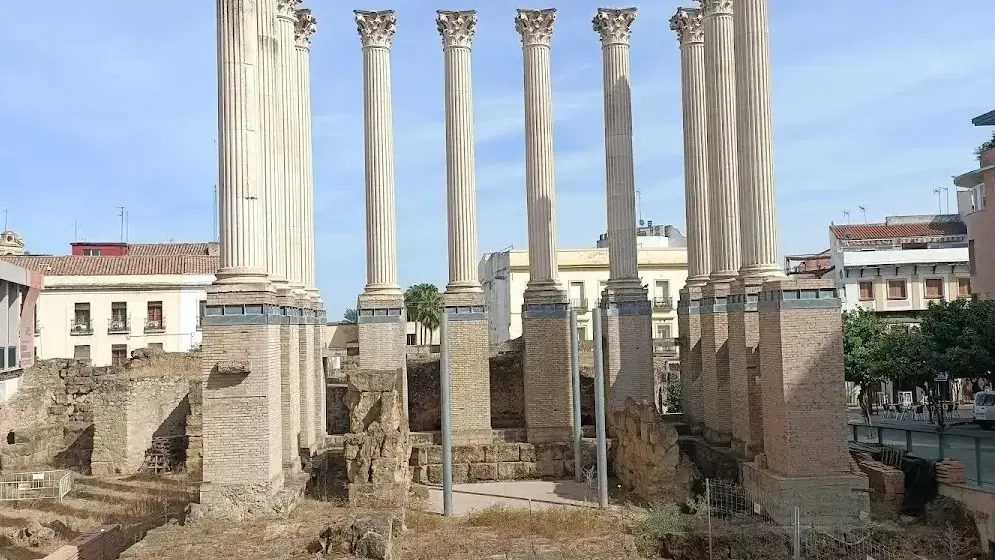

The Templo Romano de Córdoba is one of the most substantial Roman remains in a city that once served as the capital of the Roman province of Baetica. Its Corinthian columns of white marble rise several metres above street level in the heart of the Centro neighbourhood on Calle Claudio Marcelo. At night, uplighting picks out the column fluting and makes the ruins visible from across the square.
When to Visit
Best season
Year-round (open 24 hours, best at night for the illuminations)
Quietest hours
After 21:00 or early morning before 9:00
Visit duration
15 – 20 minutes
A Temple of Imperial Cult
Discovered in 1951 during expansion work on the Ayuntamiento on Calle Capitulares, this 1st-century AD temple has been partially reconstructed using its original columns. The full story of that discovery — the accidental find, García y Bellido's identification from 1958, and Félix Hernández's anastylosis reconstruction — is told in the article Córdoba's Roman Temple: Found Under City Hall in 1951. Most likely dedicated to the imperial cult, it once stood at the forum of Corduba — the political and commercial centre of the Roman city. The podium height and column spacing give a reasonable impression of the original scale.
Corduba was not a minor colonial outpost. Founded around 169 BC, it became the provincial capital and one of the most important cities in the western Roman Empire. The governor's residence, the main law courts, the commercial exchange, and the principal temple of state religion all converged around this forum. The temple you see now would have dominated that space, with the elite residential quarter clustering around the forum precinct — the closer to the temple, the more expensive the real estate. For a detailed look at the Roman houses of Colonia Patricia, their atriums, peristyle gardens, and hypocaust heating, the Archaeological Museum holds the largest collection of domestic material from these excavations.
Visit at night when the columns are floodlit — the effect is dramatic
The temple is open-air and accessible 24 hours. At night, the floodlighting isolates the Corinthian columns against the dark sky in a way that daytime visits cannot match. The lit columns visible from the street are one of Córdoba's most striking night scenes.
Architectural Details Worth Examining
The Corinthian capitals are finely carved, with the fluted column shafts and monumental column bases still in good condition. Look at the profiles of the bases closely — the layered torus and scotia mouldings are typical of 1st-century Roman craftsmanship in the western provinces. Archaeologists have identified the podium and access stairs rising from street level. The podium itself would have elevated the temple above the forum floor, making it visible from a considerable distance.
For context: Córdoba's forum was comparable in ambition to those at Tarragona and Mérida, the other major Roman centres in Hispania. The column drums were quarried locally and transported through the streets of the ancient city. The Córdoba architecture guide puts the Roman temple in the long view of the city's structural history, tracing how these foundations — literally and figuratively — shaped every building era that followed.