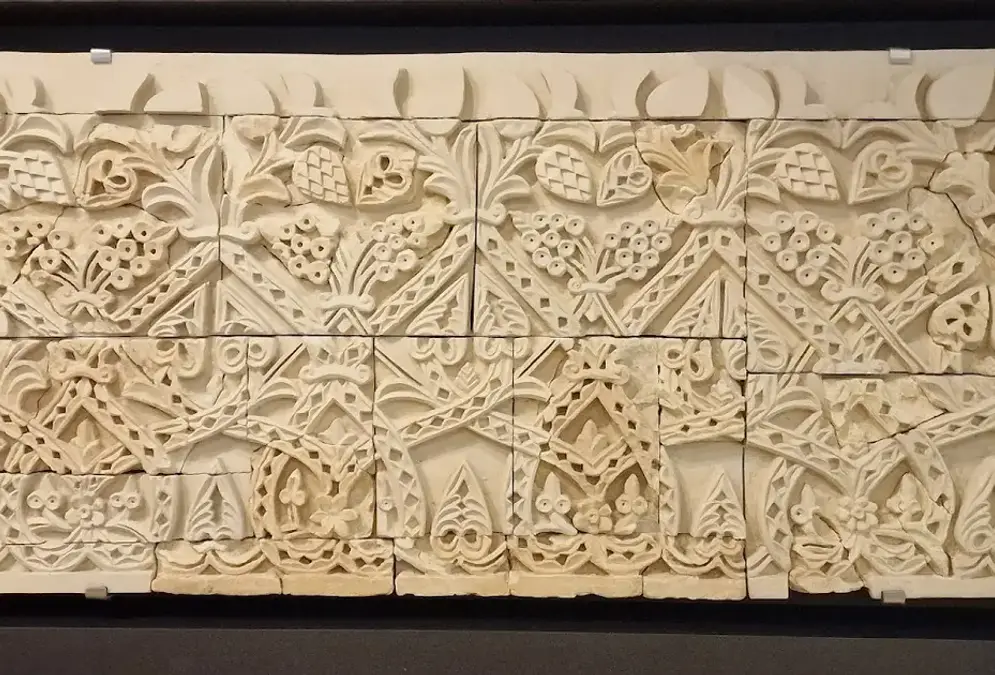

The Museo Arqueológico y Etnológico de Córdoba holds 33,500 inventoried pieces spanning from Prehistory to the Late Middle Ages — one of the oldest and largest archaeological collections in Spain, housed inside a Renaissance palace built directly over a buried Roman theatre. The rooms hold Roman mosaics, Iberian sculpture, Caliphal ceramics, and material from Medina Azahara, spread across the original Páez de Castillejo palace and a modern extension added in 2011.
- 16th century
Palace built
Hernán Ruiz II designs the Páez de Castillejo palace for its founding family
- 1868
Museum founded
Formally established as the Provincial Archaeological Museum of Córdoba
- 1990s–2000s
Roman theatre found
Excavations on adjoining plots uncover the buried theatre of Colonia Patricia Corduba
- 2011
Annex opens
A modern extension opens on 31 January, housing the restored theatre in its basement
A Renaissance Palace With Roman Foundations
The palace was designed in the 16th century by Hernán Ruiz II — the same architect who added the Renaissance bell tower to the Mezquita — for the Páez de Castillejo family. Its three Renaissance courtyards, arcaded and planted, carry the archaeological exhibits between floors and give the visit a rhythm the collection alone wouldn't have. The museum itself was formally established in 1868, following a decree issued the year before mandating the creation of provincial museums across Spain, making it one of the country's oldest archaeological museums.
The collection is organised into three broad sections — Prehistory and Protohistory, Rome and Visigothic culture, and Islam and Mudéjar art — a structure that mirrors the successive occupations that layered material into Córdoba's subsoil over three thousand years.
The Collection's Highlights
The Iberian Lion of Nueva Carteya is the standout piece from the pre-Roman rooms, a carved limestone funerary sculpture of considerable scale. The Roman galleries hold polychrome floor mosaics from local villas — geometric patterns and figural domestic scenes — plus the Crouching Aphrodite, a 2nd-century Roman sculpture that is the only known Roman replica of its kind found anywhere on the Iberian Peninsula. Since October 2024, the same galleries also display the Ephebes of Pedro Abad, a pair of Roman bronze statues that police recovered from a black-market sale attempt in 2012. This is the best place in Córdoba to understand how the elite Roman houses of Colonia Patricia were decorated, from hypocaust heating to peristyle gardens.
Sculptures from the Roman Temple sit alongside a substantial collection of Caliphal ceramics from Medina Azahara — seeing the specific glazing techniques and vessel forms here first makes the ruins at the site itself far more legible. Not every Roman find in the province stays local to its own site: a marble togate statue excavated at Torreparedones, the multi-period hilltop near Baena, is displayed here instead.
The Roman Theatre Beneath the Palace
Excavations on the plots adjoining the palace during the 1990s and 2000s uncovered the theatre of Colonia Patricia Corduba, a 1st-century Roman theatre buried directly beneath the building, along with late-Roman workshops and Andalusi-era medieval houses. The discovery reshaped the museum: a modern annex building opened on 31 January 2011 to house the finds, and the theatre itself has since been fully restored and opened to the public in the basement — a level most visitors walk straight past. Descending into it changes your sense of scale: this was a city of well over 100,000 people, with the civic infrastructure that implies. Córdoba keeps yielding buried history this way — a January 2026 LiDAR survey located Almanzor's long-vanished rival capital, Madinat al-Zahira, roughly 12 km east of the city, another major find that stayed hidden until modern survey work located it. Further south at Colina de los Quemados, a radiocarbon-dated elephant bone excavated near the Provincial Hospital in 2020 was linked to Second Punic War military activity by a 2026 study — another case of major history surfacing only once someone dug in the right spot, covered in our report on the Punic war elephant bone find.
The museum's standing shows in its visitor numbers — in 2022 it was the second most-visited museum in the entire Junta de Andalucía network, with roughly 285,000 visitors.
Planning Your Visit
Allow 1 to 1.5 hours. The museum is useful context before visiting Medina Azahara or the Roman Temple. Free entry for EU citizens. Closed Mondays. Best visited in the morning before crowds arrive. Located in the Centro quarter, 5 minutes' walk from the Mezquita-Catedral. The museum is a stop on our Roman-history walking route, which connects it with the Roman Temple and Plaza de la Corredera in a single afternoon circuit through the city's ancient layers.