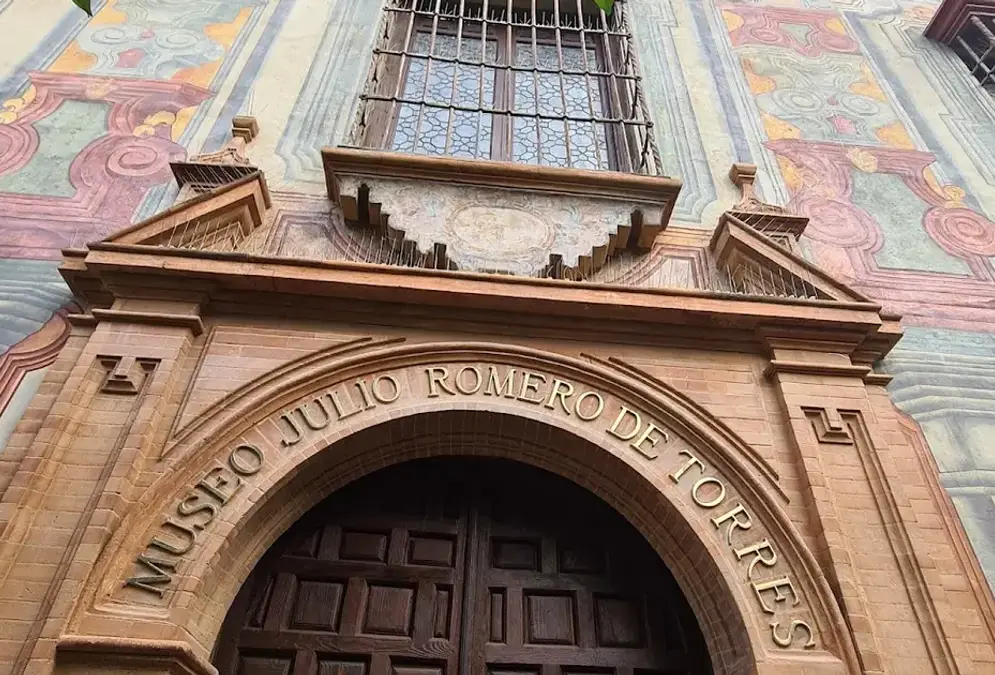

Near the old Posada del Potro in the Ribera quarter, the Museo Julio Romero de Torres is the only museum in the world dedicated to Córdoba's most-loved painter, gathering the core of his output in the same building complex where the city's Fine Arts collection has been kept since the 19th century. It is a small museum by international standards. It is also the single best place anywhere to understand why this one Cordoban painter still matters to the city that raised him.
- 1874
Born in Córdoba
Begins his apprenticeship at age ten under his father, Rafael Romero Barros
- 1908
National Exhibition medal
Wins a first-class medal for Musa Gitana (Gypsy Muse)
- 1916
Madrid professorship
Named professor at the Real Academia de Bellas Artes de San Fernando
- 1929
Seville Exposition
His work is shown at the Ibero-American Exposition, forming the future museum's core collection
- 1931–1936
Museum opens
Provisional inauguration in 1931, definitive opening on 24 May 1936
Who Was Julio Romero de Torres?
Born in Córdoba in 1874, Romero de Torres began his training early: at age ten, he started an apprenticeship with his father, Rafael Romero Barros, at the School of Fine Arts, where his father served as director of the Fine Arts Museum. His mature style is usually described as Symbolist, shaped by the currents of modernism and the intellectual mood of the Generation of '98. What stands out technically is the control of a narrow palette — precise, carefully balanced blacks, blues and greenish tones — used to build compositions that feel far more deliberate than decorative.
His breakthrough came in 1908, when his painting Musa Gitana (Gypsy Muse) won a first-class medal at the National Exhibition. The recognition did not last uninterrupted: after being snubbed at the 1915 exhibition, he stopped entering national competitions altogether and moved to Madrid instead. There, in 1916, he was named a professor at the Real Academia de Bellas Artes de San Fernando, one of the country's most prestigious art institutions — an odd, almost contradictory arc for a painter whose subject never stopped being Córdoba.
A Museum Born From a Seville Exhibition
The museum's origin is tied to a specific event: the 1929 Ibero-American Exposition in Seville, where a body of Romero de Torres's work was shown not long before his death. The family donated that collection to Córdoba, and the museum opened in the artist's former family residence, provisionally on November 23, 1931, with the definitive inauguration following on May 24, 1936. It shares its building complex with the Museo de Bellas Artes de Córdoba, directly across from the historic Posada del Potro — the two collections have effectively grown up together on the same square.
The building has been renovated three times since; the most recent, and most substantial, took place in 2012.
The Collection: What's Actually on the Walls
The museum's core holdings are the paintings that made Romero de Torres's reputation: La Chiquita Piconera, Naranjas y Limones (Oranges and Lemons), Cante Hondo, and Poema a Córdoba are the works most visitors come specifically to see, tracing his development from early work through to the fully-formed symbolist style of his last decade. La Chiquita Piconera is one of the most reproduced Spanish paintings of the 20th century — its permanent home is here, in the museum built around his life's work, not on loan anywhere else.
The collection doesn't stop at his own canvases. The same rooms also hold work by other major Spanish painters with Córdoba connections — Francisco Zurbarán, Alejo Fernández, Antonio del Castillo, and Valdés Leal — giving the visit a wider frame than a single-artist retrospective usually offers.
Beyond the Paintings
What separates this museum from a standard picture gallery is the personal material displayed alongside the art: the artist's own furniture, palettes and brushes, plus his personal library. Seeing the tools next to the finished paintings closes the distance between the working painter and the finished symbolist icon that his reputation eventually became — this was a study and a home before it was a museum.
Planning Your Visit
The museum sits a short walk from the Mezquita, on the same square as the Museo de Bellas Artes and the Centro Flamenco Fosforito — three cultural stops within a few dozen meters of each other, easily combined into one afternoon in the Ribera quarter. A combined ticket with the Fine Arts museum next door is worth asking about at the desk. Wall texts run in Spanish and English, and the gallery lighting is set low enough to protect the dark-palette paintings without making the surface detail hard to read.