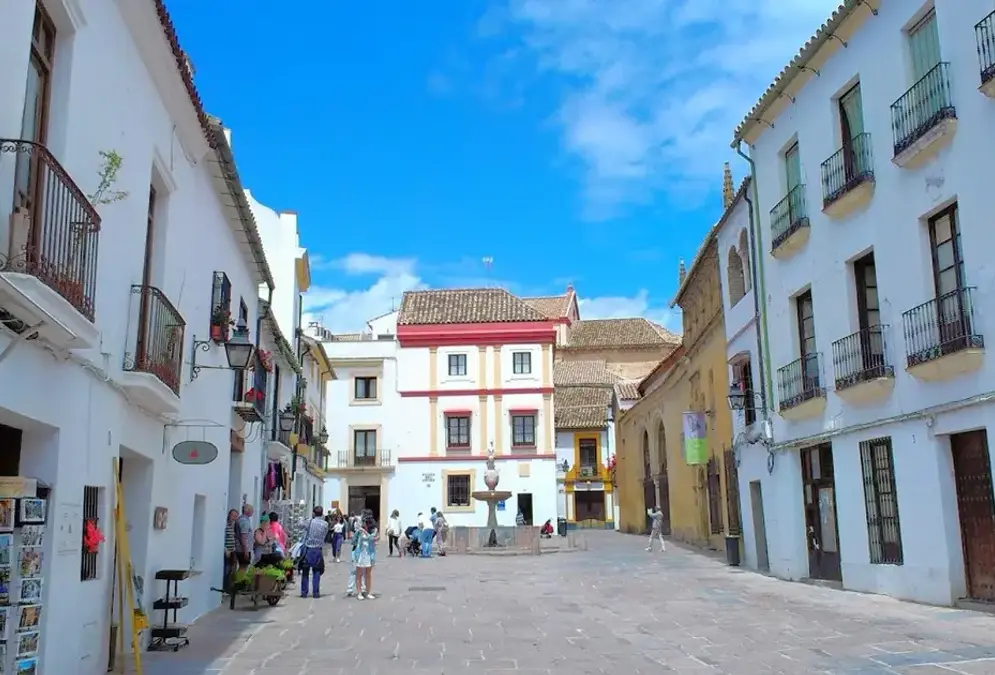

The Plaza del Potro is one of Córdoba's most historically layered squares. Cited by Cervantes in Don Quixote (Part I, Chapter 3), it was a trading hub and travellers' crossroads in the Middle Ages. At its centre stands a Renaissance fountain crowned by a young horse (potro), the emblem of the square. Three cultural venues now share the plaza, making it one of Córdoba's more rewarding cultural stops.
When to Visit
Best season
Year-round
Quietest hours
Weekday mornings 10:00–13:00
Visit duration
30 minutes (square) to 1.5 – 2 hours (with the three museums)
The Fountain and Cervantes' Inn
The square takes its name from the Renaissance fountain (1577), topped by a foal sculpted by French artist Antoine Jacquot. The former Posada del Potro, a 15th-century inn where Cervantes is said to have stayed, survives on the square. In the 16th century, Cervantes described it in Don Quixote as a haunt of 'rogues and thieves' — which tells you something about what the square's livestock markets and crowded inns actually sounded like.
The fountain and the inn together make the square one of the few places in Córdoba where you can stand in a space that feels largely unchanged from the period when the city was a major stopping point on the road between Seville and Madrid. The cobblestones and the scale of the buildings around the square have not shifted dramatically.
Three museums face this square — plan a full cultural afternoon here
The Fine Arts Museum, Julio Romero de Torres Museum and Centro Flamenco Fosforito all open onto Plaza del Potro. Combined with the 1577 fountain and the Posada del Potro inn that Cervantes mentions in Don Quixote, you could spend three hours here without repeating anything.
Three Museums on One Square
The old inn now houses the Centro Flamenco Fosforito, dedicated to flamenco as a UNESCO Intangible Heritage — with exhibitions, sound archives, and a concert programme — its free Sunday-noon recitals run in seasonal editions rather than year-round. The Museo de Bellas Artes de Córdoba displays Spanish painting from the 14th to the 20th century, including works by Zurbarán, Murillo, and Valdés Leal — free for EU citizens. The Museo Julio Romero de Torres, devoted to the Cordoban painter known for his symbolist portraits of Andalusian women, completes the set. Both museums share the same building.