
You step from the heat of Calle Cardenal Herrero into sudden cool. The light drops. Your eyes take a moment. Then the 856 columns come into focus — jasper, marble, and granite stretching in every direction, carrying red-and-white horseshoe arches that seem to recede further than the building should allow. The scale breaks your bearings within ten steps. That's the point.
The Mezquita-Catedral de Córdoba holds 1,300 years of Islamic and Christian history in the same walls. It began in 785 when Abd al-Rahman I built the first mosque on this site, and successive rulers expanded it over the next two centuries. In 1236, Fernando III consecrated the mosque as a cathedral. Then in 1523, the cathedral chapter proposed a Renaissance nave cut into the centre of the prayer hall and Charles V authorized it — a decision he reportedly regretted, telling the cathedral chapter, "You have destroyed something unique to build something ordinary." Both things are still there.
When to Visit
Best season
October to May
Quietest hours
At opening (10:00) or the free slot (8:30–9:30 Mon–Sat)
Visit duration
1.5 – 2 hours (add 30 min for the bell tower)
What to look for inside
The mosque's first phase was built on a site traditionally identified as a Visigothic church, though recent archaeology disputes whether any church actually stood there. Successive rulers expanded the building after 785 — one of them, Abd al-Rahman II, spent his reign also founding Córdoba's first state-run silk workshop, turning the city into more than a religious capital, and decades later Abd al-Rahman III proclaimed himself caliph inside these same walls in 929.
The column forest is the first thing and the thing that stays with you longest. The columns were salvaged from earlier Roman and Visigothic structures — they don't match in height, so the architects added a second tier of arches on top to level the ceiling. Why the shafts, capitals and colours differ from row to row is the subject of the Mezquita's mismatched columns. Stand in the middle and slowly turn. The arches recede in every direction like a mirror held up to another mirror. That double-arch system, built to solve a structural problem, went on to become one of the most recognizable signatures of Moorish architecture across al-Andalus.
At the far end of the prayer hall, the mihrab faces roughly south — not directly toward Mecca, a point of ongoing scholarly discussion. The mosaic work around it was made by craftsmen sent from Constantinople by the Byzantine emperor, at the request of Caliph Al-Hakam II — which makes it, technically, a piece of Byzantine art inside a Spanish mosque. The gold tessera catch the light differently depending on the hour. The Córdoba architecture guide explains how each of the four expansion phases reshaped the prayer hall, and why the mihrab's placement — offset from the building's axis — reflects a deliberate choice by Al-Hakam II rather than a surveying error.
The Renaissance cathedral inserted into the mosque's centre is jarring, exactly as Charles V feared. A high vaulted nave, carved choir stalls, a Baroque retablo — all dropped into the middle of a building whose logic they contradict. Whether this collision is a horror or a wonder is genuinely a matter of opinion. Most people end up thinking both. For the full story of how a mosque became a cathedral — and why the name and ownership are still disputed today — read Is the Mezquita a mosque or a cathedral?.
The cathedral's chapels hold other notable burials: Luis de Góngora, Córdoba's greatest Baroque poet, is buried behind an iron grille on the south side — walked past by most visitors without a second glance.
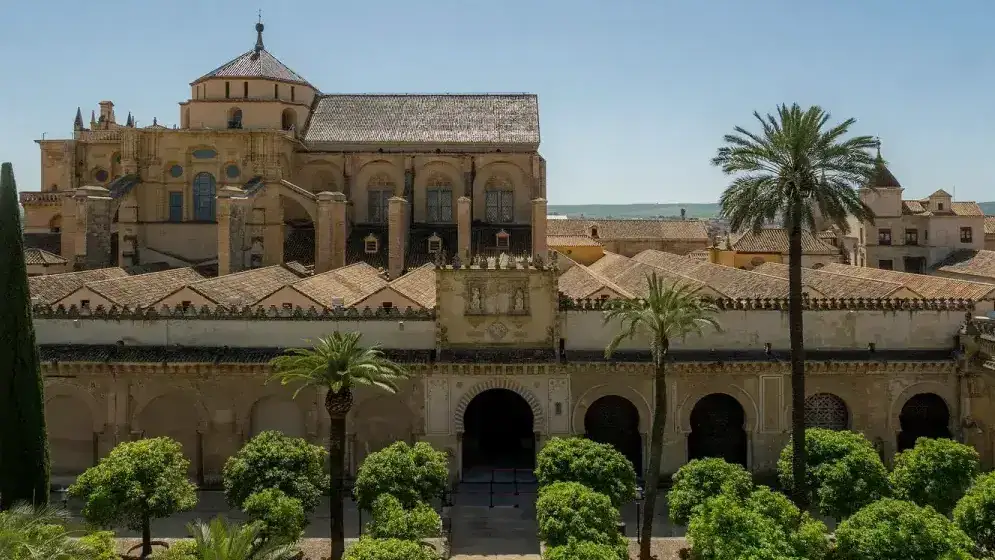
For the overhead view, climb the Torre Campanario bell tower (€4 supplement, guided tours every 30 minutes). The tower was built over the original minaret. From the top, the roofline of the Mezquita spreads below you alongside the old city and, on clear days, the Sierra Morena to the north.
Use the first hour tactically
If you want the free 8:30-9:30am entry, be at the door well before 8:00. If you miss that slot, the next-calmer moment is usually paid entry right at 10:00 before the late-morning group wave builds.