
Moorish Architecture Tour
Horseshoe arches, 10th-century caliphal baths, Moorish gardens, and Mudéjar tile work: a free 2.5km self-guided walk through Córdoba's Islamic heritage.
Walk Córdoba's medieval Jewish quarter in 1.8km: 14th-century synagogue, Casa de Sefarad, Calleja de las Flores, and Alcázar gardens. Free, two hours.
Six years specialising in heritage towns and cultural route planning across Córdoba province.
Click on any marker to see stop details. Numbered markers follow the suggested route order.
Start at the western façade on Calle Torijos. You don't need to go inside at this point — the exterior walls alone, with their blind arcades and Roman stone blocks at the base, are worth five minutes. The bell tower rising from the original minaret stays visible throughout the walk.
Tip: The west door (Puerta del Perdón) faces Calle Torijos. This is where the walk begins, not the main ticket entrance on the south side.
A 14th-century gate built over Roman foundations at the northwest corner of the old city walls. The arch frames a view back toward the Mezquita tower and north toward open countryside. The statue just outside the gate is Averroes (Ibn Rushd), the 12th-century philosopher born two streets away.
Tip: The gate faces west and catches good light in the late afternoon. The narrow Calle Judíos connects it directly to the synagogue — a 3-minute walk.
Built in 1315, this is one of three medieval synagogues still standing in Spain. The prayer hall is small — you could cross it in eight steps — but the Mudejar stucco work on the upper gallery is detailed and largely original. A Hebrew inscription runs along the upper walls. Entry costs 0.30€ for EU citizens and is free for residents of Córdoba.
Tip: Closed Monday. Lines are rare, but the hall fits maybe 20 people comfortably, so arrive early or just after opening (10:00) to have it quiet.
A private cultural centre in a restored 14th-century house directly across from the synagogue. Five rooms cover Sephardic history, music, women's roles, and the Inquisition period, with artefacts and context that the synagogue itself lacks. Live Sephardic music performances run most weekday evenings.
Tip: Entry is 4€. The small courtyard café serves decent coffee. The music programme schedule is posted at the entrance — worth checking before you move on.
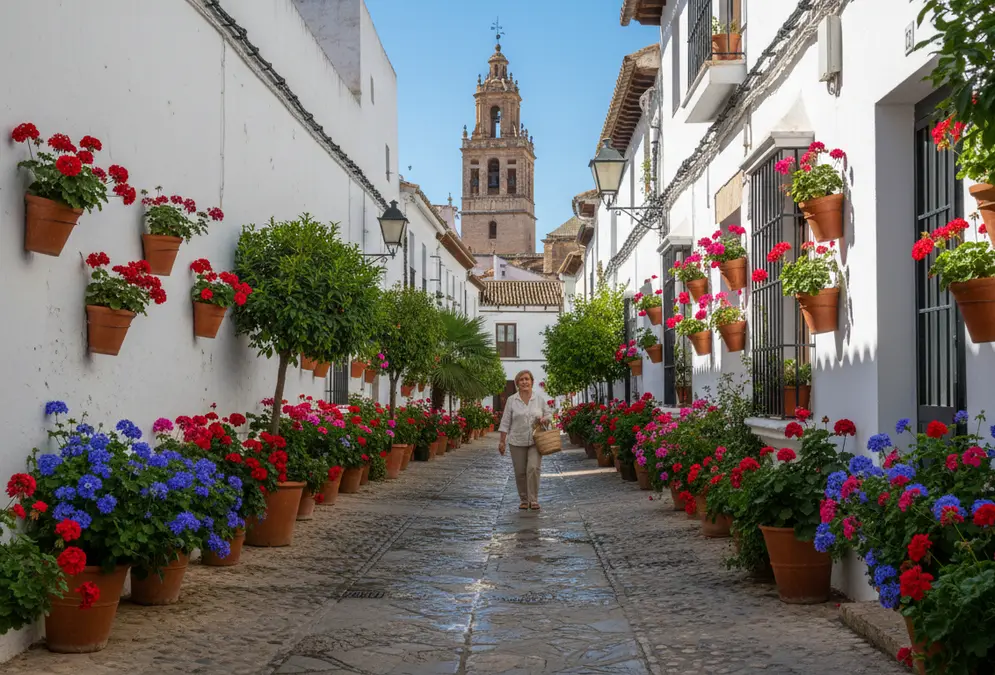
A dead-end alley off Calle Blanco Belmonte, famous for the geranium-pot walls and the framed view of the Mezquita tower at the far end. The composition works because the alley bends slightly, placing the spire dead-centre. Early morning, the pots are freshly watered and the light is soft.
Tip: Come before 9:30am or after 7pm. At midday in summer, tour groups queue shoulder-to-shoulder. The flowers are at their best April through June.
Tenth-century Arab thermal baths, part of the palace complex that once extended from the Alcázar to the river. Excavated from under a 16th-century house, the star-shaped vaulted ceiling with filtered light is the best-preserved element. Context panels explain the hot, warm, and cold room sequence.
Tip: Open Tuesday to Sunday. Often skipped by visitors rushing to the Alcázar, so it's usually quiet. Entry included in the Alcázar ticket on the same day.
A 15th-century chapel with one of the finest Mudejar tile interiors in the city — geometric azulejo panels covering the lower walls, star-vaulted ceiling painted in gold and blue. It sits on a side street that most visitors walk straight past. Free entry, almost always empty.
Tip: The chapel is on Calle Averroes, a 2-minute walk from the Caliphal Baths. Easy to miss: the door is set back in an archway. Push it — if it opens, you're in.
A small plaza on Calle Judíos with a bronze statue of Moses Maimonides (1135–1204), the philosopher and physician born in this quarter. The square is a natural rest point before the final stretch to the Alcázar. The tourist information office nearby has free walking maps if you want them.
Tip: The statue is polished smooth on the right foot from decades of tourists rubbing it for luck. The tradition is recent and purely touristic, but the plaza is genuinely pleasant.
The walk ends at the fortress built by Alfonso XI in 1328 on the ruins of earlier Visigothic and Moorish palaces. The Roman mosaics inside the lower halls are worth slowing down for — one, from the 2nd century, shows a feast scene in fine detail. But the terraced gardens along the city wall, with their long water channels and cypress hedges, are the real reason to allow 30 minutes here rather than 10.
Tip: Entry is 6€ (free Tuesday afternoons for EU residents). The tower stairs are steep and unrailed in places — comfortable shoes matter here. Gardens close at the same time as the fortress, not later.
The compact streets of La Judería pack more history per square metre than almost anywhere in Spain. Córdoba's Jewish community lived here from Roman times until the expulsion of 1492, and this 1.8km walk threads through what remains: narrow whitewashed alleys, a rare medieval synagogue, the cultural centre of Casa de Sefarad, and a Roman-era street grid that Sephardic families walked for centuries. The circuit takes two hours at an easy pace — add an hour if you stop inside the synagogue and the Alcázar. Start at the Mezquita-Cathedral's western façade on Calle Torijos, then head north along Calle Judíos. Puerta de Almodóvar, a 14th-century gate on Roman foundations, marks the original city boundary. The Synagogue on Calle Judíos (built 1315, entry 0.30€ for EU citizens) is one of only three surviving medieval synagogues in Spain, its Mudejar plasterwork largely intact. Thirty steps further is Casa de Sefarad, a private museum tracing five centuries of Sephardic life through music, textiles, and domestic ritual — budget 45 minutes.
Calleja de las Flores is the walk's most photographed stop: a dead-end alley framed in geranium pots with the Mezquita's bell tower centred at the far end. Go before 9:30am or after 7pm to avoid the crowds. The route then winds south past the Caliphal Baths — 10th-century Arab thermal baths with star-vaulted ceilings — and the Gothic facade of Capilla de San Bartolomé, whose Mudejar tilework interior is free and usually empty. The walk ends at the Alcázar de los Reyes Cristianos, where terraced gardens run along the old city wall and a 2nd-century Roman mosaic sits under glass in the lower halls; allow 30 minutes for the gardens alone (entry 6€, free Tuesday afternoons for EU residents). The entire route is flat cobblestone; wider parallel streets work for pushchairs. The Judería neighbourhood is best explored on the side streets off Calle Judíos and Deanes, where you'll find working patios and fewer tourist shops. If you finish the walk in the afternoon heat, Piacerino on Calle Historiador Díaz del Moral — a five-minute walk from the Alcázar end point — is a 100% artisan gelateria with seasonal sorbets and natural-ingredient gelato.
Horseshoe arches, 10th-century caliphal baths, Moorish gardens, and Mudéjar tile work: a free 2.5km self-guided walk through Córdoba's Islamic heritage.
San Basilio, Judería, Palacio de Viana — three patio districts on one easy 2.5km circular loop. Free self-guided walk, best in May but good all year round.
Roman Bridge to Alcázar gardens along the Guadalquivir: a free 3km walk past medieval water mills, Torre de la Calahorra, and white storks on the south bank.