
Search the site

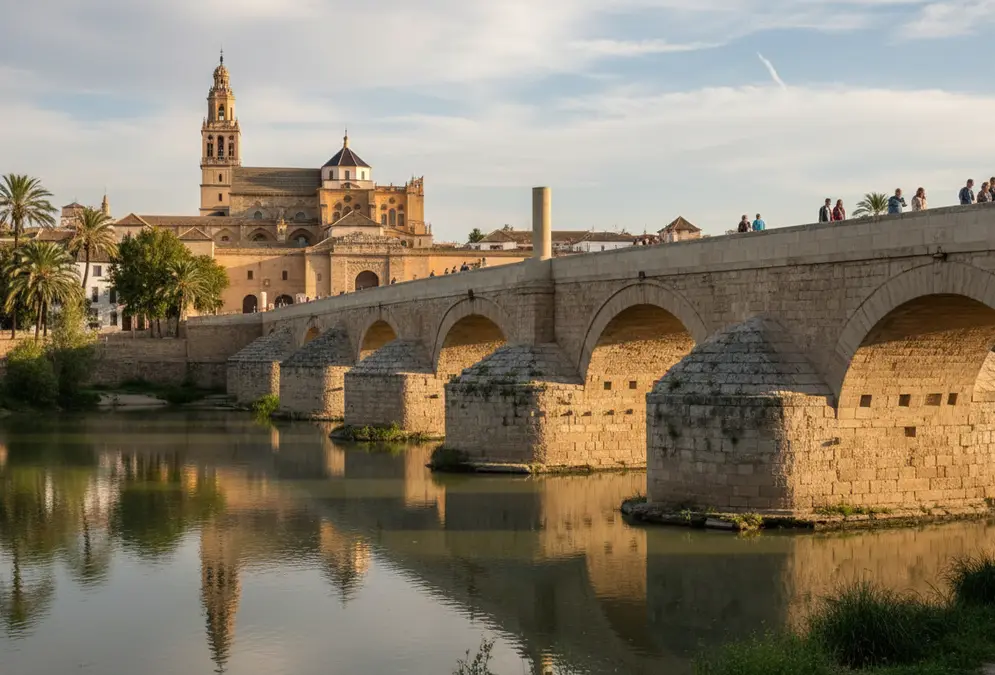
The Roman Bridge over the Guadalquivir river in Córdoba with the Mezquita-Catedral tower in the background
Nature Easy Free

Riverside & Bridges Walk

Roman Bridge to Alcázar gardens along the Guadalquivir: a free 3km walk past medieval water mills, Torre de la Calahorra, and white storks on the south bank.

Download PDF guide

At a Glance

Distance
3km
Duration
2 hours
Stops
9 stops
Route type
Circular
Best time
Early morning (before 9am) for the Roman Bridge without crowds, or late afternoon (from 5pm) when the riverside path fills with locals on their evening walk. Avoid midday in July and August — the south bank path has almost no shade.
Accessibility
Fully flat route on tarmac paths and paved promenades. The Roman Bridge itself has a slight camber but no steps. The Sotos de la Albolafia section (stop 3) uses an unpaved gravel path that may be muddy after rain. All main sections are pushchair and wheelchair accessible.

Route Map

Loading map…

Click on any marker to see stop details. Numbered markers follow the suggested route order.

Stop-by-Stop Route

  1. 1
    Roman Bridge
    Monument 10 min

    The walk starts at the north end of the Roman Bridge. Built in the 1st century BC across 16 arches, this pedestrian-only crossing gives the best view of the Mezquita-Catedral from the river. Allow 10 minutes to walk its 250-metre length.

    Tip: Walk to the middle of the bridge at sunrise — the light hits the Mezquita's belltower from the east and the Torre de la Calahorra glows amber from the west.

  2. 2
    Torre de la Calahorra
    Monument 45 min

    The 14th-century gate tower at the south end of the Roman Bridge houses a multimedia museum on Córdoba's golden age under Islam. The rooftop terrace has the best unobstructed view back across the bridge and the Mezquita. Admission €4.50.

    Tip: Skip the audio guide and head straight to the rooftop first — that view earns its own 15 minutes before you descend into the museum.

  3. 3

    Sotos de la Albolafia

    Landmark 15 min

    The narrow nature reserve running east from the Torre de la Calahorra along the south bank. White storks nest in the old mill towers from March to August. The path is unpaved and quiet — five minutes from the city centre and you're watching birds work their nests.

    Tip: Look for storks between March and July — they nest on the Albolafia mill tower. Binoculars aren't necessary; the nests are enormous and visible from the path.

  4. 4
    Guadalquivir Mills
    Monument 15 min

    The row of medieval water mills built by Abd al-Rahman II in the 9th century to supply flour to the caliphate. The Albolafia mill still has a functioning waterwheel — you hear it before you see it, a slow creak and splash that carries up from the water.

    Tip: Stand at the fence directly below the Albolafia waterwheel — the creak and splash is the closest thing Córdoba has to a living piece of medieval engineering.

  5. 5

    Puente de San Rafael

    Landmark 5 min

    The modern cable-stayed bridge 400 metres upstream from the Roman Bridge, built in 2003. Use this to cross back to the north bank. Not a destination in itself, but the mid-span view east toward the Roman Bridge and west toward open country is worth a pause.

    Tip: The handrails on this bridge are padlocked with hundreds of 'love locks' — a recent tradition that's turned the bridge into an unexpected social document.

  6. 6

    The 14th-century royal fortress built by Alfonso XI on the foundations of an earlier Moorish palace. The terraced gardens descend almost to the river and are among the best in Andalusia — fountains, clipped hedges, orange trees, and rose beds. Admission €5. Close the Alcázar in about 90 minutes if you stay for the gardens.

    Tip: Come in April or May when the orange blossoms are out — the scent comes over the garden walls while you walk the river path below, stronger than you'd expect.

  7. 7
    Sojo Ribera
    Bar 20 min

    A riverside bar on the Paseo de la Ribera with a shaded terrace directly facing the north bank of the Guadalquivir. Good for a cold beer or a tinto de verano mid-walk. The kitchen serves simple tapas from midday.

    Tip: Grab a table at the water's edge rather than the interior — the terrace faces the river directly and catches the afternoon shade from the Calahorra tower.

  8. 8
    Jardín Botánico
    Monument 25 min

    Córdoba's botanical garden occupies the old Moorish garden terraces by the river, west of the Alcázar. The riverside fence opens onto a long upstream view toward the Roman Bridge. The garden itself covers three hectares of native Andalusian species, succulents, and a cactus collection. Admission €3.

    Tip: The botanical garden closes on Mondays. If you're walking on a Monday, the riverside path along the external fence still gives good views, but save the interior for another day.

  9. 9

    A rooftop bar on the north bank with elevated views across the river and back toward the Roman Bridge. Best at dusk when the bridge lights come on. Serves cocktails and craft beers from 6pm.

    Tip: Come at 7pm in summer — you get the last direct light on the Roman Bridge and the Calahorra tower from above, and the terrace is busy but not yet packed.

The Roman Bridge sets the tone immediately — 16 arches of stone over 250 metres, 1st century BC, traffic banned, and the Mezquita-Catedral at your back as you cross. On the south bank, the Torre de la Calahorra anchors the far end; its rooftop terrace has the best unobstructed view of the whole span (€4.50, 45 min inside). East of the tower, the Sotos de la Albolafia nature strip runs along the water where white storks nest each spring in the old mill towers. The Molinos del Guadalquivir — built by Abd al-Rahman II in the 9th century — still have a turning waterwheel at the Albolafia mill; you hear the creak and splash before you see it.

Cross back north via the Puente de San Rafael (400 metres upstream) and the walk shifts tone. The path runs under the walls of the Alcázar de los Reyes Cristianos, whose terraced gardens descend almost to the river — orange trees, cypresses, and Moorish fountains (€5). In April and May the orange blossom drifts over the walls. The loop ends where it started: the north end of the Roman Bridge, 5 minutes from the Mezquita. The full circuit is 3km, about 2 hours, flat throughout, free to walk — only the tower (€4.50), Alcázar (€5), and Jardín Botánico (€3) charge entry. For a drink mid-walk, Sojo Ribera has a terrace on the Paseo de la Ribera facing the water.

Riverside & Bridges Walk FAQ

How long is the Riverside & Bridges Walk in Córdoba?

The full loop is 3km and takes about 2 hours at a relaxed pace with brief stops at the main landmarks. Add another 1–2 hours if you go inside the Torre de la Calahorra museum (45 min) and the Alcázar gardens (30–90 min).

Is the riverside walk free?

Walking the route itself costs nothing. Admission applies to two attractions along the way: the Torre de la Calahorra museum (€4.50) and the Alcázar de los Reyes Cristianos (€5). The Jardín Botánico costs €3. The Roman Bridge, the river path, and all outdoor sections are free.

Can I do this walk with a stroller or wheelchair?

Yes — the main route along the Paseo de la Ribera and over the Roman Bridge is flat, paved, and accessible. The only exception is the Sotos de la Albolafia nature strip (stop 3), which uses an unpaved gravel path. You can skip that section and walk the paved riverside road instead without missing the main mills.

What is the best time of day to walk along the Guadalquivir?

Early morning (before 9am) gives you the Roman Bridge almost to yourself and the best light on the Mezquita. Late afternoon from 5pm onwards is when locals walk the Paseo de la Ribera — livelier but still pleasant. Avoid midday in high summer (July–August): the south bank section has very little shade and temperatures can reach 38–42°C.

Where does the riverside walk start?

The walk starts at the north end of the Roman Bridge (Puente Romano) on the Paseo de la Ribera. This is about a 5-minute walk south from the Mezquita-Catedral entrance, or a 10-minute walk from the Judería. There is no car parking at the bridge itself; the nearest paid car park is on Avenida del Alcázar.

More Walking Tours