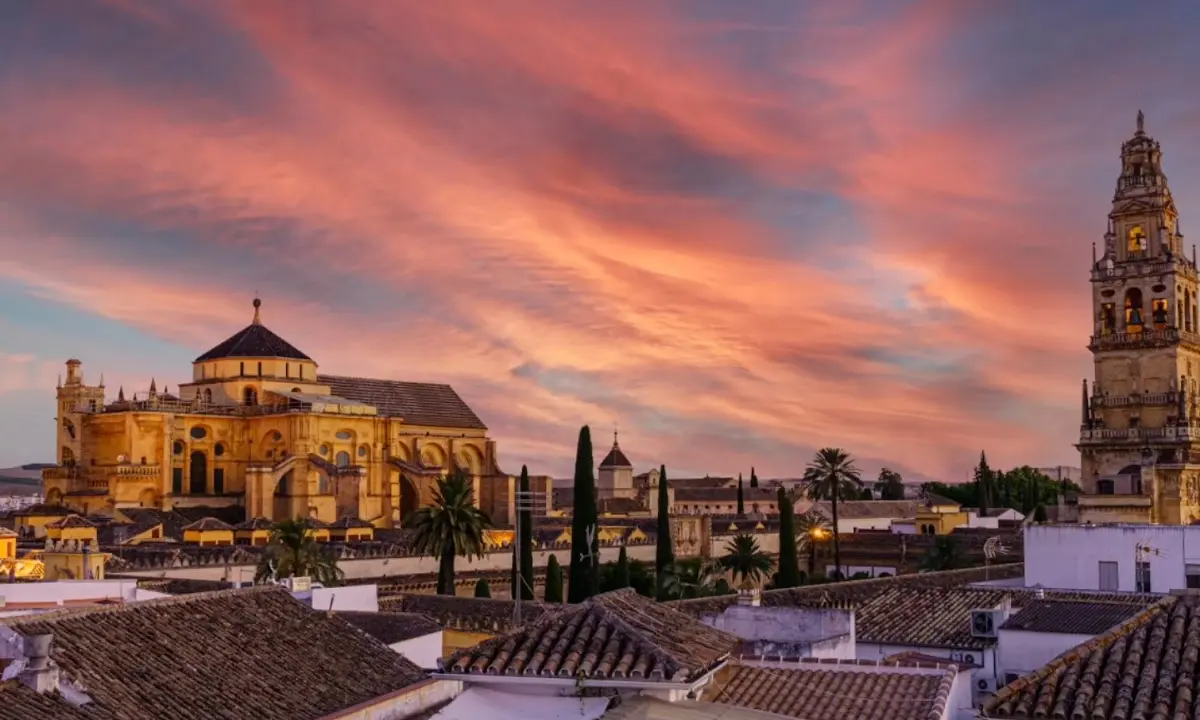

Twenty metres from the Mezquita
The Balcón de Córdoba hotel occupies a 17th-century convent in the Judería, right at the entrance to the Mosque-Cathedral. Its rooftop bar has one of the most direct views of the Mezquita bell tower and the old city's terracotta roofscape available anywhere in Córdoba, and unlike the monument itself, it stays open through the afternoon and evening.
The terrace is open to anyone, not just hotel guests. That is worth stating plainly, because many visitors assume rooftop hotel bars are off-limits. Walk in, order a drink, sit down.
The building
The convent that became the Balcón de Córdoba dates to the 17th century and sat within the Judería, the old Jewish quarter that still has some of the most intact medieval street layout in Andalusia. The hotel conversion kept the internal courtyard, the stone archways, and the general proportions of the convent floor plan. From the rooftop, the surrounding roofscape is almost entirely traditional terracotta tile, with the Mezquita's cathedral nave and bell tower occupying the sightline to the south.
The tower you are looking at is the converted minaret that Abd al-Rahman III raised in 951 CE, later encased in a Baroque bell tower after the Reconquista. At this range you can read the Baroque facing clearly and still see the original minaret structure underneath it. That kind of layered history is what makes the view here different from a hotel rooftop that simply has a good angle on a famous building.
What to drink and eat
The menu covers cocktails, Andalusian wines and local tapas. Montilla-Moriles wines from the province feature alongside the usual gin tonics and aperitifs. The fino from Montilla-Moriles travels better without the Denominación de Origen constraints that Sherry carries, and the local producers supply bottles you rarely see outside Andalusia. A chilled fino with a plate of jamón and cheese while the light falls on the tower is a combination that justifies the prices, which are fair for the location.
The kitchen sends out small Cordovan plates, charcuterie, cheese, jamón, that work well with a drink rather than demanding a full sit-down meal. Budget roughly €8–15 per person for drinks and snacks. The on-site restaurant Pairi Daeza handles longer meals if you want to stay on for dinner.
When to go
Sunset is the obvious answer, especially in spring and autumn when the light hits the Mezquita tower directly and the terracotta tiles hold the warmth for an hour after the sun drops. The terrace fills up on warm evenings, so arriving thirty to forty minutes before sunset gives you both daylight and golden hour rather than just the crowded peak moment.
The bar runs from midday to 11 pm seven days a week. That noon opening makes it a workable stop for a lunchtime aperitif too, not just an evening destination. On summer afternoons in July and August, come early or late. The midday heat on an exposed rooftop in Córdoba at 40 degrees is not ideal drinking weather, but the terrace has some shade and the management keeps the service moving.
Getting there and what else is nearby
The address is Calle Encarnación, 8, a short walk from the Mezquita's main entrance on the Judería side. The lane runs between the mosque wall and the first Jewish quarter streets, and the hotel entrance is easy to miss: look for the carved stone portal. This rooftop is a natural stop on the self-guided Riverside Walk, which passes through the Judería before following the Guadalquivir south toward the Roman Bridge.
If you want a second rooftop later in the evening with a completely different view, Sojo Ribera on the Guadalquivir bank is about fifteen minutes on foot and offers river views of the Roman Bridge. Balcón de Córdoba Rooftop leads our Best Rooftop Terraces in Córdoba and appears in the our citywide bar rankings guide, both essential references for planning an evening in the city.
What you actually see from the terrace
The terrace faces roughly south-southwest. From the parapet, the Mezquita-Catedral bell tower stands directly ahead, close enough that you can read the individual tiers of the Baroque facing that the architect Hernán Ruiz II added between 1593 and 1664 around the original 10th-century minaret. At this distance, the layering of Caliphate stonework and Renaissance facing is not an art-history abstraction; it is a visible join between two construction phases.
To the left of the tower, the cathedral nave's roof runs westward along the old mosque courtyard, with the orange trees of the Patio de los Naranjos visible below. Further left on clear days, the Sierra Morena hills form the northern horizon. To the right, the Judería's terracotta roofline drops toward the Guadalquivir and the arches of the Roman Bridge.
At sunset, the tower catches warm light on its south face while the surrounding rooftops go a deeper orange. After dark, the tower is floodlit from below, which reads differently from above than it does from street level: the light source is hidden, and the stone seems to glow from within. Both versions of the view are worth experiencing if your evening runs long enough.