Approx. 5–18 May 2027 (TBC) · 14 days
Córdoba Patio Festival: Complete Guide
Scarlet geraniums, perfumed jasmine, brilliant whitewashed walls: 64 free patios open this May, a living UNESCO heritage tradition at the heart of Córdoba's historic neighborhoods.

Written by
María Fernanda González Ten years covering Córdoba's UNESCO heritage sites, sourcing from Junta de Andalucía documentation.
Updated Published
Key facts at a glance
- Dates 2027
- Approx. 5–18 May (14 days, TBC)
- Opening hours
- 11am–2pm and 6–10pm
- Participating patios
- 64 patios open to the public (52 competing + 12 non-competing)
- Itineraries
- 6 themed routes by neighborhood
- Entry
- 100% free (all patios)
- Recognition
- UNESCO Intangible Cultural Heritage since 2012
In this guide
Jump to a section
Optimal visit strategy
- Day 1 morning: Santa Marina – San Agustín (fewer crowds, short queues)
- Day 1 evening: San Basilio (golden light on white walls)
- Day 2 morning: Judería (combine with Mezquita before the heat)
- Day 2 afternoon: Viana Palace (12 noble patios, air-conditioned — entry prices)
- Day 3: Santiago – San Pedro + San Lorenzo (working-class neighborhoods)
Understanding the Festival de los Patios
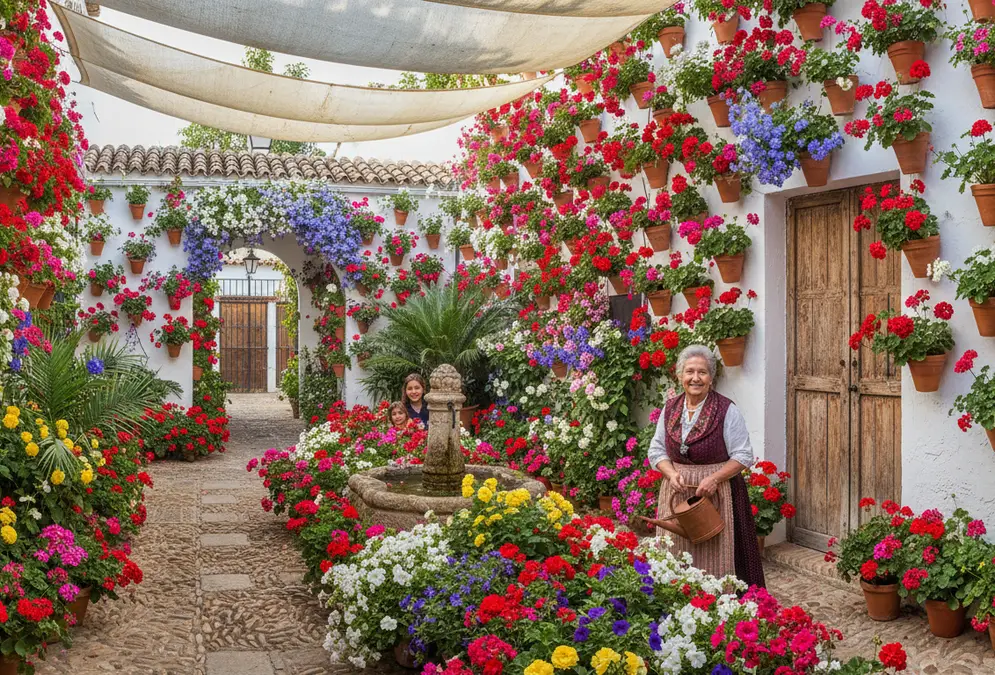
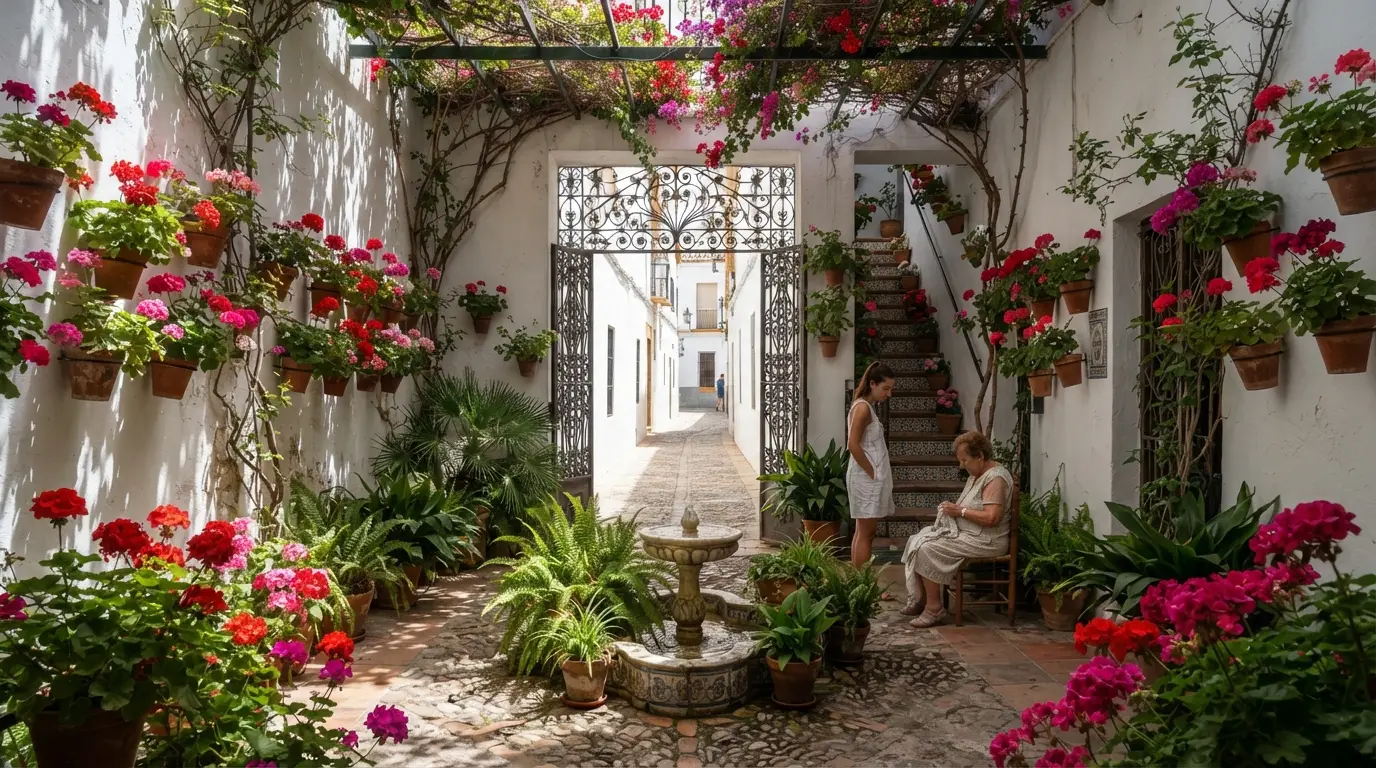
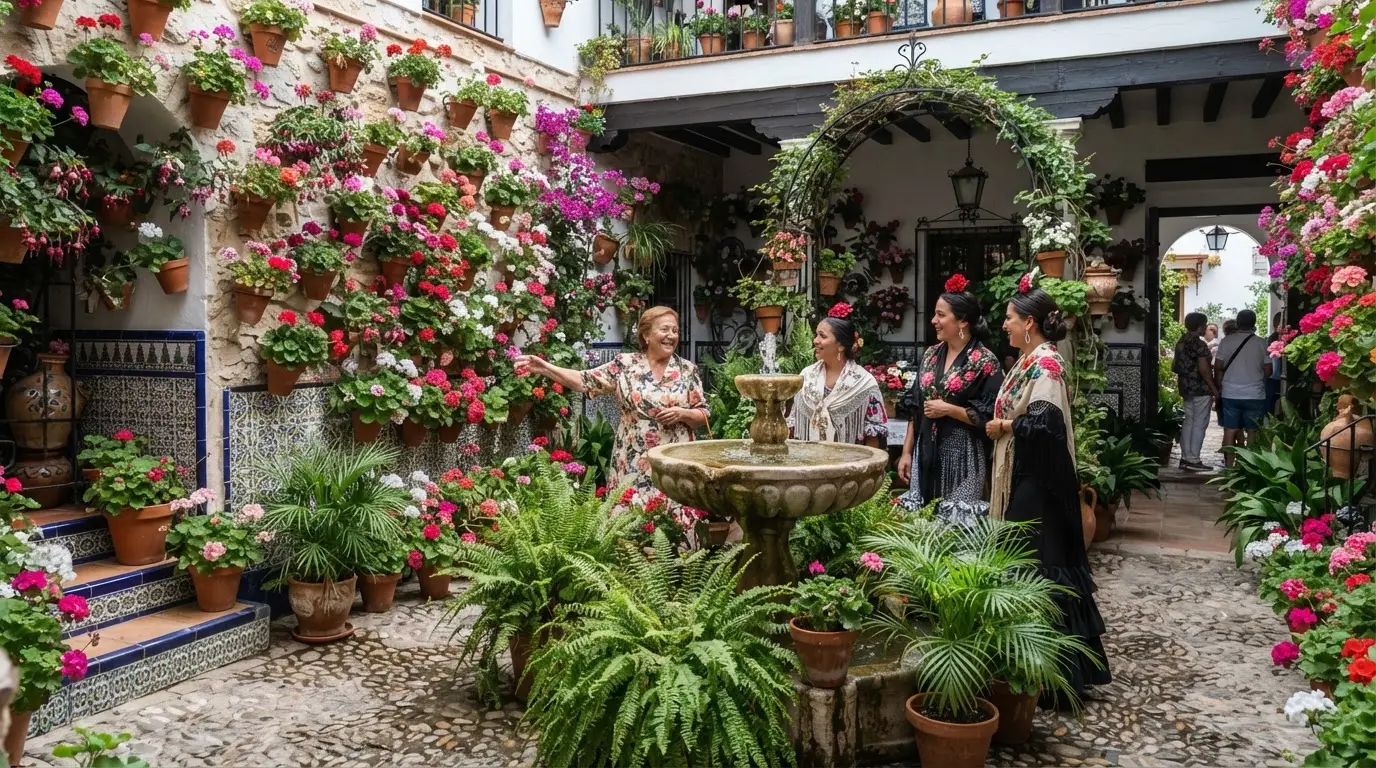
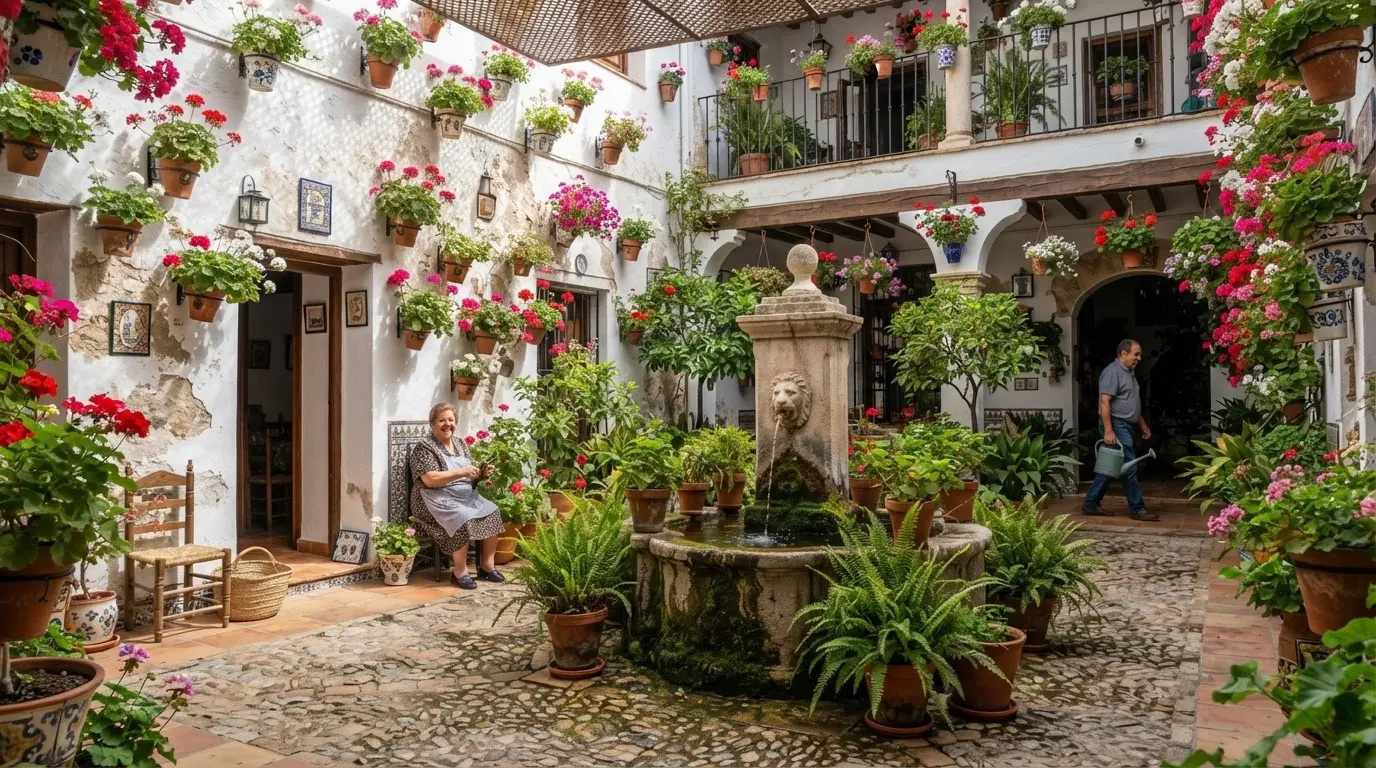
Every May, for fourteen days, 64 patios (52 competing in the contest, plus 12 non-competition institutional courtyards) open their doors to the public during the Festival de los Patios. Geraniums in red and pink fill the walls from street level to rooftop. A hundred-year-old jasmine at Patio Judíos n°23 perfumes the whole alley. Entry to every patio is free. The festival is also the highlight of visiting Córdoba in spring.
These are homes that people live in all year long, tended by owners who pass down their horticultural skills from one generation to the next. The competition has run since 1921: judges score floral density, color combinations, cleanliness, and architectural condition.
What is a Córdoba patio?
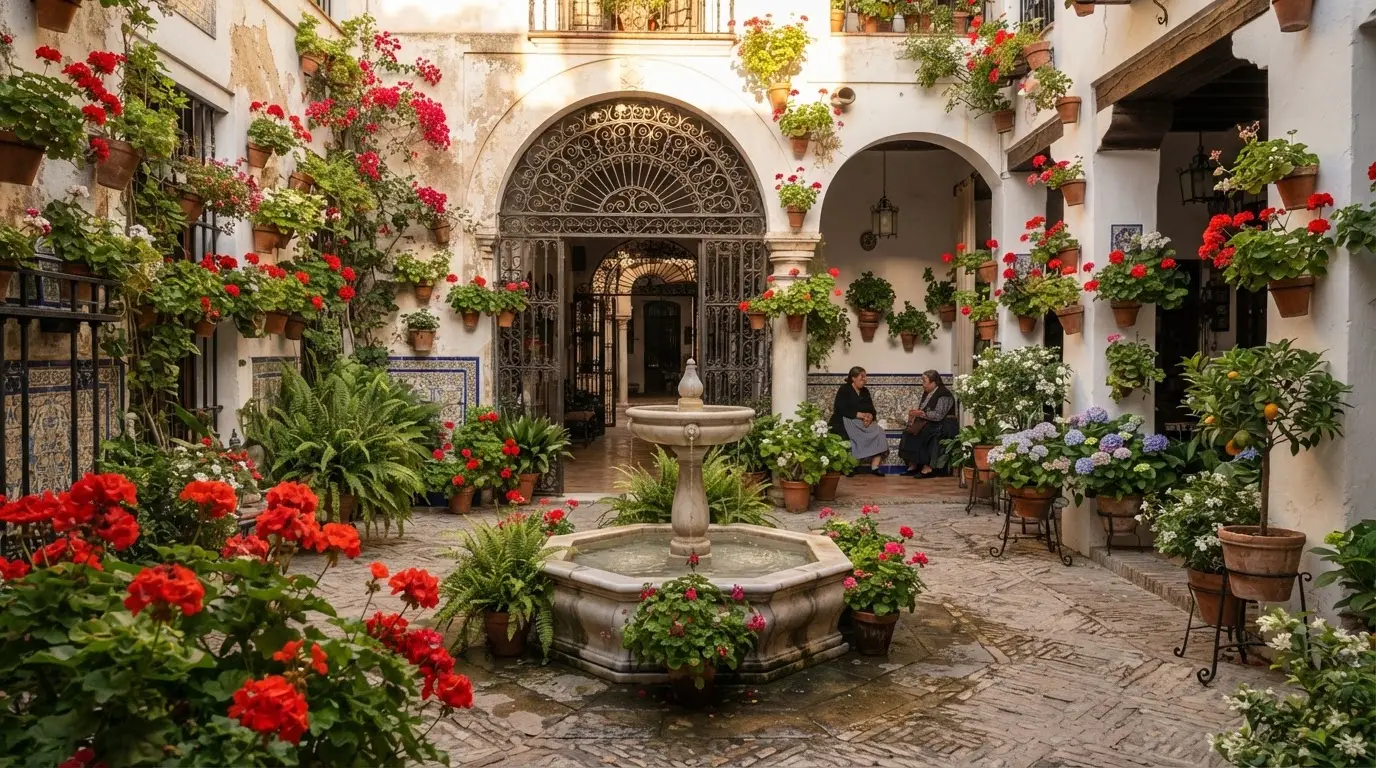
A patio is an inner courtyard typical of Mediterranean architecture, inherited from ancient Rome and Moorish Andalusia. In Córdoba, the patio serves several essential functions:
- ·Climate: Creates a cool microclimate through evaporation from the fountain or well and the shade of the plants; a well-designed patio stays at 25°C when the street outside hits 40°C
- ·Light: Brings natural light to the center of the house (before electricity)
- ·Social: A semi-private family living space, halfway between street and interior
- ·Symbolic: An expression of the Muslim earthly paradise (al-janna), meaning an enclosed, protected garden
Córdoba's patios stand out for their whitewashed walls (which reflect 80% of light), their suspended flower pots (maximizing vertical space, 100–300 pots per patio), and their central fountain or well (keeping things cool through evaporation).
The three types of patio
1. Noble patio (aristocratic)
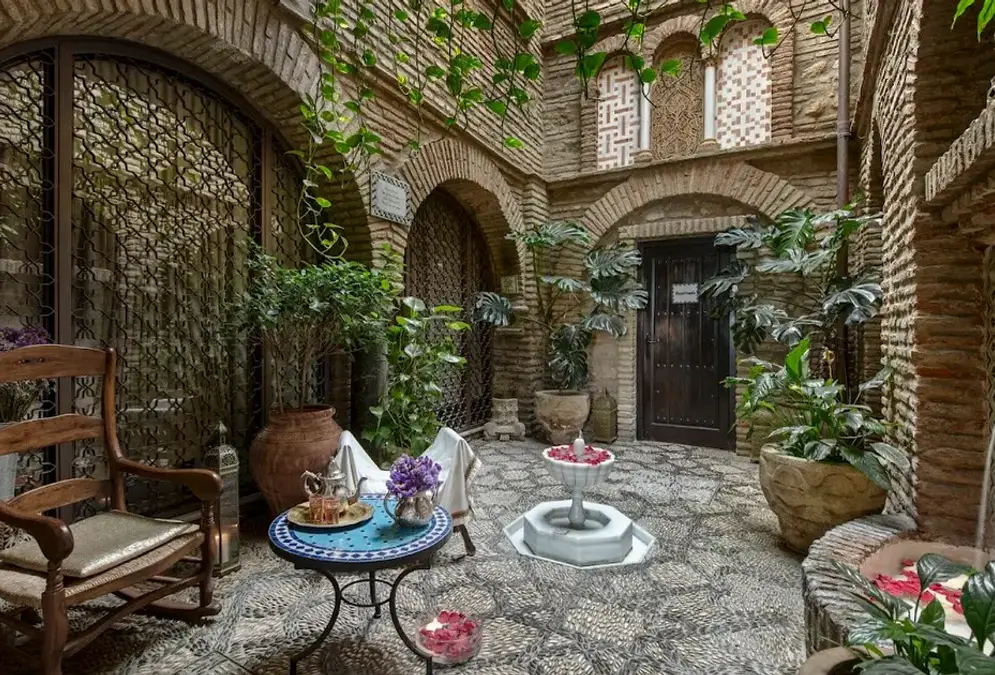
Large (150–300m²), double gallery with horseshoe arches, marble fountain, antique azulejos tiles. Example: Viana Palace.
2. Bourgeois house patio
Medium-sized (50–100m²), single gallery, central well, carefully tended. The majority of festival patios fall into this category.
3. Corrales de vecinos (shared courtyards)
Shared by 6–12 families, with an exterior staircase, laundry drying overhead, and a wonderfully authentic working-class atmosphere.
The competition: four categories
Since 1921, a competition has rewarded the most beautiful patios. There are four categories:
- Historic Architecture
- Patios in historic houses built before 1960, often two or three storeys with galleries
- Modern Architecture
- Patios in newer buildings, contemporary design, new techniques
- Shared Courtyard
- Communal patios shared by several families, a strong popular tradition
- Palaces and Exceptional Buildings
- Aristocratic palaces, monuments, and outstanding patios (Viana, museums)
Judges evaluate: floral density, color harmony, cleanliness, artisan decoration, and architectural preservation. Winners receive a certificate and a plaque on their facade.
2025 prize-winners
The municipal jury awarded the 2025 prizes across three architecture categories:
- ·Arquitectura Antigua: Calle Tinte, 9 (Historic centre)
- ·Arquitectura Moderna: San Basilio, 44
- ·Arquitectura Singular: Plaza de San Rafael, 7 (Centro)
- ·Mención de Honor: Marroquíes, 6
All four addresses are worth hunting down during the 2027 edition: prior winners typically return to competition and rarely drop their standards.
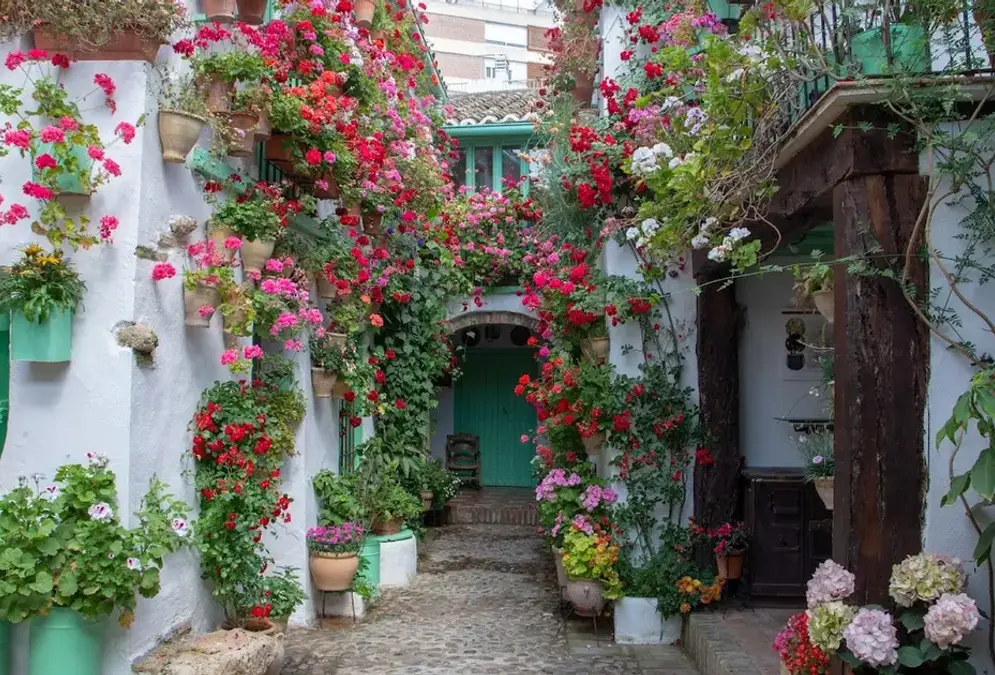
The San Basilio neighborhood patios, the most consistently prize-winning in the competition
The 6 festival itineraries
The official organization offers 6 themed itineraries corresponding to the historic neighborhoods. Each itinerary groups together 6 to 11 patios located close to one another.
11 patios
1 Alcázar Viejo / San Basilio
The most award-winning patios, white walls and cascades of flowers
Difficulty: Moderate
Crowds: Very busy
Best time: Evening 7–9pm (golden hour light)
- ·Most award-winning patios in the competition
- ·Cascading geraniums across three storeys
- ·Brilliant whitewashed walls freshly limed each spring
- ·Easy to combine with the Alcázar next door
Where to eat nearby
- Taberna San Basilio : On the street that names the neighbourhood. Fresh salmorejo and slow-braised carne en salsa. Go at lunch after your morning route: it fills up during the festival.
2
Difficulty: Easy
Crowds: Very busy
Best time: Morning 11am–1pm
- ·Intimate atmosphere in medieval alleyways
- ·Architectural patios with Moorish horseshoe arches
- ·Less spacious but wonderfully authentic
- ·Easy to combine with a visit to the Mezquita
Where to eat nearby
- Casa Pepe de la Judería : Michelin-listed since 1928 on Calle Romero. A flower-filled patio of its own. Lunch is less crowded than dinner: order the rabo de toro and stay off the tourist-menu side of the card.
- Taberna El Número 10 : Steps from the Mezquita. Montilla-Moriles specialist. The berenjenas con miel with a glass of fino is the correct first stop before hitting the patio queue.
3
Difficulty: Easy
Crowds: Moderate
Best time: Morning 11am–1pm (perfect light)
- ·A working-class neighborhood well off the tourist trail
- ·Local atmosphere, chat with the owners
- ·Shorter queues than San Basilio
- ·Authentic tapas bars all around
Where to eat nearby
- La Cuchara de San Lorenzo : Michelin Bib Gourmand, ten minutes' walk toward San Lorenzo. Brothers Narciso and Paco López do the city's best platos de cuchara. Book ahead: thirty covers fill fast.
- Taberna Los Berengueles : An 18th-century palace with trees growing in the inner patio. Worth the short walk toward Centro for the oxtail croquettes and a glass of barrel-poured Montilla-Moriles.
9 patios
4 Santiago - San Pedro
Popular tradition
Difficulty: Moderate
Crowds: Moderate
Best time: Afternoon 5–7pm
- ·Popular tradition, true neighborhood patios
- ·Handmade artisan decorations
- ·Warm welcome from the locals
- ·Popular jury prize often awarded here
Where to eat nearby
- Taberna Salinas : A fifteen-minute walk toward Centro on Calle Tundidores. Open since 1879 and still pulling wine straight from the barrel. Order the tortilla and ask for whatever stew is on the board.
8 patios
5 San Lorenzo
Neighbourhood atmosphere
6 patios
6 Regina - Realejo
Historic patios
8 must-visit patios
A selection of specific patios that are regularly prize-winners and popular with visitors. Addresses are approximate; always check the official festival map (available free of charge) since some patios change each year.
1
Patio San Basilio n°14
Calle San Basilio, 14
San Basilio 1st prize, Historic Architecture (2024)
A spectacular triple-storey patio with a central baroque fountain. Around 300 pots of scarlet geraniums cascade down three floors. The most photographed patio at the festival.
2
Patio Martín de Roa n°7
Calle Martín de Roa, 7
San Basilio Repeat winner since 2018
An authentic corrales (shared neighborhood) patio with an exterior staircase. Lively atmosphere: eight resident families live here. Decorations all handmade by the owners.
3
Patio Judíos n°23
Calle Judíos, 23
Judería Special jury prize 2025
Preserved Mudéjar architecture with horseshoe arches. A century-old jasmine perfumes the entire alley. Intimate at just 40m², calm and unhurried.
5 more worth the detour
Patio Encarnación n°8
Calle Encarnación, 8 · Santa Marina
A 15th-century Mudéjar well at the center. Rare combination of purple and white bougainvillea. A neighborhood off the tourist trail, exceptionally warm welcome.
Patio Postrera n°28
Calle Postrera, 28 · Santiago
A family patio passed down through four generations. Original 19th-century cobblestone floor (empedrado). The passionate owner loves explaining her work.
Patio Trueque n°5
Calle Trueque, 5 · San Basilio
Double-arched gallery across two storeys. 17th-century pink marble fountain. Original Sevillian azulejos tiles. Beautifully photogenic symmetry.
Patio San Basilio n°50
Calle San Basilio, 50 · San Basilio
The largest communal patio (120m²), shared by 12 families. Laundry drying, children playing: real life as it's lived. Very different from the aristocratic patios.
Patio Rey Heredia n°16
Calle Rey Heredia, 16 · Judería
Creative blend of Mediterranean and exotic plants by a botanist owner who loves to experiment. Unique color palette of orange, yellow and violet.
Locate the 8 patios
Interactive map — loads as you scroll (requires JavaScript)
Click any marker to see the patio name. Numbers match the recommended order above.
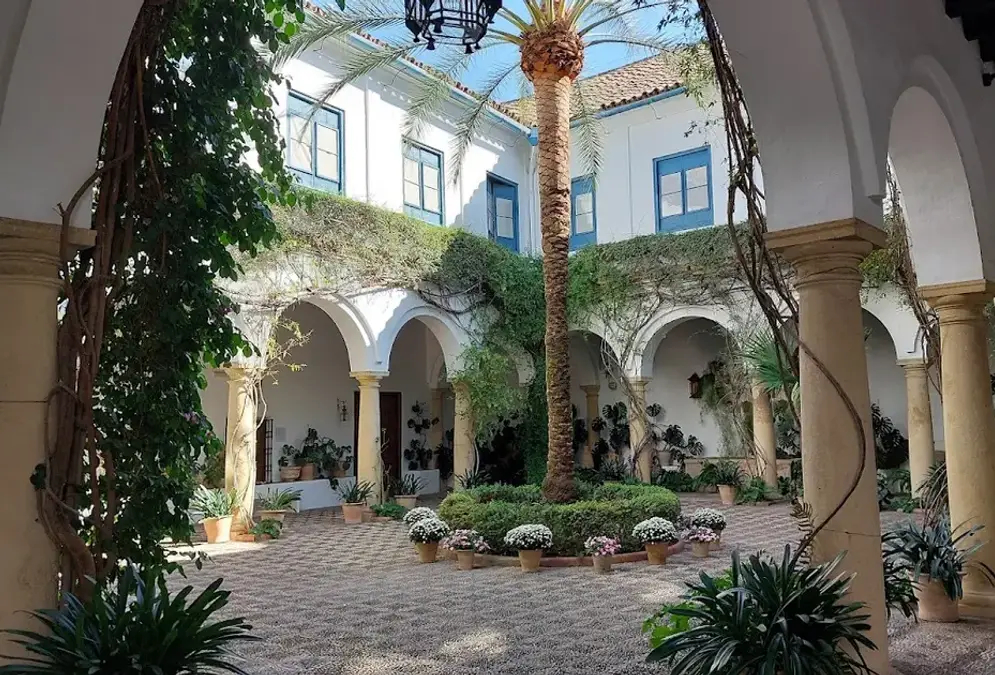
The Viana Palace: 12 courtyards tracing 500 years of patio architecture
Flowers and plants: a botanical guide
The planting palette of Córdoba's patios follows a centuries-old tradition. Five species dominate, chosen for their heat resistance, their abundant flowering in May, and their cultural symbolism.
| Plant | Flowering |
|---|---|
| Geranium (geranio) Bright red, pink, white | April–October |
| Jasmine (jazmín) Cream white | May–September |
| Bougainvillea (buganvilla) Violet, fuchsia, orange | March–November |
| Rose (rosal) All colors | May–June (peak) |
| Carnation (clavel) Red, pink, white | May–September |
All five species thrive in Córdoba's heat and flower abundantly through May. Daily watering and weekly liquid fertilizer are the norm.
The invisible work of the owners
Maintaining a prize-winning patio requires daily work all year round. Owners spend two to four hours a day watering, pruning, cleaning, and reliming the walls. In May, the effort intensifies:
- · Completely re-lime the walls (two or three coats, taking about three days)
- · Replace faded flowers, maximize floral density
- · Clean fountains, cobblestone floors, and ironwork by hand
- · Install artisan decorations (pottery, oil lamps, antique tools)
Average annual cost: €1,500–3,000 on plants, compost, lime, and water. This is a passion, not a business: entry is free and owners earn nothing from it.
Some patios keep a small collection box near the exit (a hucha) for visitors who want to contribute to maintenance costs. It is never expected and never obligatory. When one is present, a coin or a small note is the right gesture: enough to acknowledge the work, not enough to feel like a ticket price. Do not hand money directly to the owner; that changes the nature of the exchange and most will politely decline.
Why so many geraniums?
The geranium (Pelargonium) is not native to Spain (it comes from South Africa) but it took root in Córdoba's patios during the 19th century for three very practical reasons: 1) Exceptional resistance to heat and drought, 2) Continuous flowering from April to October without interruption, and 3) A vivid red that contrasts perfectly with white walls. An average Córdoba patio has around 200 geranium pots: that's 2,000 to 3,000 flowers blooming at once.
Photography tips
Photographing Córdoba's patios means mastering extreme contrast between dazzling white walls and deep shadow. These tips work whether you're shooting with a phone or a dedicated camera.
Timing and light
- Golden hour (7–9pm): The best light: warm tones on white walls, long shadows that add depth
- Morning (11am–1pm): Direct light, vivid colors. Watch for harsh shadows at midday
- After 9pm: Romantic artificial lighting; some patios have artistic LED installations
- Exposure tip: Tap on the white walls to set exposure, then brighten slightly. This prevents blown-out highlights
Composition ideas
- Frame through arches: Use doorways and horseshoe arches as natural frames
- Low angle: Shoot upward toward flowering galleries for a cascade effect
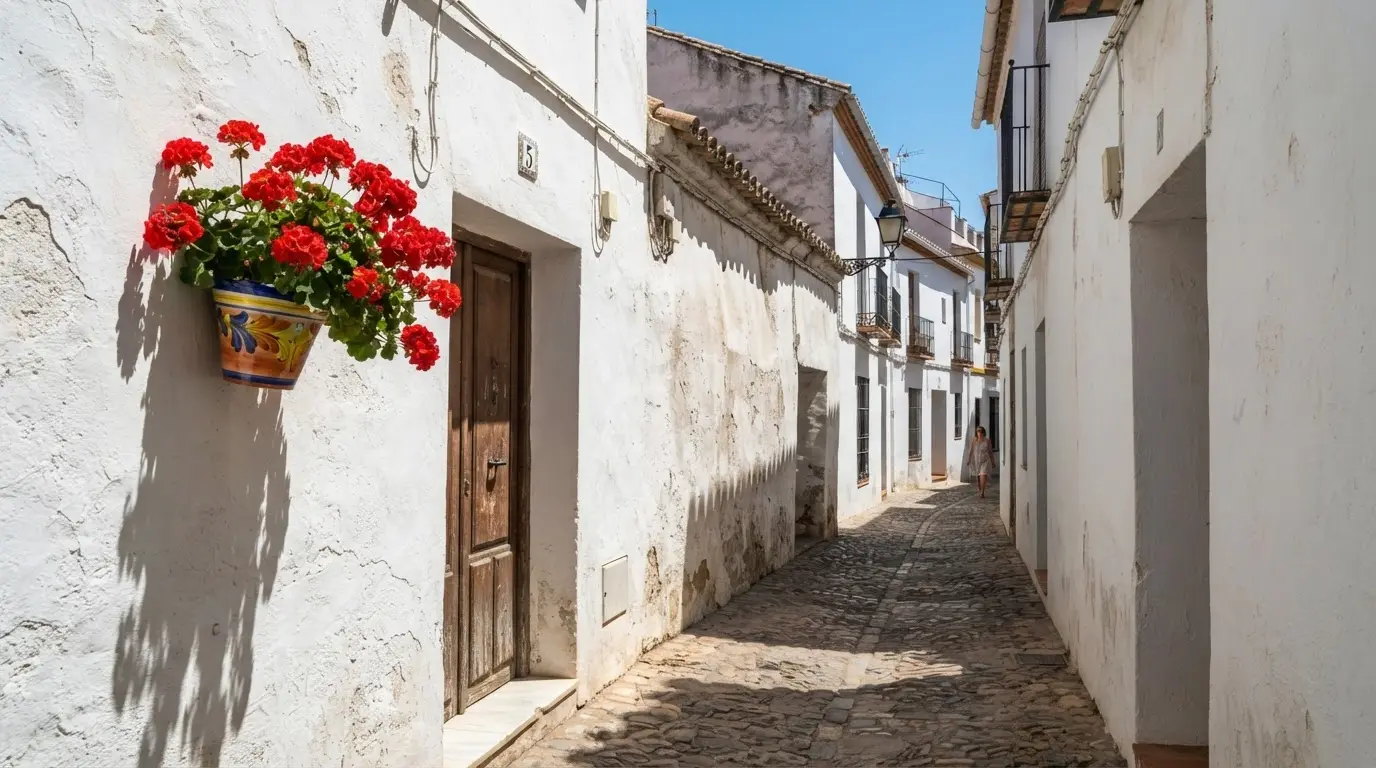
- Details: Zoom in on the red-against-white contrast, like a single geranium pot on a lime wall
- Reflections: The fountain as a mirror with inverted flowers
- Human element: The owner watering adds life, scale, and authenticity
Courtesy rules
Ask permission before photographing people. Do not touch the flowers or decorations. Avoid flash (it disturbs the plants and annoys the owners). No tripods: they block the flow of visitors.
For detailed camera settings, post-processing tips, and more photo locations beyond the festival, see our complete Córdoba photography guide.
Patios in video
Watch the festival through the eyes of official tourism bodies and cultural heritage organisations.
Patios cordobeses
Los Patios de Córdoba: Un Paraíso Oculto
Patios de Córdoba
Recorriendo Los Patios de Córdoba
Los Patios de Córdoba: Patrimonio de la Humanidad
Festival de los Patios de Córdoba: Ayuntamiento de Córdoba (UNESCO, 2012)
What's on in 2027: flamenco and live tools
The 2027 edition is expected around 5–18 May (dates TBC). A few practical details worth knowing before you go.
Flamenco at the patios
Several patios host flamenco shows during the festival fortnight. In 2027, venues are expected to include: Las Campanas, Los Naranjos, Orive, Rey Heredia, Alcázar Viejo, Corredera and La Calahorra (programme TBC). Performance times change each year.
Check the full programme at patios.cordoba.es, updated throughout the festival.
Apps for navigating the patios
The free Mayo Cordobés app (iOS and Android) covers the full festival: patios, crosses, grilles and balconies, and feria. It includes GPS maps, opening hours, and all 6 official routes with offline access, so it works in the deep lanes of the Judería where cellular signal goes patchy.
The Aumentur app is a second option worth having: offline interactive maps of all 64 patios across the 5 competition zones. Useful as a backup when even the Mayo Cordobés app struggles with signal.
The official map at patios.cordoba.es also has accessibility filtering by wheelchair icon color.
Final day
Patios close at 20:30 instead of the usual 22:00 on the final Sunday. Plan your last evening route to finish by 20:00.
“The patios are not a performance put on for tourists; they are the city's living rooms, thrown open for a fortnight each May.”
Practical tips
Optimal visiting hours
11am–2pm (morning):
Direct light, vivid colors, manageable heat. Ideal for photography. Average queues.
2–6pm (break):
Most patios close. Rest, eat, visit a monument in the cool interior.
6–10pm (evening):
Golden hour light (6–8pm), then romantic artificial lighting. Cooler temperatures. Long queues 7–9pm, short after 9pm. Note: on the final Sunday patios close at 20:30.
Avoiding the crowds
- Weekday vs. weekend: 30–50% fewer visitors Monday–Thursday
- Opening and closing times: 11am–noon and 9–10pm (shortest queues)
- Secondary neighborhoods: Santa Marina, San Lorenzo before San Basilio
- Guided tour: Reserved time slots (no queue, €16)
Queue times: what to expect
The most prize-winning patios (San Basilio, Judería) have queues of 30–90 minutes at peak times (noon–1pm and 7–9pm), especially at weekends. The visit itself is short: just 2–5 minutes per patio, enough time to walk around and take photos.
Local tip: Start with the less well-known neighborhoods (Santa Marina, San Lorenzo), where you can see 8–10 patios in 90 minutes without waiting. Save the stars (San Basilio) for after 9pm when families have gone home.
Crowd intensity by day and time
| Time slot | Mon–Thu | Friday | Saturday | Sunday |
|---|---|---|---|---|
| 11am–2pm | Moderate | Busy | Very busy | Very busy |
| 2–6pm | Patios closed: monuments and rest | |||
| 6–9pm | Moderate | Very busy | Very busy | Busy |
| 9–10pm | Quiet | Moderate | Moderate | Quiet |
San Basilio and Judería only. Santa Marina and San Lorenzo run 30–50% quieter across all time slots.
What to bring
- · Comfortable shoes (3–5km of walking on cobblestones)
- · Cap and sunscreen (May: 25–30°C)
- · Reusable water bottle
- · Paper map or the free Mayo Cordobés app (iOS/Android), since Wi-Fi is patchy in the old neighborhoods
- · Small backpack (nothing too bulky in the queues)
Etiquette
- Keep your voice low (these are people's homes)
- Don't touch anything (flowers, decorative objects)
- Follow the one-way flow (avoids bottlenecks)
- Thank the owner as you leave
- No picnics or drinks inside the patios
A few words of Spanish go a long way
Most patio owners speak little English, but they appreciate the attempt. These six phrases cover everything you need.
- Buenos dias / Buenas tardes (BWEH-nos DEE-as / BWEH-nas TAR-des) Good morning / Good afternoon. Use whichever fits the hour; it matters to the owner.
- ¿Puedo hacer fotos? (PWEH-do ah-THAIR FOH-tos?) May I take photos? Always ask; most will say yes and may even pose with their plants.
- ¡Qué bonito! (keh bo-NEE-to) How beautiful! Simple and genuine. Watch the owner's face when you say it.
- ¿Cuánto tiempo lleva cuidando el patio? (KWAHN-to TYEM-po YEH-ba kwee-DAN-do el PAH-tyo?) How long have you been looking after this patio? The question that opens a conversation.
- ¿Qué flores son estas? (keh FLOH-res son ES-tas?) What flowers are these? Useful for anything beyond the geraniums; owners love explaining their rarer species.
- Muchas gracias, hasta luego (MOO-chas GRAH-thyas, AS-ta LWEH-go) Thank you very much, goodbye. End with this; owners notice when visitors leave without a word.
Getting around
All six itineraries pass through historic neighborhoods in the compact city center, so everything is done on foot. It takes just 15 minutes to walk between neighborhoods.
Do not drive into the historic centre. Calle San Basilio and the Judería are effectively impassable during festival hours. Park on the periphery (Parking Alcázar, Parking Tendillas, €15–20 for a full day) and use Aucorsa public buses to reach the patio neighborhoods. If you arrive before 11am, some street parking is occasionally available near the Alcázar entrance.
Most patios are ground-level accessible; filter by accessibility on the official festival map.
Accessibility at the festival
- Temporary ramps: Fixed to patio entrances during the festival.
- Interactive map: Filter patios by accessibility level at patios.cordoba.es
- NaviLens codes: Visual wayfinding navigation around the festival routes.
See the accessibility FAQ for detailed mobility guidance.
Estimated budget (3 days, per person)
Accommodation (3 nights)
Book 2–3 months ahead, prices rise 40% vs normal
Guided patio tour (optional)
Priority access, reserved time slots
Food (3 days)
Local tabernas €12–20 per meal
Local transport
Walking is enough; bus if visiting outlying neighborhoods
Monument entry fees
Mezquita-Catedral, Alcázar, Synagogue
TOTAL €386–875
Money-saving tips: The festival itself is 100% free. Stay in a hostel or shared Airbnb (€60/night) to cut the biggest cost. Eat tapas at local tabernas (€12–20/meal). Visit free monuments on Sundays (Alcázar, Synagogue). Budget travelers can experience the full festival for €300–400.
History and UNESCO recognition
In November 2012, UNESCO inscribed the Festival de los Patios de Córdoba on the Intangible Cultural Heritage of Humanity list. The recognition is not for the patios themselves (the buildings), but for the living tradition: the horticultural expertise, the family transmission, the communal and festive dimension.
That tradition is 2,000 years old. For the full story of how Roman atria became Moorish courtyard houses and survived the Reconquista intact (including the bioclimatic science behind why a patio stays 10–15°C cooler than the street), see why Córdoba's patios exist and endure. For the specific question visitors most often ask — why patios open for only about two weeks each May (the "twelve days" of UNESCO's 2012 description) — see why Córdoba's patios open for only 12 days a year.
Origins of the competition (1921)
The first patio competition was organized in May 1921 by the Córdoba City Council as part of a cultural tourism promotion campaign. The idea: to let visitors discover the interior of Córdoba's houses, normally invisible from the street.
At the time, only 12 patios took part. The success was immediate. Owners, initially reluctant to open their homes, soon caught the competitive spirit and began outdoing one another with floral creativity. By the 1930s, the competition had 40 entries. It was interrupted by the Civil War (1936–1939) and resumed in 1944.
Today, the competition attracts 52 competing patios (2027, TBC), plus 12 non-competing institutional courtyards each year. Winners receive a certificate, a commemorative plaque, and a symbolic cash prize (€500–2,000 depending on category).
UNESCO safeguarding criteria
UNESCO recognized the festival for five heritage values:
- Horticultural expertise: Container growing techniques, water management, plant combinations
- Family transmission: Owners teach their children, passing knowledge across three or four generations
- Social cohesion: Mutual help between neighbors, collective neighborhood pride
- Openness to the public: Free entry, intercultural dialogue, Andalusian hospitality
- Environmental respect: Zero pesticides, home composting, rainwater collection
The UNESCO listing imposes safeguarding obligations: free entry must be maintained, commercial exploitation is forbidden, the family character must be preserved, and younger generations must be encouraged to participate.
The impact of recognition
Since 2012, visitor numbers have surged: +150% in foreign visitors. The festival now draws some 250,000–300,000 people over the 14 days (versus 100,000 in 2011). The city is trialing solutions: online booking for popular patios, off-season openings to spread demand, and financial support for owners (€500/year for maintenance).
Where to stay during the festival
Book 2–3 months in advance
Prices rise 30–50% during the Patio Festival. Historic center hotels fill up from March onwards. See our spring travel guide for broader planning.
Option 1: Historic center (Judería)
Ideal for being at the heart of the patio neighborhoods. You can head back to your hotel to rest between morning and evening sessions. Just 5–10 minutes' walk from all the itineraries.
Hotels with their own patio:
- • Hacienda Posada de Vallina, award-winning patio, €140–220/night
- • Hospes Palacio del Bailío, 3 noble patios, luxury, €200–350/night
- • Las Casas de la Judería, labyrinthine patios, charming, €120–200/night
- • Balcón de Córdoba, panoramic terrace overlooking the Mezquita, €150–280/night
- • Hotel Mezquita, facing the Mezquita-Catedral, unbeatable value, €47–72/night
Option 2: Modern neighborhood (North Center)
More affordable, well connected. A 15–20 minute walk from the festival. Comfortable chain hotels.
Good value options:
- • NH Collection Amistad Córdoba, Plaza Maimónides, rooftop pool, €90–150/night
- • Eurostars Palace, €80–140/night
- • AC Hotel Córdoba, €85–145/night
Option 3: Apartment with a patio
Airbnb offers apartments in traditional patio houses. An immersive experience: you sleep in exactly the type of home you spend the day visiting.
Approximate budget: €100–200/night for a 2–4 person apartment with a private patio
Find Hotels for the Patio Festival
We earn a small commission if you book a hotel through this search — at no extra cost to you.
Festival de los Patios runs 5–18 May. Historic centre and Judería rooms fill 2–3 months ahead — prices rise 30–50% during the festival.
The full story: the patios
A Córdoba patio is really a Roman atrium wearing horseshoe arches, and the cooling trick the two share goes back two thousand years; one companion article works out exactly how it still functions once the August heat sets in. Another article takes on the question every visitor ends up asking on the spot, in almost the same words each time: why doesn't the festival just stay open longer? Palacio de Viana's noble courtyards, open long after the flowers and the crowds are gone, show what the same tradition looks like the rest of the year.
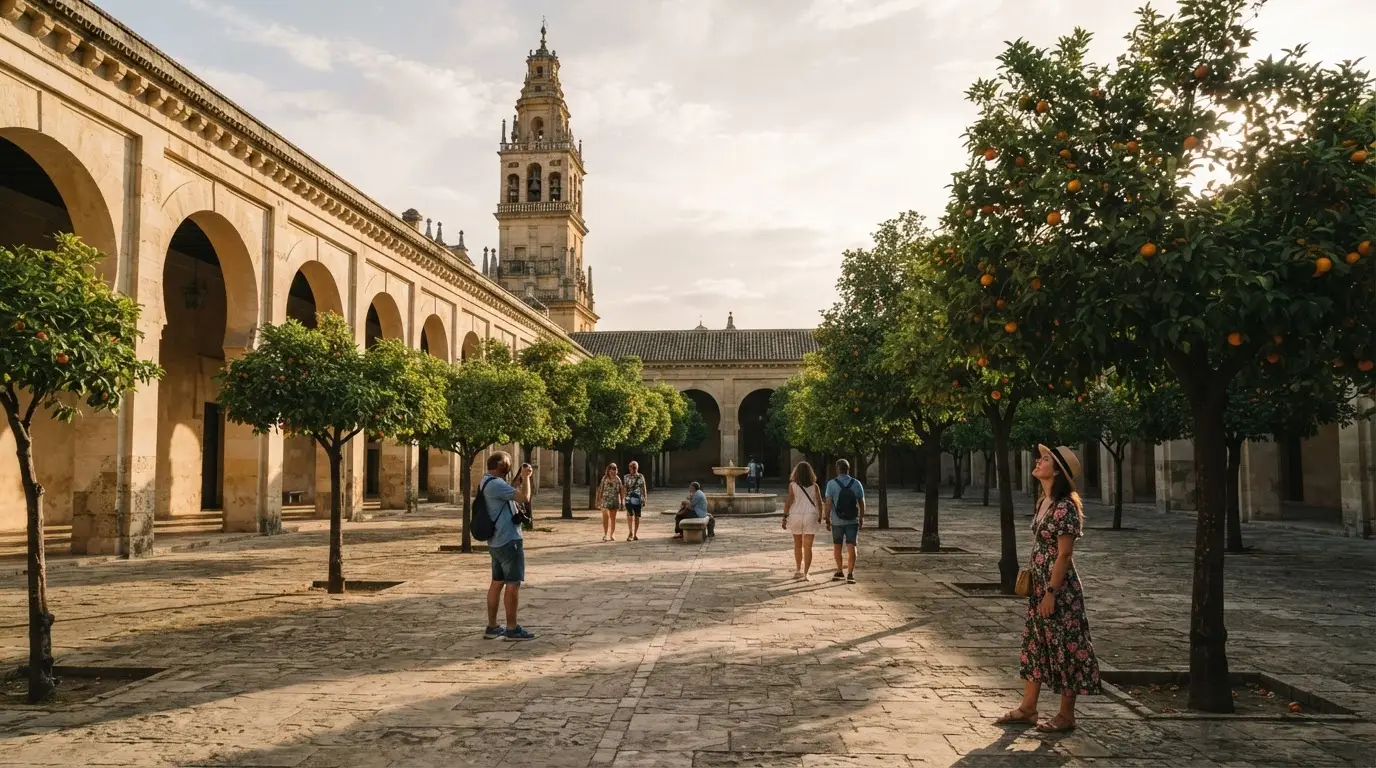
The Mezquita Handed Its Orange Courtyard to Flower Artists
Córdoba Extreme Heat: How Europe's Hottest City Survives
Palacio de Viana's Twelve Patios: A 500-Year Story
Why Córdoba's Patios Open for Only 12 Days a Year
Spain and Europe's Hottest City: Why Córdoba Is So Hot
Córdoba's Patios: Why They Exist and Endure
Frequently asked questions
Do I need to book tickets in advance for the Patios Festival 2027?
No. Entry to all 64 patios is completely free, and no appointment or booking is required. Simply arrive during opening hours (11am–2pm or 6pm–10pm) and visit at your own pace. That said, if you want to skip queues at the most popular patios, paid guided tours (€16 per person, 2 hours) with reserved time slots are available, worth considering for peak weekend dates.
What are the opening hours for the 2027 Patios Festival?
Patios open daily from 11:00am–2:00pm and 6:00pm–10:00pm. The 2027 dates are expected around 5–18 May (TBC: check patios.cordoba.es for official confirmation). Some patios outside the main competition keep different hours. Check the interactive map at patios.cordoba.es for individual patio schedules. Note that on the final day patios typically close at 20:30 instead of the usual 22:00.
How many patios participate in the 2027 Festival de los Patios?
64 private patios open to the public: 52 competing for municipal prizes across three architecture categories (Antigua, Moderna, Singular) and 12 non-competition patios from religious institutions and associations.
Are there guided tours available for the 2027 edition?
Yes. Official 2-hour guided tours with reserved time slots cost €16 per person. Tours bypass the long queues at the most popular patios and are especially useful for peak festival dates. Book through official tourism channels or at our guided tours page during the festival period.
What's the best app to use for navigating the patios?
The Mayo Cordobés app (free, iOS and Android) covers the whole festival: patios, crosses, grilles and balconies, and feria, with GPS maps, opening hours, and all 6 official routes working offline. The Aumentur app is worth downloading as a backup: offline interactive maps of all 64 patios across 5 routes, useful when cellular signal disappears in the medieval lanes. Both are free.
Is there parking near the patios?
Parking in the historic centre is nearly impossible during the festival. Calle San Basilio and the Judería are effectively inaccessible by car during peak hours. Use guarded parking on the city periphery, then take Aucorsa public buses to reach the patio neighborhoods. If you arrive before 11am, some street parking is sometimes available near the Alcázar entrance.
Can I combine the Patio Festival with other Córdoba events in May?
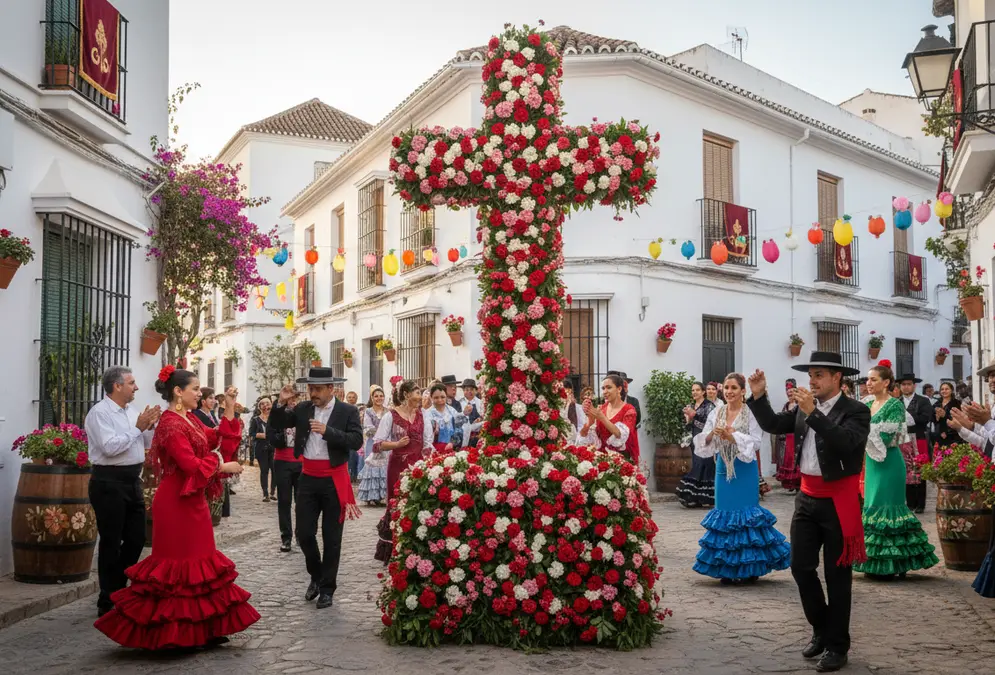
Yes, and the timing works well. The Cruces de Mayo (Crosses of May) run in late April and early May: flower-decorated crosses fill the squares across the city, free to see. The Batalla de las Flores procession usually falls in late April too. Arriving the first weekend of May means you catch the tail of both celebrations while the patios are just getting started. That first Saturday morning, Santa Marina is quiet and the city feels genuinely festive.
How many days should I spend at the Patio Festival?
Two to three days is ideal. With 60+ patios spread across six neighborhoods, you need at least two days to see the highlights without rushing. Three days lets you visit at a relaxed pace and combine the patios with monuments like the Mezquita-Catedral and Viana Palace.
How long are the queues at the patios?
The most popular patios in San Basilio and the Judería can have queues of 30–90 minutes at peak times (noon–1pm and 7–9pm, especially weekends). Visits are short: 2–5 minutes per patio. Start with less-visited neighborhoods like Santa Marina where you can see 8–10 patios in 90 minutes with minimal waiting.
Can I visit Córdoba's patios outside the festival?
Yes, but options are limited. Viana Palace (12 noble patios) is open year-round. A handful of private patios also open occasionally outside May; check with the Córdoba Tourism Office for off-season openings. Our Patios & Courtyards Trail is a self-guided walk you can do any time of year.
Which neighborhood should I visit first?
Start with Santa Marina – San Agustín on your first morning: fewer crowds, shorter queues, and a genuinely local atmosphere. Save San Basilio (the most prize-winning area) for the evening when the golden light on white walls is spectacular and queues thin out after 9pm.
Do I need to book accommodation in advance?
Yes, book 2–3 months ahead. Hotel prices rise 30–50% during the festival and historic center hotels fill up from March. Look for hotels with their own patio for the full experience, or consider staying in a modern neighborhood 15–20 minutes' walk away for better rates.
What should I bring to the Patio Festival?
Comfortable walking shoes (3–5km of cobblestones daily), a hat and sunscreen (May temperatures reach 25–30°C), a reusable water bottle, and a paper map of the routes (Wi-Fi is patchy in the old neighborhoods). Keep your bag small; bulky backpacks are awkward in the queues and narrow patios.
What should I wear to the Patio Festival?
Comfortable clothes for a full day on cobblestones in 25–30°C heat. Light-soled shoes matter more than anything else; sandals with thin soles get painful after 3km of uneven stone. Because the patios are people's homes, neat casual is appropriate: avoid beachwear or swimwear. Evenings cool down noticeably after 9pm, so a light layer is worth carrying if you plan to stay out late. For tips on dressing for Córdoba in May more broadly, see our spring travel guide.
When should I visit during the 14-day Córdoba Patio Festival if I have limited time?
The festival runs for 14 days in May; check the current year's programme at patios.cordoba.es. Whenever you visit, timing within the fortnight matters. The first week is the sweet spot: patios are freshest, owners still have energy for conversation, and you catch the tail of other May celebrations. Midweek (Tuesday–Thursday) beats weekends: locals and serious patio enthusiasts visit weekdays, the queues are shorter, and you get better patio owner conversations. Avoid peak lunch hours (noon–2pm) when heat is worst and queues peak. The evening window (6–10pm) is golden for San Basilio and Judería: light on white walls is spectacular, crowds thin dramatically after 9pm, and many patios are lit with strings of bulbs. If you can't stay overnight, pick a Wednesday evening and do 2–3 hours in Santa Marina then San Basilio after 8pm. The spring travel guide has more on managing crowds across all May events.
Is the Patio Festival accessible for visitors with limited mobility?
Most competition patios are ground-floor accessible, but the neighborhood streets are another story: cobblestones are uneven in places and can be tough on wheels. Temporary ramps are fixed to entrances during the festival (no need to carry them), and the official map at patios.cordoba.es has accessibility filtering: blue wheelchair icon means fully accessible, orange means partial. There's also NaviLens visual codes around town if you're using a phone reader. If you want to skip the crowds entirely, a guided tour with reserved time slots removes the need to stand in line. Start in Santa Marina if you want the flattest access: several patios there have level entrances from the street.
Patios & Courtyards Trail
Explore Cordoba's most beautiful patios on a self-guided walking route through San Basilio, the Juderia, and beyond. Perfect year-round, not just during the festival.
View the routeReady to discover Córdoba's patios?
The festival runs approximately 5–18 May 2027 (dates TBC). Hotel prices rise 30–50% during those 14 days. Book early to get the best rates in the historic centre. Missing this fixed window entirely is a recurring first-timer misstep — see our guide to avoidable Córdoba trip-planning mistakes.
Further reading
Official sources
4 references Show Hide
- UNESCO Intangible Heritage: Festival de los Patios de Córdoba (opens in a new tab)
Official UNESCO inscription on the Intangible Cultural Heritage of Humanity list
- Patios de Córdoba: Official Festival Website (opens in a new tab)
Official website of the Córdoba Patio Festival with interactive map, routes, and accessibility info
- Córdoba Tourism Office (opens in a new tab)
Official tourist information on events and the festival
- UNESCO World Heritage: Historic Centre of Córdoba (opens in a new tab)
Heritage context of the historic center where the festival takes place

Book tours & activities in Córdoba
Tours are selected for quality, not commission. We earn a small fee if you book — at no extra cost to you.
Guided tours, skip-the-line tickets, and bookable experiences: browse everything available in Córdoba.
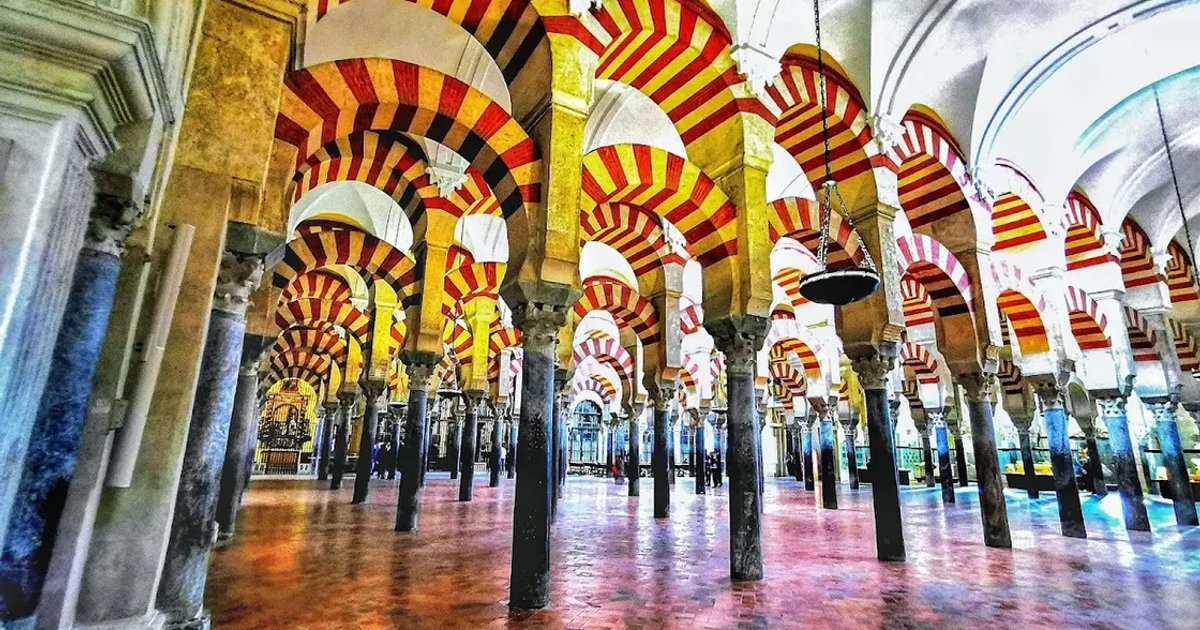 1.5 hours
 Mosque-Cathedral Skip-the-Line Guided Tour
4.7 From €29
Reserve
 1.5 hours
 Mosque-Cathedral Skip-the-Line Guided Tour
4.6 From €28
Reserve
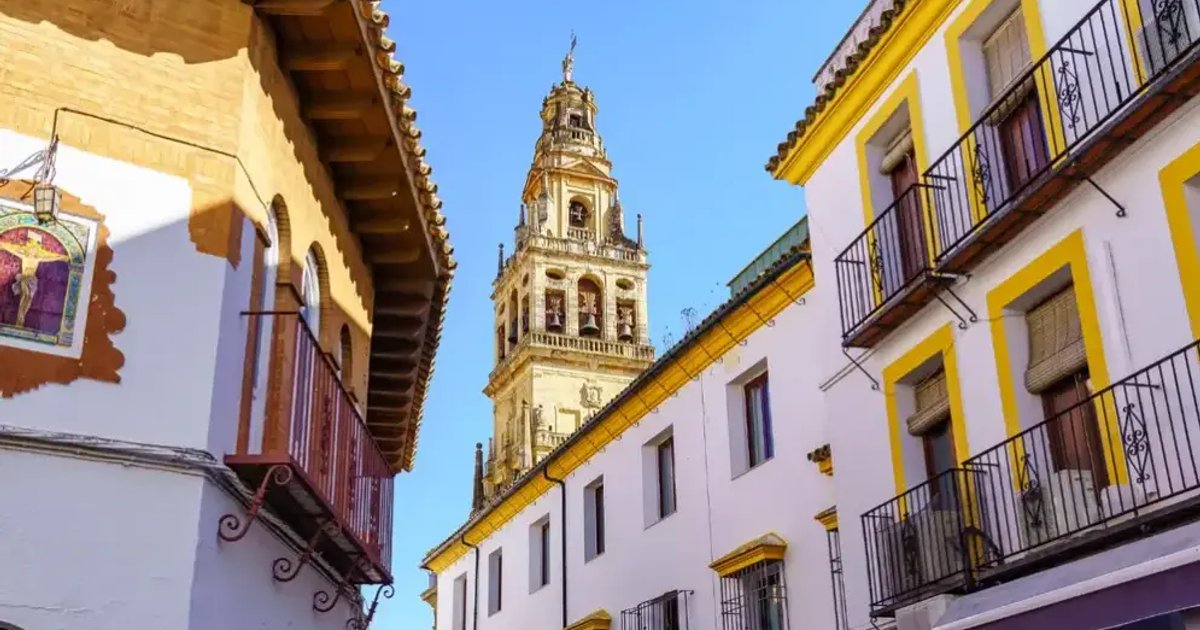 3 hours
 Jewish Quarter, Mosque & Alcázar Tour
4.6 From €49
Reserve
Self-guided Mosque-Cathedral E-Ticket with Audio Guide
4.2 From €18.50
Reserve
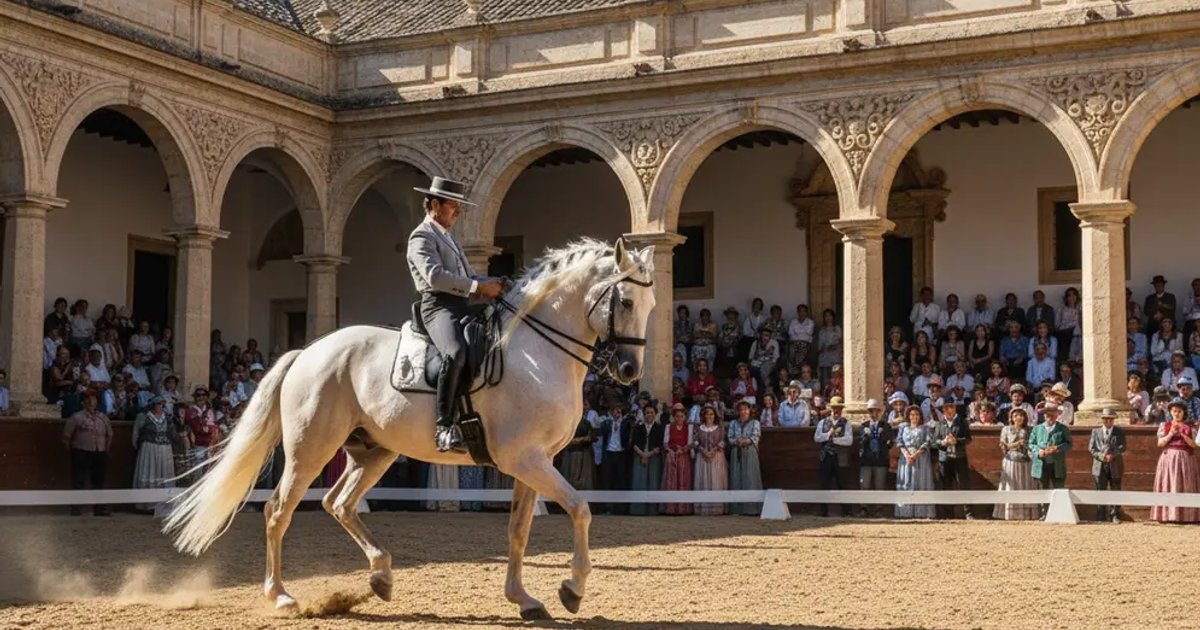 70 minutes
 Caballerizas Reales Equestrian Show
4.5 From €18.50
Reserve
2 hours Mosque & Jewish Quarter Tour with Tickets
4.6 From €35.55
Reserve
3 hours Mosque-Cathedral, Jewish Quarter & Alcázar Tour
4.6 From €49.99
Reserve
 1.5 hours
 Alcazar Guided Tour and Skip-the-Line
4.2 From €19
Reserve