
Search the site

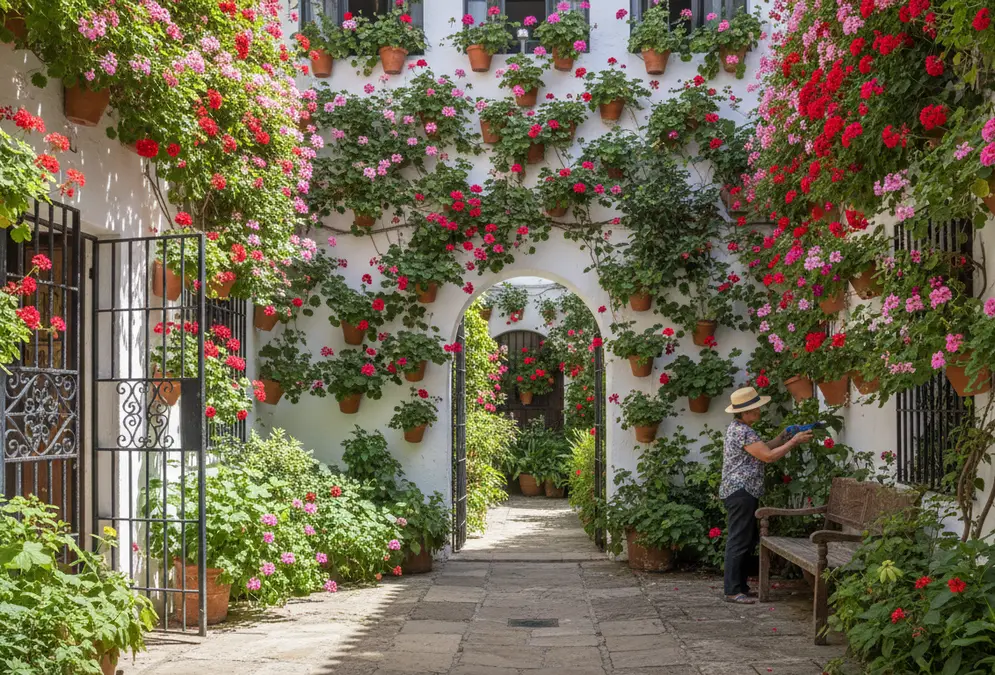
Flower-filled courtyard on Calle San Basilio, Córdoba, with whitewashed walls covered in red and pink geraniums
Culture Easy Free

Patios & Courtyards Trail

San Basilio, Judería, Palacio de Viana — three patio districts on one easy 2.5km circular loop. Free self-guided walk, best in May but good all year round.

Download PDF guide

At a Glance

Distance
2.5 km
Duration
2 to 2.5 hours
Stops
9 stops
Route type
Circular
Best time
April and May for peak bloom; May for the UNESCO Patio Festival (50+ patios open). October and November offer quieter visits with autumn light. Avoid midday in July and August.
Accessibility
Flat route throughout, all on paved streets within the historic centre. The Alcázar and Palacio de Viana have some steps inside but the courtyards themselves are accessible. Cobblestones in parts of the Judería and San Basilio.

Route Map

Loading map…

Click on any marker to see stop details. Numbered markers follow the suggested route order.

Stop-by-Stop Route

  1. 1
    Alcázar Gardens
    Monument 30–45 min

    Start where formal courtyard design meets medieval history. The Alcázar's terraced gardens — geometric pools, water channels, sculpted cypresses — show the Moorish-influenced tradition of using plants to cool enclosed spaces. The same logic underlies every patio you'll see on this walk.

    Tip: Free entry on Tuesdays. Arrive after 4pm to avoid the morning rush — the low afternoon light on the pools is better for photos anyway.

  2. 2
    San Basilio neighbourhood
    Neighborhood 10 min

    From the Alcázar, cross into San Basilio — the quietest part of the old city and the neighbourhood where the patio tradition runs deepest. The streets narrow, the whitewash intensifies, and you start to notice doorways left deliberately ajar.

    Tip: Walk slowly. Several residents keep their courtyard doors open during the day as a standing invitation. A small coin donation is the custom.

  3. 3
    Patios de San Basilio
    Monument 30–45 min

    The most concentrated patch of patio culture in the city. Calle San Basilio holds several of the competition's strongest entries — walls covered floor-to-ceiling in geraniums, jasmine, bougainvillea, arranged by families who have been tending these same pots for generations. This is the UNESCO tradition at its least curated.

    Tip: Outside the May festival, most patios keep rough hours: 10am–2pm and 5pm–8pm. Some open by donation only. A few are closed Mondays. Worth confirming the day before if you're making a special trip.

  4. 4

    Calle Trueque courtyards

    Landmark 15 min

    A short detour off Calle San Basilio along Calle Trueque turns up smaller, less-visited patios that rarely appear in guidebooks. The owners here are often more willing to stop and talk — planting schedules, watering techniques, why certain colours cluster together.

    Tip: These patios don't always appear on official maps. Look for doors left open — that's the invitation.

  5. 5
    Calleja de las Flores
    Monument 10–15 min

    Head north through the Judería to the city's most photographed alley. The Calleja de las Flores is a dead-end lane where red and pink geraniums frame a view of the Mezquita-Catedral's bell tower at the far end — a composition that works in every season. It's the patio tradition turned outward, decorating a public street rather than a private courtyard.

    Tip: Come before 9am or after 6pm. The alley is open 24 hours and the morning light on the whitewash is better than anything you'll get at midday. In May, arrive at dawn — it's the only time you'll have it to yourself.

  6. 6
    Judería patio doorways
    Neighborhood 15 min

    Walking north through the Judería toward Plaza de las Bulas, pause at the private houses with half-open doors. Courtyards here are smaller than San Basilio's — more Roman atrium than Arab garden — but the flowering walls follow the same principle. Several houses here enter the Festival de los Patios competition.

    Tip: The Judería is technically part of the Centro district but has its own patio character. The medieval street plan means courtyards are often deeper than they look from the doorway.

  7. 7
    Santa Marina quarter
    Neighborhood 15 min

    Continue northeast through Santa Marina, a working neighbourhood away from the tourist core. The patio tradition here is lived-in and unpretentious — smaller courtyards, older families, pots that have been on the same wall for fifty years. The [Santa Marina church](/monument/church-santa-marina), built in the 13th century, anchors the main square.

    Tip: This neighbourhood has fewer tourists and more atmosphere than San Basilio in high season. Locals here are used to curious visitors slowing down to look at doorways.

  8. 8
    Palacio de Viana
    Monument 60–90 min

    The walk's main stop, and the most complete expression of the patio tradition under a single roof. The Palacio de Viana has **twelve courtyards** — each added by a different generation of the Viana family between the 14th and 19th centuries. The Patio de la Reja, packed with geraniums in spring. The Patio de los Naranjos, where the temperature drops as you step under the trees. The Patio del Estanque, with its long rectangular pool reflecting the sky. An hour here, minimum.

    Tip: Wednesday afternoons (2–5pm) are free. Arrive at 1:45pm — locals know about the free entry and a small queue forms by 3:30pm. The combined ticket (€12) adds the palace salons, which hold a serious collection of Flemish tapestries and Cordoban embossed leather.

  9. 9
    Festival de los Patios (May only)
    Event Half a day minimum

    If you're here in May, the [Festival de los Patios](/event/festival-patios) changes this walk entirely. Over 50 private courtyards open simultaneously, judged in a competition the city takes seriously. Pots are rearranged into colour patterns. Owners stand in their doorways. The whole city smells of orange blossom. This is Córdoba at its most particular — nothing else like it in Spain.

    Tip: Pick up the official festival map from the tourist office near the Mezquita before you start. The patios are spread across multiple zones — the map groups them by neighbourhood so you don't backtrack.

Córdoba has been filling its private courtyards with flowers since Roman times. The Cordoban patio tradition — added to UNESCO's Intangible Cultural Heritage list in 2012 — isn't a museum piece. Behind unassuming doorways on Calle San Basilio or Calle Trueque, families tend hundreds of terracotta pots on whitewashed walls with the same care their grandparents did. This walk links the three main patio zones: San Basilio, the Judería, and the northern quarter around Palacio de Viana, finishing where it started near the Alcázar.

The route is 2.5 km on flat, paved streets — walkable in 35 minutes between stops, with 2 to 2.5 hours at a relaxed pace. The Patios de San Basilio are the densest cluster: walls covered floor-to-ceiling in geraniums by families who have tended the same pots for generations. The Calleja de las Flores in the Judería turns the tradition outward — red geraniums framing the Mezquita's bell tower at the end of a dead-end lane. The Alcázar adds formal garden geometry (€5, free Tuesdays). Then Palacio de Viana in the Santa Marina quarter: twelve courtyards, each planted differently across five centuries of Andalusian taste (€8 patios only, €12 full palace).

In May, during the Festival de los Patios, more than 50 private courtyards open simultaneously — geraniums stacked four metres high, judges with clipboards, neighbours handing out homemade lemonade. Outside the festival, the experience is quieter: you talk to owners, see the watering cans, ask which pot has been in the family longest. April and May are the months of maximum colour, but the walk is worth doing any time of year. If you're visiting during festival season (4–17 May), the complete Patio Festival guide covers competition routes, optimal timing, and which patios to prioritise.

Patios & Courtyards Trail FAQ

When is the best time to do the Patios & Courtyards Trail?

May is the most spectacular month, when the Festival de los Patios opens over 50 private courtyards simultaneously and every patio is at full bloom. April and early June are also excellent — flowers are near their peak and crowds are lighter. The route works year-round, but avoid midday in summer (July–August) when heat makes the walk uncomfortable.

Is the Patios Trail free?

Most of the walk is free. The Calleja de las Flores, San Basilio neighbourhood, and street-level patios cost nothing. The Alcázar charges €5 (free Tuesdays). The Palacio de Viana charges €8 for patios only or €12 for the full palace (free Wednesday afternoons 2–5pm). The Festival de los Patios in May has free entry to all participating courtyards.

How long does the Patios Trail take?

Allow 2 to 2.5 hours at a relaxed pace for the walk itself. Add 30–45 minutes if you enter the Alcázar's gardens, and 60–90 minutes for the Palacio de Viana. A full day is reasonable if you're here during the May festival, when the density of open patios warrants a slower pace.

What is the Cordoban patio tradition?

The Cordoban patio tradition is the practice of decorating private interior courtyards with flowering plants — primarily geraniums, jasmine, and bougainvillea — arranged in elaborate patterns on whitewashed walls. The tradition combines Roman atrium design with Arab courtyard cooling principles and has been maintained by Córdoba families for centuries. UNESCO recognised it as Intangible Cultural Heritage in 2012.

Can I visit the patios outside the May festival?

Yes. The Patios de San Basilio keep variable year-round hours (roughly 10am–2pm and 5pm–8pm), with some open by small donation. The Palacio de Viana is open Tuesday through Sunday year-round. The Calleja de las Flores is always open. Outside the festival, visits are quieter and more intimate — a better chance to speak with the families who maintain the courtyards.

More Walking Tours