
Jewish Quarter Heritage Walk
Walk Córdoba's medieval Jewish quarter in 1.8km: 14th-century synagogue, Casa de Sefarad, Calleja de las Flores, and Alcázar gardens. Free, two hours.
Horseshoe arches, 10th-century caliphal baths, Moorish gardens, and Mudéjar tile work: a free 2.5km self-guided walk through Córdoba's Islamic heritage.
Six years specialising in heritage towns and cultural route planning across Córdoba province.
Click on any marker to see stop details. Numbered markers follow the suggested route order.
The southern gate of the old medina marks the start. The arch and tower date from the 16th century but stand on Islamic foundations — the original gateway that controlled access between the bridge and the city. Look at the proportions of the street feeding north: that grid is Moorish, not Roman.
Tip: Face north from the gate and you're looking straight up the axis the caliphs used for royal processions into the medina.
The bridge was Roman in origin but rebuilt almost entirely by Moorish engineers in the 10th century. Sixteen arches cross the Guadalquivir; the lower courses are original, the rest reconstructed over the centuries. It was part of the main trade route between Córdoba and North Africa.
Tip: Walk to mid-bridge for the best view of the Mezquita's minaret-turned-bell-tower rising above the old city walls.
Built by the Almohads in the 12th century to defend the southern approach to the bridge, the Calahorra is among the better-preserved examples of Moorish military architecture in Córdoba. The lower masonry is original; the upper floors were rebuilt by Castilian kings. Inside, a small museum covers the three monotheistic cultures that shared the city.
Tip: Entry costs 4.50€. The rooftop terrace gives an unobstructed view back across the bridge toward the Mezquita — one of the best vantage points on the walk.
The current Alcázar was built by Alfonso XI in 1328, but it occupies the site of the original Umayyad palace. The terraced gardens — geometric pools, fountains, and cypress hedges — follow the same hydraulic principles as Moorish palace gardens across al-Andalus. The Roman mosaics inside were discovered under Moorish floor levels.
Tip: The gardens open from 8:30am in summer. Go early — by 10am tour groups fill the main terraces and the pools lose their mirror-calm.
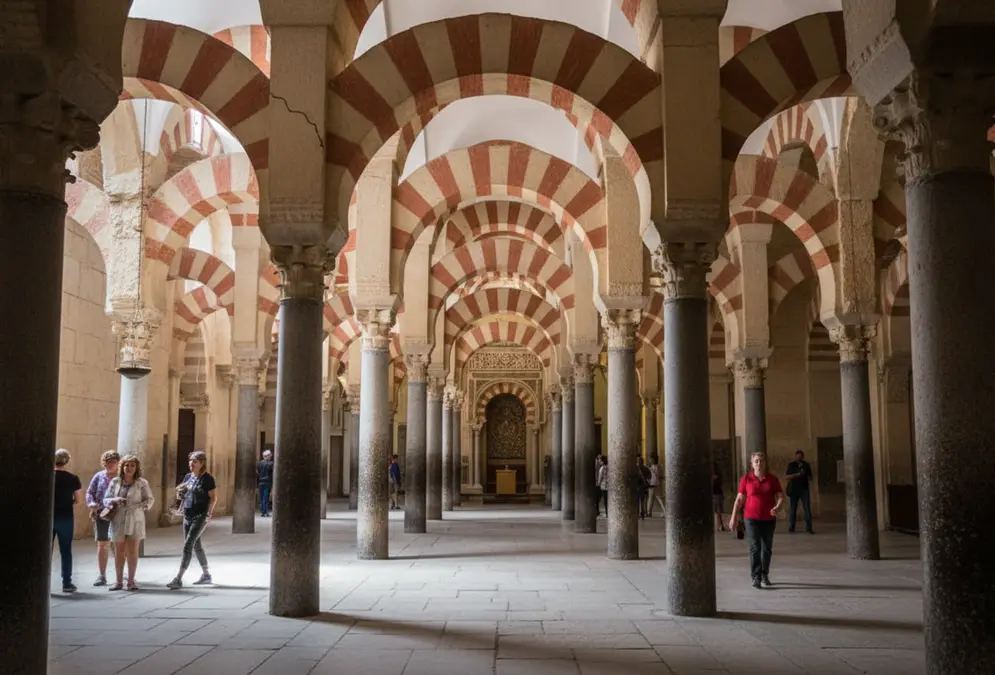
Abd al-Rahman I began construction in 784 on the site of the Visigoth church of Saint Vincent. Four successive caliphal expansions produced the forest of 856 columns in jasper, marble, and onyx, topped by double arches of alternating red brick and white limestone — the defining visual of Córdoban Moorish style. The Catholic cathedral was inserted into the center in 1523, an intrusion Charles V himself later regretted.
Tip: The north door on Calle Cardenal Herrero opens at 10am for paid entry (13€). Free entry for mass at 9:30am weekdays, but you cannot move freely around the building during the service.
Excavated in 1961 beneath a house on Calle Velázquez Bosco, these are the most complete 10th-century hammam remains in Spain. Three chambers — cold, warm, hot — survive largely intact, with the distinctive star-shaped ceiling vents that filtered light and regulated steam. The baths served the caliph's palace quarter during Córdoba's peak population of around 500,000.
Tip: Free entry, Tuesday–Sunday 9am–3pm. The site is small and the lighting is dim — let your eyes adjust before moving through the chambers.
Built in the early 15th century within what had been the Jewish quarter, this small chapel is the finest Mudéjar example in Córdoba. Craftsmen trained in Islamic geometric tradition covered the walls and vaulted ceiling in arabesques, interlocking star patterns, and Kufic-style inscriptions — for a Christian patron, using a visual language that was still entirely Moorish.
Tip: Entry is 2€ and rarely crowded. The ceiling is the main event — stand in the center of the nave and look straight up.
Fifteen minutes north on foot through the San Lorenzo and Santa Marina neighborhoods, the Palacio de Viana has twelve interconnected patios that show how the Islamic courtyard tradition survived the Reconquista intact. Orange trees, jasmine, and a central fountain in each courtyard — the layout, the scent, and the sound of water are straight from 10th-century Córdoba.
Tip: Patios-only entry costs 5€; full palace 10€. Go in April during the Festival of the Patios when the orange blossoms peak and the courtyards smell like something from another century.
No city in western Europe preserves as much Islamic architecture as Córdoba. Between 756 and 1236, caliphs and emirs built on a scale that still floors you: 856 columns of jasper and marble inside the Mezquita, a royal hammam that holds heat in the stone a thousand years later, defensive towers that outlasted every army sent against them. This walk covers 2.5km through the Judería, Centro, and Santa Marina neighborhoods, linking the core Moorish monuments in the order that makes geographical and historical sense. It starts at the Puerta del Puente, passes the Roman Bridge and Calahorra Tower, then moves through the Alcázar gardens — terraced pools and fountains following the same hydraulic logic Umayyad engineers used across al-Andalus.
The heart of the walk is the Mezquita-Catedral, where Abd al-Rahman I laid the first stone in 784. Four successive expansions produced the forest of double arches — alternating red-brick and white-stone voussoirs in horseshoe form — that no photograph quite prepares you for. Five minutes northwest, the Caliphal Baths on Calle Velázquez Bosco survived because they were buried; the star-shaped ceiling vents still filter light the way they did when Córdoba was the largest city in Europe. Nearby, Capilla de San Bartolomé shows what happened when the two traditions fused: Mudéjar craftsmen hired by Castilian patrons after the Reconquista covered every surface in geometric arabesques indistinguishable in technique from what the caliphs had built two centuries earlier.
The walk ends at Palacio de Viana in Santa Marina, fifteen minutes north on foot. Twelve interconnected patios show how the Islamic courtyard tradition — shade, water, scent, enclosure — survived the change of rulers and shaped Córdoban domestic architecture for five more centuries. Go in April when the orange trees are in blossom and the smell hits you the moment the porter opens the gate.
Walk Córdoba's medieval Jewish quarter in 1.8km: 14th-century synagogue, Casa de Sefarad, Calleja de las Flores, and Alcázar gardens. Free, two hours.
San Basilio, Judería, Palacio de Viana — three patio districts on one easy 2.5km circular loop. Free self-guided walk, best in May but good all year round.
Roman Bridge to Alcázar gardens along the Guadalquivir: a free 3km walk past medieval water mills, Torre de la Calahorra, and white storks on the south bank.