Cruces de Mayo
Five days of flowers, sevillanas and free entry
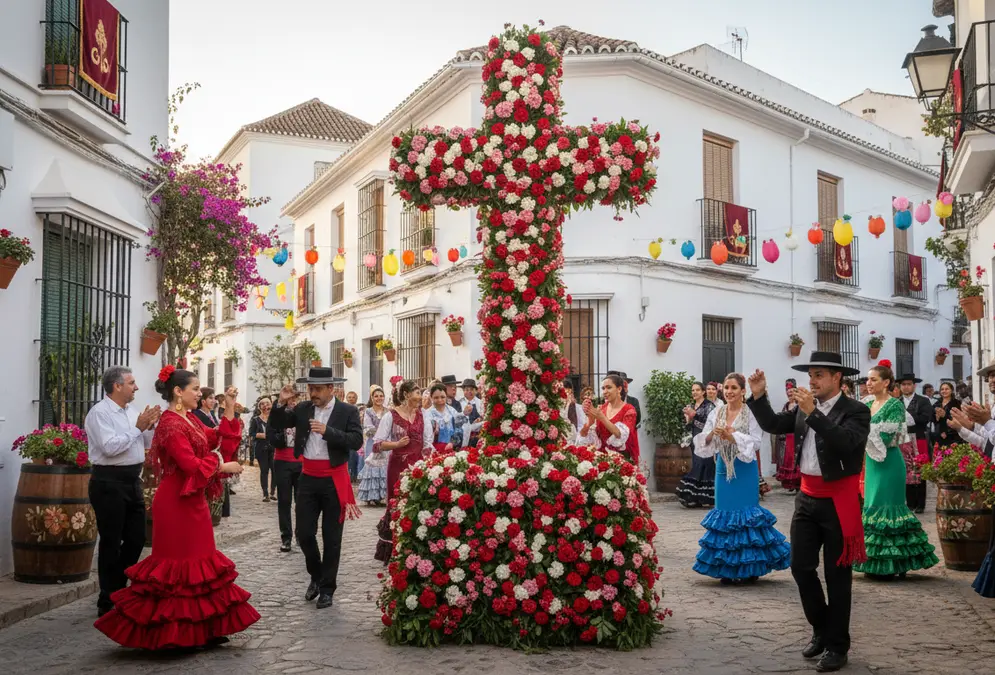
Every spring, the neighbourhoods of Córdoba compete to build the most elaborate flower-covered crosses. Carnations, geraniums, Manila shawls, candles, and bars open in the streets alongside every one. The Cruces de Mayo runs for five days in late April and early May, and every cross is free to visit.

Written by
María Fernanda González Ten years covering Córdoba's UNESCO heritage sites, sourcing from Junta de Andalucía documentation.
Updated Published
For five days each spring, Córdoba's neighbourhoods compete to build the most elaborate cross they can from carnations, geraniums, foliage, and whatever else the local association decides looks good. The crosses go up in courtyards, plazas, and streets across the old town. Bars open alongside each one. The sevillanas start in the evening and go on late.
The Cruces de Mayo runs for five days from late April into early May. Every decorated cross is free to visit. Typically 50+ crosses are installed across the city: around 19 in the historic centre, 22 in modern neighbourhoods, and 11 in enclosed spaces (private patios and courtyards). The official competition is organised by the Ayuntamiento de Córdoba and covers crosses in San Basilio, San Andrés, Santa Marina, San Agustín, and the city centre, each neighbourhood approaching the festival with its own character and style.
It also leads directly into the Festival de los Patios, which starts on 4 May. If you time a trip for early May, you catch both.
At a glance
- When
- Late April – Early May (5 days)
- What to see
- Flower crosses in public squares
- Entry
- Free
- Best areas
- San Basilio, Santa Marina & San Andrés
- Photo tip
- Noon–15:00 flowers; 19:00–23:00 illuminated
- Duration
- 2–3 hours to see all major crosses
- Weather
- 23°C days, 9–11°C evenings; bring a jacket
In this guide
Jump to a section
History and origins
From the Catholic Church's calendar to Córdoba's street corners: the Cruces de Mayo has a longer history than the competition format suggests.
Religious roots
The festival originates in the Catholic celebration of the Invention of the Holy Cross — the May 3rd feast commemorating Saint Helena's discovery of the True Cross. The tradition venerates Saint Helen (mother of Emperor Constantine), who is credited as its founder. In Andalusia, those celebrations took a particular form: decorating crosses with flowers and gathering around them in the street. The religious endpoint is 3 May, Día de la Cruz, which remains the closing date of the Córdoba festival today.
Córdoba's own tradition
In Córdoba, the neighbourhood practice is documented from the early 20th century, when barrios like Matadero Viejo, Huerta de la Reina, and Alcázar Viejo began erecting decorated crosses in their streets and patios. Community associations — peñas and local clubs — built the displays, and the collective work of flower-arranging became as much a part of the tradition as the cross itself. The formal competition began in 1953 under the Ayuntamiento de Córdoba, giving the neighbourhood practice its current competitive shape.
The layering goes deeper than the competition format suggests — Roman spring rites, Saint Helena's 4th-century discovery of the True Cross, and centuries of folk-Catholic practice all fed into the tradition that reached Córdoba's neighbourhoods. For the full story, see the article on the origins and cultural syncretism of Cruces de Mayo.
What this means in practice
When you walk past an elaborate competition cross in San Basilio, the community association behind it is continuing something their neighbourhood has done (in various forms) for several hundred years. The competition format is relatively recent. The habit is not.
How the crosses are made
The structure is standard; the decoration is where the competition happens.
The structure
Each cross is a wooden frame roughly three metres (about ten feet) high. That's the common starting point across all the neighbourhood associations. What goes on top of it, and around it, is where every group makes its own decisions. The crosses are installed in courtyards, plazas, and streets. Some stand alone; others are part of a wider decorated space, with tables, lighting, and a bar set up alongside.
The decoration
Carnations and geraniums are the main materials, in red, white, green, or yellow, depending on the association's design choices. Foliage provides structure and depth. Manila shawls (mantones), multicoloured throws, and candles add texture and light.
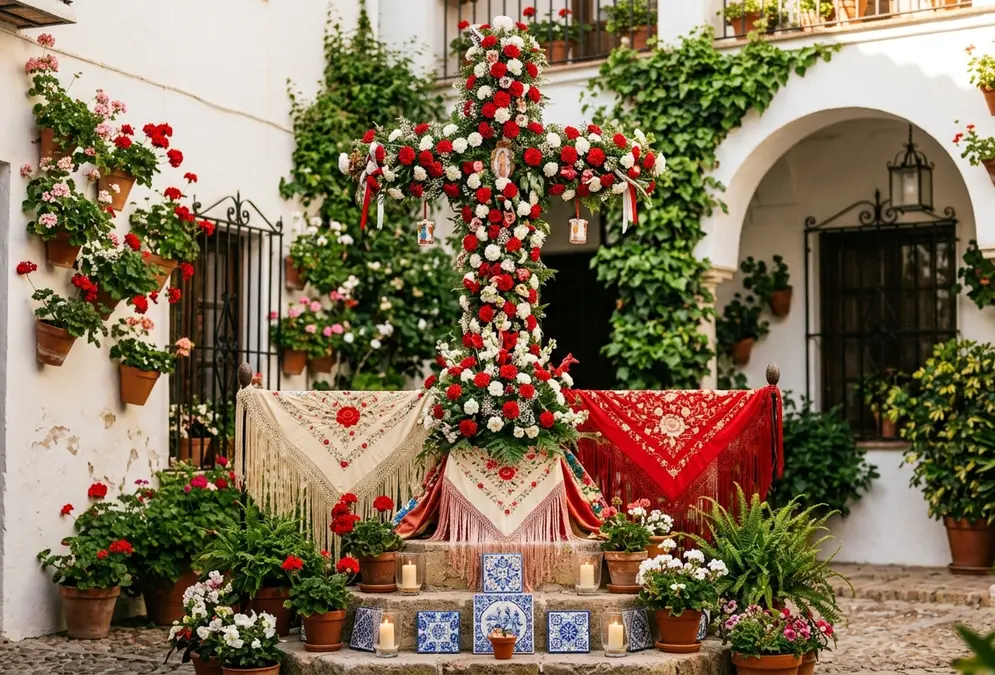
A competition cross in full bloom: carnations, geraniums, and Manila shawls layered around a three-metre wooden frame
The competition
The official Popular Contest of May Crosses is organised by the Ayuntamiento de Córdoba each year. Neighbourhood associations (peñas) register their cross and are judged on decoration quality, creativity, and overall presentation. Prizes typically run to €2,000 for first place in aesthetics, €1,260 for second, €980 for third, and a €700 participation prize for every cross that enters. The bars, tapas, and entertainment that accompany each cross are not judged, but they're part of what makes the festival worth visiting.
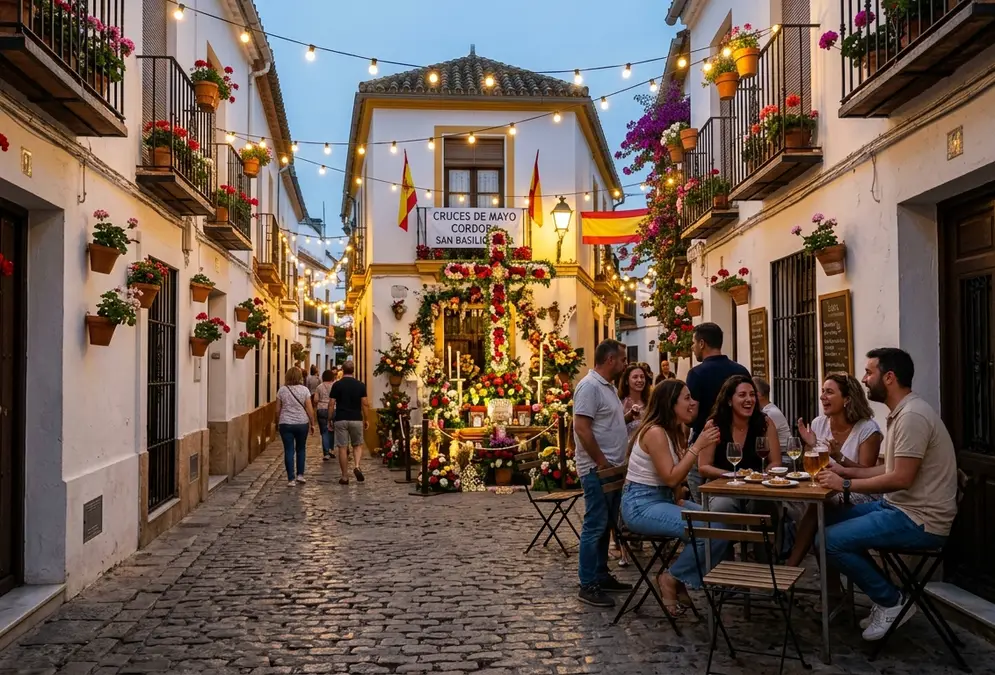
San Basilio in the evening: the neighbourhood where most visitors start their cross route
Best neighbourhoods to visit
Five neighbourhoods, each with a different character. All free. Below is what each one is actually best for.
San Basilio
Best overallSan Basilio is the neighbourhood most people think of first, and with reason. Its steep cobblestone streets and whitewashed walls were made for this festival. The crosses here tend to be among the most elaborately decorated in the competition, and the bars that open alongside them serve proper tapas, not tourist-facing snacks. Sevillanas spill out of doorways from early evening.
Competition crosses Traditional tapas bars Evening sevillanas Authentic cobblestone streets
Best time: From 19:00 for music and dancing · Tip: The cobblestones are uneven and the streets slope: wear shoes with grip. Music is at 50% volume 16:00–19:00 (neighbour quiet period); arrive after 19:00 when full music resumes and the bars fill.
San Andrés
Daytime detailsSan Andrés has a slightly quieter character than San Basilio: less steep, easier to walk, and good for seeing the decoration up close without jostling through crowds. Visit here during the day to examine the flowers and construction properly, then head south to San Basilio for the evening atmosphere.
Multiple decorated crosses Community celebrations Local bars Easier terrain
Best time: Daytime for decoration; evening for atmosphere · Tip: Look at the carnation work up close: the artistry involved in these arrangements is genuinely impressive and easier to appreciate here than in busier spots.
Santa Marina
Local feelSanta Marina is one of Córdoba's most traditional neighbourhoods, home to the Palacio de Viana and its twelve courtyards. During Cruces de Mayo it comes into its own: the crosses are placed in plazas and courtyards that already have character, and the community feel is genuine. It's also the neighbourhood that connects directly to the May Patio Festival, which follows the week after.
Courtyard and plaza crosses Cultural performances Traditional neighbourhood setting
Best time: Evening · Tip: Cross visits pair naturally with a walk around the neighbourhood. The Palacio de Viana is close; worth doing on the same afternoon.
San Agustín
Worth the walkLess visited than San Basilio and Santa Marina, San Agustín rewards the detour. The crosses are set against quieter streets, the bar prices tend to be lower, and you're less likely to be sharing a narrow passage with fifteen other visitors at once. A good option if you want the festival experience without the bottlenecks.
Multiple decorated crosses Evening entertainment Less crowded
Best time: Evening · Tip: Combine with Santa Marina for a longer northern neighbourhoods loop; allow 2 to 3 hours.
City Centre / Historic Centre
Official competitionThe central plazas and main streets host some of the official competition crosses: more polish, more crowds, and the most photographed installations. Good for seeing what the competition format produces at its most ambitious. Easy to reach from anywhere in the city.
Official competition crosses Central location Accessible any time of day
Best time: Any time; evening for full experience · Tip: Come during the day if you want photographs without people in every shot. Evening here gets busy: the central location draws the largest crowds.
Suggested routes
Three ways to approach the festival, depending on how much time you have.
1
San Basilio evening route
1.5–2 hours Atmosphere and sevillanas
Head straight to San Basilio from 19:00, when full music resumes after the afternoon quiet period. Walk the steep streets, find the competition crosses, eat tapas at one of the neighbourhood bars, and stay for the dance shows. This is the most concentrated single-neighbourhood experience the festival offers.
2
Northern neighbourhoods loop
2–3 hours Covering more ground
Start in San Andrés in the afternoon, walk through Santa Marina examining the courtyard and plaza crosses, then continue to San Agustín. End at a neighbourhood bar as the evening begins. Good for seeing a variety of cross styles and neighbourhood characters in one outing.
3
Full festival day
Full day Seeing everything
Daytime in San Andrés and the city centre, focusing on the flower details and the official competition crosses. Late afternoon in Santa Marina and San Agustín. Evening in San Basilio for the music and dancing. Bring cash for tapas at multiple stops.
May in Córdoba: the festival month
Cruces de Mayo is not an isolated event. It sits inside a month that Córdoba fills almost entirely with festivals.
Late Apr – 3 May
Cruces de Mayo
50+ flower-covered crosses across the city. Free entry throughout. Music and tapas bars open alongside each cross. Note: the final day (3 May, Día de la Cruz) closes at 16:00; the preceding Friday and Saturday evenings are the peak nights.
4 May – 17 May
Festival de los Patios
The festival that opens Córdoba's private courtyards to visitors. Many of the same neighbourhoods (San Basilio, Santa Marina, San Andrés) feature in both festivals. If you're visiting for the crosses, staying an extra week for the patios is worth it. Full Patio Festival guide →
Late May
Feria de Córdoba
Córdoba's annual fair, with flamenco, horses, and casetas (private party tents). The Feria traditionally falls in the last week of May. It's a different kind of celebration (louder and later) but it completes the spring season.
Planning a May trip
The first two weeks of May (covering Cruces de Mayo and the Patio Festival) are the single best window of the year to visit Córdoba. The weather is good (warm but not yet the brutal summer heat), the festivals are running, and the old town streets look genuinely different from the rest of the year. See the full Córdoba in spring guide.
Practical information
Everything you need before you go.
Dates and admission
Festival dates Late April – Early May
Admission Free
Opening day (Thursday) 12:00–00:00 (midnight)
Days 2–4 (Fri–Sun) 12:00–02:00
Final day (Monday) 12:00–16:00 only
Music quiet period 16:00–19:00 (50% volume)
Getting there
Walking: The historic neighbourhoods are all walkable from each other. San Basilio is roughly 10 minutes on foot from the Mezquita; Santa Marina is 15–20 minutes north.
Bus: Córdoba's public bus network serves the main areas. Useful if you're staying further from the centre or want to avoid the steep streets of San Basilio entirely.
Footwear: Wear shoes with grip. San Basilio's cobblestones are uneven and the streets slope noticeably.
Food and drink
Each decorated cross has a bar set up alongside it, run by the neighbourhood association. These serve tapas and traditional drinks: salmorejo, flamenquín, local wine, rebujito (the sherry-and-lemonade mix you'll also encounter at the Feria).
Bring cash. These neighbourhood bar setups don't take cards. Budget €20–30 per evening for rebujito and tapas at a few stops.
Prices are reasonable. This is not a tourist-facing commercial operation; you're buying from the local association.
Tips
- ·Opening weekend is the busiest; the middle days are noticeably calmer and the flowers are still good
- ·Photography windows: noon–15:00 for flower detail, 19:00–23:00 for illuminated crosses, after 23:00 for dancing energy
- ·Music at 50% volume 16:00–19:00 (neighbour quiet period); full volume resumes at 19:00, a good arrival window
- ·Evenings drop to 9–11°C; a light jacket makes a real difference after 22:00
- ·Final day (3 May, Día de la Cruz) closes at 16:00; awards announced in the afternoon. The Saturday before is the best night for late dancing
- ·Photography is welcomed at all locations
Official programme
The Turismo de Córdoba official programme lists all competing crosses with their locations, neighbourhood maps, and competition categories. The annual programme map is published on the Turismo de Córdoba website several weeks before the event.
Frequently asked questions
What should I wear to Cruces de Mayo?
Comfortable walking shoes with good grip. San Basilio's cobblestones are uneven and the streets slope steeply. Daytime reaches around 23°C, but evenings drop to 9–11°C, colder than most visitors expect. A light jacket you can carry during the day is worth it if you're staying past 21:00 for the sevillanas.
Which day of Cruces de Mayo should I visit?
The festival runs five days (29 April–3 May). Opening weekend (April 29–30) draws the biggest crowds. If you want to move freely between crosses, come on May 1 or 2: the flowers are still good, the streets are noticeably less packed. Note that the final day (3 May, Día de la Cruz) closes at 16:00 (not in the evening), as it is a Sunday with restricted hours. The preceding Saturday (2 May) is the best night for late atmosphere. For photography, the first two days give you the freshest flowers.
Which neighbourhood has the best crosses?
San Basilio is the most atmospheric: steep streets, elaborate competition crosses, and proper evening entertainment with sevillanas. For daytime decoration-watching, San Andrés is easier to navigate. Santa Marina has the most authentic community feel. All are worth visiting if you have the time.
What is the connection between Cruces de Mayo and the Patio Festival?
The two festivals run back to back. Cruces de Mayo finishes on 3 May; the Festival de los Patios starts on 4 May and runs until 17 May. Together they create a near-continuous three-week spring celebration. The same neighbourhoods (San Basilio, Santa Marina, San Andrés) feature prominently in both.
How are the crosses decorated?
The crosses are wooden structures roughly three metres high, covered in carnations, geraniums, and other flowers in red, white, green, or yellow, with foliage and greenery. Manila shawls (mantones), candles, and ceramic tiles often feature as additional decoration. Neighbourhood associations and social clubs (peñas) construct and maintain them throughout the festival.
Need the quick facts?
Dates, hours, location, admission, and what to expect at a glance. The event page has the logistics covered.
Further reading
Sources and further reading
3 references Show Hide
- Ayuntamiento de Córdoba: Cruces de Mayo (opens in a new tab)
Official municipality site with information on the Popular Contest of May Crosses, registration dates for neighbourhood associations, and programme announcements
- Turismo de Córdoba: May Festivals (opens in a new tab)
Official Córdoba tourism site covering all May festivals, including Cruces de Mayo, the Patio Festival, and the Feria, with dates, maps, and neighbourhood guides
- UNESCO: Patio Festival of Córdoba (Intangible Cultural Heritage) (opens in a new tab)
UNESCO listing for the Festival of the Patios, which follows Cruces de Mayo and shares the same neighbourhoods. Provides cultural context for both spring festivals
Book tours & activities in Córdoba
Tours are selected for quality, not commission. We earn a small fee if you book — at no extra cost to you.
Guided tours, skip-the-line tickets, and bookable experiences. Browse everything available in Córdoba.
 1.5 hours
 Mosque-Cathedral Skip-the-Line Guided Tour
4.7 From €29
Reserve
 1.5 hours
 Mosque-Cathedral Skip-the-Line Guided Tour
4.6 From €28
Reserve
 3 hours
 Jewish Quarter, Mosque & Alcázar Tour
4.6 From €49
Reserve
Self-guided Mosque-Cathedral E-Ticket with Audio Guide
4.2 From €18.50
Reserve
 70 minutes
 Caballerizas Reales Equestrian Show
4.5 From €18.50
Reserve
2 hours Mosque & Jewish Quarter Tour with Tickets
4.6 From €35.55
Reserve
3 hours Mosque-Cathedral, Jewish Quarter & Alcázar Tour
4.6 From €49.99
Reserve
 1.5 hours
 Alcazar Guided Tour and Skip-the-Line
4.2 From €19
Reserve