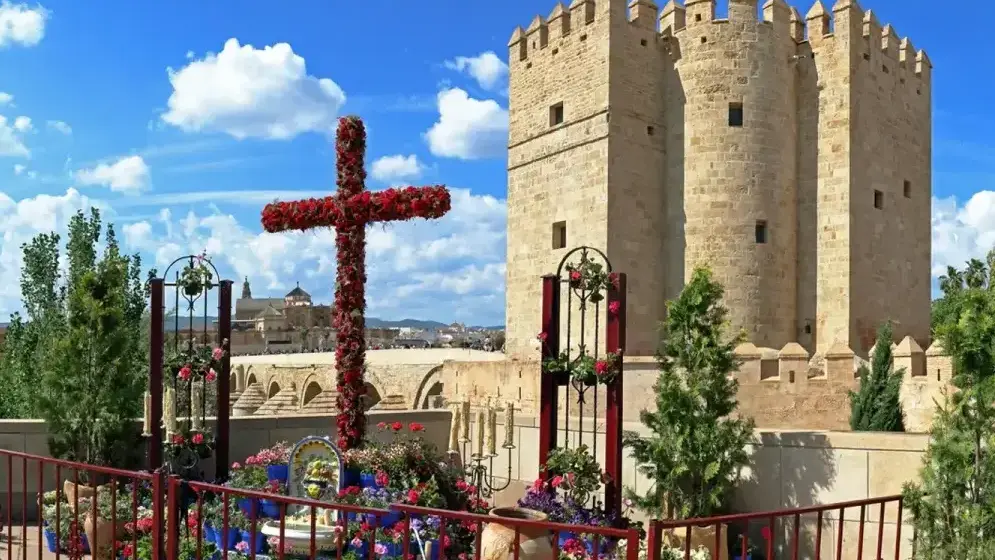
The May Crosses of Córdoba mark the start of the spring festivities, just before the famous Patio Festival. Across the city, 50 or more monumental crosses go up decorated with flowers, silk mantones, colourful shawls and traditional objects: roughly 19 in the historic centre, 22 in modern neighbourhoods, and 11 in indoor (enclosed) spaces. Every neighbourhood and association competes to build the most spectacular display around its cross. The tradition stretches back centuries, religious devotion and popular celebration braided together so tightly it's hard to separate them.
A three-category contest
A jury awards the best displays across three categories: historic centre, modern neighbourhoods and enclosed spaces. The crosses in San Basilio and the Judería draw the most visitors. Around each cross, people dance, sing and share the first tapas of the festive season alongside a rebujito. It's the signal that spring has properly arrived.
What you actually see
These aren't small roadside shrines. The finest crosses are 3 to 4 metres tall, dense with geraniums, carnations, roses and lilies worked into tight compositions. Embroidered fabrics, handmade pottery and antique religious objects frame the flowers. Each neighbourhood brings its own character to the display. The crosses in Santa Marina have a different feel from those in Centro, slightly rougher and more genuinely devotional.
In the evenings, tables and chairs appear around the crosses, music plays, and the squares turn into something between an outdoor bar and a street party. Neighbours who organised the cross serve food and drinks to whoever turns up. It's the kind of event where locals are genuinely pleased when visitors stop to look. The competition is partly about showing outsiders what the neighbourhood can do.
How to visit
The crosses are scattered across multiple neighbourhoods, so it takes some walking. Music plays from 12:00 to 16:00 and again from 19:00 to 02:00 (reduced to 50% between 16:00–19:00 for neighbours). Plan around this: arrive for the afternoon session, or come back after 19:00 for the full festive atmosphere with the crosses lit and the squares busy.
A practical route: start in San Basilio for the most decorated displays, then work north toward the Judería and Centro. By 10 pm the music is louder, the crowds are warmer, and the crosses are lit properly.
The 2027 contest runs Wednesday 28 April to Sunday 2 May; 3 May, Día de la Cruz, falls the day after it closes. In 2026 the final day, also a Sunday, closed at 16:00, not the usual 02:00; the 2027 hours have not been published. The Festival de los Patios opens right as the Crosses close: in 2026 it opened on 4 May and ran to 17 May, and in 2027 the Ayuntamiento's approved calendar sets it for Monday 3 to Sunday 16 May. For anyone who can stay a few extra days, this back-to-back sequence is the best possible introduction to Córdoba's spring.
Practical information
The crosses are accessible for 5 days, from Wednesday 28 April to Sunday 2 May 2027, as set in the Ayuntamiento de Córdoba's approved 2027 calendar (acuerdo 1215/26). Hours follow the typical pattern: the opening day runs 12:00–00:00; middle days run 12:00–02:00; the final day closed at 16:00 in 2026, and the 2027 final-day hours have not been published. Music volume reduces 50% from 16:00–19:00 each day. Free entry for all. The best crosses are traditionally in San Basilio, Centro and the northeastern quarter near the Manolete statue. Visitors planning rooms for the same trip can use our guide to where to stay for the May festivals.