
Las Casas de la Judería is a union of five palace houses, built around the Casa-Palacio de las Pavas, whose Renaissance reform was completed in 1597. Descend to the basement and you walk above Roman remains from the 1st century A.D., from the era when the city was expanding toward the Guadalquivir. The 64 rooms connect through a network of inner courtyards and vaulted passages: an actual labyrinth, not a design concept. This is one of the few places in Córdoba where the building itself rewards slow exploration rather than quick check-in and checkout.
The Casa de las Pavas and Its 1597 Reform
The hotel's core building predates its best-known makeover by two centuries. Records trace ownership to the canon Juan Sigler de Espinosa, who in 1597 spent part of his fortune on a Renaissance-style reform: the façade you see today, the patio del crucero, and the Renaissance patio all date from that campaign. It is why the property reads less like a single 15th-century palace and more like what it actually is: a much older core, reworked in the Renaissance, then joined to four neighbouring houses. Rooms vary accordingly. Some retain brick vaults and stone floors close to the original construction; others sit in the later wings with carved wooden beams and antique azulejos. The junior suites have separate sitting areas and are worth booking for stays of two nights or more; the superior rooms above the excavated Roman section make a good middle ground between character and space.
Sleeping Above the 1st-Century City
The ruins beneath the hotel are not a display cabinet. Documented remains found during renovation works date to the High Roman Empire, when Córdoba was expanding toward the river in the 1st century A.D. The excavation runs under three of the five palace buildings: column bases, mosaic fragments, a section of hypocaust floor, lit low with narrow passages. No guided tour runs continuously; the front desk can tell you when access is open during your stay. Most guests walk past the entrance on the way to breakfast and realise afterwards they spent two nights above something that would draw a crowd anywhere else in the city.
Five Houses, One Layout
With 64 rooms spread across five interconnected buildings, the layout takes a night to learn. Andalusian patios link each house: fountains, ornamental arcades, some Renaissance and some Mudejar in style. The main inner courtyard, shaded by century-old orange trees, is where most guests spend more time than planned. In the evenings, once the day-trippers clear the neighbourhood, only the water sound and the distant bells of the Mezquita remain. During April's Festival de los Patios, the hotel's own courtyards enter the city's celebrated patio competition, and orange blossom scent reaches every room. If atmosphere matters more than square footage, ask for a room in the oldest wing when booking, since positions vary a lot across the five houses.
Hammam, Pool and Garden
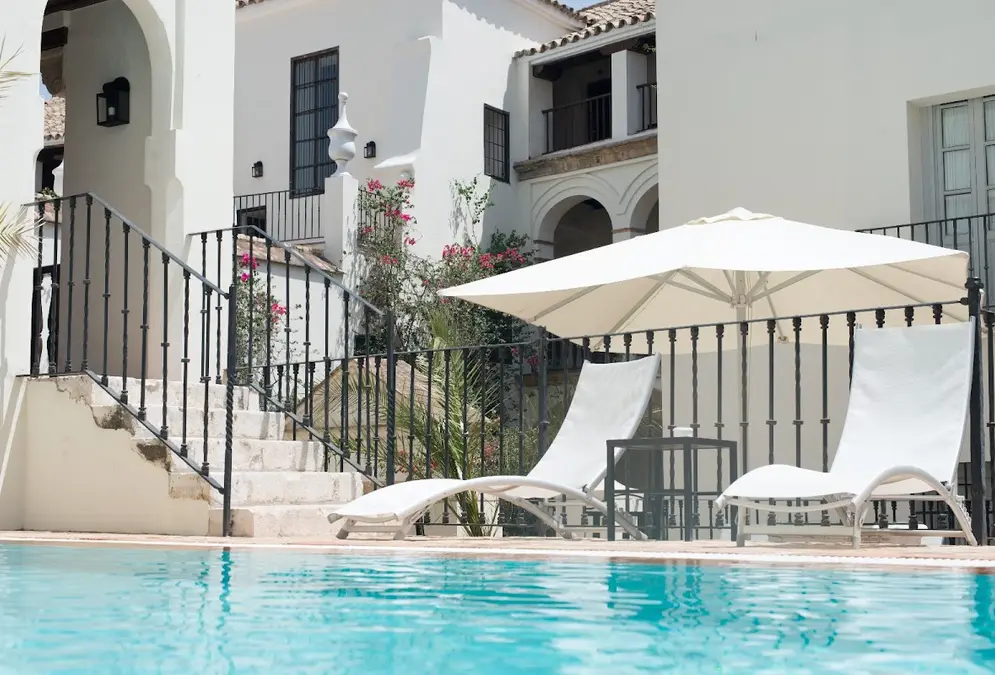
The spa draws on Andalusian hammam tradition with a heated indoor pool under stone vaults, a steam room, and massage treatments. For a fuller thermal experience nearby, the Hammam Al Andalus is a short walk away in the Judería, while Hotel Viento10 is another Judería hotel with a sauna and jacuzzi. The gardens hold an outdoor pool, one of the few in the historic centre surrounded by actual vegetation rather than concrete; in July and August it fills up after noon, so the best hours are 8am to 10am before the heat peaks. Breakfast is served daily in one of the main courtyards, and the restaurant serves Andalusian dishes made from local produce at lunch and dinner.
Between the Synagogue and the Alcázar
The hotel sits in the historic Judería, the Jewish Quarter where Jews lived between the 10th and 15th centuries, directly opposite the Alcázar de los Reyes Cristianos and near the Caballerizas Reales, the Caliphal Baths, and the Synagogue. It is 3 minutes on foot from the Mezquita-Catedral, with the photogenic flower alley under 5 minutes away. Noor (Michelin-starred) is 400 metres; El Churrasco is 200 metres. The neighbourhood is pedestrianised, meaning no traffic noise at night, but suitcases with wheels need to be carried over cobblestones for the last 200 metres of the approach. Paid on-site parking is available and worth reserving when you book; peak season runs from Easter week through mid-June and again in September, so book at least three weeks ahead and request your preferred room type at reservation rather than at check-in.
For a self-catering apartment in the same neighbourhood with a panoramic Mezquita terrace, Apartamentos Calleja de la Hoguera is 200 metres from the monument with commissioned original artworks on the walls. Las Casas de la Judería ranks second in both our Top 10 Hotels in Córdoba and Best Boutique Hotels in Córdoba guides.