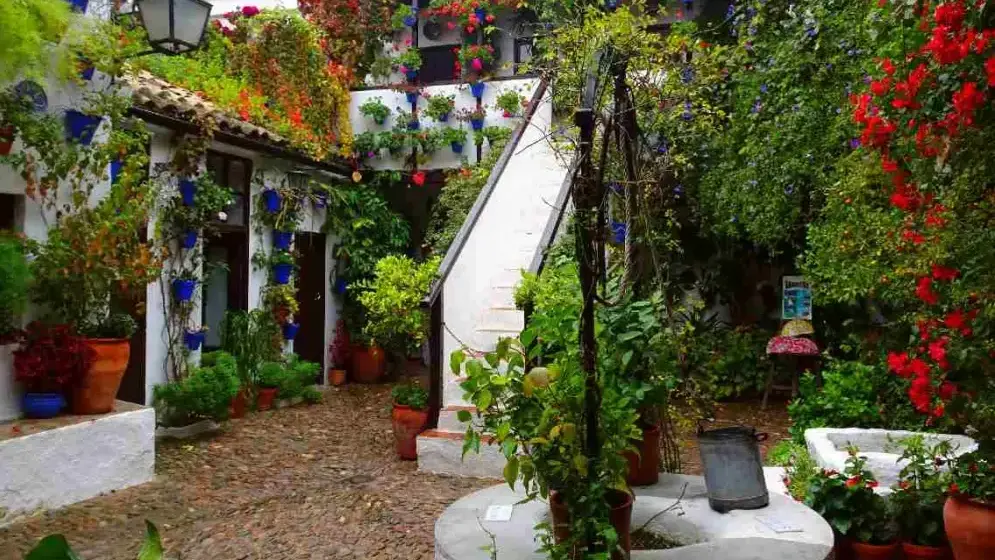

Córdoba's patios are not just flowering courtyards — they're an urban practice going back more than 2,000 years, inscribed on UNESCO's Intangible Cultural Heritage list in 2012. Red geraniums cascade down whitewashed walls, fountains murmur in shaded corners, and for two weeks each May, the whole city opens its doors.
The Patio Festival in May
The Festival de los Patios runs during the first two weeks of May (2026 dates: 4–17 May). More than 50 private patios open free of charge — houses where owners have been cultivating flowers for decades, communal courtyards where neighbours decorate together, former stables turned into hanging gardens. Queues reach 30 minutes for the prize-winning patios, which is the price for seeing spaces that stay closed the rest of the year.
The festival has existed since 1921, when the mayor launched a competition to beautify the city. Owners now compete across four categories — old vs modern architecture, private vs communal — with prizes from a jury scoring upkeep, floral composition and colour harmony. On festival evenings, flamenco shows and improvised concerts animate some patios. The energy is real, but so are the crowds.
Visiting year-round without the crowds
Outside the festival, the patios have a completely different quality. No queues, no tourists jostling for the same angle. You can stand in a courtyard for ten minutes watching how light filters through jasmine leaves.
Palacio de Viana: twelve patios at once
The Palacio de Viana is a 15th-century aristocratic palace with twelve patios spanning all eras and styles — Renaissance, Baroque, Romantic. Full entry costs €9 (patios + palace interior), or €5 for the patios only. Free on Wednesdays from 2 to 5 pm — arrive early because locals know this. Open Tuesday–Saturday 10 am–7 pm (9 am–3 pm in July–August), Sunday 10 am–3 pm, closed Monday.
Three free patios in San Basilio
The San Basilio neighbourhood, between the Alcázar and the old city walls, has three free patios open year-round:
Patio San Basilio 17 (Casa LONGA) — a small boutique hotel with an intimate patio in blue and white pottery. Open Monday, Thursday–Sunday 11 am–2 pm.
Patio San Basilio 20 — the La Plata Cordobesa silversmithing workshop, where you watch craftsmen working filigree silver. Every day 10:30 am–2 pm.
Patio San Basilio 44 — the largest, with craft shops around a central fountain and vine climbing to the first floor. Every day 10:30 am–2 pm.
All three are walk-in — no booking, no obligation to buy.
Guided tours: six patios in two hours
Several operators run 2-hour guided tours combining 6 to 8 patios across the Alcázar Viejo, Santa Marina, San Agustín and San Lorenzo neighbourhoods. The guide explains the historical arc: Romans importing the concept of a central courtyard, Arabs adding fountains and plants for cooling, and how the tradition formalised in the 20th century.
You visit private patios that open only for organised tours — usually modest homes where a family tends hundreds of pots. Owners often describe their routine: watering twice a day in summer, pruning geraniums after flowering, whitewashing walls each spring. Some families have been doing this for three generations.
Around €18.83 per person. Book the 2-hour patio tour on GetYourGuide. In May, these tours let you skip the queues at the most popular patios through reserved time slots.
The architecture and plants you'll see
Cordovan patios follow a recognisable structure: whitewashed walls that reflect heat, cobblestone or hydraulic-tile floors, a central fountain or well, terracotta pots hung in quincunx patterns. Climbing plants (jasmine, honeysuckle, bougainvillea) cover trellises and create shade.
Geraniums dominate — scarlet red, soft pink, pure white. They flower from April to October, withstand the heat and are easy to maintain. Jasmine provides the scent that hits you the moment you cross the threshold. Some patios line up 200 to 300 pots in 30 m². It's dense and sometimes excessive, but that's the local aesthetic.
Planning your visit
During the festival in May, allow at least a half-day for 8–10 patios at a comfortable pace. Download the official interactive map at patios.cordoba.es, which shows all participating patios with opening times. Go early in the morning (10 am) or late afternoon (5 pm) to avoid peak crowds.
Outside the festival, combine the Palacio de Viana (allow 1h30) with the three free San Basilio patios (30–45 min) for a solid patios morning. The guided tour of the Mezquita or Jewish Quarter free walking tour in the afternoon work well — everything is within 10 minutes on foot.
The cycling tour passes through Santa Marina and San Lorenzo where you glimpse patios from the street. And for a monumental-scale comparison, the excursion to Medina Azahara shows how the 10th-century caliphs organised their own palatial courtyards — the same architectural logic at a completely different scale.
Why UNESCO recognised this tradition
In December 2012, UNESCO inscribed the Feast of the Patios of Córdoba on the Representative List of the Intangible Cultural Heritage of Humanity. Not for the architecture itself — that's material heritage — but for what the tradition represents: a collective way of life where neighbours share maintenance, gather in shared space and pass down gardening knowledge across generations.
Cordovans continue to open their patios, plant geraniums and whitewash their walls each spring. Not because tourists come to watch, but because that's how life has been lived here for as long as anyone can remember.