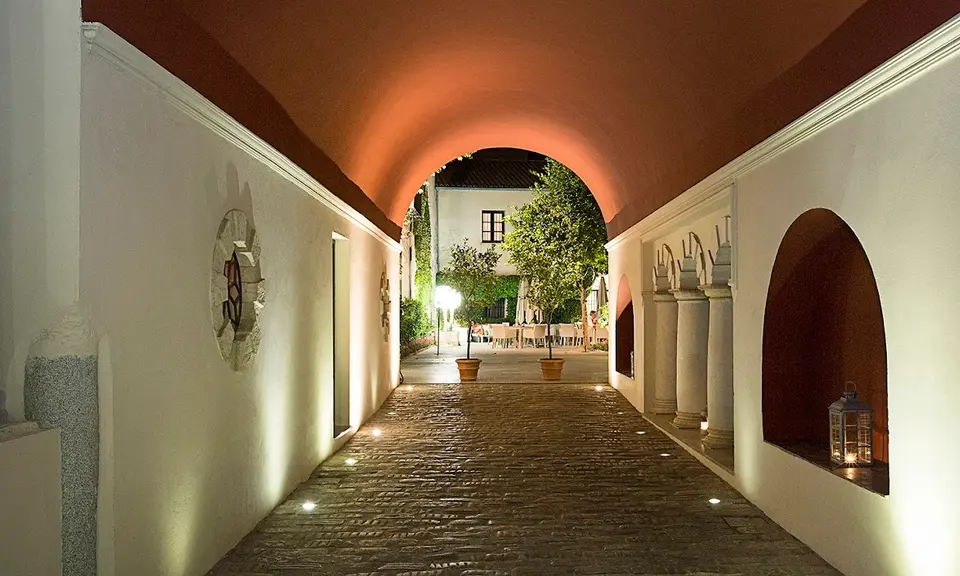

The Hospes Palacio del Bailío is a 16th-century Renaissance palace in Córdoba's Historic Centre, and it holds a secret most guests only discover at dinner. The Arbequina restaurant serves its dishes above a glass floor, looking straight down onto Roman archaeological remains uncovered during restoration and left exactly where they were found.
A Palace Protected Since 1982
The Casa del Bailío was declared Bien de Interés Cultural on 1 February 1982, Spain's top heritage designation, and that status anchors every restoration decision made since. The Roman foundations date to the era when Córdoba was Colonia Patricia, capital of the Baetica province. Moorish architectural traces from the Al-Andalus period survive in the structure. The late-Gothic, Plateresque-influenced portal is attributed to Hernán Ruiz II, the same architect who built the Mezquita-Catedral bell tower.
This is not a building dressed up in historical details. The layers are real, and the hotel has done the work to make them readable. When you walk through the main entrance, the transition is immediate: the sound of the street stops, the stone floors cool, and the proportions of the courtyard do something to your sense of time. The scent of orange blossom hangs over the patios in April and May.
Sleeping Around Four Andalusian Courtyards
The hotel's 53 rooms and suites are arranged around four Andalusian courtyards, from entry Superior rooms to multiple suite grades. The patio-facing rooms are the most requested: their windows look directly into the courtyards, and morning light angles through the arches in a way that rewards waking up early. Ask explicitly when booking, because the room categories online don't always map clearly to which view you get.
Deluxe rooms have more floor space and higher ceilings, with original architectural details preserved throughout. Suites on the upper floor have private terraces. Beds are large and the linen is of the kind that makes you adjust your sleep schedule. The bathrooms are marble-fitted, with walk-in showers and deep soaking tubs in the suite categories.
Bodyna Spa: Bathing Where Romans Bathed
The Bodyna Spa occupies a courtyard flanked by Roman columns, with treatment rooms above and the restored Roman Baths on the floor below. Thermal pools, a steam room, and a full treatment menu operate inside structures close to two thousand years old. It is a genuinely unusual wellness experience, not comparable to a standard hotel spa setup.
For a more traditional Arab bath experience nearby, the Hammam Al-Andalus in the Judería is the alternative worth knowing. The Bodyna Spa is primarily for hotel guests; outside bookings depend on availability, so call ahead if you're not staying.
Arbequina and the Glass Floor
Arbequina's dining room sits over a glass floor that opens onto the Roman remains beneath the hotel. The kitchen focuses on local Andalusian produce: Montilla wine reductions, cold-pressed olive oil from the Sierra Morena, slow-cooked meats from the Córdoba mountains. Book a table over the glass floor section if you want to eat directly above the ruins. The contrast, worked stone below your feet and contemporary plating in front of you, is the point of the room. Breakfast at Arbequina is optional and can be added to any rate; the buffet uses on-site made pastries and regional products.
From the Palacio to the Mezquita
The palace is 15 minutes on foot from the Mezquita, close enough to walk everywhere important. The Roman Bridge takes about the same time. The ancient forum remains are on the way. Noor, Paco Morales's Michelin-starred restaurant exploring pre-Al-Andalus cuisine, is a short walk south. The hotel has a concierge that handles Mezquita tickets (which should be booked ahead, especially May through October), restaurant reservations at Noor and other hard-to-book addresses, and guided tours of the historic centre. Parking is available on site: reserve a space when booking, as the historic centre has no casual parking nearby.
A Michelin Key Address
In 2024, the Palacio del Bailío was awarded a Michelin Key, a distinction given only to the world's most outstanding hotels. That recognition puts the palace in different company than a typical historic-house conversion: it functions as a destination in its own right, not just a convenient base. Couples on anniversary trips, architecture and history enthusiasts who want context alongside comfort, and food-focused travellers who came specifically for a table at Arbequina or Noor make up most of the guest list. The location in the Centro rather than the Judería means slightly less footfall outside the door, a few minutes' extra walk to the Mezquita, and more space around the building. Solo travellers who care about quality over size will find the Superior rooms well-priced for what they offer.
Choosing Between Córdoba's Historic Hotels
For a more intimate stay in the adjacent Judería, the Balcón de Córdoba has 10 rooms and the best panoramic terrace over the Mezquita. Las Casas de la Judería spreads across five interconnected 15th-century palaces. For a more moderate budget, Hotel Madinat has a private hammam and panoramic terrace. The Eurostars Palace offers another contemporary 5-star option with a rooftop pool on the Paseo de la Victoria. Hospes Palacio del Bailío leads both our Top 10 Hotels in Córdoba and Best Boutique Hotels in Córdoba guides, two essential references for accommodation in the historic centre.