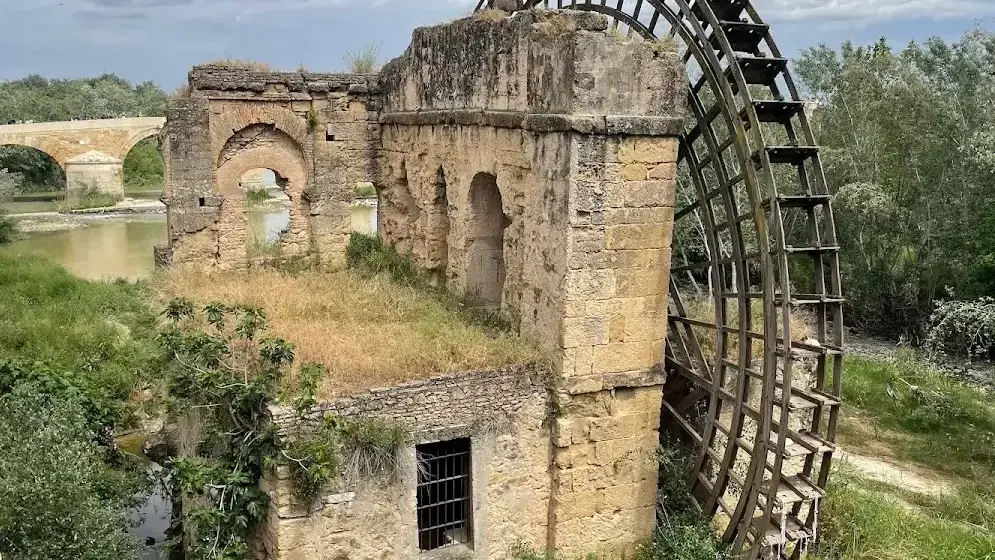

The Molinos del Río Guadalquivir are the remnants of a hydraulic milling system built during the Al-Andalus period. Constructed between the 9th and 13th centuries, these mills used the current of the river to grind grain and supply the city with flour. The Albolafia mill had a large paddlewheel (noria) that lifted water from the river to the gardens of the Alcázar. The Albolafia was built under Abd al-Rahman II in the 9th century and has appeared on Córdoba's coat of arms since the 14th century — the story of the emir who commissioned it explains how a single wheel became the city's defining civic symbol.
When to Visit
Best season
Year-round (open 24 hours; best at sunset or after dark for illuminations)
Quietest hours
Early morning or after 20:00
Visit duration
15 – 20 minutes
The Wheel That Kept the Queen Awake
Legend holds that Queen Isabella the Catholic ordered the Albolafia wheel stopped because its noise disturbed her sleep at the Alcázar de los Reyes Cristianos in 1492. The story tells you something about how loud these installations were — audible from the palace walls. The mills are now ruined but consolidated. The Albolafia wheel, rebuilt in 2008, turns again as a visual reference, without hydraulic function.
Shoot from the south bank at sunset — Albolafia wheel, bridge, Mezquita in one frame
The classic Córdoba postcard composition: the rebuilt Albolafia wheel turning in the middle ground, the Roman Bridge stretching behind, and the Mezquita tower visible beyond. Walk to the south bank and look northwest. The last hour before sunset gives the warmest light.
An Exceptional Industrial Heritage
At the peak of the Caliphate in the 10th century, Córdoba operated multiple mills along the Guadalquivir to supply flour to a city of 500,000 people — the largest in Europe at the time. The milling system combined grain mills with norias for irrigating riverside gardens. This combination of Roman hydraulic knowledge and Arab engineering produced technology that remained in use here for several centuries after the Reconquista. The full story — from the Roman norias on the Baetis through the Umayyad construction of all eleven mills, their redistribution after the 1236 conquest, and Isabella I's decision to silence the Albolafia in 1492 — is told in our full history of the riverbank mills.
The mills you see today are the surviving remnants of a more extensive system. Medieval records mention at least twelve mill structures along this stretch of the river; what remains has been consolidated and partially interpreted by archaeologists. The ruins stretch westward from the Roman Bridge toward the Alcázar gardens.