
Search the site

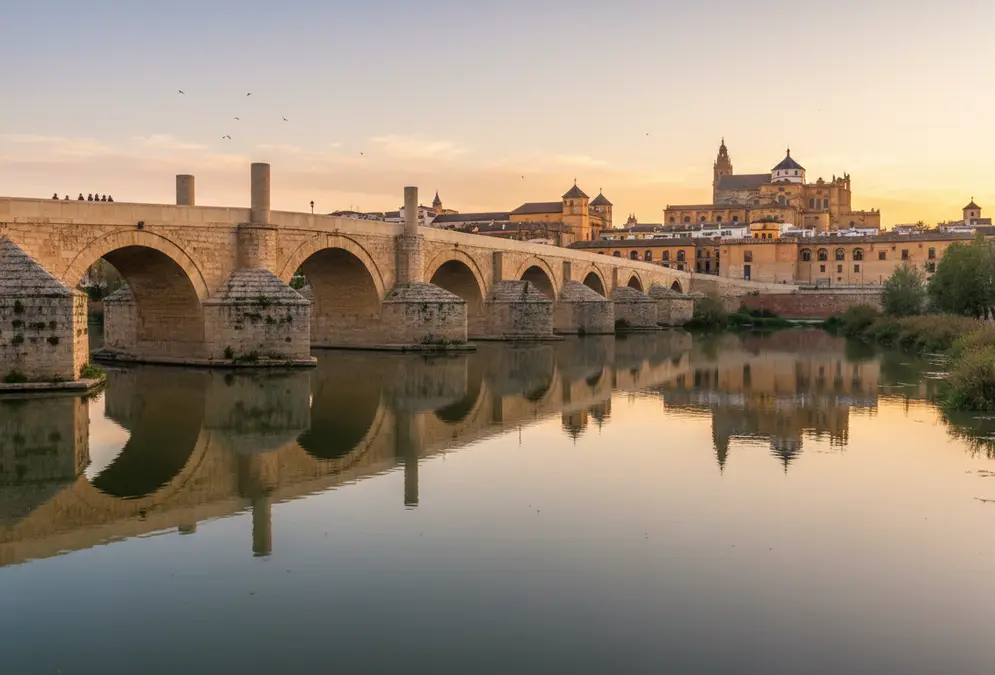
The Roman Bridge of Córdoba with the old city behind it, reflecting in the Guadalquivir at dawn
History Moderate Free

Roman Córdoba Walking Route

Seneca's birthplace on foot: a 2.5 km self-guided route through 8 Roman sites — bridge, temple, circus, and floor mosaics inside a Renaissance palace.

Download PDF guide

At a Glance

Distance
2.5 km
Duration
2.5–3 hours
Stops
8 stops
Route type
Roman Bridge (Puente Romano), south end of Calle Magistral González Francés, 14003 Córdoba → Archaeological Museum, Plaza de Jerónimo Páez 7, 14003 Córdoba
Best time
October to April for comfortable walking temperatures. Morning start (9:00–9:30am) to hit the bridge and temple before the heat and crowds. Avoid the August midday entirely — the stone streets radiate heat by 11am.
Accessibility
The route involves some gentle uphill walking from the riverbank to the temple area (roughly 20 metres elevation gain). All streets are paved stone, some with irregular surfaces. The bridge and open-air sites are fully accessible. The Archaeological Museum and Alcázar have lift access to main galleries. Wheelchair access to the Roman theatre basement at the Archaeological Museum is limited.

Route Map

Loading map…

Click on any marker to see stop details. Numbered markers follow the suggested route order.

Stop-by-Stop Route

  1. 1
    Roman Bridge
    Monument 15 minutes

    The bridge that carried the Via Augusta across the Guadalquivir into Colonia Patricia. The structure dates to the 1st century BC, though every arch has been rebuilt at least once — the Romans laid the foundations, the caliphs rebuilt it, the Catholics repaired it, and a modern restoration finished in 2008 restored the original Roman stone geometry. Stand at the southern end at dawn and the 16 arches line up directly with the old city gate.

    Tip: Walk to the centre of the bridge for the best view back toward the city and the Calahorra Tower. The northern end has a statue of Archangel Raphael — patron saint of the city — installed in 1651.

  2. 2
    Calahorra Tower
    Monument 30 minutes

    The tower at the far (southern) bank was built in the 12th century as a defensive gateway protecting the Roman bridge. Inside, the Museum of the Three Cultures documents Córdoba under Rome, the Visigoths, the caliphate, and the Christian kingdom. From the rooftop terrace you get the clearest aerial view of the Roman street grid — the cardo maximus running north from the bridge straight toward where the forum once stood.

    Tip: The museum is small but the rooftop is the reason to go. Entry is €4.50. Open daily including Monday — useful if you plan to visit the Archaeological Museum (which is closed Mondays) on the same day.

  3. 3

    Walk back north across the bridge and turn right along the riverbank. The stone mill structures extending into the river were first built by the Romans to grind grain for the provincial capital. The Moors rebuilt them as water wheels supplying the palace gardens of Medina Azahara and the city's hammams. They ran continuously for nearly 1,400 years. The largest surviving mill — the Albolafia — dates to the caliphate period but sits on Roman-era footings.

    Tip: Best viewed from the riverbank path (Paseo de la Ribera). The mills photograph well at any time of day, but late afternoon puts the light directly on the water.

  4. 4

    Two hundred metres west of the main route, but worth the detour. The Alcázar was built by Alfonso XI in 1328 on Roman foundations that may have included part of the praetorium — the Roman governor's palace. The ground-floor hall contains three full Roman floor mosaics discovered during excavations in the 20th century, including the Polyphemus and Galatea mosaic from the 3rd century AD. These are among the largest Roman mosaics on public display anywhere in Spain.

    Tip: Go straight to the mosaic room on the ground floor before climbing to the towers. The gardens are caliphate-era in layout, watered by channels that still follow Roman irrigation lines. Ticket €5; closed Monday.

  5. 5
    Roman Temple (Templo Romano)
    Monument 20 minutes

    Eleven standing Corinthian columns in the middle of the city — found during construction of the town hall in 1950 and excavated over the following decade. The temple dates to the 1st century AD and was dedicated to the imperial cult, possibly to the deified Augustus. It stood at the northern edge of the Roman forum complex, which extended across roughly what is now the Ayuntamiento and Plaza de las Tendillas. The columns are over 9 metres tall. No entry fee; the site is open-air and never closes.

    Tip: Come in the morning — southern light hits the columns directly and the square is empty before 9:30am. The pavement around the temple is the original Roman forum surface at excavated depth. Look at the column bases: the stone is local travertine, quarried near Espejo, 30 km southeast.

  6. 6
    Plaza de la Corredera
    Monument 15 minutes

    Three minutes east of the Roman temple. The square looks Castilian — 17th-century arcaded galleries, uniform facades — but it sits directly over the Roman circus. The racetrack was 450 metres long and 75 metres wide, oriented east-west across what are now the blocks around Calle Lucano. Spectator capacity was estimated at 30,000. The carceres — the starting gates — were at the western end, roughly under the Bar Santos side of the square. The circus was in continuous use from the 1st through the 4th century.

    Tip: Stop for a coffee under the arcade and look at the ground-level of the western side. The Saturday market occupies precisely the axis of the old racetrack. There are interpretive panels near the south arcade explaining the circus layout.

  7. 7

    Roman Mausoleum Area (Puerta de Gallegos)

    Landmark 10 minutes

    A short walk northwest, in the Jardines de la Victoria near the Puerta de Gallegos roundabout, a partially reconstructed Roman mausoleum from the 1st century AD survives. This was the necropolis suburb outside the city's western gate — Roman law prohibited burial within the city walls. The mausoleum (known as the Mausoleo de Puerta de Gallegos) is cylindrical, 10 metres in diameter, with a concrete core faced in stone. It is one of three funerary monuments found in this area during 20th-century road works.

    Tip: This stop is optional — it adds 15 minutes of walking off the direct route. The mausoleum is visible from the street and free. Combine with a look at the Puerta de Gallegos gate, which marks the line of the Roman city walls.

  8. 8

    The walk ends here, in a 16th-century Renaissance palace built over a Roman theatre. The theatre was the largest in Roman Hispania — 124 metres in diameter — and its excavated remains are visible through glass floors and in the basement galleries. The museum holds Córdoba's most significant Roman collection: Ibero-Roman funerary sculptures, bronze statues, coins minted in Colonia Patricia, surgical instruments, everyday ceramics, and additional floor mosaics. The theatre excavation alone justifies the visit. The museum reopened after restoration in 2011.

    Tip: Entry is €1.50 for EU citizens, free for under-18s and over-65s. Closed Monday. The Roman theatre section in the basement is the highlight — ask at the desk for the theatre route map before going in.

Seneca's city, on foot

Before the Mezquita, before the caliphs, Córdoba was Colonia Patricia — capital of Hispania Ulterior Baetica and one of the most important cities in the Roman Empire. Julius Caesar rebuilt it after the civil wars; Augustus made it the seat of the provincial governor; Seneca was born here around 4 BC. This walk traces what remains across 2.5 km of the old town, from the Roman Bridge at the southern edge to the Archaeological Museum near Plaza de Jerónimo Páez. The route crosses Ribera and Centro and takes 2.5 to 3 hours at a leisurely pace — longer if you go inside the museum.

The stops cover a lot of Roman ground. Six standing Corinthian columns from a 1st-century temple dedicated to the imperial cult. The Roman circus — 450 metres long, longer than Rome's Circus Maximus — whose track now runs under the arcades of Plaza de la Corredera. The Alcázar de los Reyes Cristianos, 200 metres west of the main route, holds three large Roman floor mosaics including the 3rd-century Polyphemus and Galatea. The Calahorra Tower on the far bank gives a rooftop view that makes the Roman street grid legible from above. The walk ends at the Archaeological Museum, built over a Roman theatre 124 metres in diameter — its excavated remains visible through glass floors in the basement.

Practical: The bridge, Roman Temple (calle Capitulares), and Plaza de la Corredera are free and always open. The Archaeological Museum charges €1.50 for EU citizens, free under-18s; closed Monday. The Alcázar is €5, closed Monday. The Calahorra Tower is €4.50, open daily including Monday — useful if you plan to visit both on the same day. There is some uphill walking between the riverbank and the temple area, roughly 20 metres elevation gain over paved stone streets. Morning light hits the bridge from the east and the temple from the south — both are worth seeing before noon.

Roman Córdoba Walking Route FAQ

How important was Roman Córdoba?

Very. Córdoba (Colonia Patricia) was the capital of Hispania Ulterior Baetica — the southernmost Roman province covering most of modern Andalusia. It was one of the largest cities in the western Empire, with a population estimated at 100,000 to 150,000 at its height. It was also Seneca's birthplace and the home of his nephew Lucan, making it the most significant literary city in Roman Spain.

What Roman ruins can you still see in Córdoba?

More than most visitors expect. The standing Corinthian columns of the Roman Temple (1st century AD) on calle Capitulares are the most dramatic. The Roman Bridge foundations date to the 1st century BC. The Archaeological Museum houses the excavated Roman theatre (the largest in Hispania) under a Renaissance palace. The Alcázar de los Reyes Cristianos contains large Roman floor mosaics. The Plaza de la Corredera sits directly over the Roman circus. There is also a Roman mausoleum near Puerta de Gallegos.

Was Seneca really born in Córdoba?

Yes. Lucius Annaeus Seneca — the Stoic philosopher, playwright, and advisor to Emperor Nero — was born in Córdoba around 4 BC. His father, Seneca the Elder, was also born here. His nephew Lucan (Marcus Annaeus Lucanus), author of the epic poem Pharsalia, was also a Córdoban. The city produced more significant Latin writers than any other provincial capital in the Roman Empire.

How long is the Roman Córdoba walking tour?

The core route is 2.5 km from the Roman Bridge to the Archaeological Museum. With stops and visits, allow 2.5 to 3 hours. Including the Alcázar detour (for the Roman mosaics) adds roughly 40 minutes. A full morning — starting around 9:30am — covers everything comfortably with time for coffee.

Is there an entry fee for the Roman sites in Córdoba?

The Roman Bridge, Roman Temple (open-air), and Plaza de la Corredera are free and always accessible. The Archaeological Museum charges €1.50 for EU citizens (free for under-18s and over-65s) and is closed on Mondays. The Alcázar de los Reyes Cristianos charges €5 and is also closed on Mondays. The Calahorra Tower museum charges €4.50 and is open every day including Monday.

More Walking Tours