
Bullfighting is one of those subjects that travelers tend to either seek out or sidestep entirely. Whatever your view of the corrida, the Museo Taurino de Córdoba offers something more specific than spectacle: a close study of five men from this city who came to dominate an entire art form across more than a century. The museum calls them the five Cordoban Caliphs — Lagartijo, Guerrita, Machaquito, Manolete, and El Cordobés. The nickname is older than the museum itself: the Aragonese critic Mariano de Cavia coined it for Lagartijo, reaching back to the medieval Caliphate that once ruled from this same city to describe a bullfighter's total command of the ring. The museum is also, notably, the only one of its kind in Spain located outside a bullring — the tone here is closer to archive than arena.
- Late 19th c.
Lagartijo & Guerrita
Their rivalry makes Córdoba the center of gravity for Spanish bullfighting
- Early 20th c.
Machaquito
Carries the Cordoban tradition into the new century
- 1947
Manolete's death
Fatally gored by Islero in Linares on August 28, the only matador ever killed in the ring
- 1954
Craftsmanship museum
The city converts the Casa de las Bulas into a museum of local crafts
- 1983
Museum rededicated
The building shifts focus fully to bullfighting heritage
- 2014
Reopens restored
The museum reopens after a nine-year closure for restoration
A 16th-century mansion in the Jewish quarter
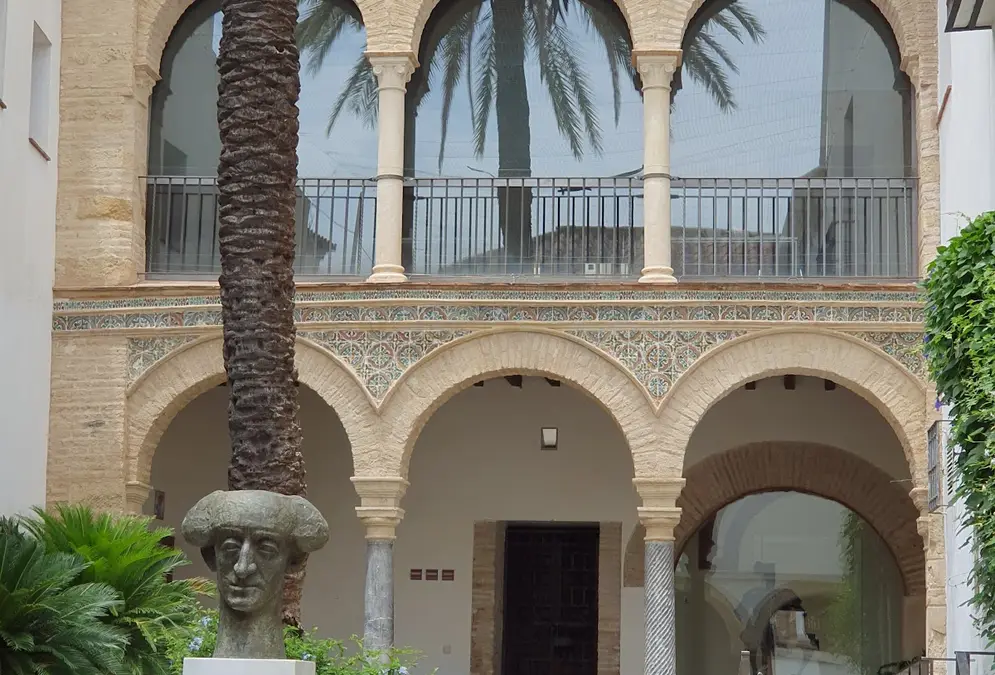
The museum sits inside the Casa de las Bulas, a 16th-century aristocratic mansion on Plaza de Maimónides in the Judería, two minutes' walk from the Synagogue and five from the Mezquita-Catedral. The house has belonged to the Góngora family since 1605 and stands as an example of Mudéjar architecture — the carved timber ceilings and horseshoe-arched galleries read differently from the purer Renaissance palaces elsewhere in the centre. The interior courtyard — stone arches, potted geraniums, the particular quiet of a shaded patio on a summer afternoon — is worth seeing before you've looked at a single exhibit.
The building's own history took a detour before it became a bullfighting museum: the city purchased the property in the mid-20th century and ran it as a craftsmanship museum from 1954, only rededicating it to bullfighting in 1983 as the sport's cultural weight in Córdoba kept growing. It closed again for restoration between 2005 and 2014, reopening with the stonework and display galleries visitors see today.
Shaded stone courtyards are common currency in the Judería — both the Casa de Sefarad and Casa Andalusí build their visits around a similar patio. What sets the Casa de las Bulas apart is that its display cases line the surrounding galleries rather than sitting apart from the architecture: the trajes de luces and photographic archives read as part of the house's fabric, not furniture dropped into a restored shell.
The five Caliphs and what they left behind
Each of the five matadors gets dedicated space across the museum's six exhibition halls, which trace bull-rearing, matador training, and the city's bullfighting heritage in sequence. Lagartijo (Rafael Molina Sánchez) and Guerrita (Rafael Guerra Bejarano) dominated the late 19th century, their rivalry filling the Córdoba bullring and making this city the center of gravity for the entire profession. Machaquito (Rafael González Madrid) carried the tradition into the early 20th century.
The collection's emotional weight falls on Manolete — Manuel Rodríguez Sánchez, born in Córdoba in 1917 — who fought through the austerity years of the 1940s and became, for many Spaniards, the defining figure of the postwar period. He remains the only matador in the history of the sport to die at the horns of a bull: he was fatally gored by Islero in the Linares bullring on August 28, 1947. His death at 30 sent the country into genuine public mourning. The museum holds his personal effects, photographs, and several of his trajes de luces — the embroidered silk and gold-thread suits that matadors wear in the ring. The needlework on these costumes is extraordinary up close, each jacket weighing several kilos before the fight even begins.
El Cordobés (Manuel Benítez Pérez) closes the sequence, his rock-star persona and crowd-pleasing style representing a deliberate break from the classical tradition of the four who came before him.
What to expect on your visit
Across the six halls, the displays include mounted bull heads, capes, swords, posters, sculptures, paintings, and extensive photographic archives — a complete visual record of how deeply the tradition runs through Andalusian culture. QR codes throughout the galleries link to audio and video content in English, which matters — the Spanish-only panels can leave non-speakers with gaps. Budget 45 to 60 minutes for a thorough visit.
Admission is €4 for adults, €2 for students, and free for children under 13. Entry is free on Fridays, which makes it an easy add-on to a morning walk through the Judería. The Casa de Sefarad is 90 seconds away on the same street — the two make an efficient pairing for a neighborhood afternoon.
The museum is closed on Mondays. Winter hours (September 16 to June 15): Tuesday to Friday 8:30–20:45, Saturday 8:30–16:30, Sunday 8:30–14:30. Summer hours (June 16 to September 15): Tuesday to Saturday 8:30–15:00, Sunday 8:30–14:30.
A cultural note: the museum presents bullfighting as an art form and a piece of Córdoba's urban identity. It does not engage with the ongoing debate about the ethics of the corrida. Visitors who want that context will need to bring it themselves.