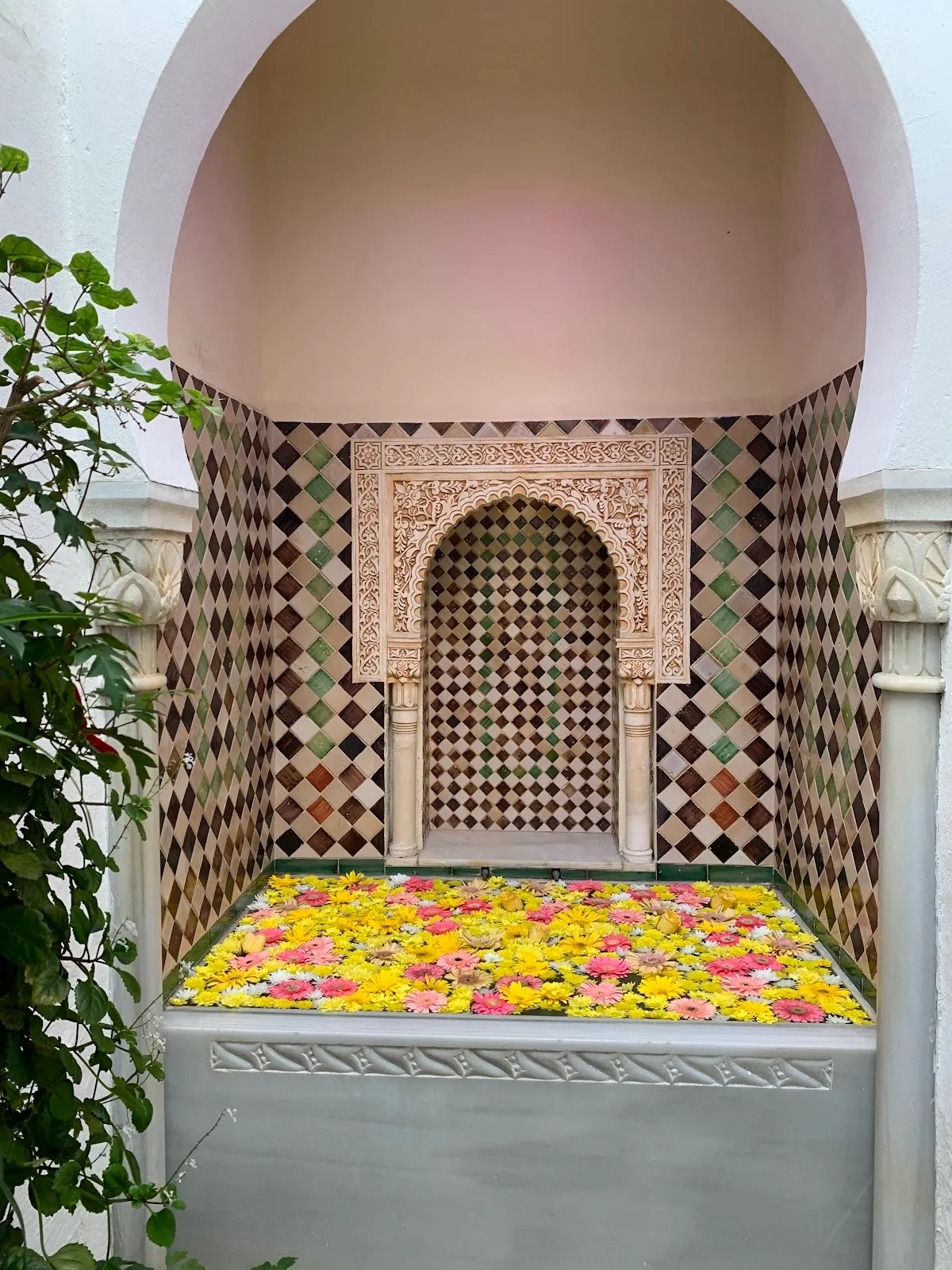

Two doors on Calle Judíos 12-14, one combined ticket, and a span of medieval Islamic science that most visitors to the Judería walk straight past. The Casa Andalusí is a restored 12th-century civil house that opened as a museum in 1997 after a careful restoration; next door, occupying the upper floor of an adjacent 13th-century house, sits the Al-Iksir Alchemy Museum. They share a courtyard, a ticket desk, and a subject: the intellectual and domestic life of Al-Andalus.
Casa Andalusí: the house and the Paper Museum
Cross the threshold and the street noise disappears. Stone floors, a central fountain whose water fills the courtyard with sound, greenery overhead — this is a Moorish domestic world reconstructed room by room rather than dressed up for visitors. Below the house, a cellar holds a Roman mosaic and the start of a network of underground galleries that once ran beneath the old city walls of the Jewish Quarter, a reminder of how many building phases sit stacked under this one street.
The museum's most specific room is the Paper Museum, which walks through how paper was manufactured in Caliphate-era Córdoba, anchored by a model of the first papermaking machines to reach the Western world. Nearby cases hold collections of ancient coins alongside everyday caliphal-era objects — the kind of material that rarely survives outside a restoration this careful.
The house is 50 meters from the Synagogue and two minutes from Casa de Sefarad, which covers the Jewish dimension of the same neighborhood. The Mezquita-Catedral is a ten-minute walk east.
Al-Iksir: the alchemy laboratory
Al-Iksir is the more unusual of the two museums, and it occupies the upper floor of the house next door. The reconstructed alchemical laboratory holds alembics, a lapidary, and a small observatory, alongside displays of alchemy stones, elixirs, medicines, and mortars. A reconstructed zodiac wheel and explanatory videos cover how medieval Islamic alchemists linked astronomical observation to the preparation of medicines and the transformation of matter — treated here as an early chemical science, not mysticism. An audio-guide carries you through the exhibits at your own pace.
This is not a large museum, but it covers ground that nowhere else in Córdoba addresses.
Practical information
Both museums are open daily 10:00-20:00. Entry to the Casa Andalusí alone costs €4; Al-Iksir alone is €5; the combined ticket is €7.50. Groups of 15 or more pay €3 per person. The phone is +34 957 290 642.
The address is Calle Judíos 12-14, in the heart of the Judería, about 30 seconds on foot from the Synagogue. Budget 60-75 minutes for both museums together.