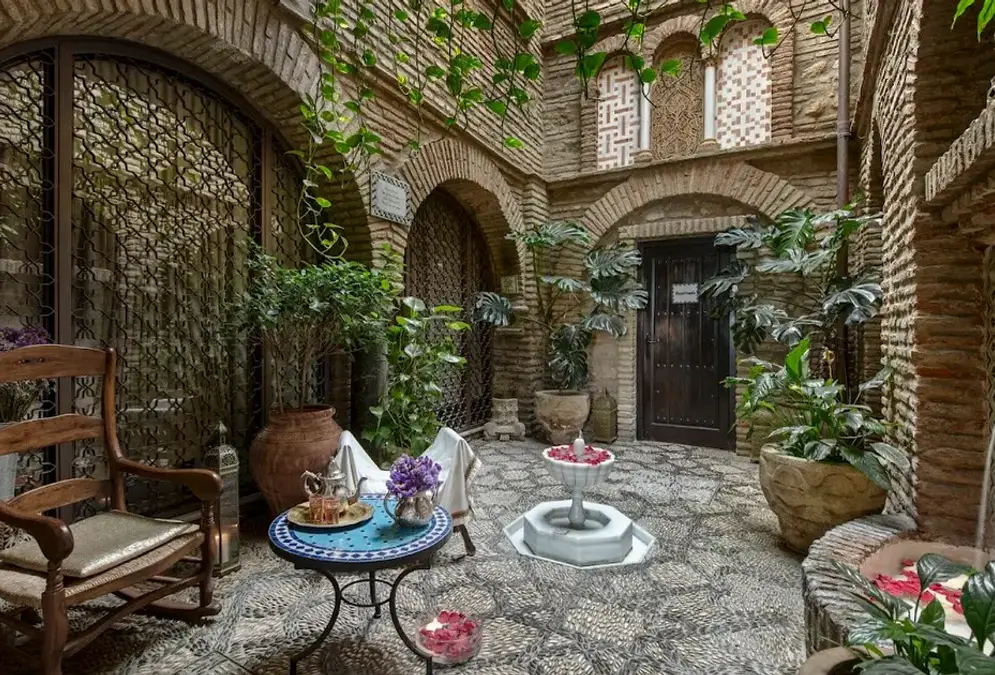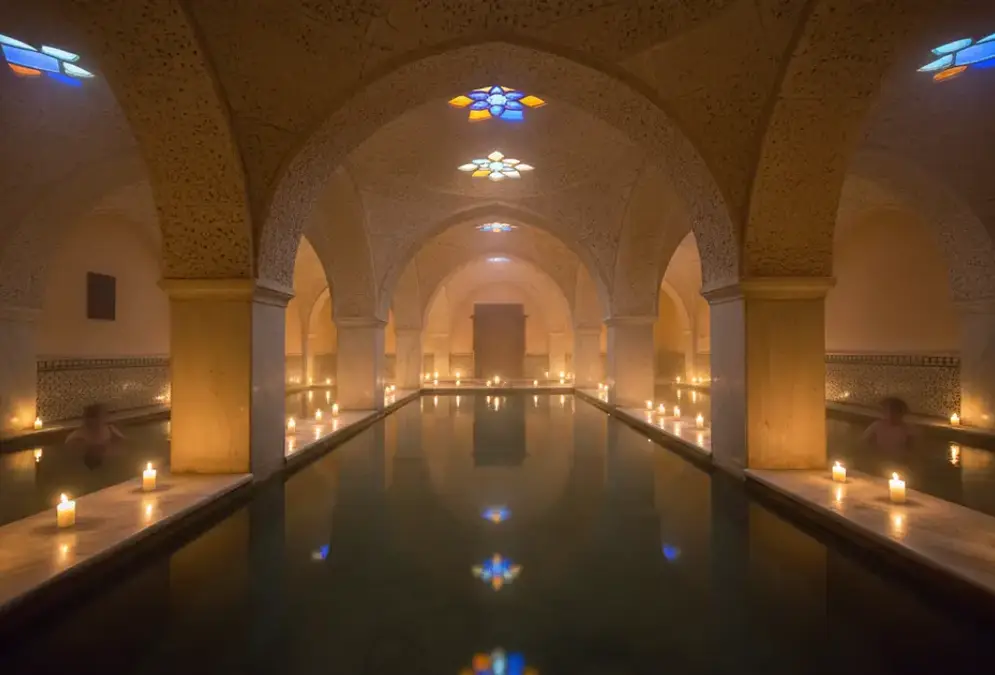

Five minutes from the Mezquita, this hammam occupies a restored 9th-century building in the heart of the Judería. By the Caliphate's peak in the late 10th century, Córdoba had accumulated hundreds of public bathhouses — rivalling the great cities of the Islamic world. Hammam Al Ándalus revives that tradition in rooms with barrel vaulted ceilings, lit through star-shaped stained glass windows that scatter coloured light across the water.
The Arab bath tradition in Al-Andalus
The hammam was not an amenity. In Caliphate Córdoba it was social infrastructure: contracts negotiated in the warm room, friends gathered after Friday prayer, scholars and merchants sharing the same benches. The bath served ritual purposes too, as Islamic law requires ablution before prayer. When Abd al-Rahman III built the Medina Azahara in the 10th century, every residential quarter had its own hammam. Public baths followed a standard layout inherited from Rome and adapted by Moorish engineers: an underfired stone floor (hypocaust) circulating hot air from below, octagonal skylights to vent steam and regulate temperature, columns salvaged from earlier Roman structures. This building dates to the 9th century and retains its original bones.
The thermal circuit in practice
Three pools at 18°C, 36°C and 40°C trace the classical Andalusian sequence. The ritual runs cool to warm to hot, with a cold plunge at the end. The 40°C pool opens the pores and loosens deep muscle tension. The cold pool at 18°C closes them again; the contrast sharpens circulation in a way that a shower cannot replicate. The steam room sits off the main hall, tiled in dark terracotta, the air thick with eucalyptus. Sessions run 90 minutes. There is no audio, no phones, no photography inside the baths. The sound is water, the occasional low voice, and the drip of condensation from the vault above.
Packages and treatments
The thermal circuit alone (from €12) is enough for most visitors. If you want more, two upgrades are genuinely worth considering. The Mimma massage (15 or 30 minutes, essential oils on a heated marble slab) targets specific muscle groups and pairs well with the circuit; the 30-minute version is the one to book. The Midra 30 package adds the Kessa scrub: natural red soap applied warm to the skin, then worked in with a kessa mitt in the Moroccan tradition. It reads as aggressive on paper but leaves skin noticeably smoother. Skip the basic 15-minute massage and either go full circuit-only or invest in the Midra 30. The mid-range options in between do not add much. Full packages run to €67.
What to bring and what is provided
Bring your own swimwear; it is mandatory throughout. Everything else is provided: towel, swimming cap, bathrobe, secure locker, shower products, shampoo, hair dryer, body lotion, and unlimited water. Changing rooms are separate for men and women. The pools are mixed-gender. There are no single-gender sessions; if that is a concern, check directly with the hammam before booking.
After the circuit, the relaxation room serves mint tea with dried fruit. The room is quiet and carpeted, with low seating. Most people linger 20 to 30 minutes. The scent in that room, cedar from the woodwork and dried rose from the tea, is part of the experience. Do not rush it.
An evening for two
The late slot (10 pm to midnight) has a different quality: fewer people, dimmer light, and no background noise from the street. It also sells out first, sometimes days ahead on weekends. The couples massage in a private room can be added to this session and turns the evening into something genuinely different from a standard spa visit. More ideas in the Romantic Córdoba guide. Pair with a late dinner in the Judería afterward, or a walk to the Roman Bridge when the city is quiet. For the full picture of Córdoba after dark, see the Córdoba at night guide.
Booking and timing
Online booking is required. The hammam recommends 24 to 48 hours in advance; in practice, the popular slots (evening, weekends) disappear faster. Book the week before if your dates are fixed. The Hammam Al Ándalus ticket and booking guide covers all session types, package pricing and exactly how far ahead to reserve each slot. Midweek mornings (Tuesday to Thursday, 10 am to noon) are the sessions with fewest people and most room to move between pools. The building is on Calle Corregidor Luis de la Cerda, 51, a five-minute walk from the Mezquita. Arrive 30 minutes before your session for check-in and locker assignment.
A separate hammam, Baños Árabes de Córdoba on Calle Almanzor, also operates in the Judería with its own self-paced circuit and pricing, run by a different business.
After the hammam, the Judería and its lanes are right outside the door. The Mezquita is a logical pairing for a full day in Andalusian heritage. For summer days when you want water outdoors instead, the natural swimming pools of the Sierra Morena offer a completely different version of the same impulse.
Hammam Al Ándalus features in the Top 10 Activities in Córdoba and the Top 15 Highlights of Córdoba, both useful starting points for planning your time in the city.