
Search the site

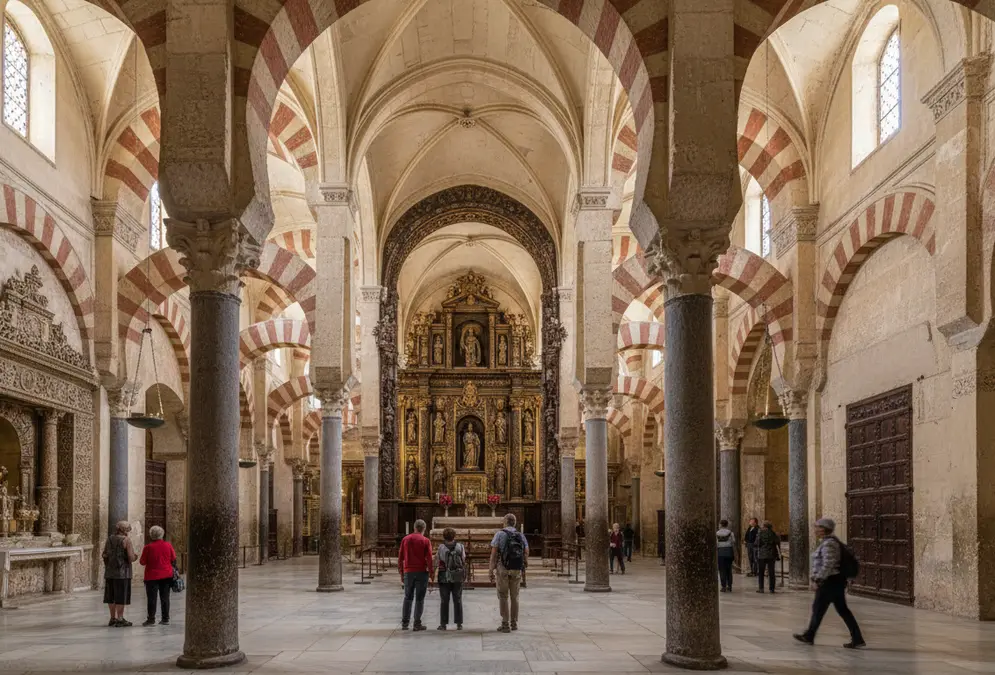
The striped arches of the Mezquita-Catedral interior in Córdoba, showing Islamic columns and Christian cathedral elements coexisting in the same space
Heritage Moderate Free

Three Cultures Heritage Route

Walk 3 km through medieval Córdoba where Islamic, Jewish, and Christian cultures built monuments within metres of each other. 9 stops, ~3 hours, free.

Download PDF guide

At a Glance

Distance
3 km
Duration
3 hours
Stops
9 stops
Route type
Circular
Best time
September to November and March to May. Avoid July and August unless you start before 9:30am — the Judería's stone lanes trap heat by late morning. Evenings work well in summer: most monuments close by 7pm but the outdoor sections stay pleasant until dark.
Accessibility
Mostly cobblestone surfaces throughout the Judería and Centro neighborhoods. The Mezquita and Alcázar have wheelchair-accessible entrances but the approach streets have uneven stone. The Caliphal Baths have steps at the entrance with no ramp. Flat-soled shoes are essential for everyone.

Route Map

Loading map…

Click on any marker to see stop details. Numbered markers follow the suggested route order.

Stop-by-Stop Route

  1. 1
    Mezquita-Catedral
    Monument 45-60 min

    The route starts here, and for good reason. Abd al-Rahman I began construction in 784 on the site of a Visigothic church, building over it rather than destroying it — a pattern that repeats across this entire walk. The 856 columns, the mihrab pointing toward Mecca, and the cathedral nave inserted in 1523 without demolishing the mosque: this is what three layers of faith in one building looks like.

    Tip: Enter from the Puerta del Perdón (north, off Calle Cardenal Herrero) as early as possible. The €13 entry fee includes the bell tower, but book online — the first entry slot often sells out by 8am.

  2. 2

    The Mezquita's bell tower was built over the original Umayyad minaret between 1593 and 1664. The lower third of the structure is original caliphal brickwork: you can see the transition where the geometric Islamic decoration gives way to Renaissance stonework about 12 metres up. The tower is included with Mezquita entry.

    Tip: The views from the top show the full layout of the Judería — you can map the walk ahead from here. Lift access available for limited mobility visitors.

  3. 3
    Episcopal Palace
    Monument 10 min

    Built by the Christian bishops after the Reconquista on the site of the Umayyad palace complex, the Episcopal Palace makes the power transfer explicit. The current building is largely 18th-century Baroque, but the foundation stones are caliphal. It sits directly beside the Mezquita — bishop and mosque, wall to wall.

    Tip: The exterior courtyard is open to the public — in spring, orange blossom fills the whole space with scent. The interior is institutional and not worth entry unless you're interested in diocesan archives.

  4. 4
    Caliphal Baths
    Monument 20 min

    A 10th-century hammam hidden on a side street off Calle Velázquez Bosco, the Caliphal Baths are among the least-visited monuments in the historic center. The three thermal rooms — cold, warm, and hot — are still structurally intact. The star-shaped skylights let in the same quality of light they've admitted for a thousand years.

    Tip: Entry is €3.50 (reduced €1.75). Check opening hours before you go — the baths are sometimes closed for private events. Mid-morning on a weekday and you'll likely have them to yourself.

  5. 5

    Built by Alfonso XI in 1328 on the foundations of the Umayyad palace, the Alcázar sits at the southwest corner of the historic center. The Roman mosaic fragments displayed inside were found here during excavations — a fourth layer underneath everything else. The gardens, with their long reflecting pools and orange trees, follow the Islamic garden tradition that the Christian monarchs kept intact.

    Tip: The Alcázar is free on Friday mornings (10am–2pm). The tower views require a short climb but show the full arc of the city's historic layers. Gardens stay open late in summer — often until 10pm.

  6. 6
    Synagogue of Córdoba
    Monument 15 min

    Built in 1315, this is one of only three surviving medieval synagogues in Spain. The prayer hall is small — perhaps eight by seven metres — but the Hebrew and Castilian inscriptions on the walls are remarkably preserved. The synagogue was converted to a chapel after the 1492 expulsion, which is the only reason it survived. Entry costs €0.30.

    Tip: EU citizens enter free. Go in the first hour after opening — the room holds about 15 people comfortably and tour groups book it solid from 11am onward. The upper women's gallery has the best view of the carved stucco panels.

  7. 7

    Maimonides Statue and Plaza Tiberiades

    Landmark 10 min

    In the middle of the Judería, a small plaza holds the bronze statue of Moses ben Maimon — Maimonides — born in Córdoba in 1135. He was rabbi, physician to the Sultan of Egypt, and one of the most influential Jewish philosophers of the medieval world. His right foot is perpetually polished by hands that have touched it for luck over decades. A good place to stop and think about what the city once was.

    Tip: The plaza is also a shortcut between Calle Judíos and Calle Almanzor — locals use it as a through-route, which means it's one of the few squares in the Judería that doesn't fill entirely with tourists.

  8. 8
    Casa de Sefarad
    Museum 30 min

    A private museum in a restored 14th-century house, Casa de Sefarad covers Sephardic culture in five thematic rooms: Jewish traditions, the history of Córdoba's Jewish community, medieval medicine, women's roles, and Sephardic music. The collection is compact but well-curated. The room dedicated to the 1492 expulsion — with maps of where Sephardic communities scattered to after leaving Spain — is particularly affecting.

    Tip: Entry is around €4. The museum sometimes hosts live Sephardic music on weekend evenings — check the notice board at the entrance when you arrive. The gift shop has one of the better selections of books on medieval Córdoba in the city.

  9. 9

    Built in the early 15th century as a Mudéjar chapel, San Bartolomé is the clearest example of Christian-Islamic synthesis on this route. The azulejo tile panels on the lower walls, the geometric plasterwork in the upper register, the interlacing arches above the altar: all of it comes from Islamic craft traditions, built by artisans who had converted but kept working in the same vocabulary. The cross above the altar looks like it belongs to a different building.

    Tip: Entry is €2.50. The chapel is tucked into the northern edge of the Judería — easy to miss if you're not looking for it. It's within 200 metres of the Mezquita but almost no one visits because there's no signage from the main tourist streets.

In the 10th century, Córdoba was the largest city in Western Europe — a place where a Muslim caliph, a Jewish philosopher, and a Christian bishop could walk the same street. This route traces that coexistence through nine sites across 3 km of the Judería, Centro, and San Basilio neighborhoods, starting and ending at the Mezquita-Catedral. No transfers, no route ticket required.

The Mezquita-Catedral sets the scale: 856 columns of jasper, marble, and granite, a mosque built from 784 under Abd al-Rahman I with a cathedral wedged into its center in 1523. The Alcázar de los Reyes Cristianos sits on Umayyad foundations built on Roman ones. The Caliphal Baths off Calle Velázquez Bosco — a 10th-century hammam — are small, intact, and almost always empty. In the Judería, the Córdoba Synagogue (1315) is one of only three surviving medieval synagogues in Spain; it costs €0.30 to enter and the Hebrew inscription reads as clearly as it did 700 years ago. Fifty metres away, the Casa de Sefarad covers Sephardic culture in five rooms, and the bronze statue of Maimonides — born here in 1135 — stands in a small plaza with his right foot polished bright from decades of luck-touching. The Capilla de San Bartolomé closes the route: a Mudéjar chapel where the Islamic geometry on the tile walls is so complete that the cross above the altar looks like it belongs to a different building.

Allow three hours at a comfortable pace — 45–60 minutes inside the Mezquita, 15 for the synagogue, 30 for Casa de Sefarad. Start at 9:30am: the stone is still cool, the tour groups haven't arrived, and the morning light on the striped arches is different from anything you'll see later in the day. Flat-soled shoes are not optional — the Judería's cobblestones punish anything with a heel.

Three Cultures Heritage Route FAQ

What does 'three cultures' mean in Córdoba?

It refers to the medieval coexistence of Muslim, Jewish, and Christian communities in Córdoba during the caliphate period (929–1031 AD). Under the Umayyad caliphs, the city reached 500,000 inhabitants and became the intellectual capital of Europe. The three communities lived in defined but overlapping quarters, shared trade, and produced scholars — including Averroes (Islamic philosophy) and Maimonides (Jewish philosophy), both born in Córdoba.

Is the Three Cultures Route free?

The walk itself is free. Individual monuments charge entry: the Mezquita-Catedral costs €13 (book online), the Alcázar costs around €4.50 (free on Friday mornings), the Synagogue is €0.30 (free for EU citizens), Casa de Sefarad is around €4, the Caliphal Baths cost €3.50, and the Capilla de San Bartolomé is €2.50. Budget around €25–28 per person if you enter everything.

How long does the Three Cultures Route take?

Three to four hours at a comfortable pace, with time spent inside the major monuments. If you skip the interior of the Mezquita (already visited separately) and do the route as an exterior walk with brief stops, you can cover it in 90 minutes. The Mezquita alone accounts for 45–60 minutes of that time.

When did the three cultures of Córdoba end?

The Jewish community was expelled from all Spanish territories in 1492 under Ferdinand and Isabella. The Muslim population faced forced conversion after the final Reconquista in 1236, with most practicing Muslims gradually expelled or converted over the following two centuries. By 1502, the formal coexistence had ended, though Mudéjar craftsmen (converted Muslims) continued working in Christian-commissioned buildings well into the 16th century — which is why the Capilla de San Bartolomé looks the way it does.

Do I need to book the Mezquita in advance?

Yes. Online booking is strongly recommended — first entry slots (9:00–9:30am) regularly sell out the day before. Book at least 48 hours ahead during spring and autumn peak season. Tickets cost €13 for adults; the bell tower is included. On-the-day queuing at the door is possible but you may wait 30–45 minutes and miss your preferred entry time.

More Walking Tours