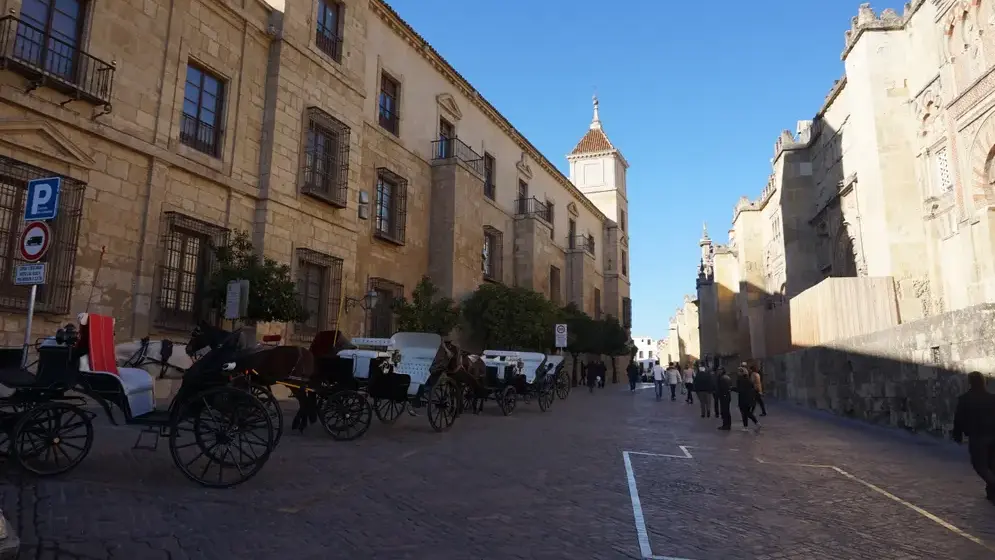

The Palacio Episcopal de Córdoba stands opposite the western façade of the Mezquita, in the Judería. Its centrepiece is a baroque central courtyard with a monumental staircase beneath a polychrome stucco vault — the most ornate interior space in Córdoba that most visitors never bother to enter.
When to Visit
Best season
Year-round
Quietest hours
Weekday mornings 9:00–11:00
Visit duration
45 minutes – 1 hour
Fourteen Centuries of History on One Site
Built over a 6th-century Visigothic palace, the building was used as a fortress during the Umayyad dynasty before becoming the bishop's residence after the Reconquista of 1236. The current structure layers several periods: Visigothic foundations, Arab elements from the Caliphate era, 15th-century Gothic pointed arches, and baroque additions from the 18th and 19th centuries. If you stand in the courtyard and look carefully, you can read about 1,400 years of Córdoba through the building's walls. That long tenure had at least one violent interruption: in June 1808, French troops occupying the city during the Napoleonic Wars looted 100,000 reales from the palace as part of a four-day sack of Córdoba's churches and palaces — read the full account in the 1808 sack of Córdoba.
The Visigothic foundations were confirmed by archaeological investigations in the 20th century. Fragments of Visigothic stonework — column capitals and carved panels — are incorporated into the museum displays on the lower level and allow direct comparison with the later Islamic and Christian layers of the building above them.
Free with your Mezquita ticket — just walk across the street
Most visitors don't realize their Mezquita ticket includes the Episcopal Palace. After the mosque-cathedral, cross the street and enter. The baroque courtyard and polychrome stucco vault are among the most ornate surfaces in Córdoba, seen by almost nobody.
The Diocesan Museum of Fine Arts
The museum holds works from churches across the diocese: religious sculpture from the 13th to 18th centuries (altarpieces, crucifixes), Spanish paintings from the Sevillian and Cordoban schools, liturgical furniture, illuminated psalm books, and tapestries from the cathedral. The baroque courtyard is as much a reason to visit as the collection.
The polychrome stucco vault above the staircase is the most theatrical interior surface in the building — painted in multiple colours with figurative and architectural motifs, it shows the 18th-century ambition for the palace as both a working episcopal residence and a statement of ecclesiastical prestige. For more art in the city, see our complete guide to Córdoba's museums.