The 1880 Repair That Revealed a Mosque Ceiling and Lost a Mural
How fallen plaster in 1880 led to a Baroque vault's collapse in Córdoba's Villaviciosa chapel, uncovering an Islamic ceiling as a Gothic mural cycle vanished.
Art history background with eight years writing interpretive content on Córdoba's Caliphal heritage.
Published
history-buffsarchitectureart-lovers
Some plaster fell in the Villaviciosa chapel of the Mezquita in October 1880, and the bishop was encouraged to restore the altarpiece[1]. Taking it apart brought down a Baroque vault and exposed an Islamic ceiling, while the 14th-century mural cycle on the walls disappeared the same year. The paintings were no secret, since they had been known since 1875, and no source says who took them down.
Plaster falls
Oct 1880
Loose plaster prompts Bishop Ceferino González to restore the altarpiece[1]
Grant for cathedral repairs
100,000 ptas
Granted in December 1878 to restore Córdoba Cathedral[2]
Survivor, per cathedral
1 head
Cathedral says only the Head of Christ survives, shown at the Museo de Bellas Artes[3]
In this article
Jump to a section
⌄
What the Baroque vaults were covering
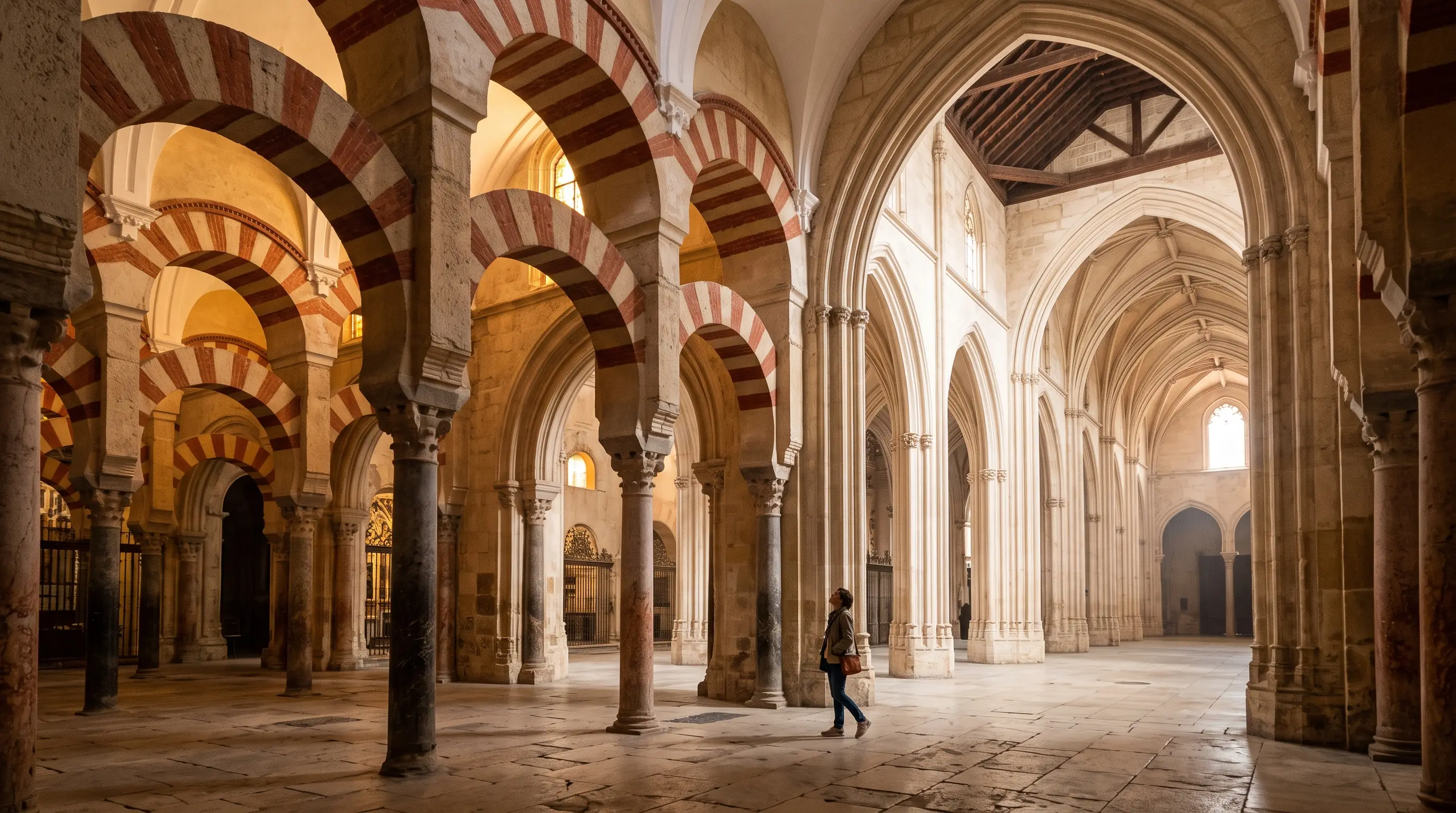
By 1880 the chapel was a stack of layers, and the oldest were out of sight. Baroque vaults had been laid over the caliphal structure of the chapel[4], and a Baroque altarpiece filled the end wall.
Some people already knew what lay behind them. In 1875 Rodrigo Amador de los Ríos, accompanied by the architect Rafael de Luque y Lubián, was aware of the wall paintings[5]. The paintings were not news. What was missing was a reason to open the chapel up.
A word on dates, since this chapel's are easy to muddle. The cathedral credits its Gothic nave to Bishop Íñigo Manrique, between 1486 and 1496[6], decades before Charles V's 1523 nave, and dates the frescos of the earlier main chapel to 1351[7]. Never 1371: that year belongs to the Royal Chapel, finished under Enrique II of Trastámara[8], which rose behind al-Hakam II's old skylight bay, the former main chapel at the end of the Villaviciosa nave[9].
A grant, an architect and a bishop's altarpiece
A grant of 100,000 pesetas to restore Córdoba Cathedral was secured in December 1878[2]. Works under the architect Rafael de Luque y Lubián began six months later[10].
That is the money and the machinery behind 1880. The Mezquita-Cathedral was a building site, and the Villaviciosa chapel was one corner of it.
Between 1879 and 1881 the chapel's religious furnishings were cleared out. The central altarpiece went to the church of Jesús Crucificado[11].
The bishop's part needs stating carefully. Fray Ceferino González encouraged the restoration. No source credits him with finding anything.
October 1880: the altarpiece comes down and a vault follows
Restoring the altarpiece meant dismantling it first.
Taking it apart brought down the lath-and-plaster Baroque vault[12]. Behind it stood the Islamic ceiling, together with Gothic paintings and interlaced arches. A repair to a piece of church furniture had turned into an excavation of the building.
The result was not a quiet one. The study names a second architect, Felipe Saínz de Varanda, as director of the intervention on the ceiling and calls it highly controversial[13]. The cited passage does not spell out the objections.
The timeline is short and crowded, which is why it is worth setting out.
Timeline
1351
Fresco cycle
Painted in the original main chapel, per the cathedral.
1486-96
Gothic nave
Bishop Íñigo Manrique builds it.
1875
The paintings are known
Amador de los Ríos and Luque are aware of them.
1879
Works begin
Luque's repairs start six months after the grant.
Oct 1880
Plaster falls
The altarpiece is dismantled and a Baroque vault collapses.
1880
Mural cycle disappears
Painted walls are gone by year's end.
1907
Velázquez Bosco project
Per the Academia inventory, the major artistic restoration project begins.
The mural cycle that disappeared the same year
The wall paintings were the casualty. The cycle, made in the middle of the 14th century, held a triumph of Saints Peter and Paul and a series of Castilian kings around the high walls. It disappeared in 1880[14].
Disappeared is the careful word. None of the accounts names who removed the paintings, or on whose orders.
The cathedral lists a single survivor: a Head of Christ, on display in the Museo de Bellas Artes in Córdoba[3].
A study on Dialnet adds a storage chapter. What was kept sat in the Seminario de San Pelagio until 1939, when Bishop Adolfo Pérez Muñoz deposited it in the museum[15]. The cathedral counts one head; the study speaks in the plural. The two accounts do not obviously agree on how much survived.
What one repair gave and took
The 1880 work did not finish the job. The Real Academia de San Fernando's drawing inventory dates the most significant artistic restoration project for the chapel to 1907, under Velázquez Bosco[16].
The cathedral's page credits him with a different find: the wooden gabled roof of Bishop Manrique's Gothic nave, which he "discovered and recovered" in the 20th century after it had stayed hidden under vaults since the Modern Age[17]. The same page describes that gabled roof as coffered, with painted plant decoration and Latin and Greek inscriptions referring to "Jesus the Saviour"[18].
Recommended tours
Tours are selected for quality, not commission. We earn a small fee if you book — at no extra cost to you.
That timber roof is a separate object from the Islamic ceiling exposed in 1880. The Academia's inventory says Baroque vaults covered the caliphal structure[4], and separately describes the chapel's ribbed (gallonada) vault, built around 960[19]. A collapse in one year revealed a layer, the painted walls went missing in the same year, and later campaigns worked with what remained. For the wider story of the building, see the Mezquita's mosque-to-cathedral history.
One question stays unanswered: who took the paintings down. The Head of Christ is what the cathedral says remains.
Frequently asked questions
What is the history of the Villaviciosa chapel in the Mezquita, and what happened in 1880?
Plaster fell in the chapel in October 1880 and Bishop Fray Ceferino González was encouraged to restore the altarpiece. Dismantling it collapsed a Baroque vault and exposed the Islamic ceiling, with Gothic paintings and arches. The 14th-century mural cycle on the walls disappeared in the same year. The paintings had been known since 1875.
Did the bishop discover the hidden paintings in the Villaviciosa chapel?
No source credits him with the discovery. Ceferino González encouraged the restoration, but the existence of the wall paintings was already known in 1875, when Rodrigo Amador de los Ríos and the architect Rafael de Luque y Lubián were aware of them.
Was the Villaviciosa chapel built in 1371?
No. The 1371 date belongs to the Royal Chapel, finished under Enrique II. The Villaviciosa Gothic nave is the work of Bishop Íñigo Manrique between 1486 and 1496, and the cathedral dates the chapel's frescos to 1351.
“The execution of the first significant Christian work corresponded to Bishop Íñigo Manrique (1486-1496), with the construction of a large Gothic nave.”
“El ciclo realizado a mediados del siglo XIV comprendía un triunfo de san Pedro y san Pablo y una interesante serie icónica de los reyes castellanos, que circundaba los muros altos y desapareció en 1880.”
“estuvieron almacenados en el Seminario de San Pelagio hasta que en 1939 el obispo Don Adolfo Pérez Muñoz los depositó en el Museo de Bellas Artes de Córdoba”
“In this ceiling we can make out coffers with pictorial motifs representing both plant decoration and Latin and Greek inscriptions referring to "Jesus the Saviour".”