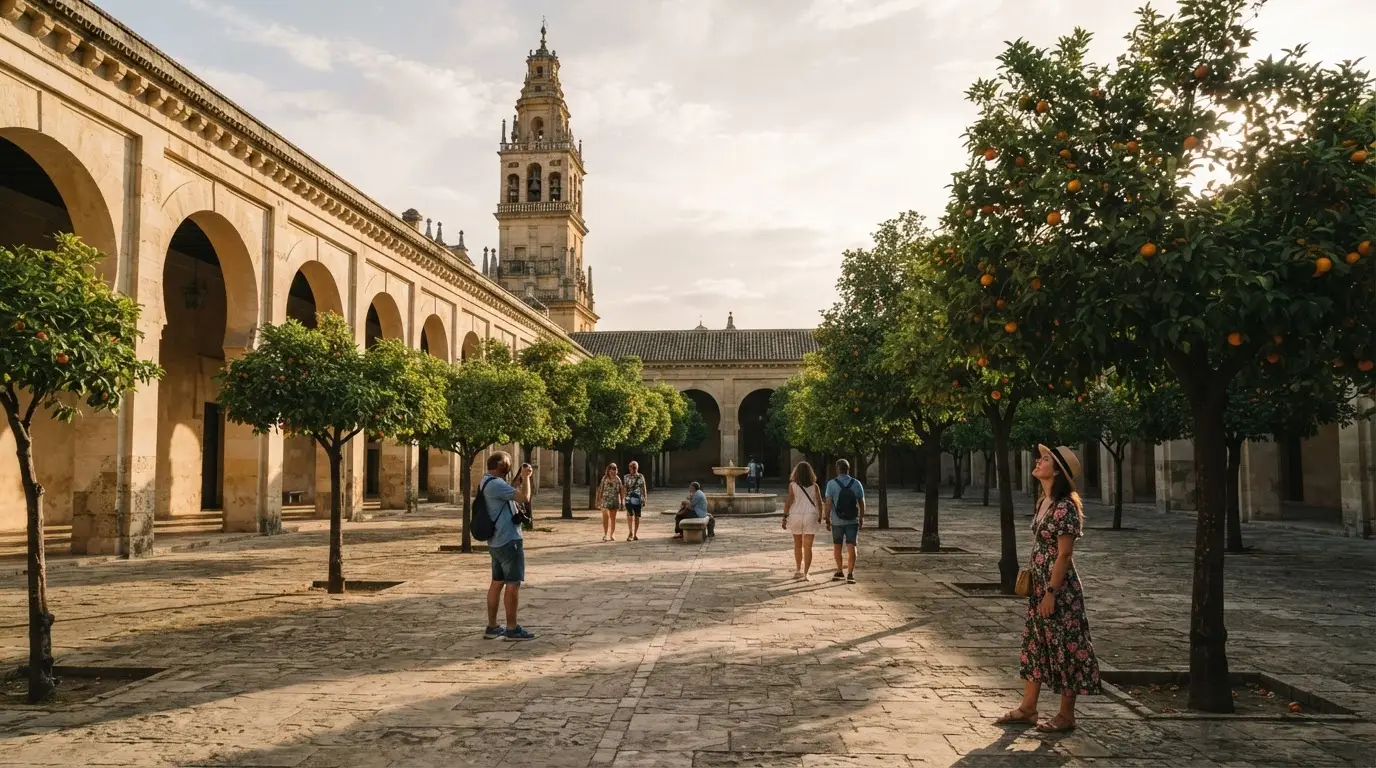

From court of ablutions to cathedral courtyard
The caliphal courtyard was a court of ablutions, a place for ritual washing. The Mezquita-Catedral's own guide says its functions were "very different" from one stage of the building's history to the next.[4]
The Christian era began in 1236, the year UNESCO gives for the cathedral's installation.[5] The courtyard changed with it, slowly. Its three galleries were rebuilt during the episcopate of Bishop Martín Fernández de Angulo (1510–1516), commissioned from the architect Hernán Ruiz I.[1] That is some 270 years after the cathedral arrived, so this was reshaping by instalments, not by decree.
Water never left. The courtyard still has the fountains of Saint Mary and of the cinnamon.[6]
Reinoso's garden: orange rows that continue the columns
The courtyard visitors photograph today is younger than its galleries. Bishop Francisco Reinoso, working between 1597 and 1601, proposed using the space as a garden. The planting that followed gave the courtyard its name and its look: orange trees, palms and cypresses in rows, laid out "as if they were the outward continuation of the columns found in the prayer hall."[7]
Read that sentence twice and the geometry clicks. Inside, the Mezquita-Catedral is a forest of columns; outside, the grove repeats the rhythm in living wood. A courtyard planted for its architecture is, in my view, a more natural host for plant-based art than a bare square would be.

Explore nearby · Monument
Mezquita-Catedral de Córdoba
856 columns, 1,300 years of Islamic and Christian history. UNESCO monument in Córdoba, Andalusia. Red-and-white arches, Byzantine mosaics, a Renaissance nave.
2024: the Cabildo cedes the courtyard again
The decision belonged to the Cabildo, the cathedral chapter. In 2024 it ceded the Patio de los Naranjos to FLORA once more.[8] Its dean-president, Joaquín Alberto Nieva, said the chapter was boosting the Mezquita-Catedral's cultural dimension "in a novel and diversified way" (translated from the Spanish).[9]
By 2025 the arrangement had a record. The Mosque-Cathedral was one of four venues returning for a third consecutive year, alongside the Palacio de la Merced, the Palacio de Viana and the Palacio de Orive.[10]
The artists noticed what they were working inside. Michael Putnam, who made the 2025 courtyard piece, put it in one line: "Fue mezquita y ahora catedral. Estoy obsesionado con estas capas de la historia" ("It was a mosque and now a cathedral. I'm obsessed with these layers of history").[11]
What FLORA means by art in a courtyard
FLORA's artistic director describes the project as taking patio culture and reinterpreting it through contemporary art (translated from the Spanish).[12] The installation is the art format, and the idea is "to arrive at a courtyard and try to tell it another way."[13] The director adds that no other event approaches floral installations from the contemporary-art angle.[14] That is the festival's claim about itself, but it explains why a heritage courtyard is the brief rather than the backdrop.
Each year starts with a theme chosen to inspire the artists.[15] Four floral designers are invited, and a fifth place goes to an applicant from a related design industry.[16] Artists may use organic materials such as fresh flowers, potted plants and branches.[17] The artists are not paid. The director says they come because the festival lets them make work they cannot make elsewhere, and that they take no fee for coming.[18]
The prizes are first, second and an audience award chosen by public vote.[19] After judging, the displays are dismantled and the materials get a second life in a non-competitive Guerrilla FLORA installation.[20] The plant material is then recycled once more and offered to anyone in the community who wants it.[21]
Among the pieces the Patio de los Naranjos has hosted:
Putnam's remark about the mosque-turned-cathedral is quoted above. The 2026 piece follows below.
FLORA 2026: five courtyards and one theme
FLORA's ninth edition runs from 12 to 22 October 2026.[2] The installations are on show from 16 to 21 October, and a closing Guerrilla Flora takes place on 22 October.[25]
Five artists from South Korea, France, Spain, the United States and the United Kingdom transform five courtyards and compete for two prizes.[26] The programme places Halcyon, by Sohee Park, in the Patio de los Naranjos.[27] The prizes are €25,000 for first place and €10,000 for second.[28]
The theme is "Ephemeral", which Cordópolis ties to the speed at which current affairs pass.[29] The festival says its installations are ephemeral in duration and in material, flowers and plants.[30] Set that beside the courtyard: trees planted to be permanent now frame art designed to be temporary.
FLORA's founder told Cordópolis the festival opens conversations between heritage and contemporary art.[31] Guerrilla Flora puts recycled festival material to work in new ephemeral pieces.[32] For schedules, venues and the full line-up, see the FLORA festival page.
Seeing the courtyard during FLORA
The festival says its floral installations can be visited continuously from 11:00 to 20:00, Friday to Wednesday.[3] El Debate's report on the programme adds that the exhibition, 16 to 21 October, is free and open access.[33] The festival's practical page makes access to all its activities free except where otherwise indicated,[34] and Turismo de Córdoba says the installations can be visited for free.[35]
What the Mezquita-Catedral's courtyard page does not say is how the courtyard is entered outside the festival. Before you go, check festivalflora.com or the Mezquita-Catedral's official site.
Recommended tours
Tours are selected for quality, not commission. We earn a small fee if you book — at no extra cost to you.
For wheelchair users, the festival provides ramps and purpose-built inclined platforms in its courtyards.[36]
Deep dive · Article
Game of Thrones' Dorne: Córdoba's Real Architecture
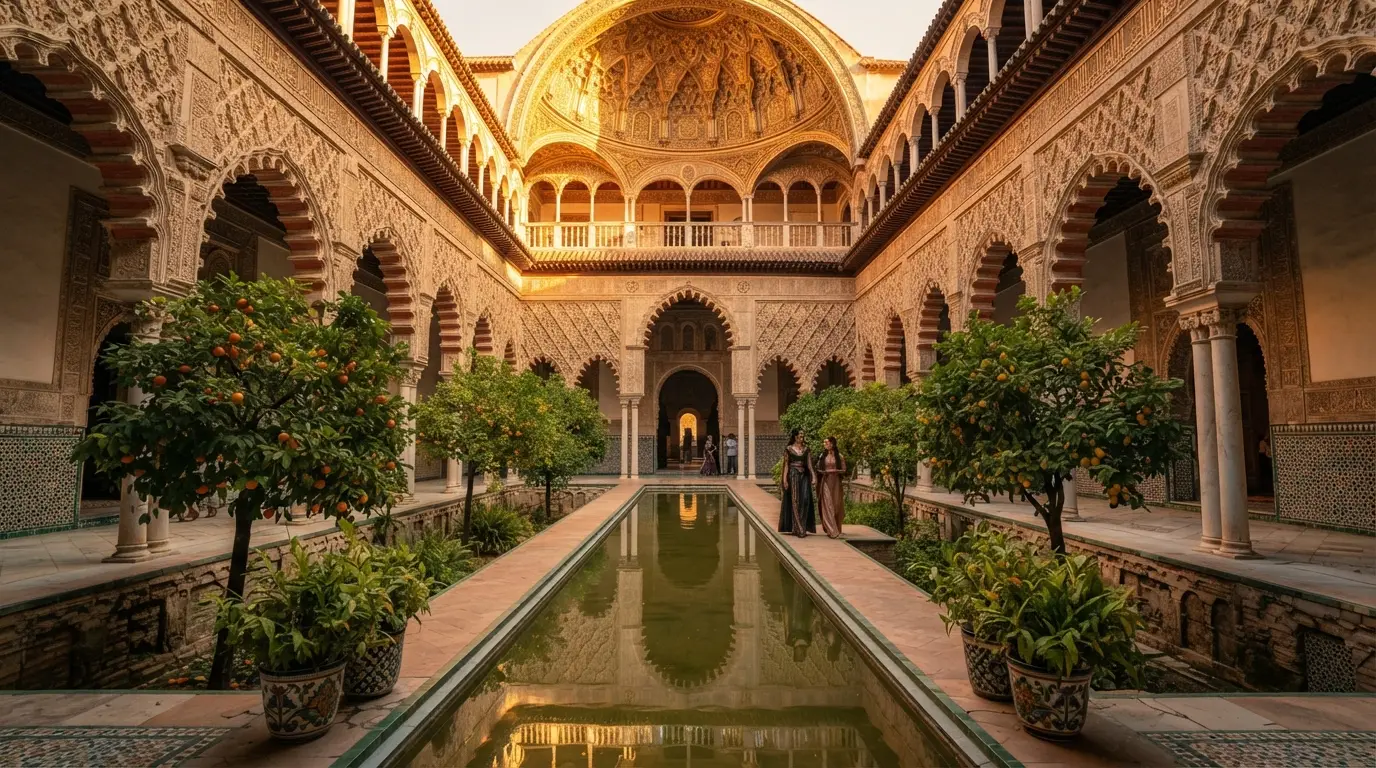
HBO's Game of Thrones built Dorne's look from medieval Córdoba's Umayyad architecture: horseshoe arches, muqarnas domes, though filming happened in Seville.
UNESCO's description of Córdoba's historic centre says its courtyard houses "heighten the presence of water and plants in daily life."[37] FLORA sits inside that tradition, which is also the subject of why Córdoba's patios open for only 12 days a year. The orange rows were there first, and they will still be there when the flowers are gone.