UNESCO's official name for this Córdoba monument is 'Historic Centre of Cordoba,' not Mosque-Cathedral: built as a mosque in 785, a cathedral since 1236.
Art history background with eight years writing interpretive content on Córdoba's Caliphal heritage.
Updated Published
history-buffsart-loverssolocouples
The Córdoba Diocese became the legal owner of a UNESCO World Heritage Site in 2006 by paying a nominal fee. Not through a court judgment, not through a centuries-old deed, but by invoking a Mortgage Law provision that required no conventional proof of title, a provision repealed by legislative reform in 2015 amid unresolved constitutional objections that were never tested in court. The building was an Islamic great mosque from 785, a Catholic cathedral from 1236, and the argument over what to call it and who controls it has never quieted.
In this article
Jump to a section
⌄
Three authorities, three names, thirty metres apart
Stand outside the ticket booth on Cardenal Herrero and you will notice something odd. The queue-management signs say "Catedral." The UNESCO plaques say "Mosque-Cathedral of Córdoba." The audio guide available in six languages hedges between the two. Taxi drivers in the city have called it la Mezquita for generations, full stop.
The naming is not a pedantic quibble. What the building is called determines, in part, who feels entitled to control it, who may worship inside, and which legal framework governs its future. UNESCO inscribed the mosque in November 1984 and subsequently — after extending the inscription in 1994 to the surrounding historic district — adopted the name Historic Centre of Cordoba (site 313bis) as the official World Heritage designation[1][6]. The "Mosque-Cathedral" framing visible on plaques throughout the site reflects Spain's domestic heritage law and local convention, not the UNESCO title. The Catholic Church's preferred designation is simply "Cathedral of Córdoba" or "Santa Iglesia Catedral." Activist groups have long insisted on "Mezquita" and argue that the Church-preferred name erases the Islamic heritage that makes the building singular.
In the years since 2010, documented disputes broke out over signage, audio-guide scripts, and ticket language, with the Church making several attempts to reduce the prominence of "Mezquita" in official visitor materials. Some reversals followed public pressure. The inconsistency remained. A visitor in 2026 may still encounter "Catedral" on the approach and "Mosque-Cathedral" on the monument plaques within thirty metres of each other.
That inconsistency is what this article is about. The Mezquita visitor guide covers what to expect inside; the Mezquita-Catedral entity page has hours and access details. This piece addresses the question those logistics pages do not: whose building is it, and how did we get here?
Four rulers, two centuries, one prayer wall facing the wrong direction
The site is sometimes said to be the location of a Visigothic basilica dedicated to San Vicente, said to have stood there from the mid-6th century, with remains attributed to it reportedly visible in the San Vicente area within the current structure, though this attribution is itself disputed. Recent archaeological work disputes this: excavators have argued the buried remains are late-Roman residential structures rather than a church, while others maintain the Christian-occupation evidence still points to a religious building. The question is unresolved. When the Umayyad prince who escaped the Abbasid massacre fled Abbasid persecution and established the Umayyad Emirate of Córdoba in 756, he initially shared the site with the Christian community before purchasing the Christian half and demolishing the building. Construction of the new mosque began around 785 and was complete by 788.[2]
Timeline
c. 550
Traditional site of San Vicente basilica
Traditionally identified as a Visigothic Christian basilica; recent archaeology disputes this, finding no confirmed church remains
785–788
Abd al-Rahman I builds the mosque
Original structure with 11 naves; first minaret added under Hisham I in 788
833–966
Three expansions
Abd al-Rahman II (833–848), Abd al-Rahman III's minaret (951–952), Al-Hakam II's mihrab (962–966)
987–988
Almanzor's expansion
Final enlargement eastward; current footprint established
1236
Ferdinand III's conquest
June 29: mosque consecrated as Cathedral of Our Lady of the Assumption
1523–1713
Renaissance cathedral inserted
Hernán Ruiz dynasty builds Gothic-Baroque nave inside the Islamic prayer hall
1984
UNESCO World Heritage inscription
November 2: inscribed as a World Heritage Site (ref. 313); extended and renamed Historic Centre of Cordoba (ref. 313bis) in 1994[6]
2006
Church registers ownership
Córdoba Diocese registers the building for a nominal fee under Article 206 of the Ley Hipotecaria
By the mid-2010s
PMCC petition launched
Platform for the Mosque-Cathedral of Córdoba petition demands public ownership and restoration of the Mezquita name[10]
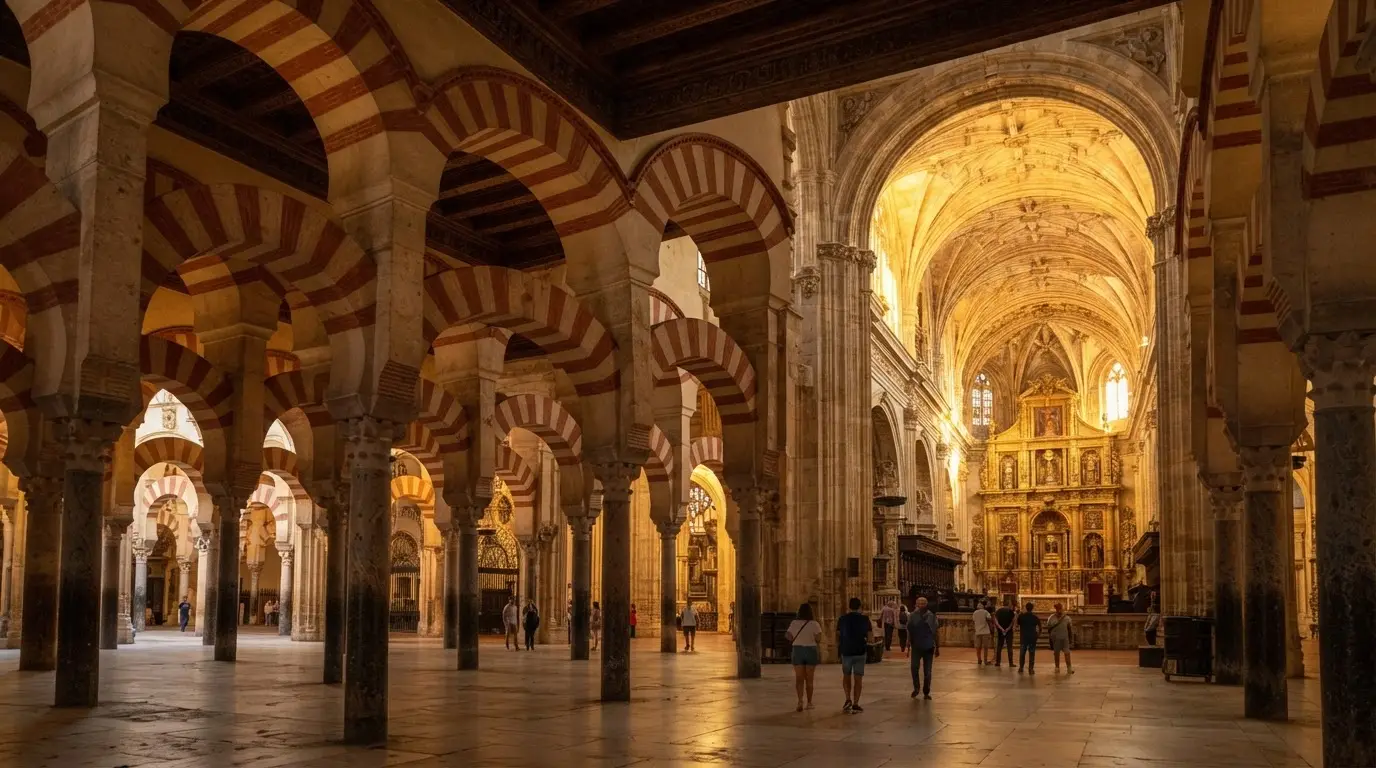
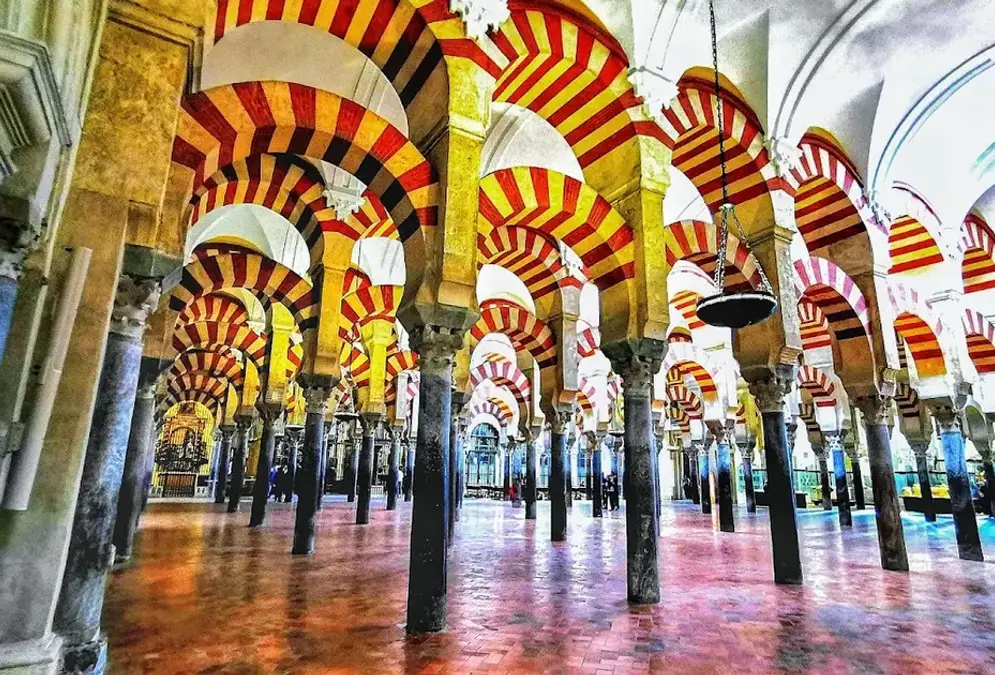
The original building had eleven naves arranged perpendicular to the qibla wall, the prayer wall facing roughly south rather than directly toward Mecca. This orientation reflects early Islamic practice, not error, and its exact cause remains a point of scholarly discussion. It gave the prayer hall its distinctive longitudinal depth, a depth that four separate rulers would extend across two centuries:
Abd al-Rahman II added eight naves to the south between 833 and 848
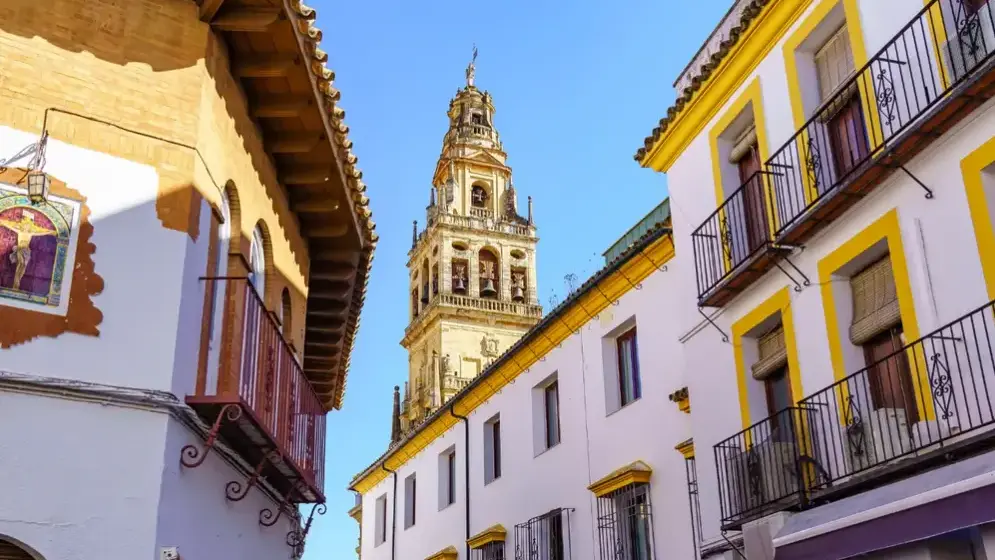
Abd al-Rahman III commissioned a new minaret reaching 47 metres in 951–952[3], later encased in the current bell tower
Al-Hakam II refurbished the mihrab and added some of the most refined Byzantine-influenced mosaics on the Iberian peninsula between 962 and 966[4]
Almanzor (al-Mansur) extended the structure eastward between 987 and 988, establishing the mosque's current footprint
Abd al-Rahman III was building Medina Azahara outside the city walls during these same years. The palace-city and the mosque were conceived as twin demonstrations of Umayyad power. By the 10th century, Córdoba ranked second in the Islamic world after Baghdad, and the mosque was its visual centre. A century and a half later, the grandfather of Averroes (the philosopher who would transmit Aristotle to Christian Europe) served as its chief imam under the Almoravid dynasty, binding three generations of the ibn Rushd family to this building.
The emperor who authorised demolition and later regretted it
King Ferdinand III of Castile conquered Córdoba on 29 June 1236, the feast day of Saints Peter and Paul, and consecrated the mosque as a Catholic cathedral the same afternoon. The first Christian mass was held before the day was out. Unlike Seville and Toledo, where Islamic structures were demolished and rebuilt, Córdoba's mosque was preserved. Christian authorities chose to insert their worship into the standing Islamic architecture rather than erase it, a decision whose consequences are still argued over. For a close account of what those first hours and decades actually changed — and what was left untouched for nearly three centuries — see The Mezquita Conversion: What 1236 Actually Looked Like.
Recommended tours
Tours are selected for quality, not commission. We earn a small fee if you book — at no extra cost to you.
For nearly three centuries after 1236, the additions were modest: side chapels attached to the outer walls, a choir, minor modifications that left the prayer hall substantially intact. Then, in 1523, Emperor Carlos V authorised the construction of a full Renaissance cathedral nave inside the body of the mosque[7][9]. The project proceeded against the wishes of Córdoba's city council and, according to historical records, some of the local Christian congregation. Bishop Alonso Manrique de Lara commissioned the work; the architect Hernán Ruiz I began the transept that year, a project continued by Hernán Ruiz II and Hernán Ruiz III into the 17th century.
Carlos V reportedly visited the finished cathedral some years after authorising it, though no primary source confirms he made a specific trip to Córdoba to inspect the work. He is widely reported to have said: "Habéis destruido lo que era único en el mundo, y habéis puesto en su lugar lo que se puede ver en todas partes" — "You have destroyed what was unique in the world, and put in its place what can be seen anywhere." The quote appears consistently across Spanish cultural and academic sources; no direct primary document has been traced, and it should be understood as a famous attributed statement rather than a verified transcript. That it persists so stubbornly in the record says something about how the decision was perceived, even at the time. The provenance of the quote, the question of whether Carlos V actually visited Córdoba in 1526 at all, and the full political circumstances of the 1523 decision are examined in our full account of the emperor's famous regret.
“
“You have destroyed what was unique in the world, and put in its place what can be seen anywhere.”
Emperor Carlos V, attributed, 1526
What the 1984 UNESCO inscription actually fixed — and what it left open
On 2 November 1984, UNESCO inscribed the Mezquita-Catedral on the World Heritage List as site number 313[1]. The inscription was extended in 1994[6] to include the entire Historic Centre of Córdoba — and it is under that broader name, "Historic Centre of Cordoba," that site 313bis is officially listed today, placing the monument within a wider landscape that also encompasses the Judería and Roman remains.
The UNESCO designation carries two consequences. It fixes an internationally recognised name that explicitly acknowledges both the Islamic and Christian identities, without subordinating one to the other. It also creates obligations: World Heritage status requires that any significant modification be notified to the World Heritage Committee, and that Outstanding Universal Value be maintained. Activist groups have periodically invoked these obligations in the ownership dispute, though UNESCO has not intervened formally on the question of title.
The 1994 inscription extension is sometimes confused with a structural expansion of the mosque itself; these are separate events.[6] The four architectural enlargements of the mosque were all complete before 994. The 1994 action extended the protected perimeter to the surrounding historic city. The mosque's physical form has been unchanged since Almanzor's eastward expansion, over a thousand years ago. That continuity is partly why the legal and political argument around it has intensified rather than quieted.
A Nominal Fee and a Mortgage Law: how the Church registered the Mezquita
In 2006[7][11], the Córdoba Diocese registered the Mezquita-Catedral in the Spanish Property Register as the "Holy Cathedral Church of Córdoba" (Iglesia Catedral Metropolitana de Córdoba). The registration cost a nominal fee, according to contemporaneous investigative press reporting.
The legal mechanism was Article 206 of the Ley Hipotecaria (Spain's Mortgage Law), a provision that allowed bishops to certify Church ownership of property without presenting conventional documentary proof. The provision had historical roots in a 1946 Franco-era law[7]; it was expanded in 1998 under José María Aznar's PP government, which brought places of worship under this right of private registration[11]. The Church used this provision across Spain to register numerous properties, the Mezquita being the most prominent.
Nominal fee
What the Córdoba Diocese paid to claim ownership of a UNESCO World Heritage Site in 2006, using Article 206 of Spain's Ley Hipotecaria, a provision that allowed bishops to certify ownership without title deeds. The article was repealed by legislation (Law 13/2015) in 2015.
A commission of legal experts convened under Córdoba's city council (led by then-mayor Isabel Ambrosio, PSOE) subsequently concluded that the Church had never held documented ownership of the Mezquita in the conventional legal sense: the 2006 registration was performed without the Church presenting title deeds in the manner that any private citizen would be required to produce[7]. Article 206 was repealed by Law 13/2015 (Ley 13/2015, de 24 de junio)[5], a legislative reform that eliminated the bishops' self-certification provision. The registration itself was not reversed. As of the most recent public reporting, the Córdoba Diocese remains the legal registered owner of a UNESCO World Heritage Site[7].
The story of the nominal-fee registration reached the public through investigative journalism (El Diario, El Salto, Nueva Tribuna, and others), not through official disclosure. The Church's use of a provision repealed amid unresolved constitutional objections that were never tested in court, applied to the most prominent Islamic monument in Spain, is precisely why the ownership question remains live rather than settled.
Three overlapping disputes that the ownership question hasn't resolved
In autumn 2014, after Google Maps briefly dropped "mosque" from the site's listed name, a petition platform called the Platform for the Mosque-Cathedral of Córdoba (PMCC) launched an online petition on Change.org[10]. It accumulated more than 50,000 signatures within weeks and has gathered close to 500,000 since[10]. The platform's grievances extended beyond the naming incident to the Church's 2006 nominal-fee registration of the building, and its demands included restoring "Mezquita" to official signage, transferring administrative control to a public authority, and requesting UNESCO intervention. The Junta de Andalucía, then under PSOE governance, expressed in-principle support for public ownership; no concrete legislative action followed.
The question of Islamic prayer access became acute in April 2010, before the ownership dispute became public.[8] A group of approximately 118 Muslim youth from Austria, organised as a tour for young Muslims across Europe, entered the monument[8]. A small number began to pray among the marble columns. Security guards ordered them to stop; two men refused and a physical altercation followed. Two were detained by police[8]. The Muslim Youth of Austria (MJO) issued a statement saying the group "was captivated by the beauty and spiritual atmosphere of the place, so much so that a small number of them decided spontaneously to pray." Some eyewitnesses and Spanish media reported that the prayer appeared coordinated: separate entry points, radio communication, a prayer leader screened by other visitors. The truth of what happened inside is contested; both accounts have been published.
Córdoba's bishop condemned the incident. Spanish Catholic authorities maintain a formal policy against Islamic prayer in the space. The policy has not changed since 2010.
The signage dispute, the property registration, and the prayer access question are three distinct but overlapping conflicts. They share the same underlying premise: that the monument itself carries an Islamic identity that remains alive and contested, not merely historical. The full account of the nominal-fee registration, the prayer prohibition (commonly dated to 2003, though undocumented in primary sources), and the UNESCO naming dispute is examined in detail in the modern ownership dispute. The building's Córdoba architecture is frequently cited in heritage debates as the most complete surviving example of Umayyad construction anywhere, which is itself the reason why the argument about who controls it does not quiet down.
Córdoba's contested Islamic, Jewish, and Christian past runs through the city's other layers too: the Stoic philosopher born in Roman Corduba lived under that earlier layer of the city; the culinary argument over the city's braised-oxtail classic belongs to the same story of converging cultures; the patios tradition grew from the same enclosed domestic spaces the Umayyad city made standard. What happens next with the Mezquita depends on decisions in the Spanish courts, the Junta de Andalucía, and possibly UNESCO, not on the opinions of historians or travel writers.
Frequently asked questions
Is the Mezquita a mosque or a cathedral?
Both, historically and structurally. Built as an Islamic great mosque from 785 onwards, it was consecrated as a Catholic cathedral on 29 June 1236 when Ferdinand III of Castile conquered Córdoba. The Islamic prayer hall was never demolished; the Renaissance cathedral nave was inserted inside it from 1523. The 'Mosque-Cathedral' framing seen on-site plaques reflects Spanish domestic usage; UNESCO's own official World Heritage designation is 'Historic Centre of Cordoba.'
Who owns the Mezquita of Córdoba?
The Catholic Church, through the Córdoba Diocese, which registered ownership in 2006 under Article 206 of Spain's Ley Hipotecaria for a nominal fee. The legal mechanism required no conventional proof of title; it was repealed by Law 13/2015[5] — a legislative reform, not a constitutional court ruling, though constitutional concerns had been raised. The registration itself was not reversed. As of the most recent public reporting, the Córdoba Diocese remains the legal registered owner[7], though the Platform for the Mosque-Cathedral of Córdoba (PMCC) — which launched its petition in 2014 after Google Maps briefly dropped "mosque" from the site's name, and whose grievances also include the registration — continues to contest this and argues for public administration.[10]
When did the Mezquita become a cathedral?
On 29 June 1236, the feast day of Saints Peter and Paul, when King Ferdinand III of Castile conquered Córdoba after nearly 500 years of Islamic rule. The mosque was consecrated as the Cathedral of Our Lady of the Assumption (Catedral de Nuestra Señora de la Asunción) the same day, and the first Christian mass was held that afternoon.
Why did Carlos V regret building the cathedral inside the mosque?
In 1523, Carlos V authorised construction of a full Renaissance cathedral nave inside the standing Islamic structure[7][9]. He reportedly visited some years later, though no primary source confirms a specific trip to Córdoba, and is widely attributed to have said: 'You have destroyed what was unique in the world, and put in its place what can be seen anywhere.' The quote is consistent across Spanish cultural and historical sources, though no verified primary document has been traced. His regret (real or attributed) reflects the scale of the architectural intervention, which destroyed a section of the Islamic prayer hall to insert the transept and choir.
What does UNESCO call the Mezquita?
UNESCO's official World Heritage designation for site 313bis is 'Historic Centre of Cordoba,' not 'Mosque-Cathedral of Córdoba.'[1][6] The mosque was first inscribed on 2 November 1984; in 1994, when the inscription was extended to include the surrounding historic district, the World Heritage Committee adopted 'Historic Centre of Cordoba' as the title. The 'Mosque-Cathedral' label visible on plaques at the site reflects Spain's domestic heritage law and local usage, not the UNESCO official name.
Can Muslims pray in the Mezquita?
No. Islamic prayer is formally prohibited by the Church authority that manages the building. The policy came to public attention after an April 2010 incident in which a group of about 118 Austrian Muslim visitors prayed among the columns; security guards intervened, a physical altercation occurred, and two people were detained.[8] Spanish Catholic authorities have maintained the prohibition since. No formal change to the policy has been announced.
Why was the mosque not demolished after the Christian conquest?
Unlike mosques in Seville and Toledo, which were torn down after the Reconquista, Córdoba's mosque was preserved. Christian authorities chose to insert their worship into the standing structure rather than replace it, an unusual decision in medieval Iberia. Historians have proposed practical reasons (the building was structurally exceptional and recent) as well as aesthetic ones (it was simply too remarkable to destroy). The consequence is that the most complete surviving example of Umayyad mosque architecture is inside a functioning Catholic cathedral.
“In 2006, the Diocese of Córdoba registered the building as its own property, under a 1946 law that allows the Catholic Church to register properties in Spain.”
“In April 2010, a group of 118 Austrian Muslims visiting the Mosque-Cathedral of Córdoba attempted to pray inside the building; security guards intervened and a scuffle broke out, resulting in the arrest of two members of the group.”
[9]
mezquitadecordoba.org
“In 1523, construction began on a Renaissance-style cathedral nave inside the mosque, by permission of Charles V.”
“A group of Spanish citizens under the name of Platform for the Mosque-Cathedral of Córdoba mounted an online petition on change.org that accumulated more than 50,000 signatures within weeks and today has close to 500,000.”