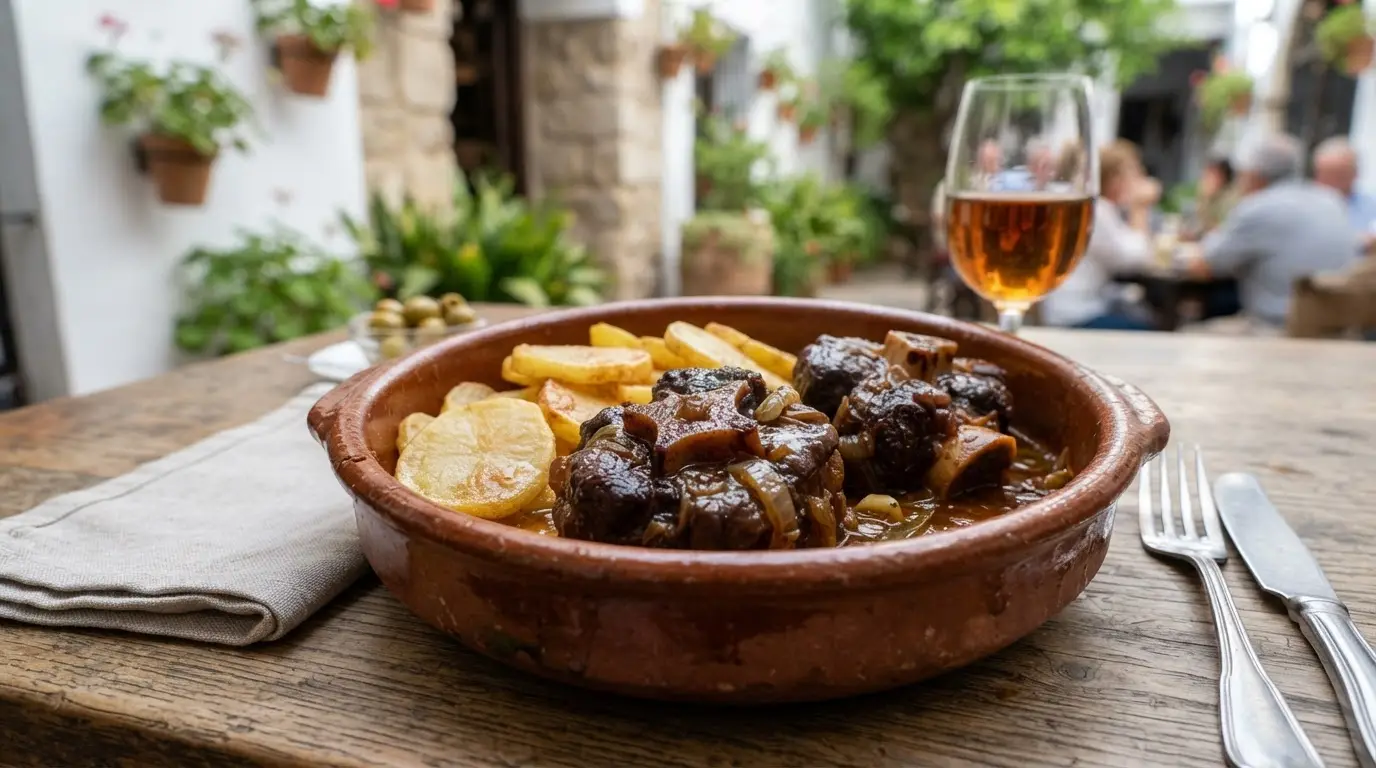

Bone, collagen, and why the cheap cut wins
The tail of a bull, or more commonly today an ox, cut at the joints into segments. Each piece has bone at the centre, a ring of meat around it, and a sheath of collagen holding the whole thing together. That collagen is why the dish works.
A three-to-four hour braise at low heat converts collagen into gelatin — the molecule responsible for the sauce's body. Not a reduction trick, not thickening agents: pure chemistry from a cheap cut. The sauce turns glossy, coats everything, and sticks briefly to your lips. A few potato wedges on the side to soak it up. Sometimes a garnish. That is all.
Córdoba's version uses Montilla-Moriles wine, specifically oloroso or amontillado from the DO south of the city. The wine's oxidative character integrates into the braise and gives the sauce a depth that a standard red cannot replicate. The rabo de toro dish page covers ingredients, seasonal timing, and where to order it. This article is about where the dish came from, and what it cost the people who first made it.
Born at the back door of the bullring
Córdoba in the 19th century had a bullring economy. After each corrida at the Los Tejares bullring, the matador and the organisers faced a practical problem: a dead bull weighing 500 kilos, most of it edible. Premium cuts went to butchers and from there to bourgeois households. The offal — tail, ears, organs, cheeks — had no such market.
The arrangement was informal but understood. Working-class residents gathered at the back entrance. The tail and other cuts were distributed, sometimes free, sometimes for a few coins. A single tail could feed a large family. The people who received them were resourceful rather than sentimental about it.
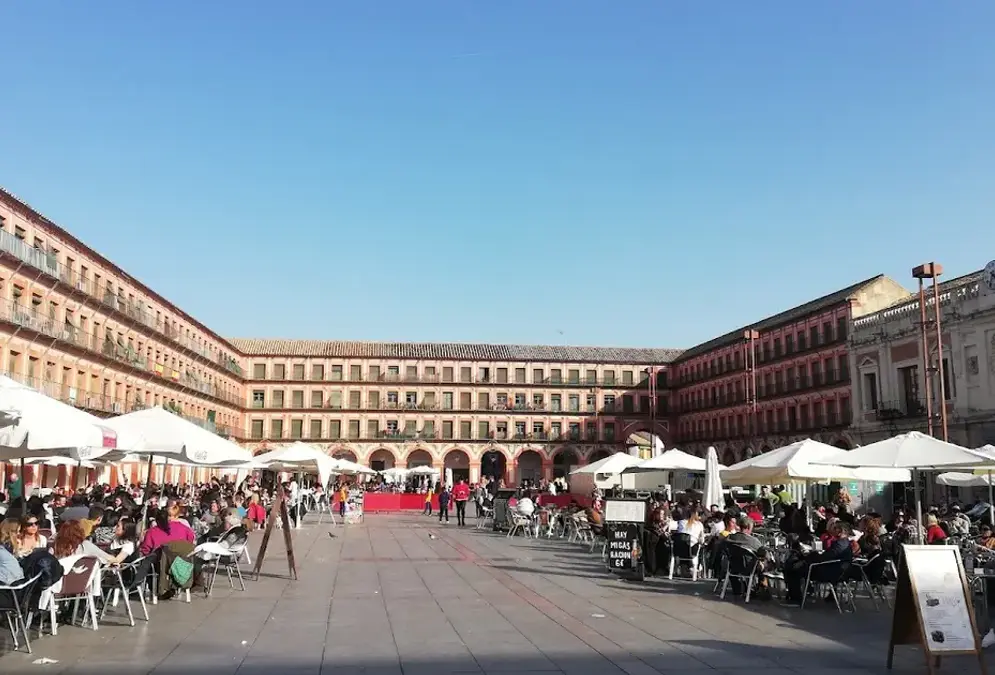
Plaza de la Corredera enters the story as the earlier venue. Built between 1683 and 1687 under magistrate Francisco Ronquillo Briceño on a design modelled after Madrid's Plaza Mayor[1], the square had hosted bullfights since the 15th century. It was around this square and its neighbouring lanes that the taberna tradition took hold, in the places where offal from the corridas reached the working-class kitchen. That continuity matters: Plaza de la Corredera is still surrounded by tabernas today, and some of them still serve rabo de toro.
The class structure built into this distribution was explicit. The tail was not a prized cut. It was what remained after the rest had been claimed. That is the origin: not gastronomy, not tradition — necessity.
Why oloroso beats red wine every time
Rabo de toro belongs to a wider family of Andalusian offal cooking. The tradition runs through:
- Morcilla: blood sausage, spiced and smoked
- Callos: tripe with chickpeas, long-braised until the broth thickens
- Criadillas: bull's testicles, grilled or fried
Read next · Dish
Montilla-Moriles
Córdoba's own wine: Pedro Ximénez grapes on white limestone, producing finos, amontillados and rich sweet wines without fortification. Taste them here.
These dishes share a logic: cheap cuts that demand long cooking times are ideal when firewood is cheap and time is the one resource the poor have in abundance.
The three-to-four hour braise was not a luxury choice. It was the only way to make the tail edible. The same slow-cooking method that transforms collagen into gelatin also breaks down the tougher muscle fibres that make cheaper cuts chewy when cooked quickly. Low heat is the equaliser between a cheap cut and a rich one.
Recommended tours
Tours are selected for quality, not commission. We earn a small fee if you book — at no extra cost to you.
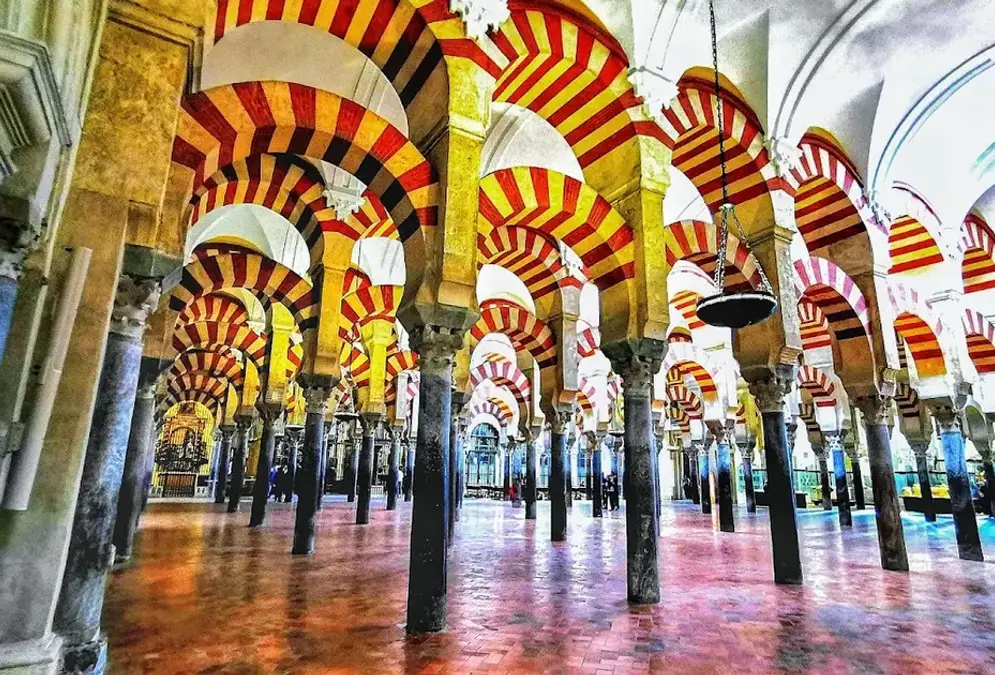
Montilla-Moriles is not interchangeable in this context. The Designation of Origin covers vineyards south of Córdoba, producing unfortified wines (oloroso, amontillado, and Pedro Ximénez) that reach high natural strength through fermentation and sun exposure to the Pedro Ximénez grape rather than through added spirit — unlike sherry from Jerez[2] — and that share the same geographic terroir as the city itself. An oloroso Montilla-Moriles, added to the braise after the initial sear, brings oxidative depth and a slight nuttiness that dry red wine cannot produce. Contemporary chefs sometimes experiment with fino for a lighter result, but the traditional version uses oloroso. A dish called rabo de toro cordobés without Montilla-Moriles in the pot is not quite the thing.
Sibling dishes in the offal tradition (see callos cordobeses above all) follow the same arc: working-class survival food that became a taberna staple and then a point of local pride. Rabo de toro travelled further than any of them, in both price and reputation. It is the one dish where the distance from free offal to a €16–24 main course[5] is, in itself, the argument.
The historian who wrote the dish into legitimacy
Almudena Villegas Becerril was born in Córdoba in 1964[3]. She holds a doctorate in History and won the National Prize for Research in Gastronomy in 2002 for her work on Roman gastronomy and the Mediterranean diet.[3] A member of the Royal Academy of Gastronomy of Spain and the European Institute of Food History, she is the scholar who placed rabo de toro inside a serious academic frame.
Villegas's argument, developed across multiple publications and symposia, treats food as a window into social and economic history rather than as a catalogue of recipes. Applied to rabo de toro, that method reveals the full arc: from the meat economy of the corridas, through the taberna culture that preserved and refined the dish across the 19th and 20th centuries, to its arrival as a gastronomic emblem on restaurant menus across Spain.[3]
Explore nearby · Monument
Plaza de la Corredera
Andalusia's only Castilian arcaded square, built in 1683 over a Roman forum. Once a bullfighting ring, now lined with bar terraces and a Sunday flea market.
In April 2024, the Cofradía del Rabo de Toro Cordobés — the Gastronomic Brotherhood dedicated to protecting the dish's heritage — held the third Simposium on Rabo de Toro, announced and presented to the press at the University of Córdoba's Facultad de Derecho y Ciencias Económicas y Empresariales. The symposium positioned rabo de toro within three domains: culture, gastronomy, and economics. University faculty, business leaders, and cultural administrators sat in the same room to discuss an oxtail stew. That is the distance the dish has travelled.
The context she provides matters if you are eating the dish as a visitor. Rabo de toro is not a regional quirk or a novelty item. It is, in Villegas's framing, a record of how a city at a specific historical moment used what it had. Córdoba's other great intellectual traditions (Averroes reconstructing Aristotle, Seneca writing to a Rome he never quite trusted) produced documents that survived because they were written down. Rabo de toro survived because people kept cooking it.
Where to eat it now, and what bullfighting has to do with it
The short answer to the bullfighting question: almost nothing now. Oxtail in Córdoba today comes from regular cattle processing, not from the Los Tejares bullring or its successor, the Plaza de Toros de los Califas. Rabo de toro is now one node in a broader Córdoba gastronomy that extends from salmorejo to flamenquín. Corridas still take place in Córdoba, but the dish's supply chain separated from the bullring decades ago. Rabo de toro has outlived its origin economy.
That decoupling is worth stating clearly, because the origin story is sometimes presented as a selling point by tourist-oriented restaurants in a way that softens the class dimension of it. The dish was not born from a charming local tradition. It was born from the fact that working families got the cuts that wealthy households did not want.
For the dish itself, three addresses worth knowing in the historic centre:
- El Caballo Rojo on Calle Cardenal Herrero, 28: historic Judería location, traditional Cordoban cooking, the tourist-area version done well
- Taberna Rafaé: credits the bullring origin honestly, and their rabo de toro backs it up
- La Siesta near Plaza del Potro (a historic square that appears in Don Quixote): more of a local address than the Judería spots
Tapa-sized portions are available at bar prices; a full ración runs €16 to €24[5] depending on the house.
Deep dive · Article
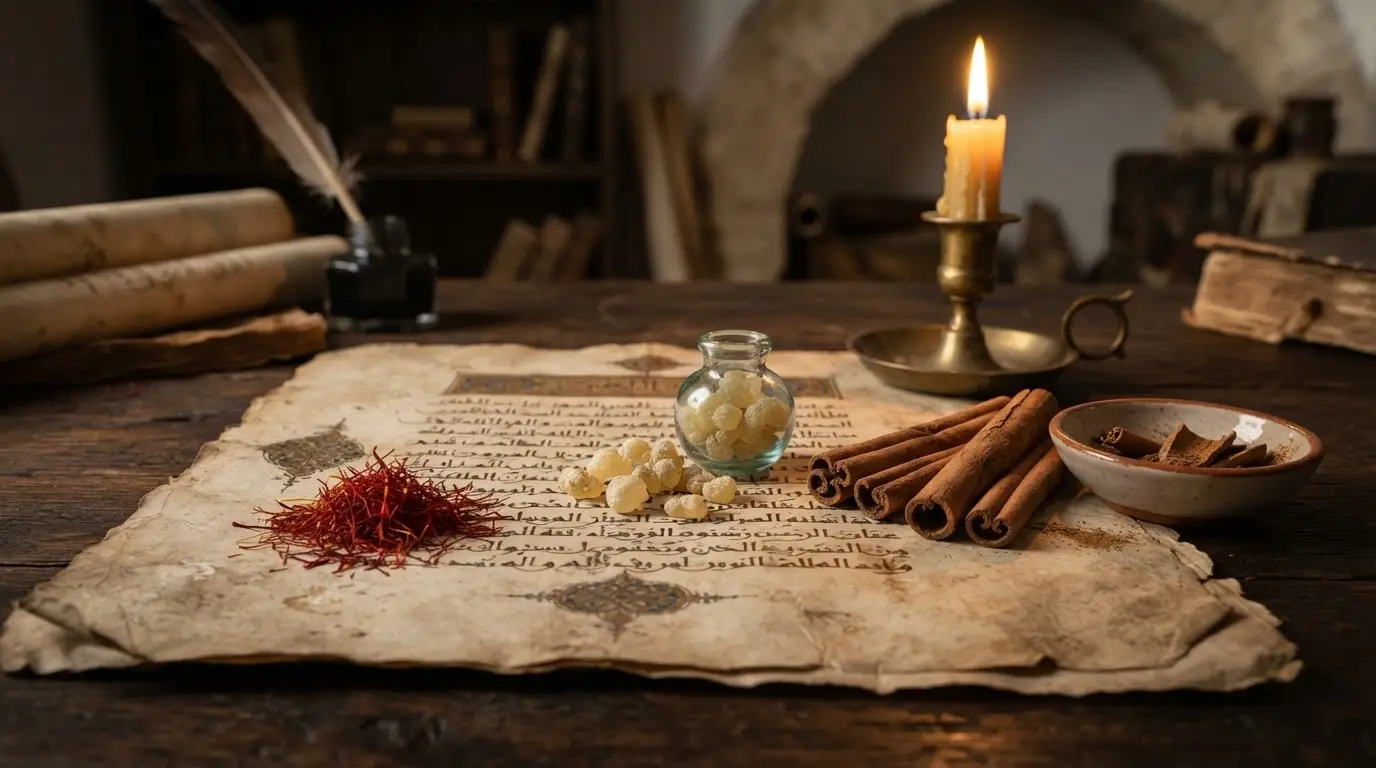
Caliphate Food in Córdoba: How Noor Rebuilt a Lost Kitchen
Paco Morales spent years in medieval manuscripts before opening Noor. What caliphate food córdoba actually was — and how he rebuilt it without a single tomato.
I've ordered rabo de toro more Novembers than I can count, and there's a quick test before the first bite: run a spoon along the inside of the bowl and watch how slowly the sauce closes the track it leaves. Slow and thick means the collagen has fully turned to gelatin, and the meat slides off the bone before the fork does any work. Fast means the kitchen rushed it.
Order it as a shared ración rather than a main if you want to keep eating. The braising liquid is the point — the potato wedges exist to carry it to your mouth. Ask how long the kitchen has been cooking the tail that day. Longer is better, but any competent taberna starts the braise in the morning.
The dish is, as Córdoba's patios are for architecture, one of those things that requires context to fully appreciate. The patios survived because residents maintained them through the 19th and 20th centuries, when the city was poor enough that renovation meant neglect. Rabo de toro survived because tabernas kept cooking it when there was no academic or institutional reason to. Both are the result of continuity rather than revival.