The Mezquita the Church Owns — and Muslims Can't Pray In
The Mezquita prayer ban dates to 2003, when Muslims were reportedly ejected mid-prayer. The Church registered it for a fee in 2006. Naming remains disputed.
Art history background with eight years writing interpretive content on Córdoba's Caliphal heritage.
Updated Published
history-buffsart-loverssoloarchitecture
You walk into the Mezquita-Catedral and you are standing in a building that is, simultaneously, a UNESCO World Heritage Site, a working Catholic cathedral, and a mosque where no Muslim has been permitted to pray since 2003. The Catholic Diocese of Córdoba registered the entire complex as its private property in 2006 for a nominal fee[1], dropping the word "Mosque" from the registered name entirely. The word persists anyway, in Spain's own domestic heritage convention and on the plaques inside — this is not ancient history but the building's live legal status on the day you visit.
In this article
Jump to a section
⌄
A building with two identities and one owner
Most visitors know the broad outline. The building is traditionally said to have started as a Visigothic church — though recent archaeology disputes that a church stood on the site at all — before becoming the Great Mosque of Córdoba from 784, then a Christian cathedral from 1236 onward. Eight centuries of Islamic use. Eight centuries of Christian use. UNESCO inscribed the mosque as a World Heritage Site in 1984, and when the inscription was extended in 1994, adopted "Historic Centre of Córdoba" as the official designation[5]. The "Mosque-Cathedral of Córdoba" label seen on-site reflects Spain's domestic convention, not UNESCO's current title.
What most visitors do not know is the legal and political fight that has been running in parallel since 2003.
The Diocese of Córdoba manages the building as an active Catholic parish. It sets the visitor ticket prices, which are waived for Catholic Mass-goers. It employs the security staff. It controls access to every corner of the interior. And since 2006, the Church has held the property title, registered under the name "Santa Iglesia Catedral de Córdoba" for a nominal fee[1].
The Islamic community of Spain, represented at various points by the Junta Islámica España (Islamic Council of Spain) and individual Muslim visitors, has spent twenty years attempting to gain prayer access. They have been refused at every level: by the Diocese, by the Vatican, and in practice by the Spanish state.
The nominal-fee registration: how a cathedral changed hands for pocket change
The legal mechanism that gave the Diocese its property title goes back to Francisco Franco.
Spain's 1946 Mortgage Law contained a provision allowing the Catholic Church to register properties without going through normal title procedures. A bishop's certificate alone was sufficient: no court judgment, no prior deed of ownership, no independent verification. The provision sat largely unused for decades.
In 1998, the government of José María Aznar (Partido Popular) amended Spain's Mortgage Law in a way that made the process significantly easier to use. The Church moved quickly. Between roughly 2000 and 2015, Spanish dioceses used this procedure to self-register an estimated 34,961 properties[7], including beaches, historic squares, churches, monasteries, and heritage sites. The registration cost was minimal, requiring little more than the bishop's certificate[1].
The Mezquita was registered by the Diocese of Córdoba in 2006[1] as "Santa Iglesia Catedral de Córdoba." The Islamic heritage designation was dropped from the registered name entirely. The registration went largely unnoticed outside Spain until 2013, when investigative journalism, particularly a series in El País, began mapping the full scale of the Church's property acquisitions across the country.
34,961
Properties the Catholic Church registered across Spain using the same Franco-era Mortgage Law provision used for the Mezquita, each for a nominal registration fee[7]. The number was documented by investigative reporting in 2013 and became the central figure in the parliamentary debate that followed.
The building had been under active use as a Catholic cathedral since the 1236 conquest. The Diocese's position was that this use, stretching back nearly 800 years, constituted the functional basis of ownership[2]. The counter-argument was that a bishop's declaration in 2006 cannot substitute for legal title, and that the building's funding, maintenance, and cultural significance had been substantially public throughout its history.
The Spanish state had never formally assigned ownership. The Mezquita existed in a kind of legal grey zone for centuries: managed by the Church, used by Catholics, but never the subject of a formal title transfer from any prior Spanish government. The 2006 registration was, in that sense, the Church filling a vacuum. Critics called it a land grab. The Diocese called it regularisation.
The prayer ban: from ejection to arrest
The prayer ban at the Mezquita predates the 2006 property registration by three years.
The modern ban is commonly dated to 2003, when accounts describe Muslim women attending a conference organised by the Junta Islámica España being ejected by security staff while praying at the mihrab. That specific episode is not documented in primary sourcing reviewed for this piece, but it is consistently cited by Muslim advocacy groups as the origin point. What is well established is the outcome: a formal Diocese policy against Islamic worship in the building, enforced consistently since.
Around 2004, Mansur Escudero, then president of the Islamic Council of Spain, is reported to have petitioned the Vatican for shared prayer rights at the Mezquita[1]. He proposed a model of respectful coexistence: Muslims could pray in the building outside Catholic service hours. The request did not succeed.
Escudero is reported to have tried again around 2006, this time proposing that the building become a shared space open to both faiths[3]. The response, again, was rejection. Escudero then shifted tactics: he began leading Friday protest prayers outside the cathedral walls, on the street, in public view.
Recommended tours
Tours are selected for quality, not commission. We earn a small fee if you book — at no extra cost to you.
The confrontation has periodically sharpened into physical intervention. In one widely reported case, a group of Muslim visitors attempting to pray inside the cathedral were confronted by security staff, who became physically involved in removing them[6]. Incidents like it have drawn international coverage and condemnation from Spanish and international Muslim organisations. The Diocese has defended such interventions as consistent with its policy, and the Spanish government has consistently declined to intervene.
Timeline
1984
UNESCO inscribes the mosque as a World Heritage Site[5]; renamed Historic Centre of Córdoba with the 1994 extension.
2003
Muslim women attending a Junta Islámica España conference are reportedly ejected from the Mezquita while praying at the mihrab — an episode often cited as the ban's starting point, though undocumented in primary sourcing. The Diocese enforces a policy of no Islamic worship.
2004
Mansur Escudero reportedly petitions the Vatican for shared prayer rights[1]. The request does not succeed.
2006
Escudero reportedly renews his petition, proposing a shared space open to both faiths[3]. Rejected again. He begins leading Friday protest prayers outside the cathedral. The Diocese registers the building as its private property for a nominal fee[1].
Late 2010
Mansur Escudero dies. Organised Muslim campaign for prayer access effectively ends.
2013–2015
The Platform for the Mosque-Cathedral (PMCC) secures close to 500,000 signatures[1] demanding public management of the building. No legislation passes.
2017
Muslim visitors attempting to pray inside are confronted by security staff in a physical scuffle[6]. The incident draws international attention.
2022–2024
Prayer ban remains in force. Muslim visitors report continued security monitoring. The Diocese continues daily Catholic Mass.
Mansur Escudero died in 2010, effectively ending the most organised period of Muslim advocacy for prayer access inside the building. The ban has remained in force since. Muslim visitors report that security staff maintain close visual monitoring of anyone who appears to be praying or adopting a prayer posture near the mihrab or in any other part of the interior.
The name war: UNESCO vs. the Diocese
In 2010, the Archbishop of Córdoba issued a directive asking that the word "Mosque" be removed from all tourist signage and official references to the building[6]. The Diocese prefers "Catedral de Córdoba" or "La Catedral." On the Diocese's own website, the building is presented primarily as a cathedral, with the Islamic heritage acknowledged as historical context rather than as a current identity.
UNESCO's own official title, adopted when the inscription was extended in 1994, is "Historic Centre of Córdoba" — not "Mosque-Cathedral of Córdoba"[5]. The "Mosque-Cathedral" framing that persists on-site and in Spanish domestic usage is a heritage-law and site-level convention, not UNESCO's literal designation. What UNESCO's inscription does establish is a principle: the Islamic heritage of the building is not merely historical decoration but constitutive of what the site is — a separate claim from what the building's official title happens to say.
The naming dispute is not trivial. In heritage law and tourism marketing, the name of a site shapes visitor expectations, academic framing, and the cultural identity associated with the building. When the Diocese drops "Mosque," the building becomes straightforwardly a cathedral with a picturesque Islamic interior. When the dual "Mosque-Cathedral" framing is insisted on instead, it holds open the question of what the building fundamentally is.
For a deeper account of the Mezquita's architectural history, the naming conflict is one layer of a much longer argument about what more than a millennium of use and conversion does to a building's identity. The Diocese's answer is that 800 years of Catholic use has settled the question. Advocates for the "Mosque" framing answer that it has not.
Spanish civil authorities have largely stayed out of this specific dispute. The name on tourist signage varies: national tourism bodies tend to lead with the dual "Mosque-Cathedral" framing; local Córdoba signage and the Diocese's own materials favour "Catedral." The two versions coexist in the same city block.
385,000 signatures and a parliamentary debate that changed nothing
The 2006 registration went largely unnoticed for six years. What broke it open was journalism.
In late 2013, a series of investigative reports in El País documented the full scope of Church property registrations across Spain, putting the Mezquita story in context of a national pattern[4]. The coverage was picked up internationally. The Platform for the Mosque-Cathedral of Córdoba (PMCC) was founded shortly after, bringing together Muslim organisations, civil society groups, and secular political parties.
By 2014, the PMCC had gathered close to 500,000 signatures[1] on a petition demanding that the Spanish state reclaim the building and place it under public management. The argument was that the Mezquita belongs to Córdoba and to humanity, not to a diocese, and that a nominal registration fee[1] using a Franco-era loophole cannot substitute for legitimate title.
The petition landed in a charged political moment. Spain's 2015 general elections were approaching. Izquierda Unida (United Left) and the Spanish Socialist Workers' Party both incorporated the Mezquita question into their platforms. Andalusia's Socialist-led regional government formally condemned the Church's registration. Parliamentary questions were raised.
None of it produced legislation. The right-wing parties blocked any bill that would have forced the Church to cede ownership or revoke the registration. The PP government, which had made the 2006 registration easier through the 1998 law amendments, was not going to unwind that mechanism. The PSOE lacked the votes to pass anything unilaterally.
What the campaign revealed was the structural difficulty of the problem. The Church's registration, whatever its merits, was legally completed and registered. Reversing it would require either new legislation specifically voiding Church property registrations (politically impossible at the time) or successful court challenges on procedural grounds. Several court challenges were attempted; none succeeded.
The Aznar-era legal framework that enabled the registrations remains on the books. The Mezquita remains registered in the name of the Diocese of Córdoba. The nearly 500,000[1] signatories did not change that. What they did change is the public conversation: the Church's ownership of the Mezquita is now a live political issue in Spain rather than an accepted background fact.
What they did change is the public conversation: the Church's ownership of the Mezquita is now a live political issue in Spain rather than an accepted background fact.
What this means when you visit
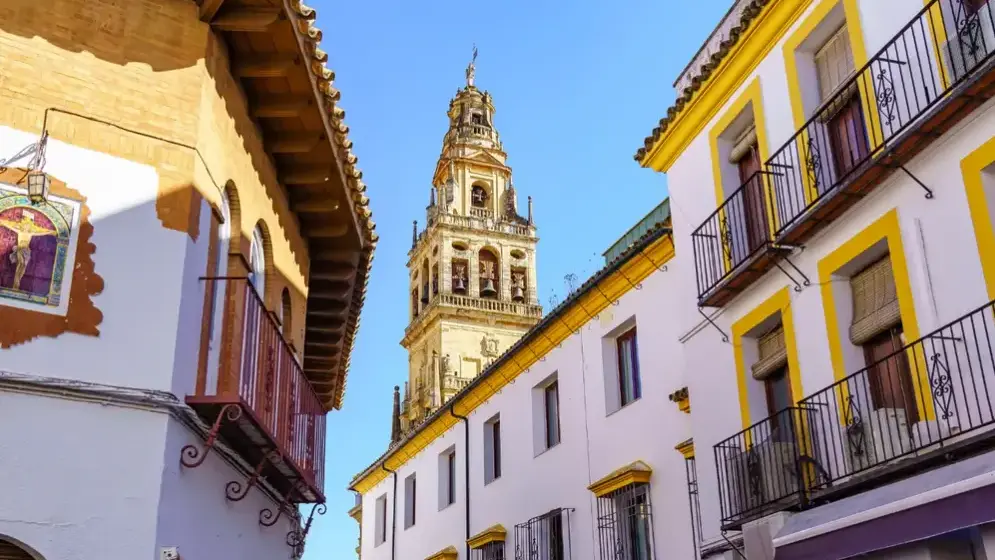
None of this changes what you can see at the Mezquita-Catedral. The building is fully open to tourists of every background and religion. The standard tourist ticket grants full access to the prayer hall, the mihrab, Charles V's Renaissance nave, the treasury, and the bell tower. You do not need any special permission to enter, and the security staff, though watchful, is not aggressive toward tourists who are sightseeing. The Mezquita-Catedral visitor guide has practical details on tickets, hours, and what else to see nearby.
What the controversy changes is what you understand while you're there.
The mihrab in the south wall, completed in 965 under al-Hakam II, is surrounded by Byzantine mosaics commissioned from Constantinople and faces roughly south rather than directly toward Mecca. It is one of the finest mihrabs in the Islamic world. No Muslim has been permitted to face it in prayer since 2003.
If you appear to be Muslim or Arab — if you adopt a prayer posture, close your eyes at the mihrab, or move your lips near the prayer hall — security staff may approach you. Multiple visitors have reported being asked to move on or watched closely. The Diocese does not advertise this policy on its website, but it is consistently applied.
This is worth knowing before you visit, not to decide against going (the building is extraordinary on any terms) but to understand the experience clearly. You are entering a Catholic cathedral built inside a mosque. The Catholic Church controls the space. The prayer ban is active. And the argument about who this building belongs to has not been resolved.
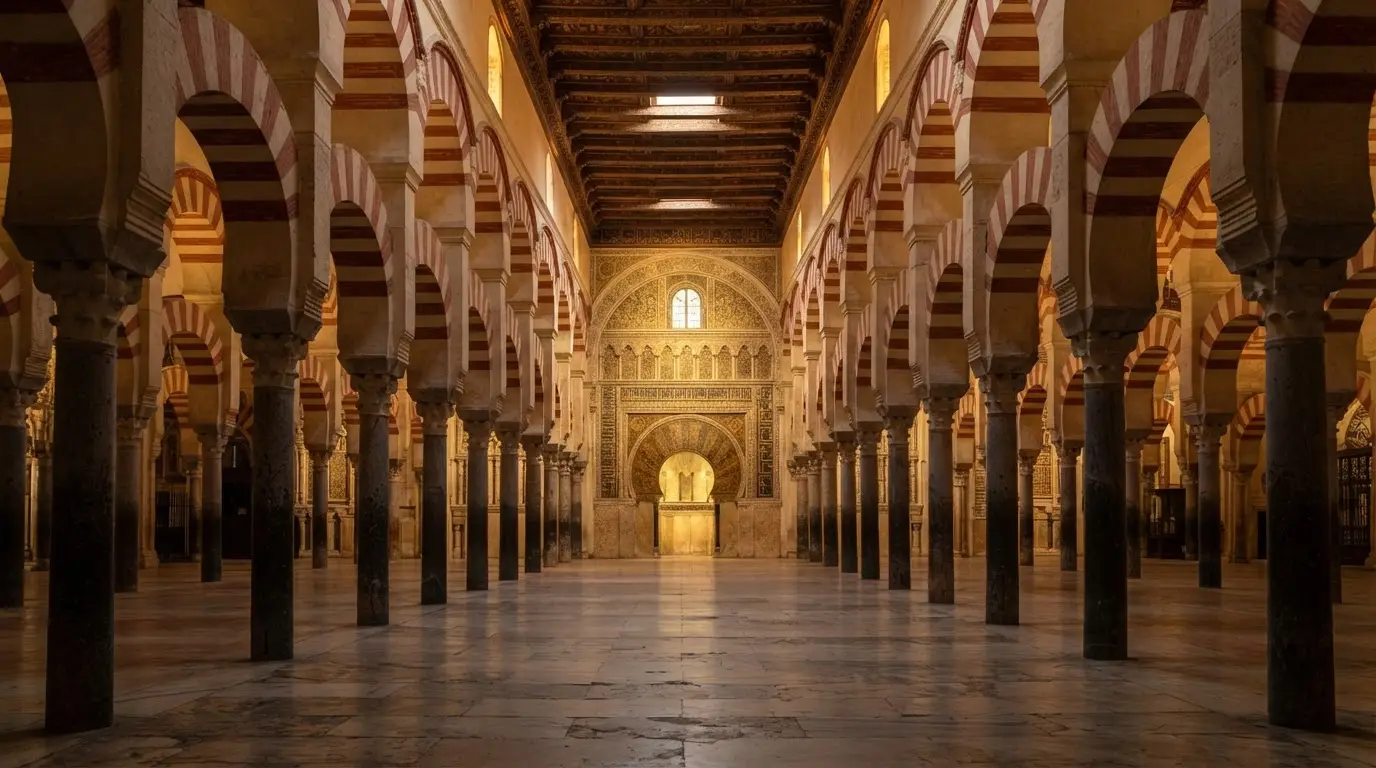
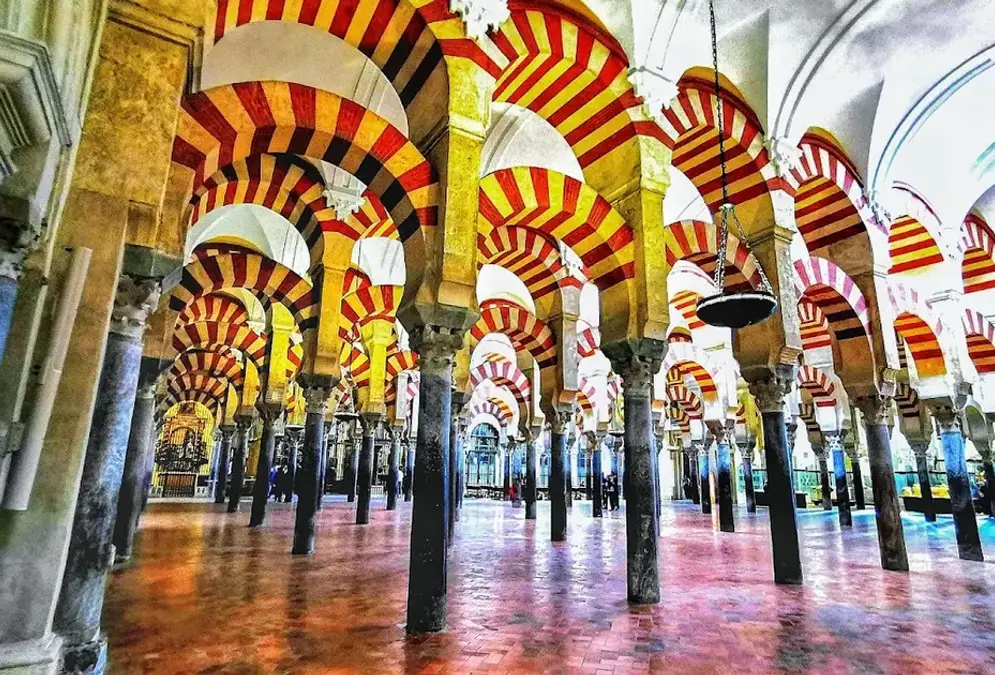
The controversy does not diminish the architecture. The red-and-white striped arches, the forest of 856 columns, the gilded mihrab, the jarring intrusion of the Renaissance nave through the centre of the hypostyle hall: all of it is still there, still astonishing. But these stones carry a political weight that most guidebooks skip. Understanding that weight is part of visiting honestly.
Frequently asked questions
Can Muslims pray in the Mezquita of Córdoba?
No. The Catholic Diocese of Córdoba has enforced a ban on Islamic worship inside the Mezquita-Catedral since 2003. The ban applies to all forms of Muslim prayer, including individual silent prayer near the mihrab. In one widely reported incident, Muslim visitors attempting to pray inside were confronted by security guards in a physical scuffle. Security staff actively monitor visitors who appear to be praying or adopting a prayer posture. The building is open to Muslim visitors for sightseeing but not for worship.
Who owns the Mezquita-Cathedral of Córdoba?
The Catholic Diocese of Córdoba holds the registered property title. In 2006, the Diocese used a Franco-era provision of Spain's Mortgage Law to register the building as "Santa Iglesia Catedral de Córdoba" for a nominal fee. The registration required only a bishop's certificate. The Spanish state has never successfully challenged or reversed this registration. UNESCO, which inscribed the site in 1984 and renamed it "Historic Centre of Córdoba" with the 1994 extension, has no authority over Spanish property law regardless of which name is used.
How did the Catholic Church come to own the Mezquita?
The Church did not acquire the Mezquita through a formal sale or state transfer. In 2006, the Diocese of Córdoba used a legal provision in Spain's Mortgage Law, made easier by a 1998 amendment under the Aznar government, to self-register the building as its property. A bishop's certificate was the only documentation required. The same mechanism was used by Spanish dioceses to register an estimated 34,961 properties nationwide. Critics called it a land grab using a Franco-era loophole. The Diocese called it regularising its longstanding management of the building.
Why did the Church ban Muslim prayer at the Mezquita?
The Diocese of Córdoba distinguishes between recognising the building's Islamic historical heritage (which it does) and permitting contemporary Islamic worship (which it refuses). The Church's position is that the Mezquita is a consecrated Catholic space where the Diocese holds exclusive religious authority. It cites 800 years of continuous Catholic use since 1236 as the basis for that authority. The Vatican is reported to have turned down proposals for shared prayer arrangements on more than one occasion in the mid-2000s.
Is the Mezquita still open to Muslim visitors?
Yes. Muslim visitors can enter, tour, and sightsee throughout the Mezquita-Catedral on the standard tourist ticket (€13 for adults). The prayer ban applies specifically to Islamic worship, not to Muslim presence in the building. However, multiple visitors have reported that security staff monitor Muslim-appearing visitors closely, particularly near the mihrab. Visitors who adopt a prayer posture or appear to be praying may be approached and asked to move.
Has UNESCO intervened in the Mezquita ownership dispute?
UNESCO has not intervened directly in the property ownership dispute, which falls under Spanish law. UNESCO's own official title for the site, since the 1994 extension, is 'Historic Centre of Córdoba' rather than 'Mosque-Cathedral of Córdoba'; either way, its position is that the Islamic heritage is constitutive of the site's Outstanding Universal Value, not merely historical background. UNESCO has no enforcement mechanism over how Spain manages the internal religious policy of the building.