
What set 1391 in motion
Ferrant Martínez was Archdeacon of Écija, a small Castilian town roughly halfway between Córdoba and Seville. He was not a powerful figure by normal measures. But from the 1370s onward, he preached systematically against the Jewish communities of Castile, calling for the destruction of synagogues and the forced separation of Jews from their Christian neighbours.[4] Church authorities and the crown tried to silence him repeatedly. King John I issued a formal censure in 1382. A trial filed against him by the Jewish community in 1388 also failed to stop him. Neither had any lasting effect.
When John I died in October 1390, so did the restraint on Martínez. The Archbishop of Seville died the same year. Both institutions that had checked his worst impulses were suddenly vacant, their successors not yet in place. Martínez, reinstated in his role, stepped into the vacuum.[4]
His sermons were not calls to specific violence so much as permission slips: extended theological arguments that positioned Jews as enemies of Christian society who had to be expelled or converted. The language created conditions. The violence came from crowds who took those conditions seriously.
Seville went first. On 6 June 1391[1], a mob attacked the Jewish quarter. By nightfall, thousands were dead or had accepted baptism. The wave did not stop at Seville. The Guadalquivir valley carried it north and east within weeks: Montoro, Andújar, Jaén, Úbeda, Baeza. Then Córdoba.[6]
50,000+
Córdoba in summer 1391
Ferrant Martínez was never in Córdoba. His role was to inflame, not to organise — and the inflammation spread without him needing to travel. Royal authority in Castile was in a liminal state, with the new king (Henry III) a minor not yet in full control of his council. Local militias and municipal governments that might otherwise have defended Jewish communities had no clear political instruction to do so.
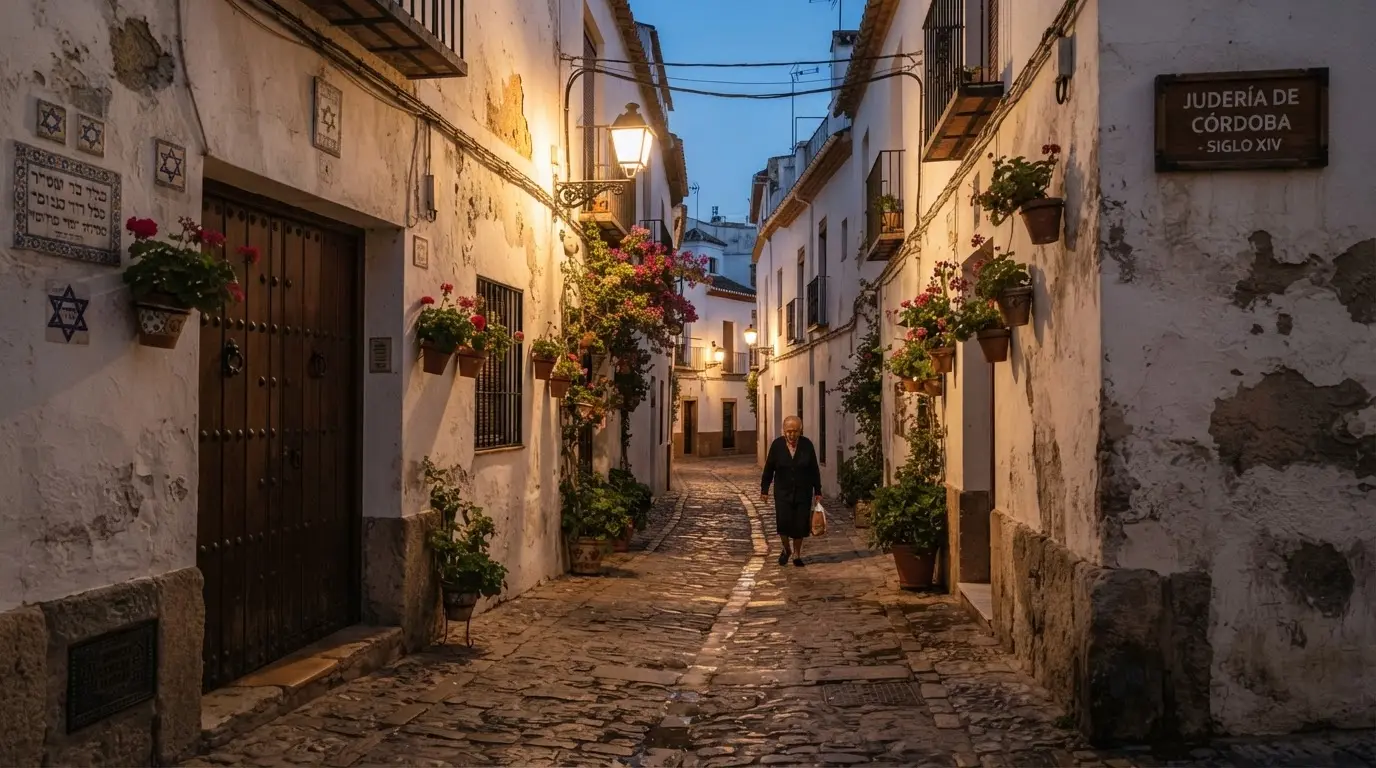
The Córdoba attack came in summer 1391, within weeks of Seville's. The Judería occupied a compact area north of the Mezquita, bordered today by the Callejón de las Flores and the streets around Calle de los Judíos. Its population in 1391 is not recorded in surviving sources; we know it was large enough to sustain a synagogue built as a private yeshiva in 1315 and to produce major scholars across the caliphal and subsequent periods.[3]
What happened in those summer weeks is not documented in granular detail. No Córdoba-specific casualty count survives. What the sources do record is the outcome: the Judería was effectively destroyed as a Jewish community. Some fled. Most of those who remained accepted baptism. A very small number may have been killed.
Explore nearby · Monument
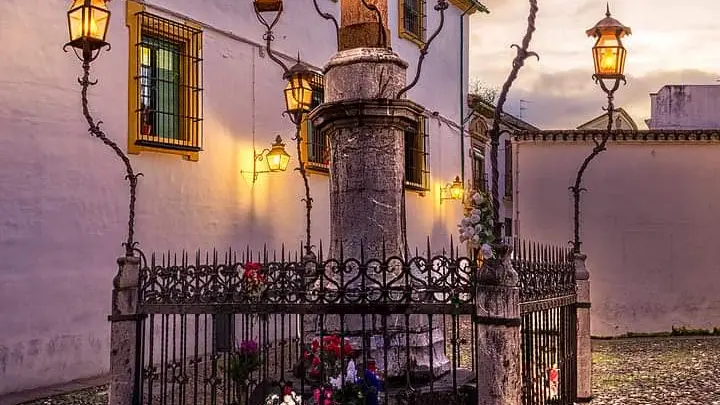
Cristo de los Faroles
1794 Christ sculpture on Plaza de Capuchinos, encircled by eight wrought-iron lanterns. Most affecting at dusk when they are lit. Free, open 24 hours.
The defensive walls of the Judería were dismantled in the aftermath. In 1399, a church dedicated to San Bartolomé was built inside the quarter, specifically to consolidate the new Christian character of the neighbourhood.[2] The physical fabric of the space was re-organised around the assumption that it would not revert.
What the conversions created
The forced baptisms of 1391 produced a new social category that did not previously exist at scale: the converso, or New Christian. These were Jews who had accepted baptism under duress, often in a matter of hours, with no religious preparation and no genuine change of belief. They were legally Christian. Many remained culturally and privately Jewish.[2]
The converso question consumed Castilian society for the next century. Three problems were immediately visible:
The 1391 pogroms did not end the Jewish question in Castile. They mutated it.
- Legal ambiguity. Conversos were theoretically full Christians with access to all positions closed to Jews. Wealthy converso families quickly entered government, the Church, and the nobility, which produced resentment from Old Christians who had previously held those positions.
- Crypto-Judaism. Many converso families continued to observe Jewish practices privately — keeping the Sabbath, avoiding pork, maintaining Hebrew prayers. Church and secular authorities referred to this as judaizing. Whether it was widespread practice or a paranoid projection is debated, but the suspicion was constant and consequential.
- Limpieza de sangre. The concept of blood purity (limpieza de sangre) emerged as a response to converso social mobility. Beginning in the mid-15th century, some institutions in Castile required applicants to prove that no Jewish or Moorish blood appeared in their ancestry for multiple generations. The Córdoba Cathedral Chapter adopted its own estatuto (blood purity statute) in this period.[2]
Recommended tours
Tours are selected for quality, not commission. We earn a small fee if you book — at no extra cost to you.
These three problems fed each other. The more conversos rose in status, the more Old Christians demanded blood purity tests. The more blood purity tests were required, the more motivation converso families had to conceal their origins. The more concealment occurred, the more institutional anxiety about crypto-Judaism grew. The 1391 pogroms did not end the Jewish question in Castile. They mutated it.
The Inquisition as institutional sequel
The Spanish Inquisition was established in 1478 by Ferdinand and Isabella, operating under royal rather than papal authority.[3] Its stated purpose was to investigate conversos suspected of secretly maintaining Jewish practices. The mechanism was elegant in its cruelty: since the suspects were technically Christian, the Inquisition had jurisdiction over them. It had no jurisdiction over Jews, who were simply Jews. Its entire target population was people produced by the forced conversions of 1391.
Córdoba got its own Inquisition tribunal early. Seated at the Alcázar de los Reyes Cristianos from 1482, it became one of the first permanent tribunal seats in Spain, handed over by Ferdinand and Isabella. For centuries afterward, its presence at the Alcázar lasted into the 19th century, processing cases, issuing sentences, and organising public autos-da-fé. The first accused tried in the Córdoba tribunal included converso merchants from the very streets of the former Judería.
Diego Rodríguez de Lucero, who ran the Córdoba tribunal between 1499 and 1507, became so notorious for fabricating charges and torturing confessions that even the Inquisitor General intervened. He was eventually removed, but not before convicting hundreds of Córdoba's converso families on evidence that later investigations found to be manufactured.[5]
The social logic running from 1391 to the Inquisition is not a simple causal chain: the forced conversions created the converso class, the converso class created institutional anxiety about crypto-Judaism, and that anxiety created the institutional demand for the Inquisition. Whether specific conversos actually practiced crypto-Judaism is a separate question. Many did not. Many did. The point is that the Inquisition treated the suspicion as sufficient and the community as guilty by origin.
Five years after the tribunal opened, in 1483, Ferdinand and Isabella issued an expulsion order targeting the Jews of three Andalusian dioceses — Seville, Córdoba, and Cádiz — giving them six months to relocate to Extremadura.[7] The order predates the Alhambra Decree by nine years, and enforcement appears to have been partial and uncertain: Jews are documented as remaining in Córdoba and Cádiz for years afterward, and it is unclear whether the 1483 order was ever fully carried out.[7] It nonetheless marked the escalating institutional pressure that would culminate in 1492. The same tribunal's legal machinery for sorting religious status by descent and conformity extended, in a different register, to the enslaved converts moving through Córdoba's 16th-century slave trade.
The path to 1492
The Alhambra Decree of March 31, 1492 ordered the expulsion of all Jews remaining in Castile and Aragon.[1] The Jews who had not converted in 1391 — a smaller, more observant community that had maintained its identity through a century of increasing pressure — had to choose once more: baptism or exile. This time there was no third option. An estimated 100,000 to 300,000 people left Spain; estimates vary widely and the historical record is incomplete.[1]
Córdoba's remaining Jewish community in 1492 was a fraction of what it had been before 1391. The pogrom had converted or dispersed the majority. Those who remained had survived the last century in a diminished and isolated quarter, without the defensive walls that had been pulled down, without the political protections that royal authority had formerly extended, watched by a Church that regarded them as potential converso backsliders.
The 1492 expulsion from Córdoba was the end of a process, not its beginning. The community had effectively ended in summer 1391. What 1492 removed was the remnant.
For the Sephardic diaspora that resulted, Córdoba occupied a specific place in collective memory. the Córdoba-born philosopher Maimonides, born in the Judería in 1138, was the defining intellectual figure of Sephardic Judaism — his Guide for the Perplexed remained the central philosophical text of medieval Jewish thought. Córdoba was, in the Sephardic imagination, the origin point: the city of Maimonides, the city of the great synagogue, the city from which the community had been driven out by baptism and violence across two waves, 1391 and 1492.
The Sephardic communities that settled in Ottoman Thessaloniki, Amsterdam, and the Maghreb preserved Ladino (Judeo-Spanish, the medieval Castilian of Córdoba and Seville) as a living language for five centuries. Some families kept door keys from their Iberian houses until the 20th century. The memory of the Iberian Jewish world, including the Córdoba Judería, was unusually tenacious precisely because it had ended so abruptly. Córdoba's Christian Mozarab community had faced its own version of this forced-choice centuries earlier: the Martyrs of Córdoba were 48 Arabic-speaking Christians who, between 850 and 859, walked voluntarily into Umayyad courts rather than assimilate, a movement that split their community and foreshadowed the pattern of religious coercion the city would repeat, in different configurations, across the following five centuries.
The Judería today: what you are actually walking through
The area sold to tourists as the "Jewish Quarter" corresponds roughly to the medieval Judería, but the connection requires some unpacking. The streets running northwest of the Mezquita (Calle de los Judíos, Calle Judería, the blind alleys leading to the Callejón de las Flores) retain their medieval footprint. The whitewash, the geraniums, the courtyards are largely post-medieval; what looks ancient is in many cases 19th-century restoration or later.
The Córdoba Synagogue, on Calle de los Judíos, is the genuine article: built in 1315[3], it survived the 1391 pogrom, though the building's religious use as a synagogue did not survive the century that followed: after the 1492 expulsion decree emptied the Judería for good, the building was converted into a hospital for rabies sufferers, later becoming a cobblers' chapel in 1588, before being rediscovered in 1885. At approximately 6.95 metres by 6.37 metres[3], it is one of only three surviving medieval synagogues in Spain. The Mudéjar stucco and Hebrew inscriptions are original. Entry requires a nominal fee — one of the most affordable medieval monuments in Spain.
The bronze statue of Maimonides on Plaza Tiberiades, installed in 1964, marks the approximate location of the Judería's centre. It has become a rubbing spot: the right foot is polished to a shine from tourists touching it. This makes the statue simultaneously a monument to Córdoba's most important intellectual and a mild desecration of the man whose community was driven out of this city.
Deep dive · Article
Abd al-Rahman III: The Morning Córdoba Became a Caliphate
Abd al-Rahman III was the first Caliph of Córdoba, declared on January 16, 929, ruling a city of up to 500,000 people and building Medina Azahara in 936.
The Alcázar, a ten-minute walk south, is where the Inquisition actually operated. Most visitors come for the gardens. Those who know that the Inquisition's presence there lasted into the 19th century see something slightly different when they walk through the towers.
Nothing marks the location of the 1391 violence. No plaque, no monument, no interpretive sign. The Judería's tourist infrastructure points to coexistence, not to what ended it.