Convivencia, the interfaith harmony idea tied to medieval Córdoba, was coined in 1948. What the actual history shows is more complex and more interesting.
Art history background with eight years writing interpretive content on Córdoba's Caliphal heritage.
Updated Published
history-buffs
In 1948, a Spanish historian named Américo Castro coined the word convivencia, meaning coexistence, and gave medieval Iberia a story it had never told itself. Córdoba, with its Great Mosque, its synagogue, and its galaxy of philosophers, became the proof text for centuries of Jewish, Christian, and Muslim harmony. Seventy-five years later, the word is in every hotel brochure in the city, and historians remain divided on whether the thing it describes ever existed in the form Castro imagined.
In this article
Jump to a section
⌄
A word coined in 1948
Américo Castro was not writing about medieval Spain when he wrote about convivencia. He was writing about modern Spain. His 1948 book España en su historia appeared three years into Francisco Franco's dictatorship, when the regime was building national identity around Catholic purity and the erasure of everything Moorish and Jewish from the Spanish past. Castro pushed back. His argument: Spanish civilizational character was forged through the interaction of three communities (Muslims, Christians, and Jews), not despite it.[1]
1948
The year Américo Castro coined convivencia in España en su historia, more than nine centuries after the period it describes. No medieval Spanish source used the term to describe interfaith relations.
The argument had political force and methodological weaknesses that Spanish historians identified almost immediately.
Castro's primary evidence came from literary sources: chronicles, poetry, philosophical texts. He treated these as transparent windows onto lived social reality. Critics noted that he largely ignored legal documents, tax records, and the extensive body of sources describing persecution, legal discrimination, and sporadic violence. Claudio Sánchez-Albornoz, his main Spanish antagonist, argued that convivencia was Castro's projection of 20th-century liberal values onto a society organized by entirely different premises.
The consensus among professional historians since then has been cautious. Eduardo Manzano Moreno, one of Spain's foremost medieval historians, has stated that convivencia has no support in the historical record as a description of systematic interfaith harmony. Mark Cohen, the Princeton scholar of Jewish-Muslim relations, traced the myth back to 19th-century Jewish historians who invented an Andalusian golden age as a polemical tool against European antisemitism. David Nirenberg, in Communities of Violence (1996), argued that periodic violence was not an aberration from coexistence but a constitutive feature of how medieval communities managed their interactions.
What the Umayyad Caliphate actually was
Strip away the debate about the myth and something real remains. Córdoba under the Umayyad Caliphate (929–1031) was a genuinely extraordinary city. By the late 10th century, it may have held as many as 500,000 inhabitants[9], a figure historians repeat often but cannot pin to a contemporary census, making it, by most accounts, the largest city in western Europe, larger than Paris or London. The caliphate's libraries were legendary; the court library under Al-Hakam II (r. 961–976) reportedly held 400,000 volumes[10], another widely cited figure with no surviving contemporary catalogue to confirm it, at a time when most European monasteries possessed a few dozen. Physicians at the palace drew on Greek, Persian, and Indian medicine without treating the traditions as incompatible.
The intellectuals who came out of this tradition are not mythological figures:
Averroes (Ibn Rushd, 1126–1198): the most thorough commentator on Aristotle in medieval history. Thomas Aquinas called him simply the Commentator.[2]
Maimonides (Ibn Maymoun, 1138–1204): born in the Judería twelve years after Averroes, the greatest medieval Jewish philosopher, whose Guide for the Perplexed engaged directly with Aristotelian philosophy.[2]
Ibn Hazm (994–1064): Muslim theologian and jurist who produced one of the most systematic catalogues of world religions ever written.
Al-Zahrawi (Abulcasis, c.936–1013): court physician to Al-Hakam II and author of Al-Tasrif, the surgical encyclopedia that trained European physicians for five centuries, the precise example of palace medicine drawing on Greek, Persian, and Indian traditions simultaneously.
the scholar who ran the caliphal library (c.940–984): enslaved mathematician, grammarian, and polyglot who served as al-Hakam II's chief secretary and managed his 400,000-volume palace library, the person who classified, annotated, and helped translate the manuscripts the other scholars on this list depended on.
Hasdai ibn Shaprut (c.915–970): Jewish court physician and diplomat who controlled Córdoba's customs revenues and served Abd al-Rahman III as de facto minister of foreign affairs, the most direct example of a non-Muslim holding genuine political power under the Umayyad Caliphate.
This intellectual culture was real. The question is what social and political conditions produced it.
The legal framework was the dhimmi system. Non-Muslims (dhimmis, meaning protected peoples) were allowed to practice their religions, maintain community institutions, and live under their own internal law. In exchange, they paid the jizya poll tax, accepted formal subordination to Muslim political authority, and operated under restrictions that varied considerably by ruler and period. Under the general terms of the Pact of Umar, the framework of restrictions imposed on dhimmi communities across the Islamic world, non-Muslims were forbidden from constructing new places of worship.[3]Jews and Christians were protected. They were not equals.
The distinction matters. An arrangement that produces philosophical collaboration between elite scholars is not the same thing as structural religious tolerance. That tension surfaced most sharply in the mid-9th century, when the Martyrs of Córdoba (48 Mozarabic Christians executed between 850 and 859 AD) split their own community over whether dhimmi conditions constituted genuine persecution justifying voluntary martyrdom. Nor did coercive violence begin with the caliphate: Al-Hakam I, the emir who ruled from 796 to 822, ordered the massacre of 72 nobles at a banquet in 806 and the complete razing of the Shaqunda suburb in 818, exiling thousands of its residents across the Mediterranean, acts of consolidation that the Umayyad state considered routine governance. The intellectual culture of Umayyad Córdoba was real; Castro's reading of what it meant was a different claim entirely.
The ornament and its critics
María Rosa Menocal's The Ornament of the World (2002) did more than any academic monograph to export the convivencia narrative into English-language public discourse. Menocal, a professor at Yale, wrote a passionate book arguing that medieval Andalusia produced "a whole series of golden ages" in which the three Abrahamic faiths generated culture together rather than despite each other. The book was widely praised, widely read, and widely assigned in undergraduate courses.
It was also challenged, sometimes fiercely.
Darío Fernández-Morera's The Myth of the Andalusian Paradise (2016) assembled a counterargument that leaned heavily on primary Arabic sources Menocal had not used, or had read differently. His thesis was stark: the convivencia narrative is a modern political construction with no adequate foundation in the historical record. Medieval Andalusia was not more tolerant than contemporary Christian Europe. Fernández-Morera argued it was in important respects less so, particularly in its treatment of apostasy and in the formal legal disabilities imposed on dhimmis.
The debate between these two positions remains genuinely unresolved, and some historians argue that framing it as a contest between optimists and skeptics misrepresents the actual state of the historiography, which is more fragmented and conditional than either camp allows.[4] The current scholarly reading sits somewhere like this:
The Umayyad caliphate produced real conditions for intellectual exchange at the elite level, through court patronage and a political culture that valued expertise regardless of religious origin
This was not a structural condition of tolerance but a political choice by specific rulers within a legal framework that formally subordinated non-Muslims
The intellectual achievements were concentrated among court-connected elites; extension to the general population is not demonstrated by the sources
The narrative of golden-age convivencia is historiographically recent, not a description medieval Iberian communities would have recognized
Recommended tours
Tours are selected for quality, not commission. We earn a small fee if you book — at no extra cost to you.
The honest answer to "did convivencia exist?" is that something happened in Córdoba that allowed manuscripts in three languages to move between scholars of three faiths. That something was more complex and more conditional than either the tourist brochure or the outright debunker admits.
The violence that tolerance forgot
The convivencia thesis, even in its most qualified form, runs into a specific problem: the events of 1066 and 1391.
On 30 December 1066, in the taifa city of Granada, a Muslim mob stormed the royal palace, killed Joseph ibn Naghrela (the Jewish vizier to the Berber king Badis ibn Habus)[8], and massacred much of Granada's Jewish community.[5] Estimates of those killed reach 4,000[7], though the historian Brian Catlos has argued the violence was more targeted than the traditional account suggests, focused on the vizier's circle rather than the general population. The disagreement about scale does not resolve the underlying point: a Jewish minister was killed by a crowd inflamed by resentment of Jewish political power, and the event demonstrates the structural fragility of dhimmi protection. It depended on political favour. When that favour ended, so did the protection.
The 1391 pogroms were worse. On 6 June 1391, a mob in Seville followed the inflammatory sermons of the Archdeacon Ferrán Martínez, attacking the Jewish quarter.[6] Within three months, the violence had spread to Córdoba, Toledo, Valencia, Barcelona, and more than 70 cities across Castile and Aragon. Thousands were killed; tens of thousands were forced to choose between baptism and death. The royal authorities, technically obligated to protect the Jewish communities under their jurisdiction, did nothing.
Córdoba, the city that tourism markets as the capital of convivencia, was among the sites of these pogroms. This is not a minor footnote.
The taifa period (post-1031) matters for the same reason. When the Umayyad caliphate fragmented into competing city-states after 1031, religious conflict increased across Andalusia. If structural tolerance had been the norm, fragmentation would not have produced this result so rapidly. The more plausible interpretation is that caliphal authority had constrained sectarian violence, not cultural acceptance but political power. Remove the power, and the constraint goes with it.
Córdoba markets the myth
The modern tourism narrative of Córdoba as the city of three cultures did not emerge organically from the medieval period. It was constructed, and the construction has a clear starting point.
Post-Civil War Spain needed a new national story. Franco's regime had built itself on Catholic reconquest mythology: Spain purified, unified, freed from Moorish contamination. After the dictatorship ended, Spanish cultural institutions looked for counter-narratives. Al-Andalus, specifically the Umayyad Caliphate of Córdoba, offered one. A medieval Spain that had been cosmopolitan, intellectually rich, multi-faith. The political utility was obvious: a usable past that repudiated Francoism without abandoning Spanish pride.
Córdoba's tourism industry absorbed this story and amplified it. The Mezquita-Catedral, the Synagogue, and Jewish heritage in Córdoba became a triad of monuments representing Muslim, Jewish, and Christian presence. The phrase tres culturas (three cultures) migrated from academic debate into hotel brochures, walking-tour scripts, and municipal marketing.
Timeline
929–1031
Umayyad Caliphate of Córdoba
Peak of intellectual and political power; the period convivencia narratives draw on most heavily.
1031
Caliphate fragments into taifas
Fragmentation correlates with increased religious conflict, complicating the structural tolerance argument.
1066
Granada massacre
Jewish community attacked; Joseph ibn Naghrela killed. The event demonstrates the fragility of dhimmi protection.
1391
Pogroms across Iberia
Massacres in Seville, Córdoba, and 70+ cities. Tens of thousands of Jews forced to convert or killed.
1492
Expulsion of Jews from Spain
The Alhambra Decree ends the period convivencia claims to describe.
1948
Américo Castro coins convivencia
The term is invented nearly five centuries after the period it describes, in opposition to Franco-era nationalism.
2002
Menocal's Ornament of the World
The English-language popularization of the convivencia thesis reaches a broad readership.
UNESCO heritage branding reinforced the narrative. The Mezquita received World Heritage status in 1984, with the Historic Centre following in 1994. The framing invariably emphasizes the convergence of civilizations. What UNESCO protects is real architecture; what the framing asserts is a historical interpretation that remains contested.
This is not to say the marketing is straightforwardly dishonest. The Mezquita was built by a Muslim dynasty, modified by Christian rulers, and sits in a city that held a significant Jewish community for centuries.[1] Those facts are not invented. What is constructed is the inference from those facts to a conclusion about harmony and tolerance. The historical record does not straightforwardly support that inference.
The city gains something concrete by sustaining the narrative: visitors. The al-Andalus golden age draws tourists who come for the Mezquita and the patios. It also gains something harder to quantify: a positioning as the opposite of cultural exclusivism, a city that embodied pluralism before the word existed. For a country still processing the Civil War and the expulsions of 1492, that positioning carries meaning beyond the tourist map.
What remains when the myth is stripped
The revisionist critique of convivencia does not leave nothing. It leaves something more honest, and in some ways more interesting.
The intellectual vitality of Umayyad Córdoba was real. Averroes and Maimonides are not inventions. The manuscripts that moved between scholars in Arabic, Hebrew, and Latin are documented. The palace library was a real institution. These are not myths in need of correction; they are facts that the convivencia story borrowed and inflated.
The coexistence was real, in the limited sense that communities existed side by side. Jews lived in Córdoba, prayed in its synagogues, worked as physicians and court officials. Christians did the same. What is in dispute is what that proximity meant for lived experience: whether it produced tolerance, structured exchange, or simply a hierarchy that occasionally permitted contact between its layers.
The oppression was also real. The dhimmi system was not a precursor to modern pluralism. It was a framework of managed subordination that could, under good rulers in good periods, permit genuine intellectual collaboration, and could, under different conditions, leave communities exposed to violence with no structural protection. The 1391 pogroms did not happen because convivencia had broken down. They happened in cities where convivencia was being actively promoted, which tells you something about what the promotion was actually selling.
Córdoba's most honest version of this history would acknowledge all three layers: the genuine intellectual achievement, the legal subordination that framed it, and the violence that punctuated it. That version is harder to fit on a walking-tour script. It also happens to be the actual history: a genuinely complex medieval society that modern tourism, like modern historiography, keeps simplifying in opposite directions.
The transfers that happened in the interstices of this hierarchy were real too. The hammam is a useful example: the Islamic hammam culture of Caliphal Córdoba — a city sometimes credited, in a widely repeated but not independently verified figure, with more than 300 public baths at its peak — passed knowledge of solid soap manufacture to northern Europe through exactly the kind of contact the convivencia story claims as its evidence. That transfer did not require equality between communities; it required proximity, commerce, and a city capable of sustaining the infrastructure. The hammam as convivencia space is not myth. It is, however, more limited and more interesting than the myth admits.
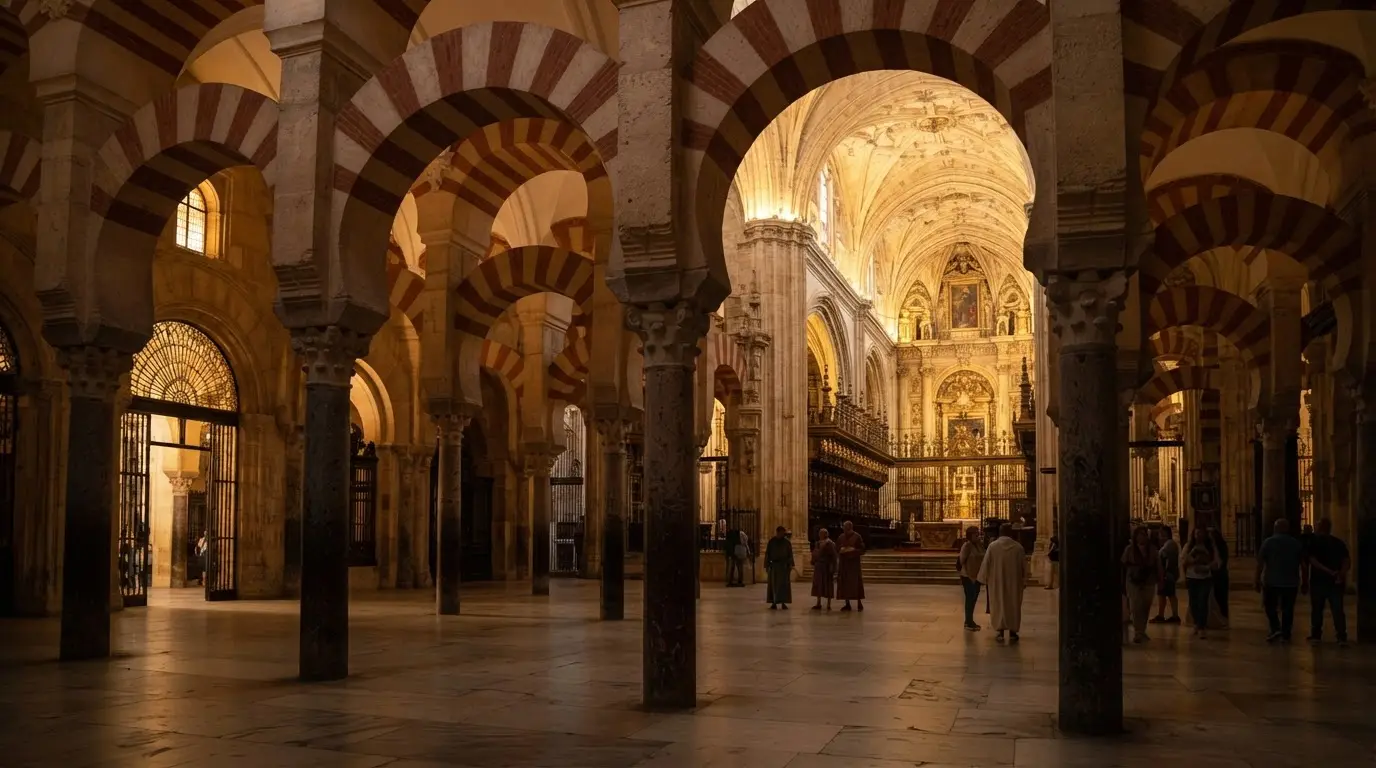
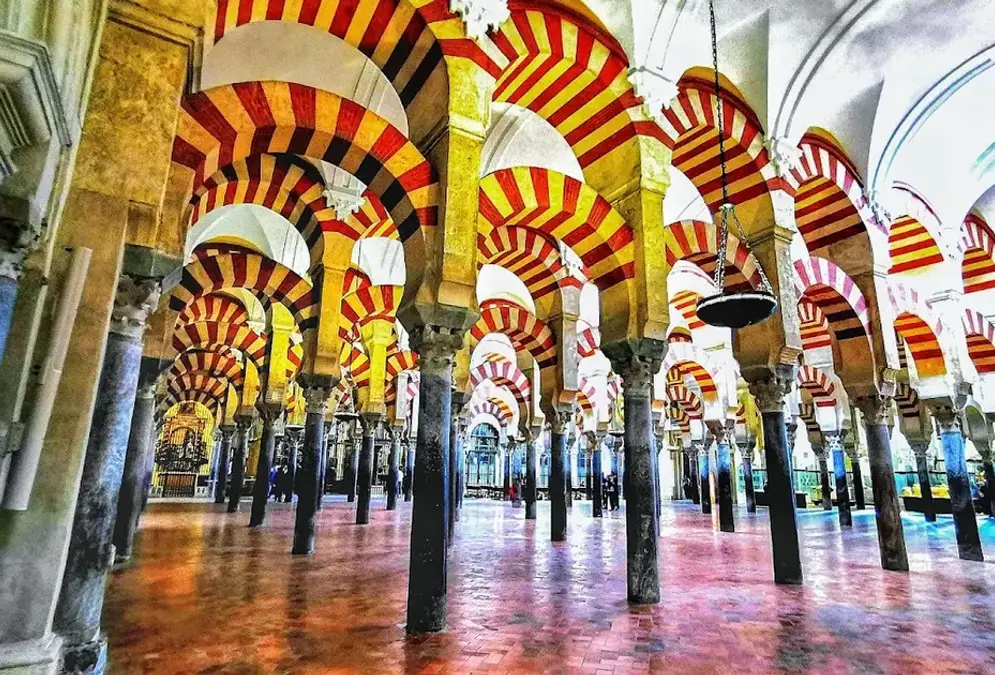
Stand in the Mezquita long enough, in the forest of 856 columns of jasper, porphyry, and marble, and you feel something that the scholarly debate cannot fully accommodate: that the building is evidence of a civilization capable of extraordinary things. Whether those things required or produced tolerance in any meaningful sense is a question Córdoba's stones cannot answer. The historians are still working on it.
Frequently asked questions
What is convivencia?
Convivencia is a Spanish term meaning 'living together,' coined by the historian Américo Castro in 1948 to describe the period from the Muslim conquest of Iberia (8th century) to the expulsion of Jews in 1492. Castro used it to argue that Spanish civilizational identity was shaped by centuries of interaction between Muslims, Christians, and Jews — primarily in Andalusia, and most intensely in Córdoba under the Umayyad Caliphate (929–1031). The term has entered common use but remains disputed as a description of lived historical conditions.
Did convivencia actually happen? Was it real?
The answer depends on what you mean by the term. The demographic fact of three communities living in the same cities is not disputed. The intellectual exchange between elite scholars, Averroes, Maimonides, and their contemporaries, is documented. What is disputed is whether these facts amounted to structural tolerance or interfaith harmony. The dhimmi legal framework formally subordinated Jews and Christians to Muslim authority. Periodic violence, including the 1066 Granada massacre and the 1391 pogroms in Córdoba and dozens of other cities, demonstrates that protection was conditional and fragile. Most contemporary historians describe convivencia not as a historical fact but as a modern historiographical construct that selectively emphasizes the positive and downplays the coercive.
Who coined the term convivencia?
The Spanish historian and philosopher Américo Castro (1885–1972) coined the term in his 1948 book España en su historia (later revised and published in English as The Structure of Spanish History). Castro wrote the book in opposition to Franco-era nationalism, which constructed Spanish identity around Catholic purity and the elimination of Moorish and Jewish influence. His argument, that Spanish culture was formed through the interaction of three faiths, had obvious political utility at the time. Critics noted almost immediately that it rested on selective literary evidence and ignored sources documenting systematic persecution and legal inequality.
What is the revisionist view of convivencia?
The revisionist position, most forcefully stated by Darío Fernández-Morera in The Myth of the Andalusian Paradise (2016), holds that convivencia is a modern political myth with no adequate foundation in the historical record. Fernández-Morera drew extensively on Arabic primary sources to argue that medieval Andalusia was not more tolerant than Christian Europe, and in some respects was less so. Earlier scholarly challenges came from David Nirenberg (Communities of Violence, 1996), who argued that violence was structural rather than exceptional in medieval coexistence, and from Mark Cohen, who traced the golden-age myth to 19th-century Jewish historians using it as a polemical tool against European antisemitism. Eduardo Manzano Moreno has stated that convivencia has no support in the historical record as a systematic phenomenon.
What was the dhimmi system in medieval Córdoba?
The dhimmi system was the legal framework governing non-Muslim communities (dhimmis, meaning 'protected peoples') in Islamic polities, including Umayyad Córdoba. Dhimmis were permitted to practice their religions, maintain community institutions, and live under their own internal law. In exchange, they paid the jizya poll tax, accepted formal subordination to Muslim political authority, and operated under restrictions, drawn from the general terms of the Pact of Umar, including prohibitions on building new places of worship. The system provided real protection in stable periods, but that protection depended on political conditions and individual rulers rather than structural equality.
What happened in the 1066 Granada massacre?
On 30 December 1066, in the taifa city of Granada, a mob attacked the royal palace, killed Joseph ibn Naghrela, the Jewish vizier to the Berber king Badis ibn Habus, and massacred much of Granada's Jewish community. Estimates of those killed vary and have been disputed; the historian Brian Catlos argues the violence was primarily directed at the vizier's political circle rather than constituting a broad pogrom. Regardless of scale, the event demonstrates a structural problem with convivencia: Jewish protection in the taifa period depended on political favour, not on any deeper cultural acceptance. When that favour ended, and when resentment at Jewish political power reached a breaking point, there was no structural barrier to violence.
How does Córdoba market convivencia today?
Córdoba's tourism industry presents the city as the capital of interfaith coexistence, emphasizing the Mezquita-Catedral (Muslim), the Synagogue (Jewish), and the Old Town (Christian) as monuments to 'three cultures.' The phrase tres culturas, three cultures, appears in hotel branding, walking tours, and municipal materials. UNESCO heritage branding reinforces the narrative, framing the city's monuments as evidence of civilizational convergence. This marketing emerged partly from post-Franco cultural politics, which needed a national narrative that repudiated the regime's Catholic exclusivism. The historical claim embedded in the marketing, that the three communities lived in harmony, is contested by most contemporary historians, though the monuments themselves are real and the demographic diversity of medieval Córdoba is not in doubt.
What did María Rosa Menocal argue about medieval Andalusia?
In The Ornament of the World (2002), the Yale scholar María Rosa Menocal argued that medieval Andalusia produced a series of 'golden ages' in which Muslims, Jews, and Christians created culture together in an atmosphere of tolerance and mutual respect. The book was widely read and assigned in universities across the English-speaking world. Critics, including Darío Fernández-Morera and various academic reviewers, argued that Menocal relied selectively on literary evidence (poetry, philosophy) while downplaying legal sources documenting formal inequality and periodic violence. The book's influence on public understanding of convivencia has been substantial; its methodology has been seriously challenged.