Art history background with eight years writing interpretive content on Córdoba's Caliphal heritage.
Updated Published
history-buffsart-loversfood-lovers
Hasdai ibn Shaprut held no official minister's title under Abd al-Rahman III, yet he ran Córdoba's foreign relations for two decades, negotiated with emperors, treated a king's obesity, and redirected Jewish intellectual authority from Mesopotamia to Andalusia. Born c. 915 in Jaén[1], he died c. 970 in Córdoba having changed the geography of Jewish learning more thoroughly than any rabbi of his century. The Caliphate gave him the platform; he used it with unusual precision.
In this article
Jump to a section
⌄
A physician from Jaén in the Caliph's court
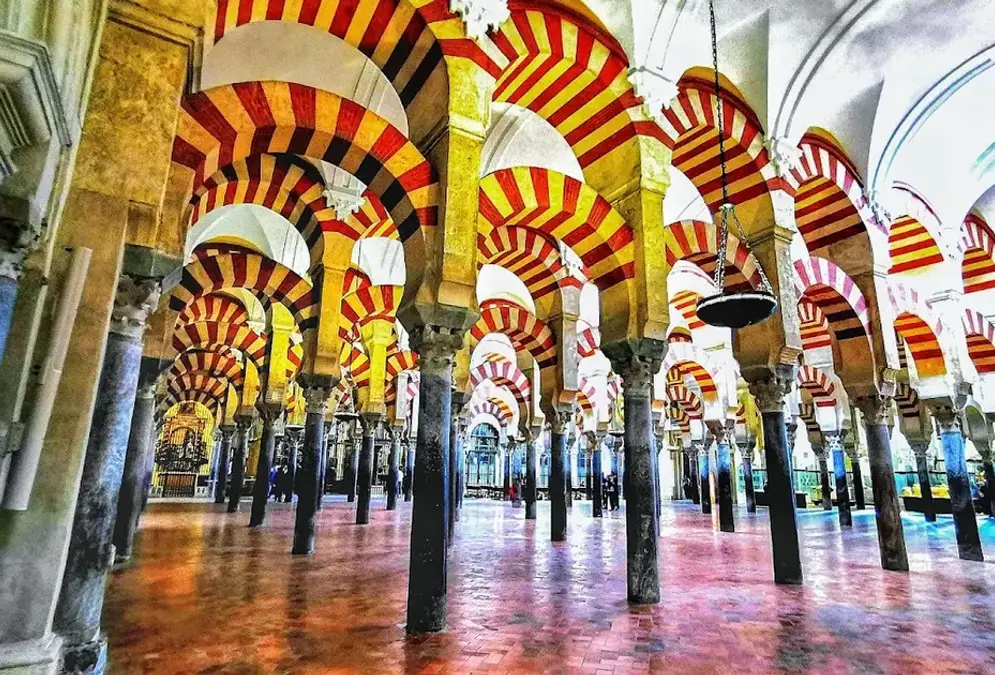
Abd al-Rahman III declared the Umayyad Caliphate of Córdoba in 929, a political statement as much as an administrative one. He was not merely a ruler; he was Commander of the Faithful, head of a state that presented itself as the most civilised polity in the western world. The court required professionals who could match that ambition: physicians who read Galen in Arabic, diplomats who could address Byzantine chancelleries, scholars who made Córdoba's intellectual life visible to foreign envoys.
c. 915–970 CE
Hasdai ibn Shaprut's lifespan spans almost exactly the reign of Abd al-Rahman III (r. 912–961) and the early years of al-Hakam II — the two caliphs who made Córdoba the intellectual centre of the western world. Hasdai rose with the first and continued under the second.
Hasdai fit the role. He had trained in medicine; his family background placed him in Jaén's Jewish community, and he moved to Córdoba where his facility with Hebrew, Arabic, and Latin made him rare in any milieu. The Caliph's medical needs brought Hasdai close to power, but what kept him there was a broader competence. Abd al-Rahman III recognised that a physician who could read Latin correspondence, manage customs revenues, and understand the political calculus of Christian courts to the north was worth considerably more than his medical title suggested.
Hasdai's formal position was that of court physician. His actual function was something closer to chief of external affairs. He controlled the port dues and customs of Córdoba[2] — a post that gave him oversight of the city's commercial relationships with the outside world, and the intelligence that came with them. Ambassadors from the Christian kingdoms arrived and found themselves dealing with a Jewish official who spoke their language, understood their theology, and had clearly thought about their kings' strategic interests.
The 11th-century Andalusian historian Said al-Andalusi described him as a physician "whose cures were successful and his praise on everyone's lips."[1] The praise was not only for medicine. In a court that valued erudition, Hasdai moved across disciplines with a fluency that made him genuinely useful to the Caliph rather than merely decorative.
This was the Córdoba of Abd al-Rahman III: a city that had surpassed 100,000 inhabitants[5] — some estimates push considerably higher, into the hundreds of thousands, but that is the more modest, better-attested figure — and was already one of the largest in western Europe, with street lighting, running water, a library culture that outpaced anything north of the Pyrenees, and a deliberate policy of employing talent regardless of religious background. For a Jewish intellectual of unusual gifts, the city in 940 was the best possible address in the world.
The diplomat no one could ignore
Three missions defined Hasdai's diplomatic reputation, and they arrived at the most sensitive junctures in Caliphal foreign policy.
In 949, the Byzantine Emperor Constantine VII sent an embassy to Córdoba. The relationship between Byzantium and the Umayyad Caliphate was careful, occasionally warm, and mutually useful as a counterweight to the Abbasid Caliphate in Baghdad and the Frankish powers in the north. The gift that mattered most was a Greek manuscript of Dioscorides'De Materia Medica, a comprehensive pharmacological text that the Byzantines knew would be valued. The problem was that Córdoba lacked a scholar who could read Greek well enough to work with it. Hasdai proposed a solution: request a Greek-literate monk from Constantinople to assist with the translation. The emperor sent Nicholas, and Hasdai directed the collaboration that produced the Arabic De Materia Medica, which became the standard pharmacological reference across the Islamic world and, via Latin translation, medieval European medicine.[4]
In 956, Otto I, at that point King of Germany and not yet crowned Holy Roman Emperor (a title he would only receive in 962), sent his ambassador John of Gorze to Córdoba. John was a Benedictine monk with strong views on Islamic rule and was reportedly uncomfortable with the diplomatic protocols required at the Caliphal court. The negotiations stalled. Hasdai became the intermediary: months of careful discussion, threading between Otto's demands, Abd al-Rahman's requirements, and John's theological scruples. John of Gorze later described Hasdai in his memoir as a man of "subtle intellect" who had managed a genuinely difficult situation.[1] The embassy eventually resolved. Hasdai had kept it from becoming a diplomatic rupture.
In 958, the negotiation was medical as well as political. Queen Toda of Pamplona arrived in Córdoba seeking an alliance with Abd al-Rahman III against the kingdom of León. She brought her grandson King Sancho I of León, who had already been deposed that same year partly because of extreme obesity that left him unable to perform the physical requirements of medieval kingship. Hasdai treated Sancho.[2] The treatment worked, but the political payoff took two more years: a Cordoban-backed campaign in 959–960 restored Sancho to the Leonese throne in 960, and the alliance between Pamplona and Córdoba was secured. For Hasdai, the episode was characteristic: a medical intervention that produced a political outcome.
None of these missions required Hasdai to hold a formal title. He operated as the Caliph's trusted representative because no one in the court combined his linguistic range, his medical authority, his financial experience, and his understanding of what Christian rulers actually wanted when they dealt with Córdoba.
Rewriting medicine: the De Materia Medica
The Arabic translation of Dioscorides'De Materia Medica in 949 was not a routine scholarly exercise. The Greek text, written in the 1st century CE, catalogued roughly 600 plants, minerals, and animal products used in medicine, with descriptions of preparation, dosage, and therapeutic effect. In Arabic, it became the backbone of Caliphal pharmacology. Physicians across the Islamic world cited it, pharmacists consulted it, and medical educators used it as a primary teaching text.
What Hasdai brought to the project was organisational intelligence. The Byzantine monk Nicholas had the Greek. Hasdai worked directly with him, managing the process of reconciling Greek plant names with their Arabic equivalents, a problem that had defeated previous attempts because botanical terminology did not map cleanly across the language boundary.[4] The resulting translation did not merely render the Greek into Arabic; it identified the Arabic names for plants that Dioscorides had described under Greek names, making the pharmacopoeia practically usable by Arab physicians who would otherwise be working from descriptions they could not connect to the plants they actually had.
Timeline
c. 915
Born in Jaén
Hasdai ibn Shaprut born in Jaén to a Jewish family; later moves to Córdoba and enters the Caliphal court as physician.
929
Abd al-Rahman III declares Caliphate
The Umayyad ruler declares himself Caliph, making Córdoba the political and intellectual capital of the western world.
949
De Materia Medica translated
Byzantine Emperor Constantine VII sends monk Nicholas to Córdoba. Hasdai directs the Arabic translation of Dioscorides, which becomes the standard pharmacological text across the Islamic and medieval European worlds.
956
Otto I's embassy
Hasdai mediates between King Otto I of Germany's ambassador John of Gorze and the Caliphal court. John later describes Hasdai as a man of "subtle intellect."
958–960
Toda of Pamplona and Sancho of León
Hasdai treats the deposed King Sancho I of León for obesity during Queen Toda's 958 visit; a Cordoban-backed campaign restores Sancho to the Leonese throne in 960.
c. 950s–960s
Hebrew literary patronage
Hasdai funds Menahem ben Saruq's Mahberet (first Hebrew dictionary) and Dunash ben Labrat's introduction of Arabic metres into Hebrew poetry.
c. 950s–970
Moses ben Hanoch and the yeshivah
Hasdai supports the establishment of a yeshivah in Córdoba under Moses ben Hanoch, shifting Jewish theological authority from Mesopotamia to Spain.
c. 970
Dies in Córdoba
Hasdai ibn Shaprut dies in Córdoba, leaving behind a Jewish community with its own scholarly infrastructure, its own literary language, and its own seat of legal authority.
The work spread. Latin translations made from the Arabic circulated through medieval European universities. The text shaped European medicine until the 16th century, when direct engagement with Greek manuscripts and new botanical exploration began to replace it. The translation that Hasdai directed in Córdoba in 949 sat at the centre of that transmission chain for six hundred years.
Recommended tours
Tours are selected for quality, not commission. We earn a small fee if you book — at no extra cost to you.
It also illustrates something about Hasdai's position in the Caliphal court that his diplomatic missions confirm: he was trusted not only with sensitive political relationships but with projects of genuine intellectual weight. The Caliph's physician who directed the most consequential medical translation of the century was the same man who managed the relationship with the Holy Roman Empire's envoy and treated the king of León.
Building a Hebrew literary language
Before Hasdai, Hebrew poetry in al-Andalus was competent but derivative. It followed the conventions of piyut, the liturgical verse tradition developed in Palestine and Babylonia: metrically irregular by the standards of Arabic poetry, tied to prayer rather than to court culture, oriented toward the East as the source of authority.
Hasdai changed that by funding two poets whose projects, and whose later argument with each other, defined the first generation of Andalusian Hebrew literature.
Menahem ben Saruq (c. 910–970) was Hasdai's secretary and his most sustained literary project. Hasdai commissioned him to write the Mahberet, the first comprehensive Hebrew dictionary, a lexicographic project that catalogued Hebrew roots and their derivatives, providing the philological infrastructure that Andalusian Jewish poets needed to write in Hebrew with the same precision that Arab poets brought to Arabic. The Mahberet was not poetry; it was the tool that made serious Hebrew poetry possible in a culture where Arabic was the prestige literary language.
Dunash ben Labrat (c. 920–990) was born in Fez, travelled to Baghdad, and then settled in Córdoba, where he was also attached to Hasdai's circle. His contribution was more direct: he introduced Arabic prosodic metres into Hebrew poetry. The quantitative metre of Arabic, based on long and short syllables rather than stress, had no precedent in biblical Hebrew, and early critics argued that Arabic metre could not work in the Hebrew phonological system. Dunash proved it could. His innovation meant that Hebrew poets could now write in forms that worked within the prestige literary culture of the Islamic world rather than outside it.
The two men later clashed in a literary dispute that generated a substantial body of polemical verse; their disciples traded arguments about prosody and lexicography in Hebrew poetry for decades. That dispute is itself evidence of how far Hasdai's patronage had taken the Andalusian Hebrew literary project: there was now enough invested in the tradition that its practitioners had strong opinions about the right way to do it.
For Hasdai personally, the literary patronage had a strategic dimension. Hebrew as a literary language of the court, parallel to Arabic and matching it in technical sophistication, was an argument about Jewish standing in al-Andalus. A community with its own dictionary and its own prosodic tradition was not dependent on Arabic cultural infrastructure. It had its own intellectual resources.
Moses ben Hanoch and the shift of authority
The most consequential thing Hasdai did for Jewish intellectual life was the least dramatic to describe. He funded a rabbi.
Moses ben Hanoch arrived in Córdoba under circumstances that became legendary in later Jewish tradition. The four captives story, recounted by the 11th-century chronicler Abraham ibn Daud, holds that four great Talmudic scholars were captured by pirates and ransomed in four different cities, each founding a new centre of Jewish learning that freed diaspora communities from dependence on the Babylonian academies (yeshivot) of Sura and Pumbedita. Three of the destinations are named in Ibn Daud's own account: Córdoba, Alexandria, and Kairouan. The fourth captive's landing place is left unspecified in the text itself — later tradition often supplies Narbonne, but that detail does not come from Ibn Daud.
It is a founding myth. The historical reality of Moses ben Hanoch in Córdoba does not depend on it: he arrived, he had genuine Talmudic authority, and Hasdai recognised what that authority was worth.
Until the mid-10th century, Jewish legal authority in the diaspora flowed from Babylonia. The geonim, the heads of the two great academies in Mesopotamia, were the final word on disputed questions of Jewish law. Communities across the Mediterranean and Europe sent their legal questions east and paid fees for the responses. Spanish Jewish communities participated in this system, but at a disadvantage: distance, cost, and the political complications of maintaining communication across the Abbasid-Umayyad divide all made Babylonian authority inconvenient.
Moses ben Hanoch, teaching Talmud in Córdoba under Hasdai's patronage, offered an alternative. Al-Hakam II's library provided the manuscript resources; Hasdai provided the financial support and the political cover. Within a generation, Córdoba had a functioning yeshivah that could issue legal decisions on the same questions that previously required consultation with Babylon. The fees that had gone east stayed in Spain. The intellectual prestige that had been located in Mesopotamia began to relocate to al-Andalus.[4]
Hasdai's role as nasi (the title meaning prince or head, applied to the leader of the Jewish community in Spain) gave him the authority to make this work institutionally. He was not simply a private patron. He was the recognised political head of Spanish Jewry, a position acknowledged by the Caliph and by Jewish communities from Narbonne to North Africa. When he chose to back Moses ben Hanoch, he was making a communal decision, not a personal one.
The practical effect was what later historians would call the translatio studii, the transfer of learning from East to West. Córdoba in the 950s and 960s was assembling the same kind of comprehensive scholarly infrastructure that made the Babylonian academies authoritative: a dictionary (Menahem's Mahberet), a school of Hebrew poetry (Dunash's prosodic revolution), and a functioning Talmudic academy under a recognised authority (Moses ben Hanoch's yeshivah). Hasdai had not accidentally created this cluster. He had built it piece by piece.
Legacy: the 10th century Córdoba he made possible
When Hasdai ibn Shaprut died c. 970, the Jewish community of Córdoba was structurally different from the one he had entered as a young physician. It had a yeshivah with acknowledged authority. It had a literary language, Hebrew reinvented with Arabic precision, and a community of poets who knew how to use it. It had a diplomatic position: the Caliph's nasi was a recognised interlocutor for Jewish communities across the diaspora, not merely a local representative.
All of this mattered for what came after. Samuel ibn Naghrillah — the great Hebrew poet and general of Granada, active in the next generation — built directly on the Andalusian Hebrew literary tradition that Dunash and Menahem had established under Hasdai's patronage. The convivencia debate that historians argue over (how collaborative or how fraught the relations between religious communities actually were in al-Andalus) had its most concrete positive example in Hasdai's career: a Jewish official with genuine political power, whose patron valued his competence over his religion, who used that position to build institutions that served his own community.
The critique of the convivencia narrative, fair as it is, should not obscure what Hasdai actually managed. He operated at the intersection of three languages, three religious traditions, and a political structure that, at its Caliphal peak, was genuinely more hospitable to Jewish intellectual life than anything available in Christian Europe. He did not produce this situation; he inherited it. What he did was see its possibilities and work them systematically.
Two centuries after Hasdai, the physician-philosopher Maimonides was born in Córdoba. The intellectual infrastructure that shaped Maimonides's formation, the Hebrew scholarship and the Arabic-language philosophy, the sense that Jewish learning belonged in the same conversation as Islamic jurisprudence and Greek science, had roots in what Hasdai built. The Golden Age of Andalusian Jewry did not arrive fully formed. It was assembled, in the 10th century, by a physician from Jaén who understood what a Caliph's court could offer and spent thirty years making use of it.
Today there is no monument to Hasdai ibn Shaprut in Córdoba. The Córdoba Synagogue on Calle Judíos still stands in the quarter his community inhabited; the streets carry no plaque with his name. Our Jewish heritage guide to Córdoba covers that quarter, the synagogue, and the other sites tied to the community he helped shape. He is documented in Arabic sources, in Jewish chronicles, in the correspondence preserved by Jewish communities he helped, and in the Hebrew poetry written by the men he funded. The absence of a physical memorial is itself a small fact about how historical memory works: the diplomat who kept three empires talking and the patron who gave Hebrew its Andalusian voice is less photogenic than a bronze philosopher on a quiet plaza.
Frequently asked questions
Who was Hasdai ibn Shaprut?
Hasdai ibn Shaprut (c. 915–970 CE) was a Jewish physician, diplomat, and cultural patron who served at the court of the Umayyad Caliph Abd al-Rahman III in Córdoba. Born in Jaén, he rose to control Córdoba's customs revenues and act as the Caliph's de facto minister for foreign affairs, conducting negotiations with the Byzantine Empire, the Holy Roman Empire, and the Christian kingdoms of the Iberian north. He is equally important for his patronage of Hebrew literature and his support for establishing Córdoba as a centre of Jewish learning.
What was Hasdai ibn Shaprut's role in Córdoba?
Hasdai held the title of court physician, but his actual functions were much broader. He controlled Córdoba's port dues and customs, giving him oversight of the city's external commercial relationships. He conducted diplomatic missions on the Caliph's behalf to the Byzantine court, to King Otto I of Germany's ambassador, and to Queen Toda of Pamplona. Within the Jewish community, he served as nasi (the recognised political head of all Jews in Spain), a position acknowledged both by the Caliph and by Jewish communities across the diaspora.
Why is Hasdai ibn Shaprut important to Jewish history?
Hasdai shifted the centre of Jewish intellectual authority from Babylonia to Córdoba. He patronised the creation of the first comprehensive Hebrew dictionary (Menahem ben Saruq's Mahberet), supported Dunash ben Labrat's introduction of Arabic prosodic metres into Hebrew poetry, and funded the establishment of a yeshivah under Moses ben Hanoch that could issue Talmudic legal decisions independently of the Babylonian academies. This transferred both the prestige and the practical machinery of Jewish scholarship from Mesopotamia to al-Andalus, laying the foundation for the Golden Age of Andalusian Jewish culture.
What diplomatic missions did Hasdai ibn Shaprut conduct?
Three missions stand out. In 949, he directed the Arabic translation of Dioscorides' De Materia Medica with Byzantine monk Nicholas, a project that arose from the Byzantine embassy of Constantine VII. In 956, he mediated the difficult negotiations between the Caliphal court and John of Gorze, ambassador of King Otto I of Germany (crowned Holy Roman Emperor only in 962); John later praised his "subtle intellect." In 958, he treated the deposed King Sancho I of León for obesity during Queen Toda of Pamplona's diplomatic visit; Sancho recovered, and a Cordoban-backed campaign restored him to the Leonese throne in 960, securing the political relationship between Pamplona and Córdoba.
How did Hasdai ibn Shaprut transform Córdoba's Jewish community?
Hasdai transformed Córdoba's Jewish community by building three overlapping institutions. He patronised the Mahberet, the first Hebrew dictionary, which gave Andalusian Jewish poets the philological tools to write in Hebrew with the precision of Arabic. He funded Dunash ben Labrat, who introduced Arabic metres into Hebrew, creating the technical foundation for Andalusian Hebrew poetry. And he supported Moses ben Hanoch's yeshivah, which provided local Talmudic authority that freed Spanish Jewish communities from dependence on the distant Babylonian academies. Together, these created a self-sufficient Jewish intellectual culture in al-Andalus.