Maimonides: Córdoba's Philosopher Who Changed Judaism
Born in Córdoba in 1138, Maimonides codified Jewish law, reconciled Aristotle with the Torah, and influenced Aquinas. His statue stands in the Judería today.
Art history background with eight years writing interpretive content on Córdoba's Caliphal heritage.
Updated Published
history-buffsart-lovers
The negative theology that Thomas Aquinas used to define God in the Summa Theologiae came, in large part, from a Jewish physician writing in Egypt who had been expelled from Córdoba as a child. Moses ben Maimon, born traditionally in 1138 (though some sources place it as early as 1135) into the same Caliphal intellectual culture that produced Averroes, spent his adult life in exile, writing in Fustat the two works that would make him the central figure in Jewish philosophy: the Mishneh Torah, the most systematic codification of Jewish law ever produced, and the Guide for the Perplexed, which Aquinas read and cited. Córdoba named a square after him nine centuries later.
In this article
Jump to a section
⌄
What a child lost when the Almohads took Córdoba
Córdoba had been, at its 10th-century Caliphal peak, a city of perhaps 500,000 people[5] — the largest in western Europe, and one of the few where Jewish scholars, Muslim jurists, and Christian philosophers worked within walking distance of one another. By 1138, that peak was already a century gone: the Umayyad Caliphate had collapsed in 1031, and under Almoravid and early Almohad rule the city had contracted significantly. What remained was still exceptional — the intellectual infrastructure, the libraries, the multilingual scholarly culture — even as the political order that had built it had fractured. The Umayyad Caliphate had made it a deliberate laboratory of learning: public libraries, a functioning university attached to the Great Mosque, physicians drawing on Greek, Persian, and Indian medicine without distinguishing between traditions. Arabic was the shared language of intellectual life regardless of faith.
500,000
Córdoba's estimated population at its 10th-century Caliphal peak — the largest city in western Europe at the time, and one of the few where Jewish, Christian, and Muslim scholars shared libraries, argued across traditions, and translated the same Greek texts. By Maimonides's birth in 1138, that apex was a century past, but its intellectual legacy shaped the city he was born into.
Maimon ibn Daud, Moses's father, was a dayyan, a rabbinic judge who adjudicated disputes within the Jewish community. He was also a philosopher and mathematician, and he taught his son both the Talmud and the Arabic-language philosophical tradition that had been building since the 8th century. The young Moses grew up reading al-Farabi and Avicenna alongside the Torah. This was not an unusual combination in Caliphal Córdoba. It was simply what an educated person read.
The city had already produced Averroes a generation earlier, and the two men's intellectual biographies run on almost exactly parallel tracks. Both were trained in law and medicine alongside philosophy. Both came from families of jurists. Both wrestled with the same central problem: how do you reconcile Aristotle's philosophy — arrived in Arabic translation and become the dominant framework for rational inquiry — with the demands of a revealed religion? For Averroes the religion was Islam. For Maimonides it was Judaism. The city gave them the same tools. A century before either of them, Ibn Hazm had mapped the same intellectual territory from a different angle — Córdoba-born, trained in Islamic law, and possessed of the same conviction that rigorous reasoning was not an alternative to faith but its deepest expression.
Maimonides was still a child, ten years old by the traditional 1138 birth date, when that world ended.[1]
The Almohad catastrophe and the road to Egypt
In 1148, the Almohad dynasty swept north out of Morocco and took Córdoba. The Almohads were religious reformers of a severe kind; they had already expelled or forcibly converted the Jewish and Christian populations of cities taken across North Africa. In Córdoba, they presented the Jewish community with three choices: convert to Islam, leave, or die.[2]
The Maimon family did not leave immediately. There is evidence, controversial among historians, that they stayed in Córdoba for roughly a decade, outwardly conforming to Islam and practising Judaism in secret. Maimonides later wrote about communities forced into such situations with a degree of specificity and sympathy that suggests personal experience. By around 1159, the family had gone. They headed first to Fez, in Morocco — itself under Almohad rule, requiring the same dangerous double life. Then to Acre in Palestine briefly. Then, in 1166, to Egypt.
They settled in Fustat, the old city of Cairo, and Moses ben Maimon never returned to Spain.
Timeline
1138
Born in Córdoba
Moses ben Maimon born to Rabbi Maimon ibn Daud, a dayyan and philosopher, in Almohad-era Al-Andalus.
1148
Almohad conquest
Almohads take Córdoba; Jewish community forced to convert, flee, or face death. Maimonides is a child, ten by the traditional birth year.
c.1159
Family flees to Fez
The Maimon family leaves Córdoba for Morocco, where Almohad rule still requires secret Jewish practice.
1166
Arrival in Egypt
Family settles in Fustat (Old Cairo). Moses never returns to Spain.
1168
Commentary on the Mishnah
First major work completed, in Judeo-Arabic. Introduces the Thirteen Principles of Faith.
c.1180
Mishneh Torah completed
The 14-volume codification of all 613 commandments in Hebrew — the most authoritative Jewish legal code ever written.
1190
Guide for the Perplexed
His philosophical masterpiece, reconciling Aristotelian philosophy with Jewish theology.
1204
Dies in Fustat
Moses ben Maimon dies on 12 December. Reinterred in Tiberias, Israel, where his tomb remains a site of pilgrimage.
Exile as crucible: the Mishneh Torah
Fustat, the administrative centre of Fatimid Egypt, had grown into one of the era's largest cities, reaching roughly 200,000 people by 1168[6]. It was not Córdoba. But it was stable, and it had a large Jewish community that needed leadership. Maimonides's brother David had financed the family's move through the gem trade. When David drowned in the Indian Ocean, probably around 1170, Moses, who had relied on his brother's income to fund his studies, was forced to earn his own living. He became a physician.
He was good at it. By the 1180s he was serving as physician to the court of Saladin's vizier, al-Qadi al-Fadil. He wrote medical treatises in Arabic that were still being cited in the 17th century. But medicine was the day job. The real work was done in the hours before dawn.
The Mishneh Torah ('Repetition of the Torah') established his authority in Jewish law. Completed around 1180, after a decade of writing, it runs to fourteen volumes and covers all 613 commandments of the Torah, presented not as scattered Talmudic debate but as coherent, organized law. Where the Talmud is an archive of rabbinical argument, position against counter-position spanning centuries, the Mishneh Torah is a code. Maimonides wrote it in clear, elegant Hebrew at a moment when most Jewish legal writing was in Aramaic. He stated his position on each question and gave the reasoning, without the usual apparatus of competing authorities.
Recommended tours
Tours are selected for quality, not commission. We earn a small fee if you book — at no extra cost to you.
This made it immediately controversial. Scholars complained that he had suppressed the tradition of debate central to Talmudic method. He had, essentially, declared the arguments over. That objection was also its appeal: a student or a judge in a distant community no longer needed an extensive library or a chain of living teachers to know what Jewish law required. The Mishneh Torah gave it to them directly. Eight centuries later, it remains the most authoritative legal code in Judaism.[3]Yeshivas around the world assign it. Jewish courts cite it.
The Casa de Sefarad in Córdoba's Judería has a room dedicated to his philosophy and legal writing. It is one of the few places in the city where the full fourteen-volume scope of the project is laid out for a general visitor, alongside manuscript facsimiles that make clear why medieval Jewish scholars argued so furiously over a book they could not stop reading.
The Guide for the Perplexed: Aristotle meets the Torah
The Mishneh Torah secured his legal authority. The Guide for the Perplexed, completed around 1190, put him into the mainstream of Western philosophy. He wrote it in Judeo-Arabic, Arabic transcribed in Hebrew letters, and addressed it explicitly to students who had studied philosophy and found themselves troubled by apparent conflicts between Aristotelian reasoning and biblical text.
The Guide has three parts, each with a distinct argument:
Part I addresses the nature of God and the problem of divine attributes: what can reason legitimately say about the divine?
Part II covers prophecy, angels, and divine providence, reconciling Aristotelian cosmology with biblical accounts.
Part III provides a rational account of the commandments, identifying the purposes that Jewish law serves when examined through reason.
The most influential section is the first, and its central argument is what philosophers call negative theology, or via negativa. Maimonides's position: God is so far beyond human comprehension that any positive statement about divine nature is false in a deep sense. We cannot say "God is wise" without implying that God's wisdom resembles human wisdom, which it does not. What we can do is negate false attributes: "God is not limited," "God is not ignorant," "God is not complex in the way a human mind is complex." Knowledge of God is the systematic removal of incorrect descriptions, not the accumulation of correct ones.[4]
This approach directly influenced Thomas Aquinas. Writing the Summa Theologiae a generation later, Aquinas drew extensively on the Guide, citing its author as "Rabbi Moses." He adopted the via negativa framework and the general argument that reason and revelation must harmonize. The same harmony that Averroes had argued for from within Islam, Maimonides now argued for from within Judaism. Three traditions, working the same philosophical problem from different starting points, had produced convergent solutions.
Baruch Spinoza, three centuries after that, studied Maimonides intensively and pushed the critique further, using the negative theology framework to argue against anthropomorphic religion generally. The Córdoban's influence on the trajectory of Western philosophy runs from the 12th century to the 17th without interruption.
The Guide was controversial in its own time. Some Jewish communities felt that subjecting religious law to rational analysis was a form of disrespect. Others burned Maimonides's books. He never relented. Rational study of philosophy, in his view, was a religious obligation. The deeper you understood the world through reason, the deeper your love of the God who made it.
The Jewish exile who kept the Muslim philosopher alive
The parallel between Maimonides and Averroes runs close enough to be structural, not coincidental. Both were born in Córdoba within twelve years of one another (Averroes in 1126, Maimonides in 1138). Both trained in law and medicine alongside philosophy, the combination Caliphal Córdoba considered normal for an educated man. Both drew on Aristotle to argue that rational inquiry and revealed religion were partners, not opponents. Both were condemned by religious conservatives in their respective traditions: Averroes by Almohad authorities, Maimonides by rabbinical opponents of his philosophical method. Both did their most important work in exile, far from the city that shaped them.
Averroes (Ibn Rushd, born 1126) was Muslim. Maimonides (born 1138) was Jewish. They almost certainly never met; Averroes was based in Córdoba and Seville, and by the time Maimonides was doing his serious philosophical work, he was in Egypt. But the connection between them is explicit and documented. In 1199, Maimonides wrote a letter to Samuel ibn Tibbon, who was translating the Guide for the Perplexed from Judeo-Arabic into Hebrew. Ibn Tibbon asked which philosophical texts he should read in preparation. Maimonides's answer was direct: study Aristotle, but do it through the commentaries of Averroes. "His commentaries are correct," he wrote. "I tell you that you should not busy yourself with other commentaries."
That letter matters beyond its immediate context. It helped drive the Hebrew translation movement that preserved many of Averroes's works. After the Almohad condemnation of Averroes in 1195 and the suppression of Arabic-language philosophy across Andalusia, the Arabic originals of some of his texts were lost. They survive today in Hebrew and Latin translation. Maimonides, the Jewish exile in Egypt, helped keep the Muslim philosopher of Córdoba alive.
The statue in the Judería: a city reckons with its exile
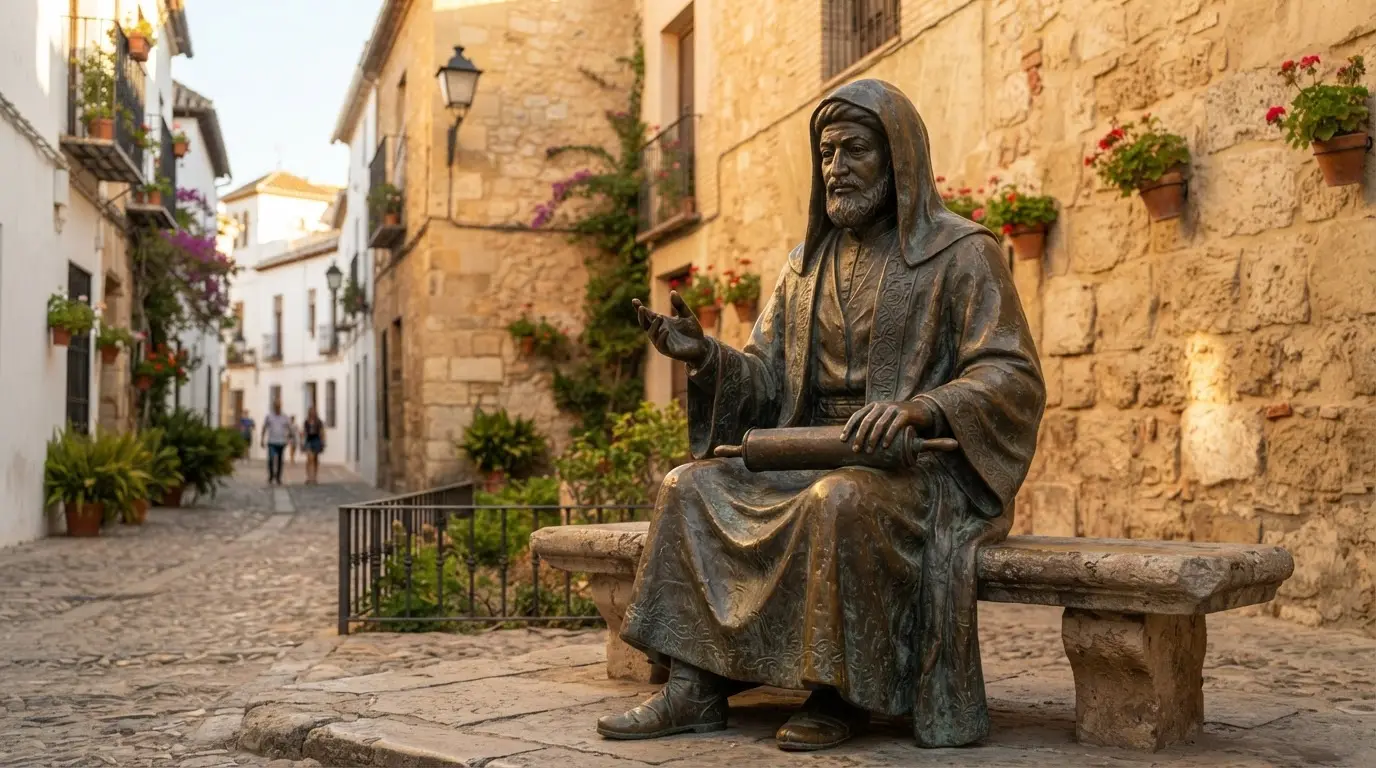
In 1964, Córdoba unveiled a bronze statue of Maimonides in the Judería, the old Jewish quarter where his family had lived. The sculptor was Amadeo Ruiz Olmos, the same artist who cast the Seneca statue near the Puerta de Almódovar. The square was named Plaza de Tiberiades: Tiberias, the Israeli city on the Sea of Galilee, where Maimonides was reinterred after his death in Egypt and where his tomb remains a pilgrimage site today. The name links the city of his birth to the city of his burial, acknowledging the arc of exile that defined his adult life.
The statue shows him seated, in scholarly robes, a book open across his lap. The posture mirrors the work: a man reading, thinking, arguing with texts. His left foot is slightly raised, as if he might stand up. Visitors photograph the statue, particularly the polished bronze foot, rubbed smooth by decades of hands, which is supposed to bring luck or wisdom depending on who you ask. The site claims to be near where his childhood home stood, though the archaeological evidence for that is thin. What matters is that the gesture is there.
A short walk from the statue, the Casa de Sefarad provides the fullest account of Sephardic Jewish life in medieval Córdoba available anywhere in the city. The museum's Maimonides room covers the Guide, the Mishneh Torah, and his medical writings, placing him inside the intellectual culture of 12th-century Al-Andalus rather than treating him as a figure who appeared from nowhere. From there, the 14th-century Synagogue on Calle Judíos, one of only three medieval synagogues still standing in Spain, is two minutes by foot. The Synagogue was built nearly two centuries after Maimonides's birth, so it is not his. But it is the only intact physical trace of the religious community he belonged to, and visiting both in sequence gives the Judería a layered meaning that the Mezquita and the Roman Bridge, magnificent as they are, do not by themselves provide.
The synagogue, statue, and museum stops fit into a single walk, mapped in our Jewish heritage guide to Córdoba. The Judería is also where you feel most clearly the tension at the heart of Córdoba's historical identity. The city promotes itself as the capital of convivencia, of the three cultures, Muslim, Christian, and Jewish, living together. Maimonides is the face of that story for the Jewish tradition: a man shaped by Arabic-language philosophy and Islamic intellectual culture, who synthesised Greek rationalism with Jewish theology and influenced Thomas Aquinas in the process. The story is true. It is also incomplete. The same Almohad-ruled city that produced him expelled him at the age of ten. The convivencia narrative, at its honest best, includes that expulsion alongside the exchange. The Jewish community he represented did not survive intact even to 1492: the 1391 pogroms had already shattered the Judería a century before the Alhambra Decree, forcing mass conversions that permanently altered the community Maimonides's bronze now overlooks.
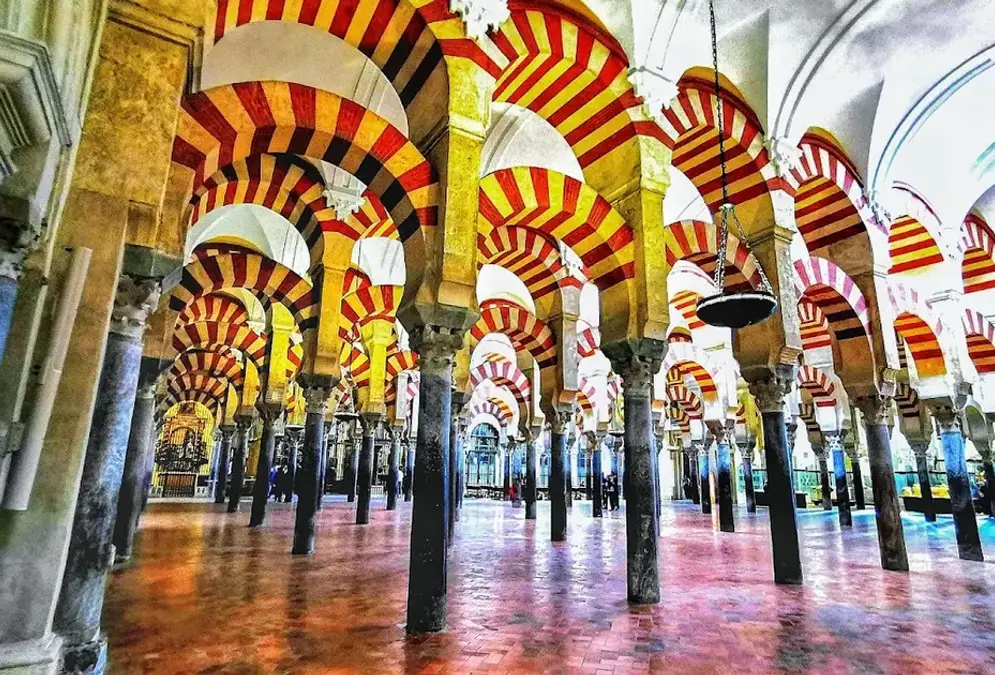
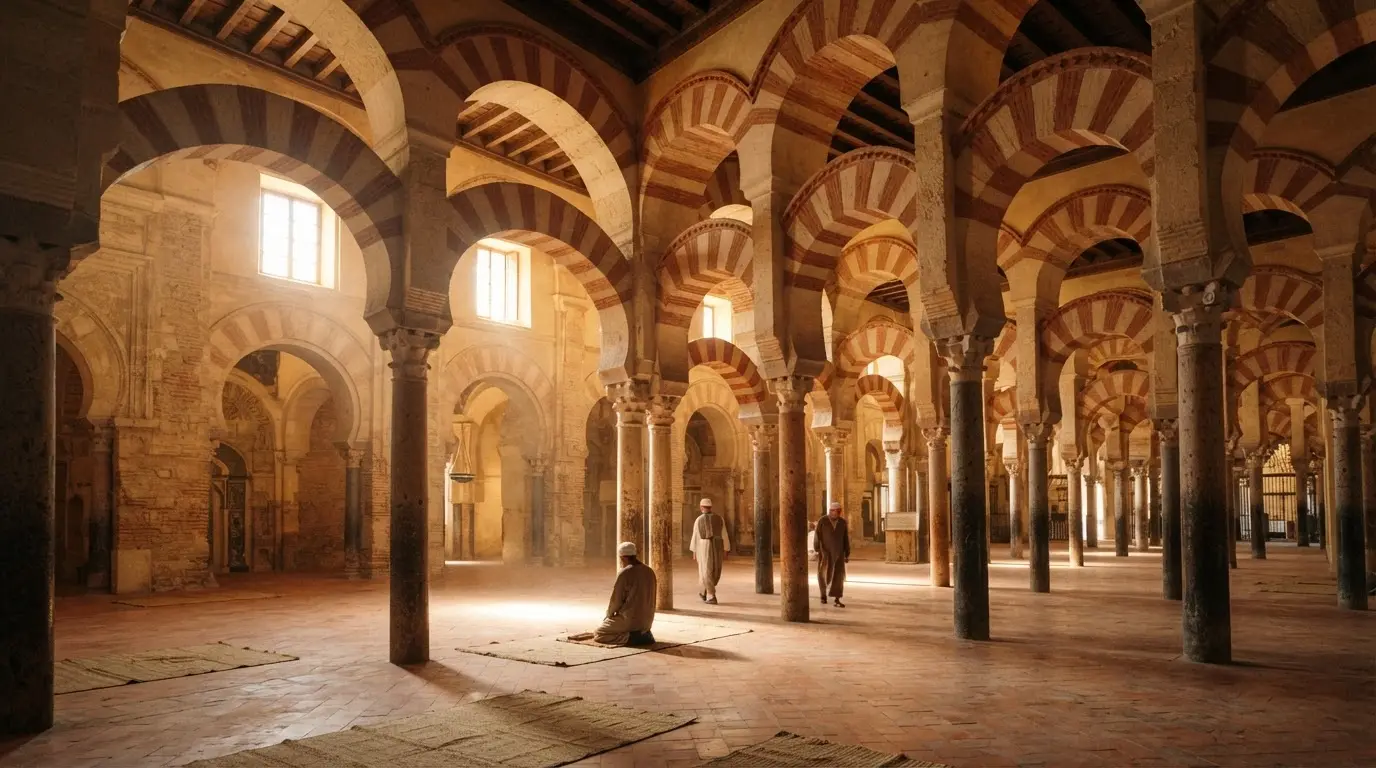
Seneca was born in Córdoba twelve centuries before Maimonides and Averroes twelve years before him. Three philosophers from the same city, separated by epochs, whose ideas reached well beyond the Mediterranean world they each moved through. A fourth Córdoba-trained exile, Al-Qurtubi, belonged to a starker rupture two generations later: pushed out not by a rival dynasty but by the 1236 Christian conquest that ended Muslim Córdoba altogether. The Mezquita-Catedral, which rises above the Judería lanes, is the architectural equivalent of that layering: Roman columns, a Caliphal mosque, a Gothic cathedral, all built inside one another. Maimonides's bronze sits a few hundred metres away in a quiet square, a book on his lap, in a city that drove him away and spent nine centuries trying to do justice to what he left behind.
Frequently asked questions
Who was Maimonides and what is his connection to Córdoba?
Moses ben Maimon (Maimonides, or Rambam in Hebrew) was born in Córdoba, traditionally dated to 1138 (some sources say as early as 1135), the son of a rabbinic judge and philosopher. He grew up in the city's intellectual culture, where Jewish, Muslim, and Christian scholars worked in proximity and Arabic was the shared language of philosophy. The Almohad conquest of 1148 forced his family out, eventually to Egypt, where he spent his adult life writing the works that would make him the most influential Jewish philosopher of the Middle Ages. Córdoba named a square and a statue after him in 1964.
What did Maimonides write?
His three major works span law, philosophy, and practice. The Commentary on the Mishnah (1168, in Judeo-Arabic) introduced the Thirteen Principles of Faith still recited in synagogues today. The Mishneh Torah (c.1180, in Hebrew) is a 14-volume codification of all 613 commandments; the most authoritative Jewish legal code ever written, still used in Jewish courts and yeshivas worldwide. The Guide for the Perplexed (1190, in Judeo-Arabic) is his philosophical masterpiece, reconciling Aristotelian philosophy with Jewish theology through the framework of negative theology. He also wrote medical treatises in Arabic that were read across Europe and the Middle East for centuries.
What is Maimonides's negative theology?
Negative theology (via negativa) is the argument that God is so far beyond human comprehension that any positive statement about divine nature is misleading. Saying 'God is wise' implies God's wisdom resembles human wisdom, which it does not. What we can reliably do is negate false attributes: God is not limited, not ignorant, not subject to change. Knowledge of God is achieved by systematically removing incorrect descriptions rather than accumulating correct ones. Maimonides developed this position in the Guide for the Perplexed; Thomas Aquinas adopted the framework in the Summa Theologiae, and Spinoza used it to critique anthropomorphic religion.
Did Maimonides know Averroes?
The two men almost certainly never met in person; Averroes lived in Córdoba and Seville, while Maimonides spent his adult life in Egypt. But Maimonides knew Averroes's work well. In a 1199 letter to his translator Samuel ibn Tibbon, Maimonides explicitly recommended Averroes's commentaries as the best guide to Aristotle. That recommendation drove the Hebrew translation movement that preserved several of Averroes's works after the Arabic originals were suppressed or lost. The two men represent the Jewish and Muslim peaks of 12th-century Córdoba's philosophical tradition, and their ideas reached Christian Europe through the same channels.
Why was Maimonides controversial among Jews?
The Mishneh Torah was controversial because it presented Jewish law as settled decisions rather than ongoing debate; critics felt he had suppressed the Talmudic tradition of competing interpretations. The Guide for the Perplexed drew fiercer opposition: some communities felt that subjecting Torah to Aristotelian philosophical analysis was disrespectful or dangerous. In the early 13th century, after his death, certain rabbinical authorities in France and Spain placed his philosophical works under a ban. The dispute, known as the Maimonidean Controversy, ran for decades. His legal code survived it and became more authoritative over time; the Guide remained contested but widely read.
How did Maimonides influence Thomas Aquinas?
When Samuel ibn Tibbon translated the Guide for the Perplexed into Hebrew in 1204, the text entered the Jewish scholarly world. Latin translations followed, and by the mid-13th century Thomas Aquinas had read it closely. Writing the Summa Theologiae in the 1260s, Aquinas cited Maimonides as 'Rabbi Moses' and drew on his negative theology and his argument that reason and revelation must harmonize. The Aristotelian synthesis that Maimonides had built for Judaism, Aquinas adapted for Catholic theology, another link in the chain that runs from Córdoba's 12th-century intellectual culture through the European university system.
Where is Maimonides's statue in Córdoba and what else is nearby?
The bronze statue, sculpted by Amadeo Ruiz Olmos in 1964, stands in Plaza de Tiberiades in the Judería, Córdoba's medieval Jewish quarter. The square is named after Tiberias, the Israeli city where Maimonides is buried. Within a few minutes' walk are the Casa de Sefarad (a Sephardic heritage museum with a dedicated Maimonides room), the 14th-century Synagogue on Calle Judíos (one of only three medieval synagogues surviving in Spain), and the Averroes statue near the Almodóvar Gate. The Mezquita-Catedral is about five minutes' walk south.
When did Maimonides live, and where did he die?
Maimonides was born in Córdoba on 30 March, traditionally dated to 1138 though some sources place it as early as 1135, and died on 12 December 1204 in Fustat (Old Cairo), Egypt. He spent his childhood in Córdoba and his adolescence moving through Morocco and Palestine before settling in Egypt around 1166. All his major works were written in exile; the Commentary on the Mishnah, the Mishneh Torah, and the Guide for the Perplexed were all composed in Egypt, not in the city of his birth. He was initially buried in Egypt; his remains were later reinterred in Tiberias, in present-day Israel, where his tomb remains a site of pilgrimage for Jewish visitors from around the world.