Abd al-Rahman III: The Morning Córdoba Became a Caliphate
Abd al-Rahman III was the first Caliph of Córdoba, declared on January 16, 929, ruling Córdoba for 49 years and starting work on Medina Azahara in 936 CE.
Art history background with eight years writing interpretive content on Córdoba's Caliphal heritage.
Updated Published
history-buffsarchitecturephotographers
Abd al-Rahman III was the Umayyad emir of Córdoba from 912 who, in mid-January 929, declared himself Caliph[5] and ruled until 961[1]. Much of what he built came after the title, beginning with Medina Azahara in 936[2]. Yet a line attributed to him, never proven to be his own, counts just fourteen days of true happiness across all of it[4].
From 912 until his death in 961, as emir and then caliph[1]
Palace-city and minaret
936 to 958
Medina Azahara begun in 936; the Mezquita minaret finished by 958[2][3]
Days of happiness counted
14 days
Late-life tally attributed to him, never proven his own words[4]
In this article
Jump to a section
⌄
Mid-January 929: the title that ended the emirate
Abd al-Rahman III declared himself Caliph of Córdoba in mid-January 929[5], after about sixteen years as emir. He did so the year after Bobastro, the centre of the Andalusian rebellion, was finally stormed in 928[6], and he took the honorific al-Nasir li-Din Allah, "Victor for the Religion of God". By then he had beaten some of the rebels, though resistance went on for several more years, and the title gave his authority a religious weight to match the military one.
The title mattered because rank in the Islamic West was announced every week. At Friday prayers the khatib names the ruler whose authority the congregation acknowledges, and coins carry the same name in metal; for generations the Córdoban emirs had left the Abbasid caliph's claim standing in theory, and from 929 the name was their own. The style that came with the office, Amir al-Mu'minin or Commander of the Faithful, was a claim over every Muslim, not just those of al-Andalus.
Nobody missed the message. For the Abbasids in Baghdad and the Fatimids in North Africa alike the proclamation was a direct affront[7], and Córdoba's new caliph had no overlord left to answer to.
929 CE
The year Abd al-Rahman III took the title of caliph, ending Córdoba's nominal place under Baghdad.
The emirate he inherited, and the years it took to hold it
Abd al-Rahman III, a prince of the Umayyad dynasty, took power in 912 and inherited the emirate of Córdoba that Abd al-Rahman I had founded, by then a patchwork: castle lords who governed as they pleased, Arab and Berber factions competing at court, and rebel strongholds in the hills where the capital's writ ran thin.
His answer mixed patience with a hard hand. On 1 January 913, in the first days of the new year, an army led by the eunuch Badr took the fortress of Écija[8]; after that, year by year, he retook castles and towns from rebel lords, and he built the army to do it from men with no stake in the old factions.
The core of the new force was a standing army of slave-born and foreign soldiers, the saqalibah among them, paid from the treasury rather than raised by clan chiefs. The number of slaves was reported to have grown from about 4,000 to 14,000 during his reign[9], and not all of them became soldiers. The system broke the Arab and Berber aristocracies' hold on military power and gave the emir troops he could send anywhere without first bargaining with a lord.
Valdejunquera, July 920
The northern kingdoms learned the lesson at Valdejunquera in 920, where the armies of León and Navarre fought together and still lost badly. That victory, together with a campaign against Pamplona in 924, secured his frontiers with Christian Spain for the next seven years[10]. For a ruler barely eight years into his reign it was proof that the rebuilt emirate could win a pitched battle against two Christian kingdoms at once. It also did something at home: every lord still holding out against Córdoba could now see that the emir's army was the strongest in the peninsula, and that waiting for him to falter was a poor bet.
Bobastro and the end of the revolt
Bobastro, the mountain stronghold at the heart of the rebellion, fell shortly before the caliphal title was claimed, and its loss removed the most dangerous rebel stronghold in the emirate. It did not end resistance, since other towns held out for years. The order of events still matters: a ruler who proclaims a caliphate while the rebellion's headquarters stands invites ridicule, whereas one who has just taken it can present the new title as the crown of a state recovering its grip.
The years between 912 and the fall of Bobastro were therefore not a prelude to the caliphate so much as its precondition. Everything that follows in the reign, from the embassies to the building programme, rests on the fact that the emirate of Córdoba again had a working centre.
Why declare a caliphate in 929?
The title served two audiences. At home it raised him above every castle lord who had ever defied the emirate, since no rebel could challenge a caliph in the same religious language used against an emir. Abroad it was aimed squarely at the Fatimid Caliphate, whose claim to the same honour it was meant to counter[11].
That claim was recent. In 909 Ubayd Allah al-Mahdi had declared himself the Shiite Imam[12], and a rival caliphate on Córdoba's southern flank gave Abd al-Rahman III reason to fear that the Fatimids might one day appeal directly to Muslims in Iberia. By claiming the caliphate first he made that appeal harder to sell: the Sunni west already had its own Commander of the Faithful.
The Abbasid side of the calculation was quieter. Baghdad's caliph held a title that every Córdoban emir had formally acknowledged, but his real authority over al-Andalus had long been theoretical, so defying him cost almost nothing. What Abd al-Rahman gained was the ability to receive envoys as an equal instead of a regional prince, and the embassies that arrived over the next three decades suggest that his neighbours chose to treat him as one.
Recommended tours
Tours are selected for quality, not commission. We earn a small fee if you book — at no extra cost to you.
Córdoba at its peak: envoys, physicians and a city of legend
Around 949 a Byzantine embassy was sent to Abd al-Rahman III in Córdoba[13]. In 950 Count Borrell II of Barcelona sent an embassy of his own[14], and over the course of the reign ambassadors from León, Navarre, Barcelona and Castile all came to pledge homage and pay tribute[15]. Constantinople and the Christian north were not courting a regional emir.
Kings rarely travel to a rival's capital out of courtesy, and that evidence is firmer than any headcount: population figures for tenth-century Córdoba come from admirers rather than census-takers, and are best treated as tradition. The record also shows scholars and physicians finding work at a court that paid for talent whatever its owner's faith.
By 958 the rulers had come themselves: the exiled king Sancho of León, King García Sánchez of Navarre and Queen Toda paid homage in person to the caliph in his capital[16].
None of this should be read as simple submission. Homage to a strong neighbour was also a way of buying a quiet frontier, and the diplomacy of the 950s served both sides.
Physicians and the court
The court ran on specialists. Hasdai ibn Shaprut, a Jewish physician, held no title of vizier yet was in reality the caliph's minister of foreign affairs[17]. A court that put a physician in charge of its diplomacy was not hiring by creed, and Hasdai's rise is the clearest sign of how little a man's religion mattered when the job was persuading foreign courts.
Medina Azahara: a capital built to be looked at
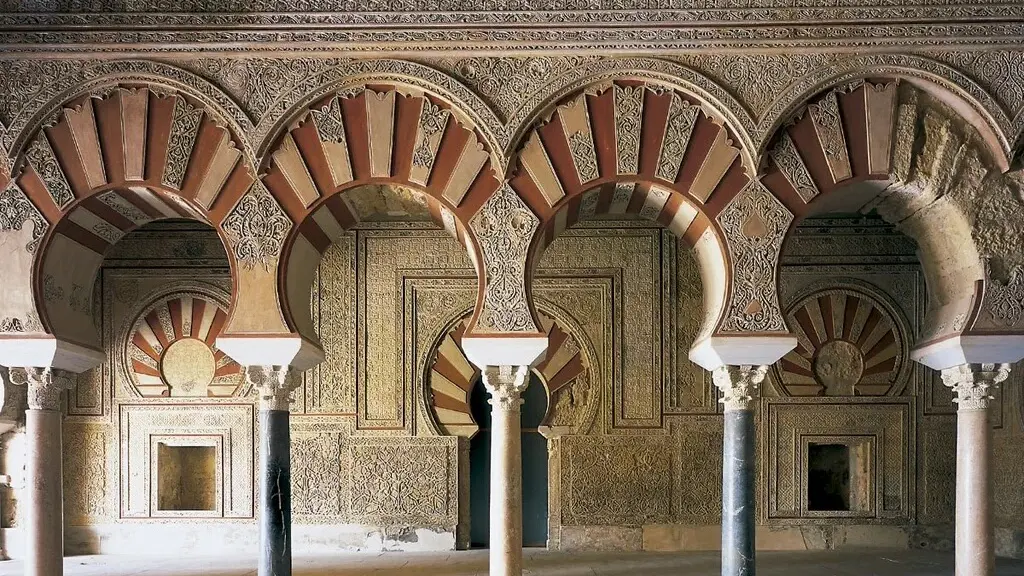
Work on Madinat al-Zahra, the palace-city Córdobans call Medina Azahara, began in 936[2], seven years after the proclamation. It was meant as the administrative and ceremonial capital of a caliphate that needed a stage: a place where an ambassador would pass through terraces and halls before reaching the ruler, and arrive already persuaded. The carved stone decoration of the Salón Rico, the caliph's reception hall, was part of that argument.
Only about 10 of the site's 112 hectares have been excavated and partially restored[18], so what visitors walk through is a fraction of the plan. It is still enough to see the logic of a city laid out around the caliph's presence.
The experiment was short. Abd al-Rahman III did not live to see its end, and neither did his son: the effort to create an ideal city lasted only about seventy years[19], and the city was abandoned after the unrest that consumed the Umayyad caliphate in 1009[20].
Today the way in is museum first and ruins second, with a shuttle bus running continuously between them during opening hours[21]. Hours and ticket rules change, so check the operator's official page before you plan the day.
The light-skinned caliph and what he left in Córdoba
Abd al-Rahman III was remembered as light-skinned, handsome, thickset and short-legged[22], and he reportedly dyed his hair black to appear more Arab[23]. Whether the dye was vanity, politics or a detail that grew in the retelling cannot be settled, but it survives because it fits a ruler with a Christian mother whose court mixed Arabs, Berbers and slave-born soldiers.
He died in 961 after forty-nine years in power[1]. Under his son al-Hakam II the caliphal library grew to more than 400,000 books[24], the library that vanished once the caliphate collapsed. The work outlasted him only briefly: the civil war that ended the Caliphate broke out within fifty years, laying Medina Azahara to waste in 1009 and 1010[25].
The best-known verdict on the reign is a line attributed to him late in life, which counts only fourteen days of true happiness[4]. Treat it as tradition rather than transcript: it is attributed to him, not proven to be his, and it is exactly the sort of sentence later writers like to place in the mouth of a man who seemed to have everything. It still sits well beside the buildings, since a ruler who spent four decades making a state look permanent may well have felt how little of that permanence was his to keep.
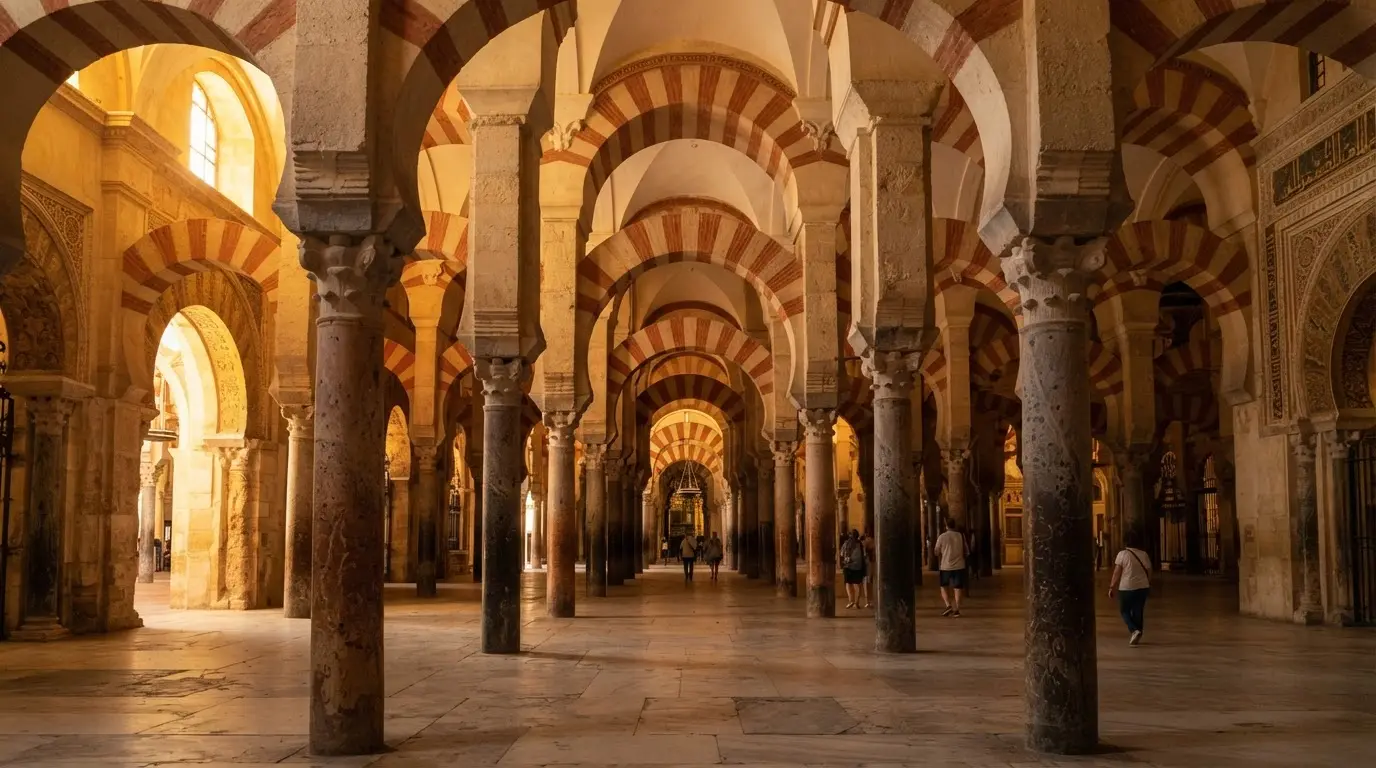
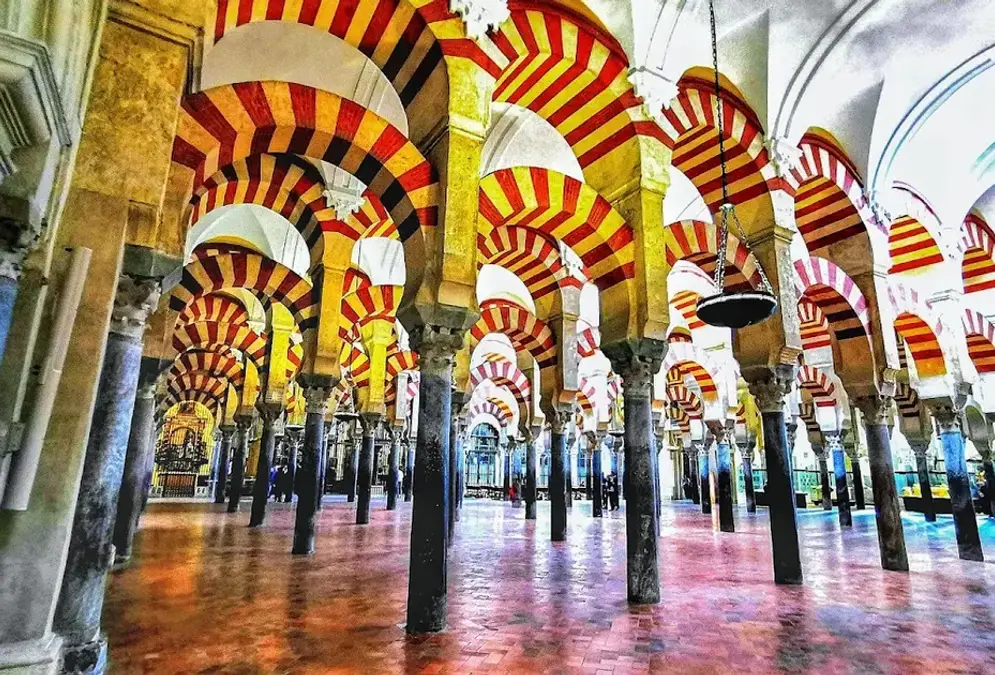
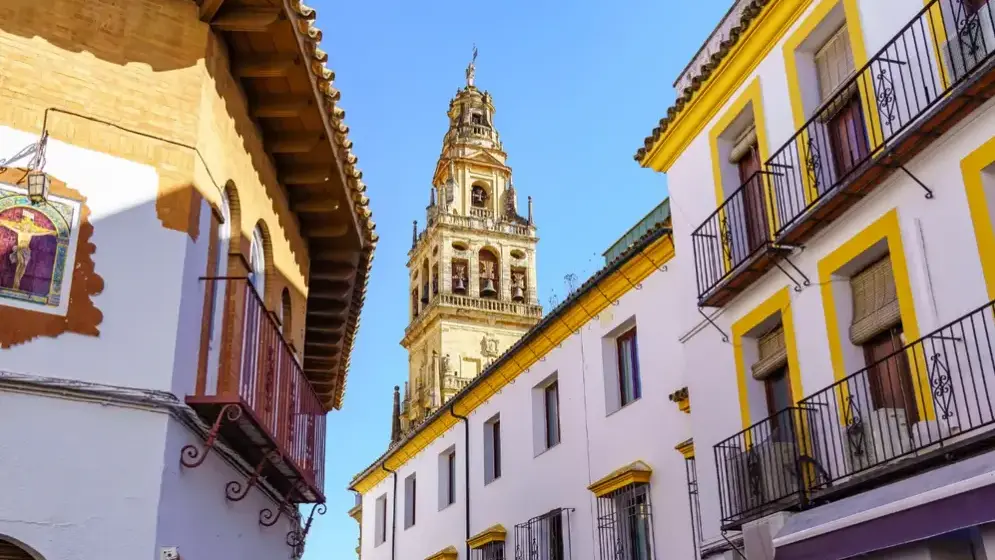
Two places in Córdoba carry his hand directly. The Mezquita-Catedral took a new minaret, finished by 958[3], while Medina Azahara is the city he founded to stage the caliphate.
Site
What belongs to his reign
Practicalities
Medina Azahara
The palace-city he founded; about 10 of its 112 hectares excavated[18]
The great minaret and the chapel façade overlooking the courtyard[27]
Central Córdoba; tickets and hours on the monument's own site
Read together they show the two ends of his project. The mosque kept its congregation and its place in the city, and its World Heritage listing calls it an irreplaceable testimony of the Caliphate of Córdoba[28]; the palace-city, built to impress ambassadors, now impresses day-trippers, with most of it still unexcavated.
Timeline
891
Abd al-Rahman III born
Son of the Umayyad prince Muhammad and Muzna, a Christian concubine.
912
Becomes Emir of Córdoba
Inherits an emirate with little authority beyond the capital and begins retaking rebel castles.
920
Battle of Valdejunquera
A crushing defeat of the combined armies of León and Navarre.
928
Bobastro falls
The stronghold at the heart of the rebellion is stormed.
929
Proclamation of the Caliphate
Mid-January: Abd al-Rahman III declares himself Caliph of Córdoba as al-Nasir li-Din Allah.
936
Medina Azahara begun
Work starts on the palace-city outside Córdoba.
958
Minaret done, homage paid
The Great Mosque's new minaret is finished, and the exiled King Sancho of León, King García Sánchez of Navarre and Queen Toda pay homage in person.
961
Abd al-Rahman III dies
Succeeded by his son al-Hakam II.
Frequently asked questions
Why did Abd al-Rahman III declare himself Caliph in 929?
Two pressures pushed him. Abroad, the Fatimid dynasty had put forward its own Shiite imam in North Africa in 909, and the Córdoban title was meant to counter that claim. At home, the title lifted him above every rebel and regional lord, and it came shortly after the fall of Bobastro, when the long rebellion had finally been broken. The Abbasids in Baghdad, whose authority over al-Andalus was already theoretical, were the third audience, and for them the proclamation was a direct affront.
What is the difference between an Emir and a Caliph?
An emir was a regional governor or prince, a title that implied some subordination to a higher Islamic authority. The rulers of Córdoba had held it since the emirate's foundation, nominally acknowledging the Abbasid caliph in Baghdad even as that acknowledgment became theoretical. A caliph claimed supreme religious and political authority over the Muslim community, answerable to no earthly overlord. When Abd al-Rahman III took the caliphal title in 929, Córdoba's formal subordination to Baghdad ended.
What can I visit today that is connected to Abd al-Rahman III?
Two sites carry his hand. Medina Azahara, the palace-city he began in 936, lies 8 km west of Córdoba on the A-431; only about 10 of its 112 hectares are excavated, and a shuttle bus links the museum and the ruins during opening hours. The Mezquita-Catedral took a new minaret and a courtyard-facing chapel façade in his reign. Both are UNESCO World Heritage listed, and the official pages give current hours and tickets.
How large was Córdoba under Abd al-Rahman III?
Nobody can give a reliable number. Medieval admirers produced enormous figures, but none comes from a census, and modern population estimates vary widely. The safer evidence is the city's standing: ambassadors from León, Navarre, Barcelona and Castile came to pledge homage, and by the end of his reign Córdoba enjoyed almost as much fame as Constantinople in the Mediterranean world.
What was the Battle of Valdejunquera?
Fought in 920, Valdejunquera was the battle in which Abd al-Rahman III's army inflicted a crushing defeat on the combined armies of León and Navarre. Together with a campaign against Pamplona in 924, it let him secure his frontiers with Christian Spain for the next seven years, nine years before the caliphate was proclaimed. Accounts differ on who commanded each side and which prisoners were taken, so treat the most colourful details with caution.
Why did Abd al-Rahman III dye his hair black?
He reportedly did, though the evidence is thin. He was remembered as light-skinned, and a tradition holds that he dyed his hair (some versions say his beard) black to look more Arab. His mother Muzna was a Christian concubine, which helps explain the contrast. Whether the dye was vanity or political theatre is not recorded.
What happened to the Caliphate after Abd al-Rahman III's death?
His son al-Hakam II continued the court's scholarly programme, and the caliphal library grew to more than 400,000 books. Hisham II then inherited the throne as a boy, and real power slid to the chamberlain Almanzor. The civil war of 1009 to 1010, the fitna, laid Medina Azahara to waste and broke the Caliphate apart; the title itself was abolished in 1031, leaving the successor taifa kingdoms to divide al-Andalus.