Born in Córdoba in 39 AD, Lucan wrote Rome's most defiant epic against a reigning emperor and was forced to die at 25. Complete story of lucan poet cordoba.
Art history background with eight years writing interpretive content on Córdoba's Caliphal heritage.
Updated Published
history-buffsart-lovers
Lucan was born in Corduba (modern Córdoba) on November 3, 39 AD, and by the time he was 25 Nero had ordered him to die: not for conspiracy alone, but for writing an epic poem that made Julius Caesar the villain of Roman history while a descendant of Caesar sat on the throne. His Pharsalia is the only major Latin epic without divine intervention; no gods tip the scales, no Jupiter sends omens, just two Roman generals destroying the Republic and each other. Córdoba produced Seneca the Elder, Seneca the Younger, and Lucan, the most important intellectual family in the Roman empire, but Lucan's story is his own.
In this article
Jump to a section
⌄
Born in Corduba: the city that supplied Rome with its intellectuals
Marcus Annaeus Lucanus was born in Corduba on November 3, 39 AD[1], into an equestrian family already embedded in Rome's intellectual network. His grandfather was Seneca the Elder, the rhetorician from Córdoba whose Controversiae documented Augustan oratorical culture. His uncle was Seneca the Younger, by 39 AD already a practicing advocate in Rome and on his way to becoming Nero's tutor and co-governor. His father, Marcus Annaeus Mela, was the quieter of the three brothers: not a senator, not a philosopher, but a wealthy private gentleman who apparently preferred commerce to politics.
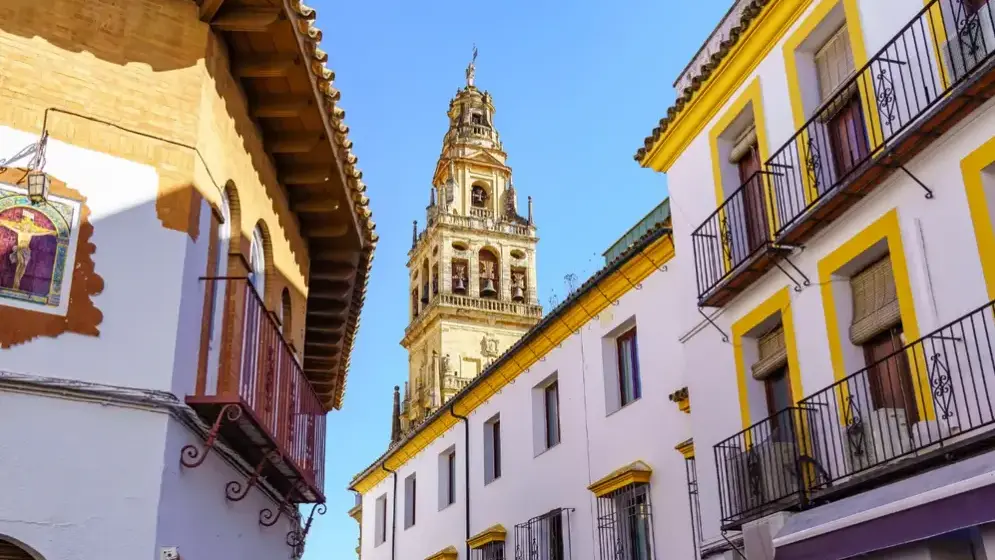
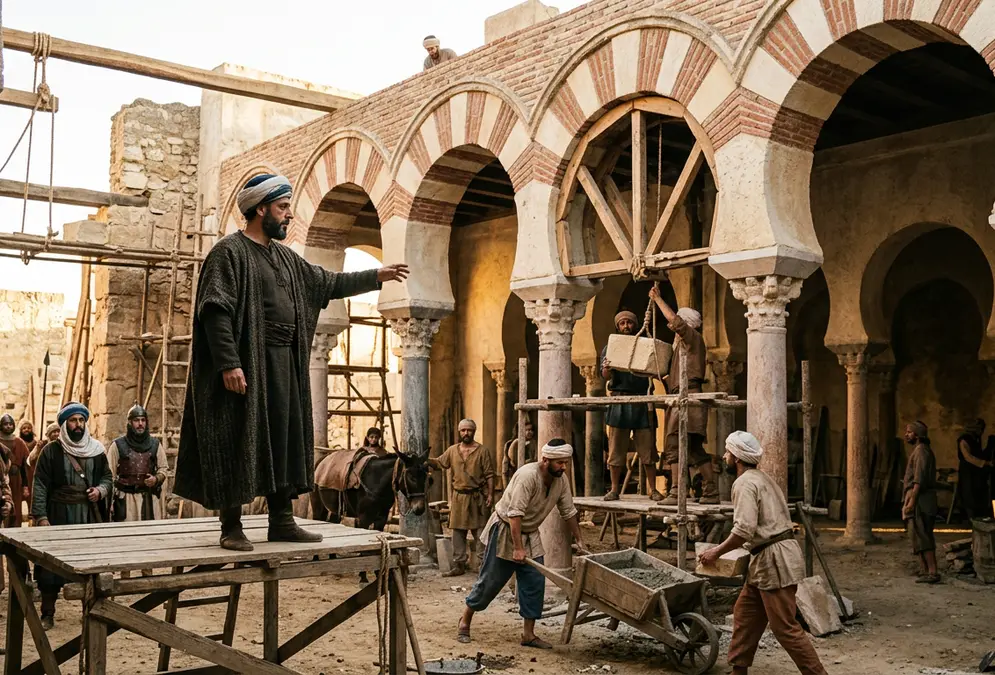
Corduba in 39 AD was a proper Roman city, not a provincial outpost. As the capital of Hispania Baetica[4], it had a forum, a circus, a theatre, and the administrative apparatus of an imperial province. The city's ancient river crossing spanned the Guadalquivir a few hundred metres from where the family's household would have stood. The temple on Calle Capitulares, still partially visible under what is now Córdoba's City Hall, was under construction during Lucan's childhood, part of the Provincial Forum complex where Baetica conducted its official business with Rome. This was the city he left as an infant, taken north to the capital by the same family network that had already sent two generations of Annaei into Roman public life. The Roman Córdoba guide brings together what still survives of that ancient city, from the bridge to the temple.
He would never live in Córdoba again. But Corduba shaped what he became: a writer from a city of writers, from a family that had made the journey from province to empire and knew exactly what that journey cost.
The prodigy at Nero's court: the Neronia festival, 60 AD
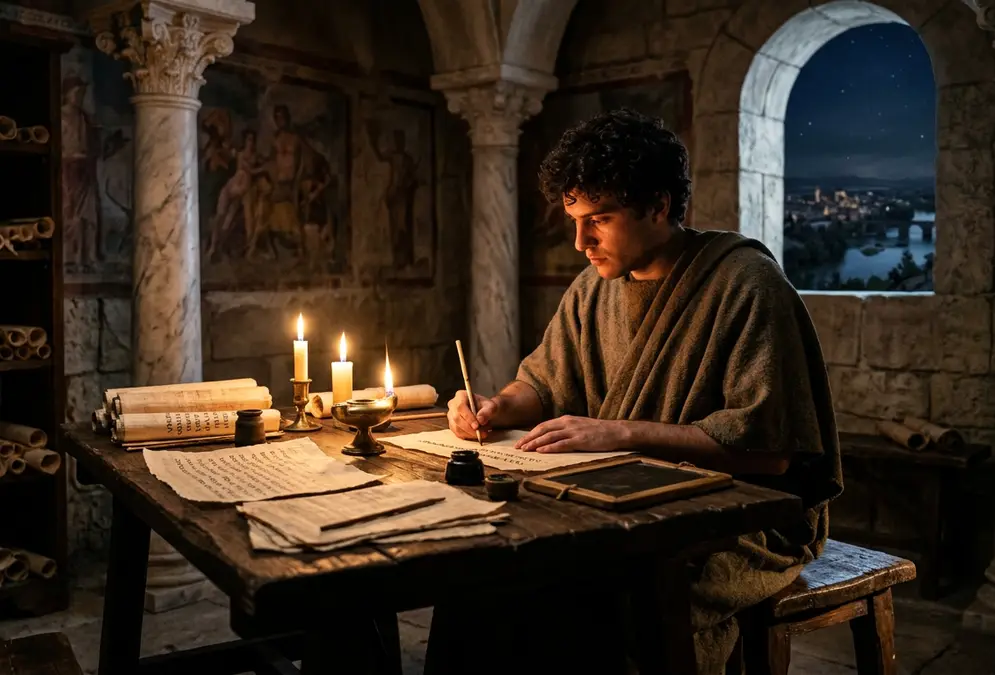
Lucan was taken to Rome as an infant and educated there under the Stoic philosopher Cornutus, who also taught the satirist Persius. He later studied rhetoric in Athens[1], the standard finishing school for Roman aristocrats who intended literary or legal careers. He came back to Rome with a reputation already forming: a young man with unusual facility for verse, quick and inventive, the kind of talent that got noticed at the dinner parties where Roman literary culture actually operated.
Nero, emperor from 54 AD, fancied himself an artist. In 60 AD he founded the Neronia, a Greek-style arts festival at Rome, the first time the city had hosted a formal competition in poetry, rhetoric, music, and athletics on the Hellenic model[1]. Lucan entered the poetry competition and won. He improvised verses in praise of Nero, the emperor who was being positioned as a new Helios, a new Apollo, a divinely gifted poet-ruler. The poem praised Nero's new star rising over Rome.
60 AD
The year Lucan won the poetry prize at Nero's Neronia festival, the first Greek-style arts competition held in Rome. He was 21. Within five years, Nero had banned him from public readings and he had joined a conspiracy to assassinate the emperor.
The victory was real and the flattery was real. At 21, Lucan was exactly the kind of talent the emperor wanted visible in his court. Nero rewarded him with the quaestorship, a junior magistracy with a legal minimum age of 30, years ahead of what a 21-year-old could normally expect. This was not a ceremonial gesture. It meant Lucan had access to Senate proceedings and was on the fast track for a public career that most young Romans spent a decade queuing for.
Neither the prize nor the appointment lasted. Within a few years, Nero was no longer treating Lucan as an asset. The reasons, Tacitus suggests, were simple: the emperor had grown jealous of Lucan's talent and reputation[1], and he could not tolerate it.
The Pharsalia: an epic written without gods, or fear
Lucan began the Pharsalia (also called the Bellum Civile, the Civil War) around 61 AD[2], probably while still on good terms with Nero, and continued writing it after the relationship soured. The poem covers the civil war between Julius Caesar and Pompey the Great, the conflict that ended the Roman Republic and set the template for autocracy. Ten books survive, covering the period from 49 BC to roughly 48 BC[2]. The poem was unfinished when Lucan died: Book 10 breaks off mid-action.
What made it extraordinary, and politically dangerous, was the choice of how to tell the story. Traditional Latin epic, from Virgil's Aeneid onwards, used the divine machinery of Olympian gods: Jupiter sends omens, Venus protects her Roman descendants, the gods argue and intervene. The Pharsalia has none of this[7]. No gods speak. No divine force guides the outcome. The war happens because of human ambition, and its result is catastrophe without redemption.
Lucan's Caesar is not the heroic founder of Rome's imperial destiny. He is a force of destruction, described repeatedly through the image of lightning that strikes without judgment, burns without purpose, and leaves only damage[2]. His simile for Caesar in Book 1 is exact: lightning is not aimed; it simply destroys whatever it hits. Pompey, by contrast, is the old oak, still impressive, already dying, roots loosened by age. Neither man is heroic. The Republic they fight over is already dead before the first battle.
The figure who emerges as the poem's moral centre is Cato of Utica, the Stoic senator who refuses to accept Caesar's victory, marches his men through the Libyan desert rather than surrender, and dies by his own hand at Utica rather than live under a dictator[7]. Cato is not a romantic figure. He is cold, severe, unsparing of himself and others. But in the Pharsalia he is the only man who understands what is actually being lost, and who refuses to pretend otherwise.
Recommended tours
Tours are selected for quality, not commission. We earn a small fee if you book — at no extra cost to you.
Writing a poem that made Caesar the destroyer of Rome, Pompey a faded irrelevance, and the real Republican hero a man who chose death over submission, while Nero read your drafts and presented himself as Caesar's heir and the living continuation of Augustan destiny, was not an accident of content. Lucan knew what he was doing. The Pharsalia was the most politically charged poem composed under the early Principate.
The falling-out with Nero: banned from reading aloud
The precise sequence of events between Lucan and Nero is disputed. Tacitus says Nero, jealous of Lucan's talent and growing reputation, banned him from public recitations, the Roman equivalent of a publication ban, since poetry in this period circulated primarily through public performance[1]. The ban fell somewhere between 62 and 65 AD, most likely in the early 60s when Nero's relationship with his court began its characteristic deterioration.
For Lucan, this was not just an insult. Public recitation was how a Roman poet built reputation, circulated work, and demonstrated continued relevance. A ban meant he could write but could not be heard. He responded, according to later sources, by continuing to compose the Pharsalia and by writing savage epigrams about Nero, passed through the private networks of the Roman literary world rather than circulated publicly. His uncle Seneca the Younger was still technically advising Nero during these years, in a relationship that had its own growing tensions; the two men's trajectories towards the same April purge ran in parallel.
The sources, primarily Suetonius's Life of Lucan, Tacitus's Annals, and the late antique Vacca vita, are not always consistent[6]. What they agree on: the relationship between Lucan and Nero, which began with a prize and a quaestorship, ended in active hostility. Lucan, denied the platform his talent had earned, found other outlets. Some of those outlets were conspiratorial.
This is the part of Lucan's biography that is easiest to romanticise and hardest to verify: the banned poet continuing to write his anti-Imperial epic in secret, the verses circulating hand-to-hand through Rome, the regime increasingly aware that the most talented writer of a generation was describing its founder as a bolt of lightning that destroys what it touches. The reality was probably less dramatic and more politically calculated. Rome's literary world was small and well-connected. People knew what Lucan was writing. Some of them found it useful.
The Pisonian conspiracy and the death of a poet at 25
In April 65 AD, the Pisonian conspiracy, a plot involving senators, equestrians, and Praetorian officers to assassinate Nero and replace him with Gaius Calpurnius Piso, was discovered[3]. The intelligence came from a freedman named Milichus, who had learned of the plan from his patron, the senator Flavius Scaevinus. Milichus went to Nero's freedman Epaphroditus and told him everything he knew. Within days the conspiracy unravelled.
The scale of the punishment was massive[3]. Piso and most of the inner circle took their own lives before they could be arrested. Tacitus lists the dead: senators, officers, poets, friends of poets. Seneca the Younger, Lucan's uncle, was among those ordered to die; his connection to the conspiracy was contested even in antiquity, but Nero used the moment to remove him. Lucan was named by the conspirators, possibly under torture, possibly by Milichus's initial testimony, possibly by his own confession. The sources suggest he also named his own mother, Acilia, in an attempt to bargain for his life; Tacitus records this with evident contempt, and Acilia was ultimately not punished[1].
Lucan died on April 30, 65 AD. He was 25 years old. The manner of his death, Tacitus records, had its own literary shape: as the blood drained from his opened veins, Lucan recited lines from his own Pharsalia, verses describing a wounded soldier bleeding to death while still conscious[1]. No exact matching passage has ever been identified with certainty in the surviving text[1]. Whether this was a prepared gesture or what simply came to mind in the moment, it is the most Lucan thing imaginable: a poet dying inside his own poem.
The Pharsalia was left at 10 books, unfinished. Book 10 ends mid-sentence in some manuscripts[2]. The poem that had cost him his life was never completed. His wife Polla Argentaria survived him by decades and apparently worked to preserve and circulate the text, a posthumous publication effort that succeeded: the Pharsalia was read throughout late antiquity, the Middle Ages, and the Renaissance, and is in print today.
Timeline
39 AD
Born in Corduba, Córdoba
Born in Corduba (modern Córdoba) on November 3, to Marcus Annaeus Mela; grandson of Seneca the Elder, nephew of Seneca the Younger[1].
c. 60 AD
Poetry prize at Neronia festival
Wins the poetry prize at Nero's Neronia festival in Rome; awarded the quaestorship, years ahead of the legal minimum age of 30.
c. 61 AD
Begins the Pharsalia
Begins the Pharsalia (Bellum Civile), an epic on Caesar's war against Pompey, without divine machinery, with Caesar as destroyer[2].
c. 62-64 AD
Banned from public recitations
Nero bans Lucan from public recitations, jealous of his talent and reputation[1]. Lucan continues writing; joins the Pisonian conspiracy.
April 65 AD
Pisonian conspiracy discovered
The Pisonian conspiracy discovered after freedman Milichus informs on the plotters[3]. Lucan is named as conspirator.
April 30, 65 AD
Forced suicide at 25
Forced suicide at 25. Tacitus records he recited his own verses from the Pharsalia as he bled out[1]. The poem remained unfinished at 10 books[2].
Lucan's legacy: why the unfinished poem survived
The Pharsalia did not disappear after 65 AD. Statius, writing a generation later, described Lucan's fame as already secure, the Pharsalia read alongside Virgil's Aeneid as one of the two great Latin epics. The poem's lack of divine machinery, which had been politically provocative under Nero, became its philosophical distinction in later centuries: here was an epic that located historical causation entirely in human choice and human failure, with no gods to blame and no destiny to shelter behind.
Dante put Lucan in the first circle of Hell alongside Homer, Horace, Ovid, and Virgil, the company of the great ancient poets, the best a pagan could hope for. Marlowe translated Book One of the Pharsalia into English blank verse, one of the earliest English renderings of Lucan. Shelley cited Lucan's treatment of Cato as a model for political poetry that refused accommodation with power. In the 20th century, the Pharsalia became a touchstone for scholars studying how literary form can carry political meaning: the absent gods, the lightning metaphor for Caesar, the Stoic Cato as the poem's moral anchor, all of it reads differently under every political era that encounters it.
For Córdoba, the significance is specific. The city produced the most important intellectual family of the early Roman empire: Seneca the Elder documented Augustan rhetoric; Seneca the Younger governed with Nero and wrote the letters that gave Montaigne the essay form; Lucan wrote the most politically dangerous poem of the Julio-Claudian period[4]. None of them spent their adult lives in Córdoba; the city exported them to Rome as effectively as Baetica exported olive oil and silver. But all three remained identified with Corduba in antiquity and remain so today.
You will not find a Lucan museum in Córdoba. There is no statue, no dedicated walking route, no entry fee. The Seneca statue near the Puerta de Almodóvar stands on Roman walls that were already old when Lucan was born; that is the closest material connection available. The physical Corduba Lucan was born into, its forum, its bridge, its civic infrastructure, is the same Roman layer visible in the Roman temple on Calle Capitulares, a Provincial Forum complex constructed and expanded across the reigns of Claudius through Domitian — work that began during Lucan's own childhood and continued for decades after his death.
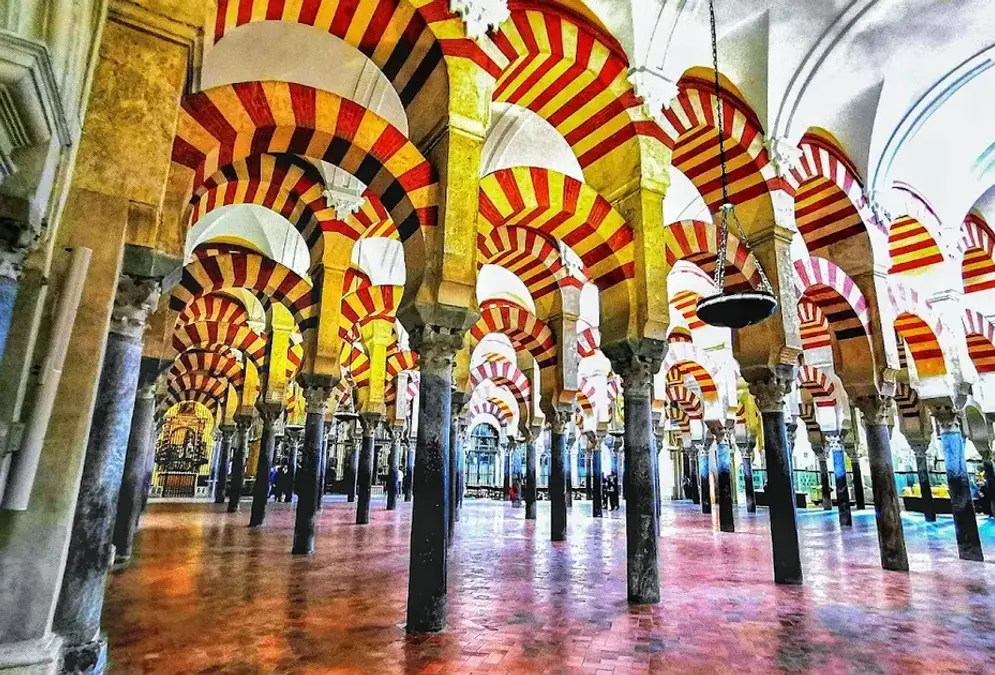
What Córdoba has is the fact of it. The city where Rome's two most important Stoics and the empire's most defiant poet were born is also the city where the Mezquita was built, where Maimonides was born, where Averroes wrote his commentaries on Aristotle. The Roman layer is the oldest, and it is the least commemorated. Walking the old city, it takes some effort to remember that before any of the medieval structures, before the caliphate, there was Corduba: a provincial capital that produced ideas large enough to trouble emperors.
FAQ about lucan poet cordoba
Was Lucan born in Córdoba?
Yes. Marcus Annaeus Lucanus was born in Corduba (modern Córdoba) on November 3, 39 AD. Corduba was the Roman capital of Hispania Baetica, one of Rome's most developed western provinces. Lucan was taken to Rome as an infant and educated there; he never returned to Córdoba, but the city claims him as the birthplace of Rome's most defiant poet.
What is the Pharsalia and why was it controversial?
The Pharsalia (also called the Bellum Civile or Civil War) is Lucan's epic poem covering the war between Julius Caesar and Pompey that ended the Roman Republic. It is the only major Latin epic with no divine machinery; no gods intervene, no destiny guides the outcome. Lucan portrays Caesar as a destructive force likened to lightning, Pompey as a fading oak, and the Stoic Cato as the poem's true moral hero. Writing this under Nero, who styled himself as Caesar's heir, was politically dangerous. The poem remained unfinished at 10 books when Lucan died.
Why did Nero ban Lucan from public recitations?
According to Tacitus, Nero banned Lucan from public recitations out of jealousy of Lucan's talent and growing reputation, some years after Lucan won the poetry prize at the Neronia festival in 60 AD. The ban fell sometime between 62 and 65 AD. For a Roman poet, public recitation was the primary way to circulate work and build reputation; the ban was both a professional sanction and a personal humiliation.
How did Lucan die?
Lucan was forced to commit suicide on April 30, 65 AD, aged 25, following the discovery of the Pisonian conspiracy, a senatorial plot to assassinate Nero. He was named as a conspirator. Tacitus records that as Lucan bled from his opened veins, he recited lines from his own Pharsalia describing a soldier dying the same way; no exact matching passage has ever been identified with certainty in the surviving text. He was 25 years old.
Is the Pharsalia related to Seneca's death?
Both Lucan and his uncle Seneca the Younger were killed in the same purge following the Pisonian conspiracy of April 65 AD. Nero used the conspiracy's discovery to eliminate multiple figures from the literary and political world he distrusted. Seneca was ordered to die on different grounds than Lucan, but both deaths happened within days of each other in April 65 AD. The Seneca article on this site covers the broader Annaeus family story.
How is Lucan remembered in Córdoba today?
There is no Lucan statue, museum, or dedicated monument in Córdoba. The city commemorates Seneca the Younger with a 1965 bronze near the Puerta de Almodóvar, but Lucan has no equivalent marker. The Roman monuments visible in the city, the bridge across the Guadalquivir and the temple on Calle Capitulares, belong to the same Roman Corduba Lucan was born into, giving physical context even without a direct memorial.
Why is the Pharsalia considered the first major Latin epic without divine intervention?
Virgil's Aeneid, Ovid's Metamorphoses, and earlier Latin epics used the Olympian gods as active participants who shaped historical outcomes. In the Pharsalia, Lucan removes them entirely. The civil war between Caesar and Pompey happens because of human ambition and human failure, with no divine sanction and no providential outcome. This was a philosophical choice, influenced by Stoicism, and also a political one: if no gods guided Caesar to victory, then imperial power has no divine mandate.
Who were Lucan's family connections in Roman Córdoba?
Lucan's grandfather was Seneca the Elder, the rhetorician from Córdoba who documented Augustan oratory. His uncle was Seneca the Younger, the Stoic philosopher who became Nero's tutor and co-governed Rome in the early years of his reign. His father was Marcus Annaeus Mela, the quieter brother who preferred private commerce. The three generations of the Annaeus family, all originating from Corduba, produced the most significant body of Latin writing from any provincial Roman family. The Seneca article covers the family history in more detail.
FAQ about lucan poet cordoba: where can I read the Pharsalia?
The Pharsalia survives complete to 10 books (unfinished). Several English translations exist: Jane Wilson Joyce's verse translation (Cornell University Press, 1993) is reliable for historical research; J.D. Duff's Loeb Classical Library edition (1928, LCL 220) gives the Latin facing the English; Susan H. Braund's Oxford World's Classics edition (1992) is a reliable scholarly translation with introduction and notes. The most readable modern translation for general readers is Matthew Fox's Penguin Classics edition. The poem is also widely available in public-domain versions online.