
The bridge Rome built, and what survives
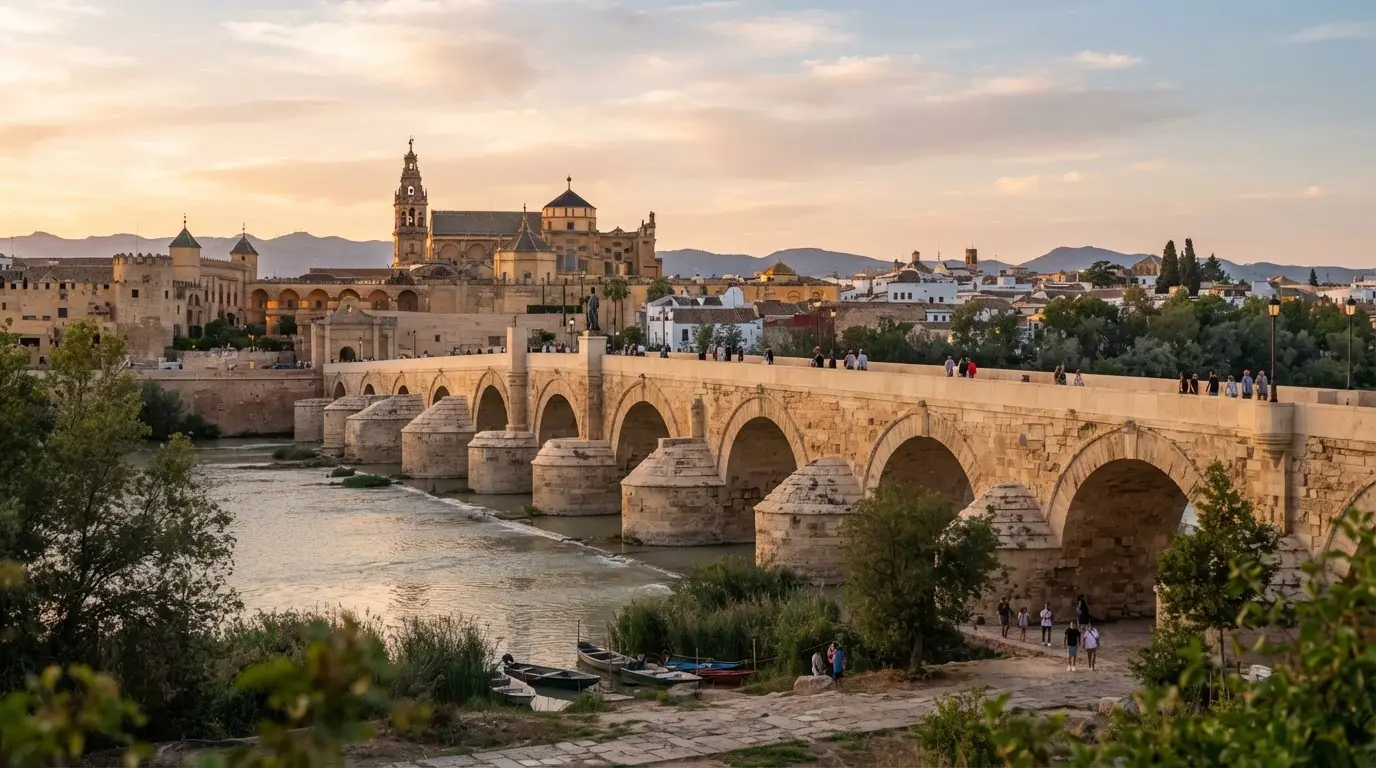
Córdoba's bridge predates the city's most famous building by roughly eight centuries. Roman engineers constructed a crossing at this point on the Guadalquivir in the 1st century, either under Augustus or shortly before[1], forming part of the Via Augusta, the road that ran from Rome's provincial capital at Tarraco (Tarragona) south through Córdoba and on to Gades (Cádiz). The crossing was not incidental. Córdoba, then called Colonia Patricia, was the administrative capital of Hispania Baetica, and the road through it was the principal military and commercial artery of the Roman south.
The original bridge had 17 arches, all semicircular in the Roman manner, cut from local calcarenite limestone and seated on piers reinforced by triangular cutwaters to deflect the river's current. At 9 metres wide, it was broad enough for heavy carts and legionary columns. The Roman engineering principle, piers on bedrock, arches transferring load outward through the voussoir wedge-stones, was sound enough that builders for the next fifteen centuries would be working on top of it rather than starting fresh.
What survives of that Roman structure? The foundations and lower piers almost certainly contain original Roman masonry throughout, since every subsequent rebuilding worked within the existing footprint. Above the waterline, the picture is starker. Most historians identify the 14th and 15th arches counting from the Puerta del Puente (the northern entrance) as the only arches retaining their Roman structure in any definitive sense. That is 2 of 16, or approximately 12.5% by visible-arch count, though some archaeological sources argue the number is even lower, and the foundations likely preserve more Roman material than that figure suggests.
12.5%
The bridge was part of the broader Roman Córdoba infrastructure: the city had a forum, an amphitheatre, a circuit of walls, a temple to Augustus. The bridge survived all of them, if only because you cannot move the river. Immediately upstream, the Albolafia mill's weir created the shallow, predictable water level that made the crossing reliable in all seasons — a hydraulic relationship between the bridge and the mills that lasted two thousand years, explored in Guadalquivir Mills: Three Civilisations, One Riverbank.
What al-Samh rebuilt in the 720s, and why historians missed it
The standard narrative of the Puente Romano skips roughly seven centuries between Augustus and Abd al-Rahman I. The historical record fills that gap in the 720s, when Al-Samh ibn Malik al-Khawlani, the Umayyad governor of Al-Andalus, ordered a reconstruction of what remained of the Roman crossing.[2] The Arabic sources are clear: he built on the ruins of the old Roman construction, not alongside it. The Roman footprint was the template; the new bridge replaced most of the Roman superstructure on those same foundations.
The reconstruction reduced the arch count from 17 to 16. More visibly, the Umayyad builders introduced 4 pointed arches among the 12 semicircular ones.[3] This is the architectural detail that gives the bridge its layered character. A semicircular arch is a perfect half-circle; a pointed arch rises to a peak, a form associated with Islamic architecture from the 8th century onward though not exclusive to it. Standing on the bridge today, the mixture is visible: most arches curve away in the Roman manner while four rise to a subtle point. No guidebook label identifies which is which, so visitors walk over the seam between two architectural traditions without knowing it.
Explore nearby · Monument
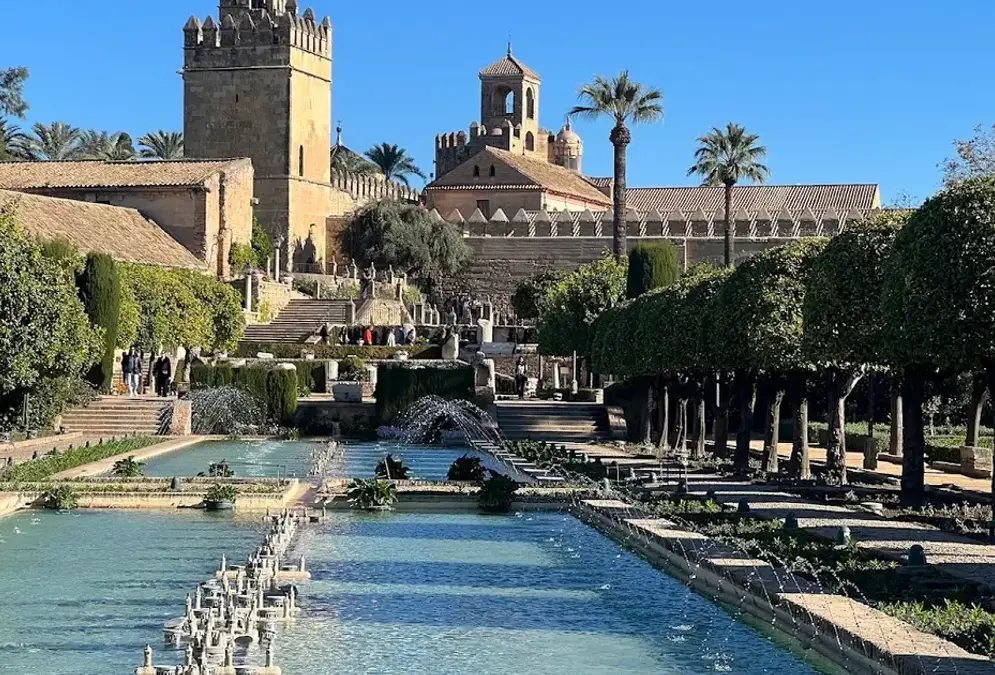
Alcázar de los Reyes Cristianos
Alcázar de los Reyes Cristianos, Córdoba: free entry on Tuesdays. A 14th-century fortress-palace with terraced Moorish-inspired gardens and Roman mosaics.
Why did historians miss the Umayyad origin for so long? Partly because the bridge continued to be called Puente Romano without interruption, a name that functioned as provenance even when the structure it described had changed. Partly because the 8th-century rebuild was so thorough that the visual impression it created, an ancient Roman crossing, was exactly what subsequent rulers wanted to maintain and what later restorers worked to preserve. The horseshoe arch and its Umayyad lineage were recognised by scholars; the bridge's own Islamic bones were easier to overlook.
Al-Samh's bridge stood for roughly two and a half centuries as the southern entrance to the city that would become the capital of the Western Caliphate under Abd al-Rahman III. Every governor, caliph, and ambassador arriving from the south crossed it. The approach from the Calahorra Tower was the formal entrance to Córdoba at the height of its power.
A thousand years of repairs you can still read in the stone
The Umayyad rebuild was not the last time the bridge changed. The Guadalquivir floods regularly and with force, and the bridge has been on its banks for the entire medieval and modern period. The repair record, patchy but continuous, is what gives the Puente Romano its current texture.
The 10th-century Caliphate restoration under Abd al-Rahman III or his successor Al-Hakam II is difficult to isolate in the standing fabric. What we know is that the bridge was maintained as a civic priority during the Caliphate's peak: it carried trade from the south into the most populous city in Western Europe, and any structural failure would have been both economically catastrophic and politically embarrassing. The work was likely consolidation and surface repair rather than arch replacement.
The bridge underwent further repairs across the medieval and early modern period:
- Medieval repairs, likely repeated across several centuries, addressed flood damage and general wear on the piers and arches, though no single documented campaign or date survives in the sources
- 1876 modifications introduced changes whose scope is not fully documented but visible in photographs of the period
Recommended tours
Tours are selected for quality, not commission. We earn a small fee if you book — at no extra cost to you.
The cutwaters (the triangular projections at the pier bases designed to split the river's current) were modified during several of these repair campaigns. Close examination of the masonry at water level shows courses of different ages, colours, and stone types. Some piers have Caliphate-period ashlar above what appears to be Roman core; others show medieval pointing over Islamic stonework. The bridge is a stratigraphic column as much as a piece of civil engineering.
The most legible repair in the standing structure may be the variation in arch profile. Rebuilds in different eras likely used the arch forms current at the time, so a later repair might show a flatter, more Renaissance-influenced curve than the Umayyad or Roman work around it. This is why the bridge's arch profiles are not uniform: some of the variation that looks like an Umayyad design choice may instead be the accumulated evidence of piecemeal work over ten centuries.
The Roman Bridge monument page has the visitor logistics: entry is free, open at all hours, with the best light in the early morning before crowds build.
1651: the saint placed on the bridge in a time of plague
By the mid-17th century, Córdoba had been a Christian city for four centuries, but the bridge remained what it had been since the 720s: a structure with unmistakably Islamic bones, even if everyone called it Roman. In 1651, the city marked that fourth century with an act of piety rather than a corrective one.
In 1651, sculptor Bernabé Gómez del Río completed a statue of Saint Raphael, patron saint of Córdoba, and installed it near the centre of the bridge on the east parapet. The commission grew out of popular religious devotion during a period of plague and hardship in the city: Córdoba turned to its patron saint for protection, and the statue was placed to bless travellers crossing the bridge below. It was part of a wider wave of Raphael monuments, the triunfos, erected across the city in this era for the same protective, devotional purpose.
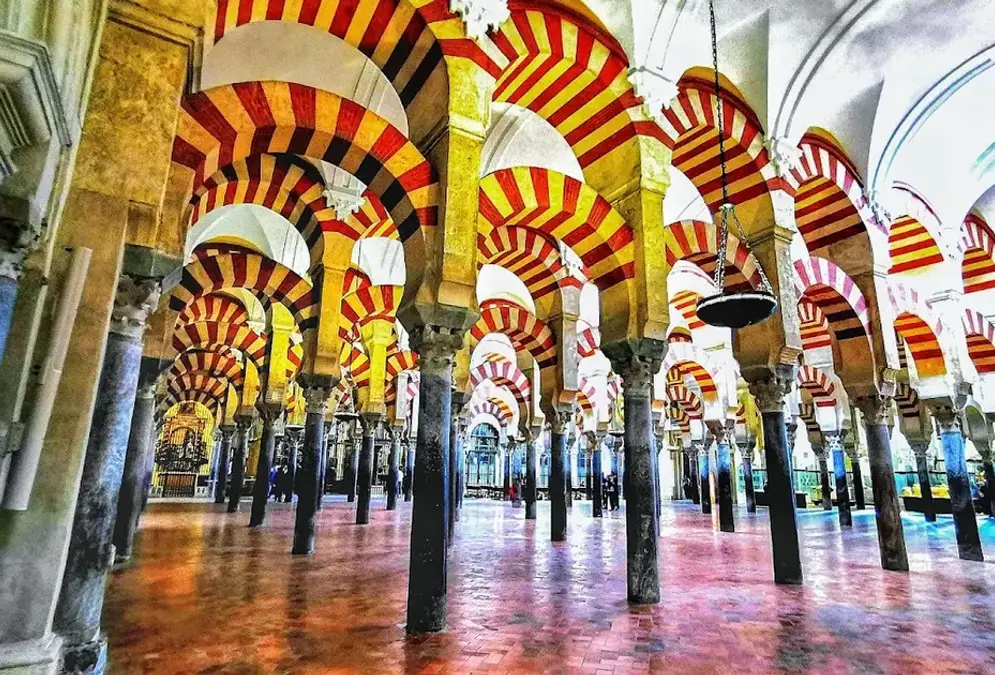
The gesture has a loose parallel on the other side of the city walls. Inside the mosque turned cathedral, Ferdinand III's architects inserted a Gothic choir and Renaissance nave into the heart of the Umayyad prayer hall after the Reconquest of 1236, physically splitting the forest of columns to make a Christian cathedral visible from the central axis. The bridge's statue is a gentler layering by comparison: a devotional monument born of plague-era piety, placed at the crossing's most visible point to bless the travellers passing beneath it.
There is something almost archaeological about this layer of the bridge's history. The Roman name, the Umayyad structure, the devotional statue: each was placed over the previous identity without erasing it completely. The result is a monument that has been trying to tell three different stories about itself for over a millennium, and all three remain legible.
2004 and 2008: pedestrian-only, then restored
For most of the 20th century, the Puente Romano carried car traffic. Asphalt covered the original stone paving; the cutwaters at the piers were obscured by vehicle infrastructure; the bridge's profile as experienced from either bank was that of a working road crossing. Photographs from the 1970s show it as a functional traffic artery with the Mezquita tower rising behind gridlocked vehicles.
Read next · Article
Horseshoe Arch Córdoba: How a Roman Form Went Global
Córdoba's Mezquita holds nearly 850 columns, but its horseshoe arch is older than Islam itself. See how Abd al-Rahman I made it the world's most iconic arch.
That changed on 1 May 2004, when the bridge closed to vehicle traffic for good.[1] The newly completed Miraflores Bridge (2003) took over the crossing's traffic role, and the Puente Romano became pedestrian-only two years before any restoration work began. For those two years the bridge stood car-free but still asphalted, its stone paving and cutwaters still buried under 20th-century surfacing.
The 2006–2008 restoration then took place on that already pedestrian bridge. Municipal architect Juan Cuenca Montilla led the project, which cost €13.6 million and was completed with an inauguration on 9 January 2008.[4] The scope went well beyond cosmetic cleaning:
- Stripping the asphalt surface to expose the original stone paving, some of it Roman
- Cleaning the cutwaters at the pier bases and repointing the masonry
- Replacing the modern cobbled surface with half-polished granite slabs
- Renewing drainage, lighting, and infrastructure throughout
When the asphalt came up, the teams found original Roman stones in sections of the carriageway that had survived under the modern surfacing. This confirmed what the structural analysis had suggested: the Roman engineers' work runs deeper in the bridge than the visible arch count implies. The foundations and pavement beneath are more ancient than the arches above.
The 2004 pedestrianisation and the 2006–2008 restoration together transformed the bridge's role in the city. Before 2004, crossing it was a transit event; by the time the granite paving was finished in 2008, it had become a destination. The bridge's appearance in Game of Thrones Season 5 (2015) as the Long Bridge of Volantis[5] relied on this cleared, restored surface, though not the way the show's fans usually picture it: a production drone filmed aerial footage of the bridge in October 2014, and that footage became the CGI base onto which fictional architecture was added. Tyrion Lannister and Varys's scene walking across the Long Bridge was shot in a studio, not on the bridge itself. Fans chasing the same storyline can go further afield: Almodóvar Castle, roughly 25 km from the city, doubled as Highgarden, seat of House Tyrell, in the same season. For the complete list of Córdoba filming locations, see the Game of Thrones filming guide to Córdoba.
The Calahorra Tower at the southern end is now the Al-Andalus Museum. Built in the 12th century during the Islamic medieval period, reinforced in 1369 by King Enrique II of Castile against his brother Pedro I, the tower records the bridge's role as a fortified approach across all of the city's ownership changes.
Reading the bridge today: Roman, Umayyad, Christian, all in 331 metres
Walking the bridge from north to south takes about five minutes at a slow pace. With the right lens, it takes considerably longer.
Enter from the Puerta del Puente at the northern end, the triumphal arch commissioned in 1572, with work continuing to 1576, that replaced an earlier Roman gate.[6] The symmetry is appropriate: a Renaissance arch leading onto a bridge whose Roman identity is itself largely a Renaissance-period construct, assembled from earlier layers.
Count the arches as you walk. The 14th and 15th arches from this end are the confirmed Roman structures; look for the slightly different stone colour and the more uniform voussoir cutting compared to the medieval rebuilds around them. Four of the arches rise to a gentle point rather than a full semicircle: these are the Umayyad additions from the 720s rebuild, a pointed arch profile consistent with early Islamic engineering. The majority curve in the Roman-derived semicircular form, though most of those date from medieval repairs rather than the original 1st-century construction.
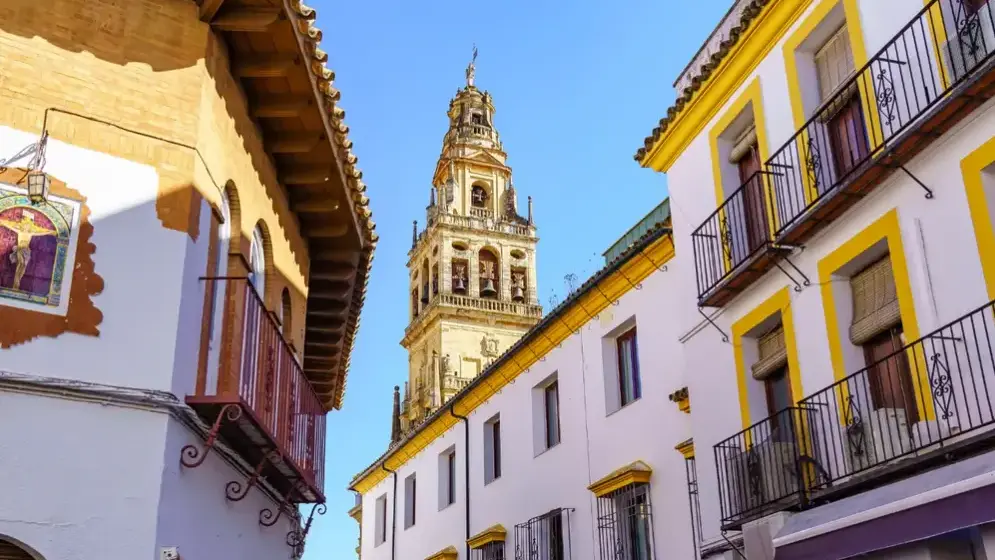
At the midpoint, the Saint Raphael statue of 1651 faces east toward the Mezquita. The Caliphate-era city's most important religious building, now a cathedral, is visible from this point on clear days. The 17th-century commissioners who placed the saint here would have known exactly what it faced.
Deep dive · Article
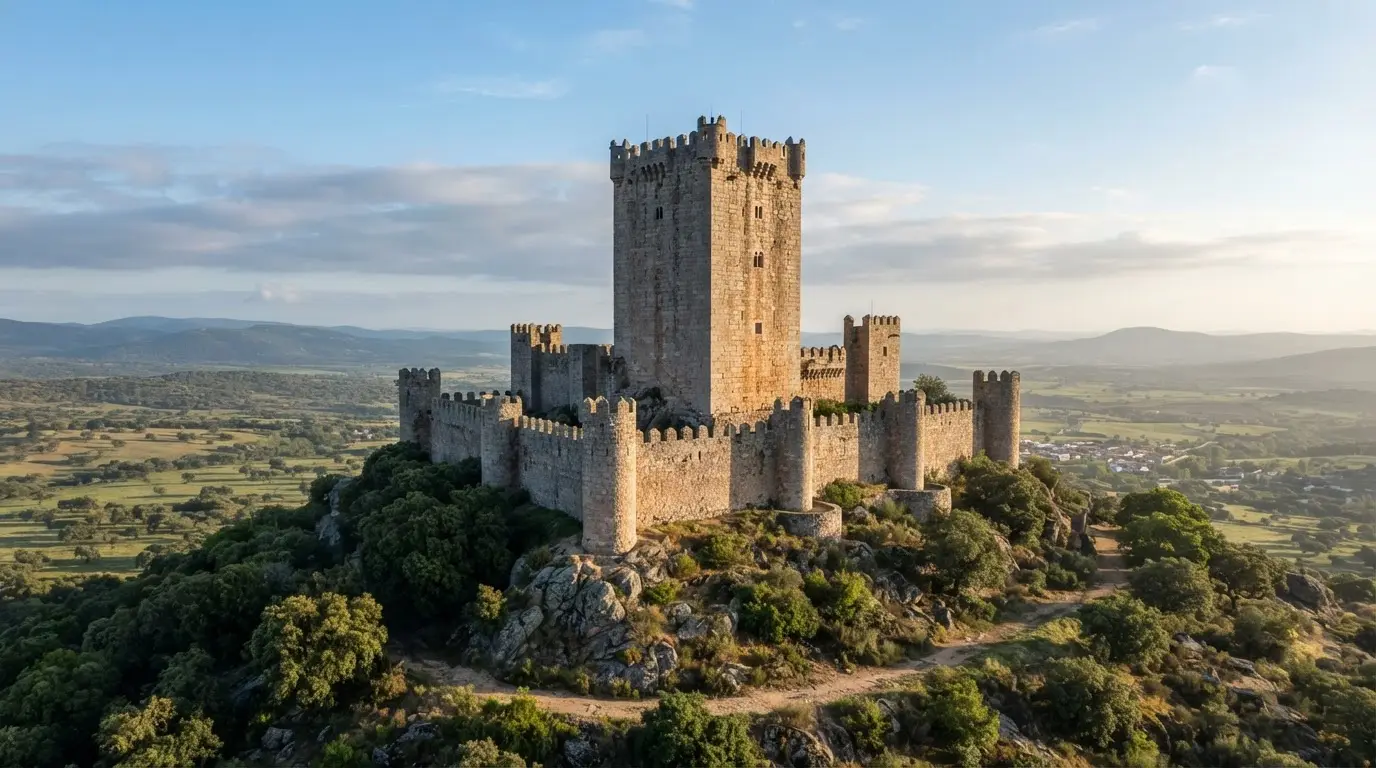
47 Metres Tall and Almost Unknown: Spain's Tallest Keep
Belalcázar Castle's 47 m keep is listed by the Junta de Andalucía as Spain's tallest. How it grew, what to see inside and how to book the free guided visit.
The cutwaters at the piers are visible from the pedestrian walkway's edge. After the 2008 restoration, they are cleaned and repointed. Lean over and look at the masonry just above the waterline: the courses of different dates are evident in the colour variation, Roman grey-white below, warmer golden limestone in the medieval replacements above.
Cross to the southern end and you arrive at the Calahorra Tower, the 12th-century fortification that guards the approach. The bridge has always been a threshold. On one side, the medina with the Mezquita at its centre; on the other, the road south toward the Sierra Morena and eventually the Strait of Gibraltar. The legionaries who crossed here, the Umayyad governors, the Caliphate merchants, the 17th-century pilgrims to the saint's statue, the drone that filmed it for Game of Thrones in 2014: the bridge has carried all of them over the same Roman foundations, under arches that are mostly not Roman at all.