Ten years covering Córdoba's UNESCO heritage sites, sourcing from Junta de Andalucía documentation.
Updated Published
history-buffsarchitecturephotographers
In the summer of 1492, Queen Isabella I ordered the Albolafia wheel dismantled. Not for theological reasons, not for political ones. The queen was ill, recovering in the Alcázar, and the 15-metre waterwheel that had been lifting water to the emir's palace for centuries was keeping her awake. That single complaint ended five hundred years of continuous operation. The Guadalquivir mills of Córdoba had survived three religions, two conquests, and a thousand years of flooding. They did not survive a sick queen's sleeplessness.
In this article
Jump to a section
⌄
Roman foundations: the first hydraulic knowledge
The Guadalquivir — the Wadi al-Kabir, the great river, named by the Arabs for a waterway the Romans called Baetis — drops across Córdoba at a gradient shallow enough to channel but fast enough to turn a wheel. Roman Córdoba, the colony of Colonia Patricia, occupied this stretch of riverbank for five centuries, and that long, continuous habitation is the strongest argument for what came later on the site.
The Albolafia itself is sometimes traced to this Roman period — not as part of a documented, valley-wide irrigation network, but as a single structure whose position, where the river narrows beside what would become the Roman Bridge, made it a natural site for a waterwheel long before the Moorish engineers usually credited with building it[2]. What a broader Roman-era irrigation infrastructure along this stretch of the Guadalquivir actually looked like is not well documented; the case for it rests on geography and on Roman practice elsewhere in Hispania, not on surviving structures or contemporary record.
What can be said with more confidence is that the weirs directing water into millraces, the stone channels, the principle of harnessing the river's lateral force rather than fighting its flow, were not Moorish inventions from a blank slate. Whether that hydraulic vocabulary traces specifically to Roman construction on this stretch of river, or to later and unrecorded practice, is not settled. When the Moorish engineers arrived, they built on a riverbank that had already known centuries of water management — even if the specifics of who built what before them are largely lost.
Timeline
1st–5th centuries CE
Roman Córdoba on the Baetis
Colonia Patricia occupies the riverbank for five centuries. The Albolafia is sometimes traced to this period, though the evidence is inferential rather than documented.
9th–12th centuries
Moorish caliphate builds the 11 mills
Most of the named mills constructed under the Umayyad caliphate. Albolafia attributed to Abd al-Rahman II (9th c.) or Tashufin (12th c.). Mills supply water to the emir's palace and the city.
29 June 1236
Ferdinand III captures Córdoba
The mills are redistributed to Christian nobility, clergy, and military-religious orders. Function shifts from palace irrigation to grain and wool milling.
1492
Isabella orders the Albolafia dismantled
Queen Isabella, recuperating in the Alcázar, orders the wheel stopped because its noise disturbs her sleep. The mill falls silent for the first time in centuries.
1942
Milling prohibition
Artisanal flour milling prohibited in Spain. The mills' primary function after nearly a millennium ends.
30 June 2009
Andalusian Historical Heritage designation
The mill complex receives heritage protection. The Albolafia replica, built 1993–94, stands as the visual anchor of the restored riverbank.
Moorish mastery: eleven mills under the caliphate
Between the 9th and 12th centuries, eleven independent mills were built along the Córdoba stretch of the Guadalquivir[1]. Their names run west to east along the south bank: Lope García, Carbonell, Martos, Albolafia, Pápalo, Enmedio, San Antonio, Alegría, San Rafael, San Lorenzo, and Casillas. Each was hydraulically independent, fed by its own millrace cut from the main channel, its own weir diverting sufficient water to drive the wheel.
The engineering was not brute-force. Islamic hydraulic knowledge, absorbed partly from Roman precedent and partly from Persian and Mesopotamian traditions carried west through the Abbasid caliphate, emphasized precision over scale[1]. The Córdoba mills were not massive industrial structures. They were carefully calibrated machines, each weir set to draw the exact depth of water the wheel required, each millrace angled to maximize the water's velocity before it reached the paddles.
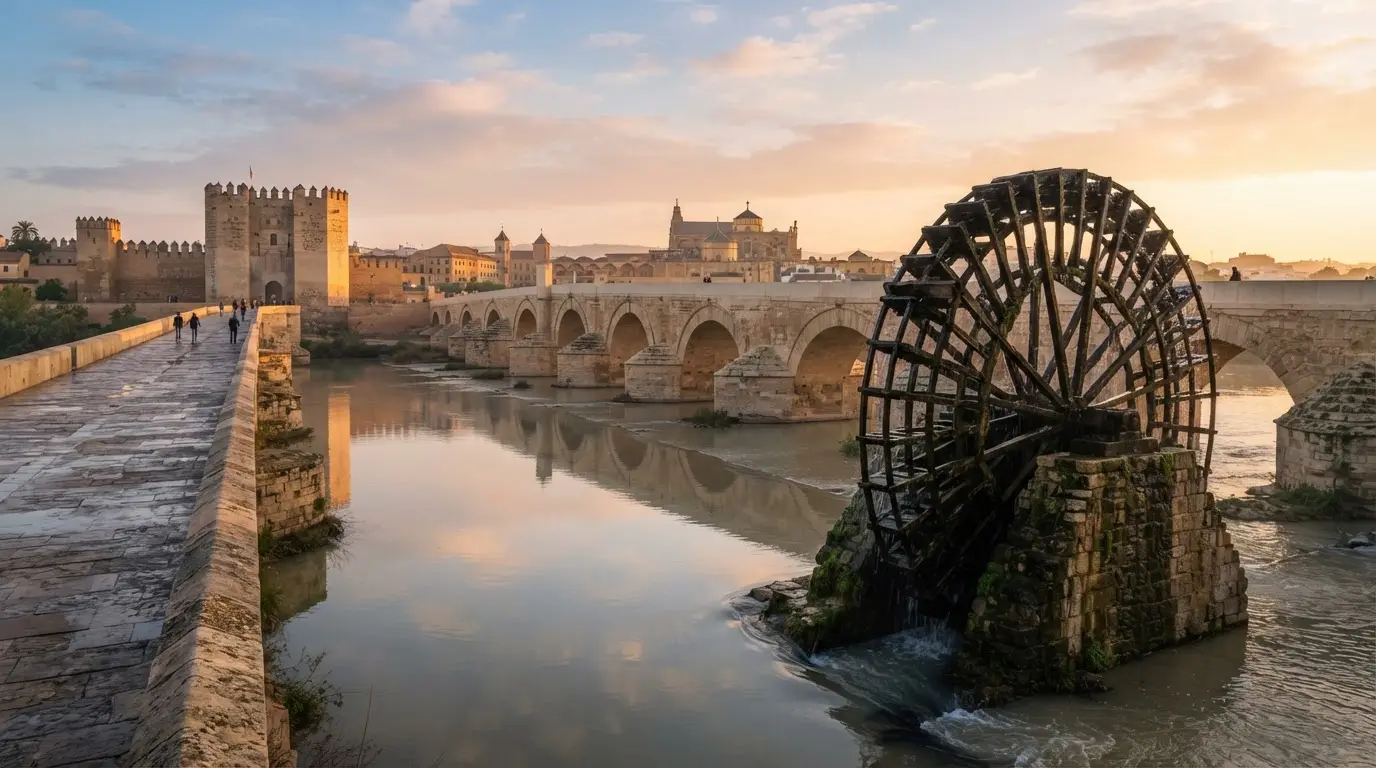
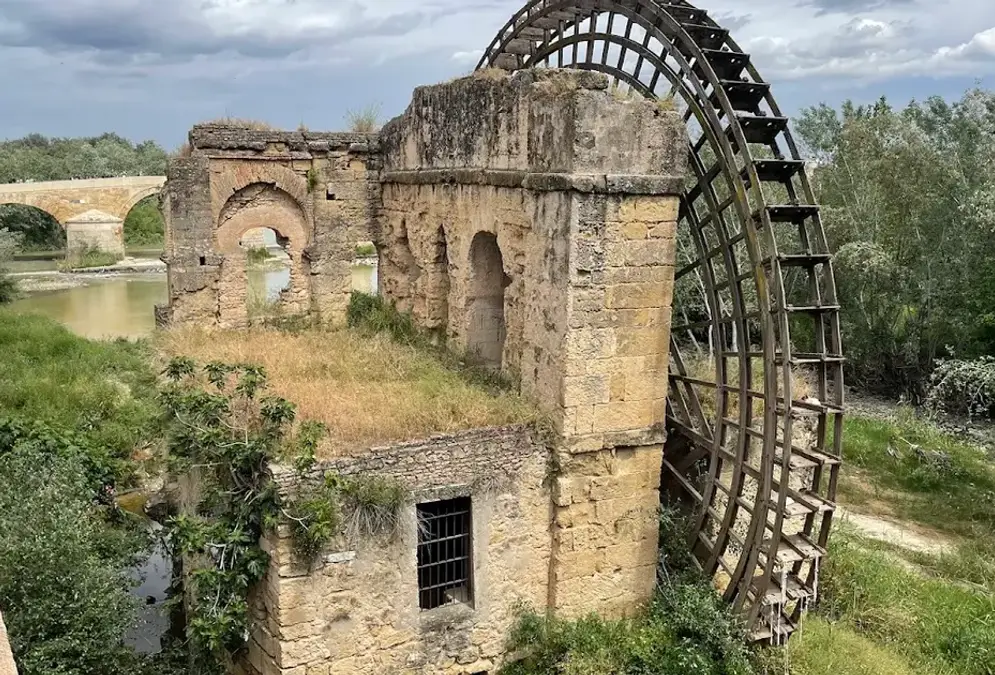
The most prominent was the Albolafia — the mill that would become the article's main character — positioned close to the Roman Bridge and the Alcázar complex. Its purpose was different from the others. While the mills further east ground grain or processed wool, the Albolafia was an irrigation engine, its 15-metre noria lifting water bucket by bucket from the Guadalquivir into an elevated aqueduct that fed the emir's gardens and palace cisterns[2].
15 metres
The diameter of the Albolafia noria — large enough to lift water to the elevated aqueduct feeding the emir's palace cisterns. The current wheel is a replica built in 1993–94; the restoration of the mill structure itself was carried out by the architect Félix Hernández Giménez in the 1960s.
Who built it is contested. The most common attribution is Abd al-Rahman II, the emir who ruled from 822 to 852 CE and who expanded the Great Mosque of Córdoba substantially during the same period — his commission of the Albolafia and what it meant for the city is explored in Albolafia Waterwheel: Abd al-Rahman II's Islamic Legacy. The same lower Guadalquivir whose current powered these mills was also navigable enough for oceangoing vessels: in 844, a Norse fleet sailed inland and sacked Seville, and some historians suggest the raid was among the reasons Abd al-Rahman II later built a naval arsenal at the river mouth — though the causal link is a proposed reading of events rather than a settled fact, and the size of the Norse fleet is not reliably established. The full story is told in Vikings in Córdoba: The 844 Raid Abd al-Rahman Repelled. Some architectural analysis, however, suggests the current structure or a significant reconstruction dates to Tashufin ibn Ali (around 1136–1137), the Almoravid governor, or to a 14th-century rebuild after flood damage[2]. The honest answer is that the Albolafia the Romans would have recognized likely had several ancestors, each one replacing the previous after the Guadalquivir's periodic floods tore out whatever stood before.
At the caliphate's peak in the 10th century, Córdoba was the largest city in western Europe, with a population that various sources put between 100,000 and several hundred thousand depending on methodology[5]. The mill complex supplied that city's grain and its palaces' water. The weirs that created the millraces also created the shallow ford at this point of the river, allowing the Roman Bridge to function as it was intended. The mills and the city were hydraulically intertwined.
The wheel that supplied a palace
To understand what the Albolafia actually did, stand on the Roman Bridge and look upstream toward the mill. The Guadalquivir at this point is not the deep, slow-moving river you might expect. The weirs create a noticeable drop, the water accelerating through the narrowed channel before hitting the mill's paddles. In the 10th century, before the city's water supply diversified, this single wheel was responsible for supplying the Umayyad palace complex that occupied what is now the Alcázar de los Reyes Cristianos.
The mechanics were elegant. The wheel's wooden buckets — later replaced with ceramic pots — dipped into the water at the bottom of each rotation and lifted it to the top, where they tipped their contents into a stone trough at the wheel's apex. The trough connected to a raised aqueduct running along the south bank toward the Alcázar[2]. The height differential was enough to feed gravity-run channels throughout the palace gardens. The system required no pumping beyond the wheel itself, no labor beyond whoever managed the weir gates.
Recommended tours
Tours are selected for quality, not commission. We earn a small fee if you book — at no extra cost to you.
For visiting dignitaries entering Córdoba via the Roman Bridge from the south, the first thing they heard was the Albolafia's creak and splash. The first thing they saw, above the mills and weirs, was the water rising in a continuous arc as the wheel turned. It was engineering as theater — a demonstration, at the city's main entrance, that the caliphate commanded the river.
The other mills had quieter purposes. Grain arrived from the agricultural hinterland, was loaded onto the millstones, and left as flour for Córdoba's bread. After 1236, some mills shifted to fulling — processing wool for the textile trades that Christian Córdoba developed. Papermaking was a different industry again: the paper mills in al-Andalus that supplied Córdoba's book trade had arrived by way of Xàtiva. The Albolafia remained distinct: it lifted water when the others ground grain, and its size made it visible for a kilometre in either direction.
On June 29, 1236, Ferdinand III of Castile accepted the surrender of Córdoba[4]. The city he entered was not the caliphal capital it had been two centuries earlier — that Córdoba had fragmented with the taifa period and been battered by Almohad austerity — but it was still a functioning city — smaller than the roughly 65,000 residents recorded for Córdoba in the 11th century[5], yet still substantial enough to support markets, mosques, bathhouses, and eleven mills running on the Guadalquivir.
The mills changed hands in a process that took years rather than days. Ferdinand did not personally redistribute each wheel; he granted the mills to the nobility, religious orders, and ecclesiastical institutions that had supported the conquest, and they in turn managed the assets according to their own economic interests[1]. The Córdoba 1236 siege had been presented to Ferdinand's Christian forces partly as a recovery of property that had been taken from the Visigoths; the redistribution of the mills fit this narrative.
In practice, the change of ownership changed the mills' function more than their technology. The Albolafia continued lifting water, though now to Christian gardens and cisterns rather than the emir's. The grain mills kept grinding. The labor force, Muslim workers who had operated the mills for generations, largely remained through the first decades of Christian rule, their technical knowledge too valuable to discard immediately.
The mills' names shifted. The Arabic names that most had carried during the caliphate were replaced by the names of their new owners or the saints their new owners favored:
San Antonio, San Rafael, San Lorenzo — Christian saints where Arabic designations had been
Alegría and Enmedio — descriptive Spanish names for location or character
Carbonell, Martos, Lope García — family names of the new proprietors
The Albolafia kept its Arabic name. Perhaps because it was too prominent to rename easily, perhaps because no proprietor wanted to claim personal ownership of something so publicly associated with the old regime, it remained al-Bulayfiyya in documents, the name corrupting slowly into Albolafia over the following centuries.
1492: a queen's complaint silences the wheel
The year 1492 is crowded with consequences in Spanish history. Columbus sailed in August. The Jews were expelled in March. The Reconquista officially concluded with the fall of Granada in January. Somewhere in this sequence, at a date the sources do not specify with precision, Queen Isabella I ordered the Albolafia wheel stopped[2].
The reason given in contemporary accounts is unambiguous: the queen was ill, recuperating in the Alcázar, and the wheel's noise prevented her from sleeping. The sound of a 15-metre wooden wheel dragging water through a stone millrace, combined with the creak of buckets and the rush of the falls beneath, would have been audible from the Alcázar's windows on a quiet night. This was not a metaphorical complaint. It was a practical one.
The decision that followed was total. The wheel was not merely stopped temporarily; it was dismantled. The buckets that had lifted water for centuries were removed. The mechanism was broken down, leaving only the stone structure and the millrace. A wheel that had creaked through the reigns of a dozen Christian kings — from Ferdinand III in 1236 to Ferdinand and Isabella in 1492, two hundred and fifty-six years — came down because one monarch could not sleep.
There is something almost absurd in the proportions: five hundred years of Islamic engineering, two and a half centuries of Christian continuity, ended by a single night's insomnia. But the act also reveals something about how the Christian monarchs related to the infrastructure they had inherited. The Albolafia was not a monument they had built. It was a convenience they had acquired. When it became an inconvenience, it went.
The irony the chronicles do not record: the palace the wheel supplied was itself built on the bones of the Umayyad complex. Isabella was sleeping in a building whose foundations the Albolafia had kept watered for centuries. The wheel that disturbed her rest had, in an earlier form, made the place habitable for the emirs who preceded her.
After 1492, the Albolafia did not disappear entirely. The structure remained. The millrace still ran. But without its wheel, it was stone and water, not a machine. The other mills continued; grain and wool kept grinding along the river. But the most visible feature of the medieval waterfront fell silent.
Industrial decline and the road back to heritage
The nineteenth century brought a different kind of water engineering to the Guadalquivir mills: cast-iron turbines. Steam power was transforming European industry, and the mills that had ground with millstones and wooden gearing since the caliphate retrofitted with metal machinery. Some were converted into small hydroelectric plants, their waterwheels replaced with turbines that generated current for local consumption rather than flour for local bread.
The shift kept the mills economically relevant for a few more decades, but it severed the last thread connecting them to their original purpose. By the early 20th century, most had passed into private hands and were generating electricity rather than processing grain. The traditional millers and their inherited knowledge of the Guadalquivir's flow had already retired or died.
In 1942, artisanal flour milling was prohibited by law in Spain[1]. The statute was aimed at consolidating grain processing in large industrial facilities, but its effect on the Guadalquivir mills was terminal. The last legitimate reason to maintain the millstones disappeared. The mills that had not already converted to other uses fell into gradual disuse. Buildings began to deteriorate. The weirs crumbled at their edges.
The physical recovery began unevenly. The architect Félix Hernández Giménez, who had also worked on restoration at the Mezquita, undertook an examination of the Albolafia structure in the 1960s. His work documented what remained and stabilized what could be saved. But the wheel itself was gone — dismantled under Isabella's orders nearly five centuries before and never replaced.
Between 1993 and 1994, a replica Albolafia wheel was constructed and installed[2]. The replica is not the original mechanism and does not function as a working irrigation device — it turns when the river level permits, as a demonstration rather than a utility. But it restored the visual signature of the riverfront that had been absent since 1492.
The two mills that received the most substantial investment became museums. The Martos mill is now the Hydrological Museum of Córdoba, documenting the city's water history from Roman aqueducts through the mill era[1]. The Alegría mill houses the Museum of Paleobotany[1]. The others are in varying states of preservation — some stabilized, some still deteriorating between restoration cycles.
On June 30, 2009, the entire Guadalquivir mill complex was designated an Andalusian Historical Heritage site[1]. The designation gave the mills formal protection under Andalusian heritage law, theoretically securing their fabric against further decay. In practice, heritage designation and physical restoration are not the same thing. The mills exist today in a state that acknowledges their importance without fully committing to their future.
Frequently asked questions
What were the Guadalquivir mills in Córdoba originally used for?
The eleven Guadalquivir mills served two main functions. Most were grain mills, grinding wheat and other cereals for Córdoba's population. The Albolafia, the most prominent, was an irrigation engine: its 15-metre waterwheel lifted water from the river into an aqueduct that fed the emir's palace gardens and cisterns. After the Christian conquest in 1236, some mills shifted to wool fulling for the textile trades.
When was the Albolafia wheel built, and who built it?
The attribution is contested. The most common account credits Abd al-Rahman II, who ruled as Emir of Córdoba from 822 to 852 CE. However, some architectural evidence points to a significant construction or reconstruction during the Almoravid period, around 1136–1137 under Tashufin ibn Ali, or possibly to a 14th-century rebuild after flood damage. The Guadalquivir floods periodically and the mills were repaired and reconstructed throughout their history, making a single founding date difficult to establish.
Why did Queen Isabella order the Albolafia wheel dismantled?
Queen Isabella I was recuperating from illness in the Alcázar in 1492. The Albolafia's 15-metre wooden wheel, dragging water through a stone millrace beside the Roman Bridge, was audible from the palace windows at night and prevented her from sleeping. She ordered it dismantled. The wheel that had operated for centuries, through both Islamic and Christian rule, was removed entirely — not merely stopped temporarily.
How many mills are on the Guadalquivir River in Córdoba?
Eleven mills were established along the Córdoba stretch of the Guadalquivir during the Moorish period. Their names are Lope García, Carbonell, Martos, Albolafia, Pápalo, Enmedio, San Antonio, Alegría, San Rafael, San Lorenzo, and Casillas. Each operated from its own millrace and weir, hydraulically independent from the others.
What happened to the mills after the Reconquista in 1236?
After Ferdinand III captured Córdoba on June 29, 1236, the mills were redistributed to Christian nobility, the church, and military-religious orders. The mills continued to function — grain grinding, and later wool fulling — under new ownership. Many acquired Christian names, either saints' names or the surnames of their new proprietors, while the Albolafia kept its Arabic name. The Muslim workers who had operated the mills often remained initially, their technical knowledge being practically necessary.
When did the Córdoba mills stop operating as flour mills?
Artisanal flour milling was prohibited in Spain in 1942, when legislation consolidated grain processing in industrial facilities. This ended the mills' primary function after nearly a millennium. Most had already been converting to hydroelectric use through the late 19th and early 20th centuries, as cast-iron turbines replaced millstones.
Are the Guadalquivir mills still standing today?
The mill structures survive in varying condition. The Albolafia has a replica wheel installed in 1993–94, though it does not function as a working irrigation device. The Martos mill is now the Hydrological Museum of Córdoba; the Alegría mill houses the Museum of Paleobotany. In 2009, the entire complex was designated an Andalusian Historical Heritage site. Some mills are well preserved; others continue to deteriorate between restoration cycles.
Which mills in Córdoba have been converted into museums?
Two of the eleven Guadalquivir mills have been converted into museums. The Martos mill is now the Hydrological Museum of Córdoba, documenting the city's water history from the Roman period through the mill era. The Alegría mill houses the Museum of Paleobotany.