Albolafia waterwheel history: Abd al-Rahman II's Córdoba
The Albolafia waterwheel first appeared on Córdoba's coat of arms in the 1300s, vanished for centuries, and returned in 1983 — not Abd al-Rahman II's work.
Most visitors photograph the Albolafia waterwheel from the Roman Bridge and walk on, not realising they are photographing Córdoba's coat of arms. The wheel first appeared on the city's escudo in the 14th century, was set aside for roughly four centuries under a different design, and was only formally readopted in 1983: the single object civic memory eventually judged worth re-encoding into the official symbol. For centuries, guidebooks credited Abd al-Rahman II with commissioning it in the 9th century — but a 2025 archaeological study, undertaken once the structure was fully cleaned, proved otherwise: the wheel is Almohad, built three centuries later than tradition assumed, in a Córdoba the Umayyad emirate no longer ruled.
In this article
Jump to a section
⌄
The Albolafia waterwheel history: what the coat of arms doesn't explain
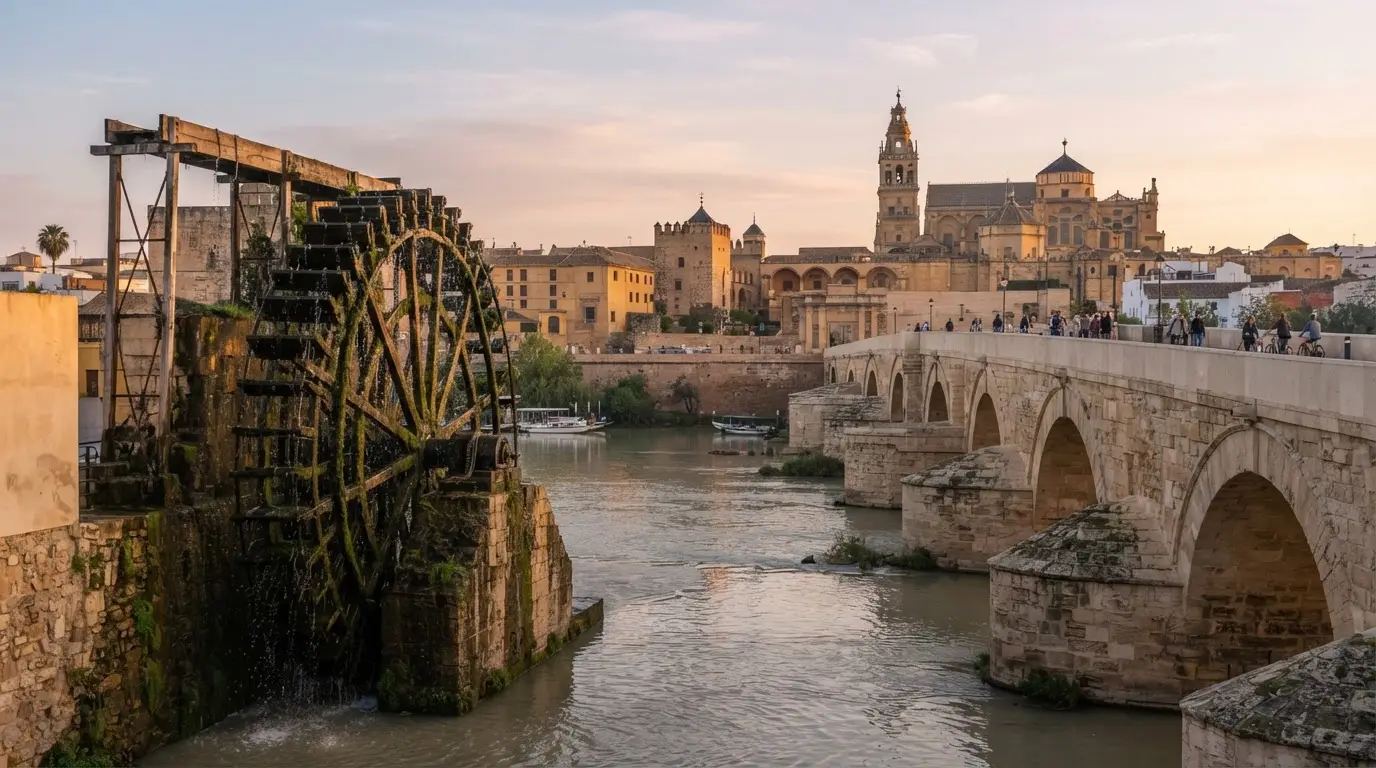
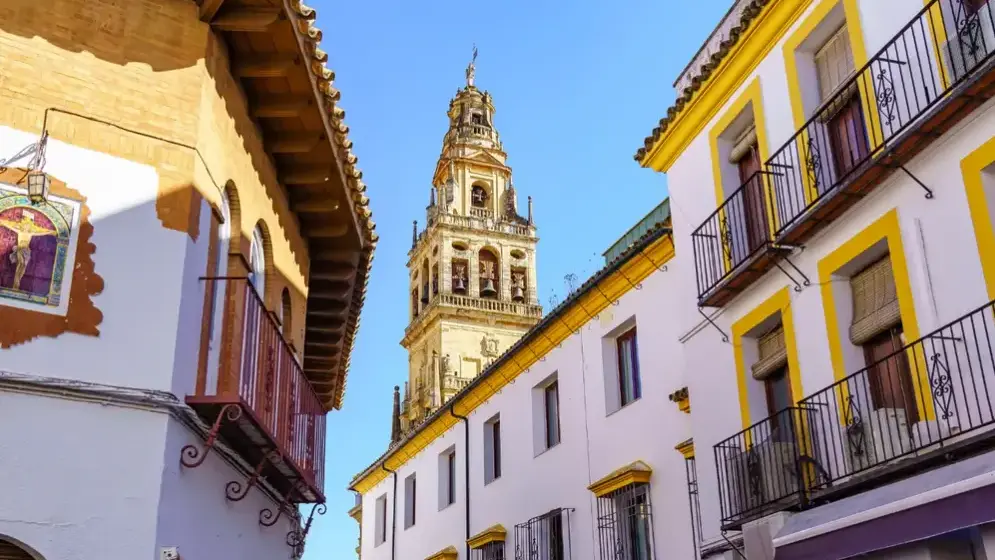
Look up Córdoba's escudo municipal and you will see the Roman Bridge spanning the river, a stretch of city wall pierced by the Puerta del Puente, and behind it the Mezquita-Catedral's tower flanked by three palm trees — and beneath the bridge, turning against the current, a noria (a waterwheel).[1] The noria is the Albolafia, on the south bank of the Guadalquivir a few metres west of the Roman Bridge. The wheel now turning there, rebuilt in the 1960s and again in 1994, was long credited to Abd al-Rahman II, supposedly commissioned in the 9th century to supply water to the Alcázar gardens. A 2025 archaeological study, carried out once the structure had been fully cleaned, overturned that attribution: an Umayyad-era wheel would have needed river levels high enough to reach the alcázar without a system of reservoirs, and no trace of such reservoirs has ever been found. The Albolafia is Almohad, built in the second half of the 12th century — roughly three centuries after Abd al-Rahman II's death.
The name comes from Arabic: al-bulafia, meaning roughly the fortunate or good health.[2] Documented sources trace it to Abu l-Afiya, a 12th-century architect credited with the noria's construction — a detail that fits the Almohad origin the 2025 study confirmed, rather than the Umayyad attribution tradition had assumed. What is documented beyond the name is the function: the noria used the current of the Guadalquivir to turn a paddle mechanism that lifted water into an aqueduct channel, which carried it uphill to the palace gardens. Gravity and river current, no fuel, no maintenance beyond the wheel itself.
Abd al-Rahman II ruled the Emirate of Córdoba from 822 to 852, a thirty-year reign. He was the fourth Umayyad emir, great-grandson of the exiled prince who founded the emirate and great-great-grandfather of the ruler who declared the Caliphate. He inherited a functioning emirate and turned it into something more complex: a court that attracted scholars and musicians from Baghdad and a city with an expanded mosque at its centre. The waterwheel that long-standing guidebook tradition credited to him actually belongs to a different dynasty and a different century — built roughly three hundred years after his line's Córdoba had already fallen to the Almohads.
How a 15-metre wheel raised water for a palace
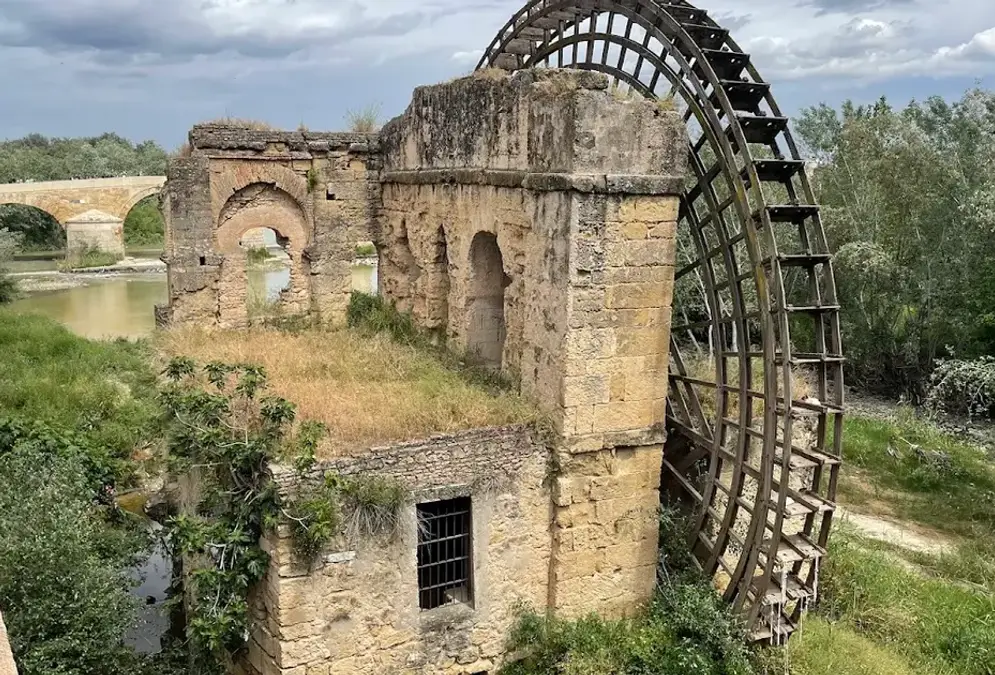
The Albolafia's mechanism was straightforward. The wheel, approximately 15 metres in diameter,[3] was anchored on a stone pier in the river. The current pushed horizontal paddles at the wheel's rim, rotating it continuously. Attached to the rim were ceramic jars or buckets that scooped water from the river at the low point of the rotation, carried it upward, and emptied into a stone trough at the top. The trough connected to a covered aqueduct that ran to the Alcázar gardens on the slight rise above the riverbank.
The technology was not invented in Córdoba. The noria (from Arabic na'ura, meaning the "groaning one", a reference to the sound the jars made) was an ancient device already in use across the Islamic world, borrowed from earlier Roman and Byzantine hydraulic engineering. What the Albolafia's Almohad-era builders did was adapt it to the Guadalquivir's specific flow conditions and route the output to a specific destination: the royal gardens that, by the 12th century, occupied the site of the emirs' earlier Alcázar.
~15 m
The Albolafia's reconstructed diameter. At this scale it was audible from the Alcázar walls, loud enough that Queen Isabella I ordered it silenced in 1492 because the noise disturbed her sleep.
Those gardens were not decorative in the modern sense. The Alcázar gardens served as an agricultural testing ground, a pleasure space, and a demonstration of the ruling power's ability to command resources, including water, the scarce commodity that defined what could grow in Andalusia's dry summers. Raising water from the Guadalquivir to the gardens required solving an engineering problem, and the Albolafia was that solution.
For the broader story of how this wheel fitted into Córdoba's river-milling system and how the full complex of eleven mills along this stretch of the Guadalquivir operated, see Guadalquivir Mills: Three Civilisations, One Riverbank. This article focuses on the Albolafia's specific history, including the tangled question of who actually built it.
Abd al-Rahman II and the Mezquita expansion
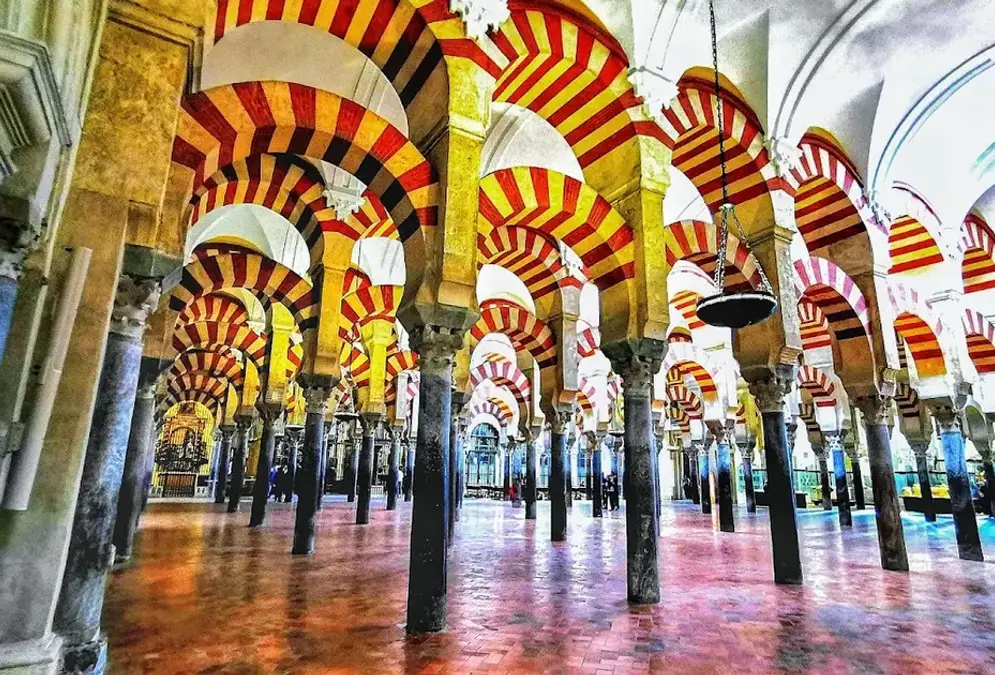
For centuries, popular memory made the waterwheel Abd al-Rahman II's signature monument — a claim 2025 archaeology has since dismantled. His actual largest project was architectural in a different sense entirely. Between 832 and 848, he commissioned the first major expansion of the Mezquita-Catedral de Córdoba, the mosque his great-grandfather had founded in 785. The prayer hall was extended eight arcs southward, doubling the covered space and increasing the column count to roughly 200. The project was directed by two eunuchs, Nasr and Masrur, who brought Abbasid architectural influences from the eastern caliphate: more refined stonework, adjusted proportions in the arches. The same reign also reshaped Córdoba's court economy: around this period, Abd al-Rahman II founded the city's first state-run silk workshop, the tiraz, producing the inscribed robes that announced a person's loyalty to the emir.
The expansion also shifted the qibla (the direction of prayer toward Mecca) eight segments south, a consequence of extending the building along its existing axis. This correction had liturgical implications that later scholars debated, but Abd al-Rahman II's decision was practical: the mosque had become too small for a city that was growing fast.
How fast? By the mid-9th century Córdoba was one of the largest cities in western Europe. It was supplied by the river, connected to the rest of al-Andalus by roads the Romans had built, and generating tax revenue that funded exactly the kind of infrastructure the emir was laying down: waterworks, mosques, palaces.
Timeline
785
First Mezquita
Abd al-Rahman I founds the mosque on the site of a Visigothic church.
822
Abd al-Rahman II takes power
Fourth Umayyad emir begins a 30-year reign that reshapes the city architecturally and culturally.
822
Ziryab arrives at court
The musician from Baghdad brings new music, cuisine, and courtly customs to Córdoba.
832–848
Mezquita expansion
First major extension of the prayer hall: eight arcs added south, column count doubled to roughly 200.
844
Viking raid
Norse raiders reach the mouth of the Guadalquivir and briefly occupy Seville before the emir's forces repel them.
852
Death of Abd al-Rahman II
His son Muhammad I inherits the emirate. The Christian martyrdom crisis, which began in his final years, continues to escalate.
The Mezquita expansion Abd al-Rahman II began was the second of five major construction phases the building went through before the Reconquista. Each emir left his addition in the stone, and you can trace them today by the slight shifts in column height and arch proportion as you move from the original 785 foundation toward the mihrab end.
Recommended tours
Tours are selected for quality, not commission. We earn a small fee if you book — at no extra cost to you.
Ziryab, the Vikings, and a court that attracted the world
The same year Abd al-Rahman II came to power, 822, a musician arrived at his court from Baghdad. Abul-Hasan Ali Ibn Nafi, known everywhere as Ziryab ("blackbird"), had been expelled from Baghdad by a jealous teacher after outperforming him before the caliph. He came west and found in Córdoba an emir willing to fund his work on an enormous scale. The full account of what Ziryab introduced (a five-string oud, a conservatoire, a body of hundreds of songs, new conventions for how courses at dinner were ordered) belongs to the musician's own article, not here. What matters in the context of Abd al-Rahman II is what Ziryab's presence signals: a court actively importing intellectual and cultural talent from Baghdad, competing with the Abbasid caliphate by replicating its cultural apparatus on the other side of the Mediterranean.
The 9th-century Córdoba Abd al-Rahman II governed had a different feel from the embattled emirate his father had held together by military force. It was urbanising rapidly. The Alcázar had expanded beyond the Roman walls. Scribes were translating Greek philosophy and medical texts into Arabic. The emir's library had become a serious institution. Córdoba was no longer trying to survive; it was trying to be a capital. The same court funded science alongside music: it was under Abd al-Rahman II that the engineer Abbas ibn Firnas built his mechanical model of the stars, a lineage that still draws visitors to genuinely dark skies today, covered in stargazing near Córdoba.
Which made the 844 Viking raid a genuine shock. Norse longships had been moving south through Galician and Portuguese waters for years, raiding monasteries and coastal settlements. In 844, a fleet reached the Guadalquivir estuary, sailed upriver, and sacked Seville for several days before Abd al-Rahman II's forces responded with enough force to drive them back. The episode prompted the emir to commission naval construction and coastal fortifications that his successors would build on further — the full account of the raid, the Battle of Talyata, and the naval arsenal built in its aftermath is in Vikings in Córdoba: The 844 Raid Abd al-Rahman Repelled. The Alcázar's gardens, still three centuries away from the Albolafia's construction, sat that day inside a city newly aware of its vulnerability from the sea.
The tension between cultural ambition and political fragility runs through the Martyrs of Córdoba episode, which began during the final years of Abd al-Rahman II's own reign: from 850 onward, Christian provocateurs began publicly denouncing Islam in the qadi's courts, seeking martyrdom and testing the limits of dhimmi law. It was a religious crisis the emir spent his last two years unable to resolve, and one his successors inherited in full.
Queen Isabella and the silencing of the wheel
The Albolafia turned for roughly three centuries after Almohad engineers set it in motion in the second half of the 12th century. Through the fall of Almohad Córdoba in the Reconquista of 1236, through the conversion of the mosque into a cathedral, through the establishment of the Inquisition in Córdoba: the wheel kept turning, raising water, making noise.
In 1492, Queen Isabella I ordered it stopped.[3] The standard account says the noise disturbed her sleep when she was staying at the Alcázar de los Reyes Cristianos, the Christian royal palace built on the site of the Islamic-era alcázar whose gardens the wheel had once supplied. The Albolafia's groan, the sound that gave the noria its Arabic name, had droned over the riverbank for three hundred years. Isabella found it intolerable.
The wheel was eventually converted into a flour mill, the grain-milling function that the other Guadalquivir mills had always served, and continued operating in that capacity until the 20th century. The original hydraulic purpose, irrigating the Alcázar gardens, was long gone.
What happened next is the standard arc of industrial heritage: the mills fell into disuse, the fabric deteriorated, the city eventually decided the ruins were worth preserving. Félix Hernández Giménez, the architect responsible for much of the Mezquita's 20th-century restoration work, reconstructed the Albolafia's mechanism in the 1960s. A second restoration brought the wheel into its current working condition in 1994.[1] It turns now without hydraulic function: a demonstration piece, a viewpoint, a symbol. The water it lifts goes nowhere.
The water it lifts goes nowhere.
The coat of arms question
Why did the Albolafia end up on Córdoba's coat of arms while the Mezquita, the Roman Bridge, and the Roman Temple did not?
The wheel first appears on the city's medieval council seals in the 14th century, alongside the Roman Bridge, the city wall, and the Mezquita-Catedral's tower.[1] That heraldic design did not survive uninterrupted, however: from the 16th century onward Córdoba largely used a different, provincial-style escudo, and the noria-bearing design was only formally readopted in 1983. At the point of its original 14th-century appearance, the wheel was still working, a functioning piece of infrastructure whose daily output was visible and audible to anyone in the city centre. The Mezquita had already been a cathedral for over a century. The Roman Bridge was six hundred years older than the wheel. Neither made it onto the seal.
The most plausible reading is practical rather than symbolic: the Albolafia was current. It was a working machine that the city's Christian governors had inherited from the Islamic period and kept running because it was useful. Placing it on the seal was less a statement about cultural inheritance than an acknowledgment of civic infrastructure: this wheel keeps the Alcázar gardens alive, it has always been here, it is part of what Córdoba is.
The deeper irony, confirmed only in 2025, is that Córdoba spent centuries crediting the wrong dynasty. The wheel entered the heraldic record in the 14th century as a piece of working civic infrastructure, its actual Almohad origin already fading from memory under Christian rule. By the time later historians went looking for a builder, the emirate remembered most fondly, Abd al-Rahman II's, absorbed the credit; his great-great-grandson Abd al-Rahman III, who declared the caliphate in 929 and turned Córdoba into the largest city in Europe, fared no better in the city's self-presentation after 1236. What survived was the machine, and a stubborn misattribution alongside it, both outlasting the men who never actually built it.
Stand on the Roman Bridge at dusk and look west. The Albolafia turns against the current, the same river whose flow Almohad engineers measured roughly eight centuries ago, in a Córdoba the Umayyad emirate had already lost. The wheel first reached the coat of arms seven hundred years ago, was quietly dropped for some four centuries, and returned to the official escudo only in 1983. Both the ancient river and the broken heraldic history are true simultaneously, and neither one cancels the other out.
Frequently asked questions
What is the Albolafia waterwheel?
The Albolafia is a medieval noria (waterwheel) on the south bank of the Guadalquivir River in Córdoba, a few metres west of the Roman Bridge. Long attributed to the 9th-century Umayyad emir Abd al-Rahman II, a 2025 archaeological study confirmed it is actually Almohad, built in the second half of the 12th century, to lift river water via an aqueduct and supply the Alcázar gardens. The wheel is approximately 15 metres in diameter. It first appeared on Córdoba's coat of arms in the 14th century, was set aside for roughly four centuries, and was formally readopted in 1983; today it is a heritage monument. The current mechanism, rebuilt in the 1960s and again in 1994, turns as a demonstration piece without hydraulic function.
When was the Albolafia waterwheel built?
For centuries, the Albolafia was believed to date to the reign of Abd al-Rahman II (822–852), the fourth Umayyad emir of Córdoba. A 2025 archaeological study of the cleaned structure overturned that attribution: it confirmed an Almohad origin, placing construction in the second half of the 12th century — roughly three hundred years later than tradition assumed. The waterwheel operated for around three centuries until 1492, when Queen Isabella I ordered it silenced. It was later converted into a flour mill and continued functioning in that capacity into the 20th century.
Why is there a waterwheel on Córdoba's coat of arms?
The Albolafia waterwheel first appeared on Córdoba's coat of arms in the 14th century, was set aside for roughly four centuries under a different, provincial-style escudo, and was formally readopted only in 1983 — a broken rather than unbroken history, but still the most enduring civic symbol of the city's Islamic engineering heritage. The wheel was originally placed on the seal when it was still a functioning piece of infrastructure: audible, visible, supplying water to the Alcázar gardens. Its inclusion was likely an acknowledgment of working civic infrastructure rather than a deliberate statement of cultural heritage. The Islamic origin of the wheel was not prominently acknowledged in post-Reconquista Córdoba; the machine outlasted its builder's reputation.
Who was Abd al-Rahman II?
Abd al-Rahman II was the fourth Umayyad emir of Córdoba, ruling from 822 to 852 (a 30-year reign). He was the great-grandson of Abd al-Rahman I, who founded the Córdoba emirate in 756, and the great-great-grandfather of Abd al-Rahman III, who declared the caliphate in 929. Under his rule, Córdoba expanded rapidly: the Mezquita was extended for the first time (832–848), and the musician Ziryab arrived from Baghdad to transform the city's cultural life. Guidebooks long credited him with building the Albolafia waterwheel too, but a 2025 archaeological study traced the wheel to the Almohad period, three centuries later. He also organised Córdoba's military response to the 844 Viking raid on the Guadalquivir.
Why did Queen Isabella I dismantle the Albolafia waterwheel?
In 1492, Queen Isabella I ordered the Albolafia stopped because its noise disturbed her sleep when she was staying at the Alcázar de los Reyes Cristianos. The noria's Arabic name (na'ura) means "the groaning one", a reference to the sound the ceramic water-lifting jars made as they rotated. After roughly three centuries of continuous operation, the wheel was silenced. It was subsequently converted into a grain mill and continued functioning in that capacity until the 20th century. The mechanism was reconstructed in the 1960s and again in 1994 for heritage purposes.
What was the Albolafia waterwheel used for?
The Albolafia was built to raise water from the Guadalquivir River into an aqueduct channel that supplied the Alcázar gardens. The river's current turned the wheel, which lifted water in ceramic jars attached to its rim, depositing it at the top into a covered stone channel. The Alcázar gardens served as both agricultural testing ground and demonstration of the ruling power's ability to command water resources in Andalusia's dry summers. After Isabella I halted its original function in 1492, the structure was repurposed as a flour mill and operated as part of the Guadalquivir milling complex until the modern era.