Martyrs of Córdoba: Why 48 Christians Chose Death in 850 AD
Between 850 and 859 AD, 48 Christians walked into Córdoba's courts and denounced Muhammad. Who they were, why they did it, and what split their own community.
Art history background with eight years writing interpretive content on Córdoba's Caliphal heritage.
Updated Published
history-buffs
In 851, a former Umayyad palace official named Isaac walked into a qadi's court in Córdoba, fluent in Arabic and Islamic law, and told the judge that Muhammad was a liar — knowing exactly what would follow. Over the next eight years, 47 more Christians did the same, and the movement they created split their own community down the middle in ways that still unsettle historians today.
In this article
Jump to a section
⌄
Isaac's decision: the moment that started everything
Isaac was not an ordinary man making a desperate choice. Before becoming a monk at the Monastery of Tabanos outside Córdoba, he had served as an administrator at the Umayyad court, fluent in Arabic, familiar with Islamic jurisprudence, and positioned close to the machinery of power.[1] When he presented himself before a Córdoba qadi in June 851 and announced that Muhammad was a false prophet, he was not stumbling into danger. He was walking into it with full legal knowledge of what would follow.
The act was deliberate provocation in the precise legal sense. Under Islamic law as applied in Umayyad al-Andalus, Christians held dhimmi status. They paid the jizya poll tax, accepted formal political subordination, and in exchange received protection. What the protections did not cover was public blasphemy against Islam. Insulting the Prophet before a judge was not a grey area. Isaac had worked in the court system. He knew the outcome before he opened his mouth.
The qadi, by some accounts, initially thought Isaac was drunk or deranged and tried to dismiss him.[1] Isaac persisted. He was arrested, held, and beheaded. His body was crucified on the bank of the Guadalquivir and then burned, a deliberate signal that this was not ordinary criminal execution but public condemnation of a provocative act.
Isaac was not technically the first. Perfectus, a Córdoban priest, had been executed in 850 after insulting Muhammad during a private conversation.[1] But Perfectus had not sought his fate; he had been tricked into speaking and then denounced by his interlocutors. Isaac was different. His act in the qadi's court was calculated. Within weeks, other Christians began presenting themselves at the same courts making the same declarations. The movement had a template.
The Monastery of San Zoilo and Eulogius's world
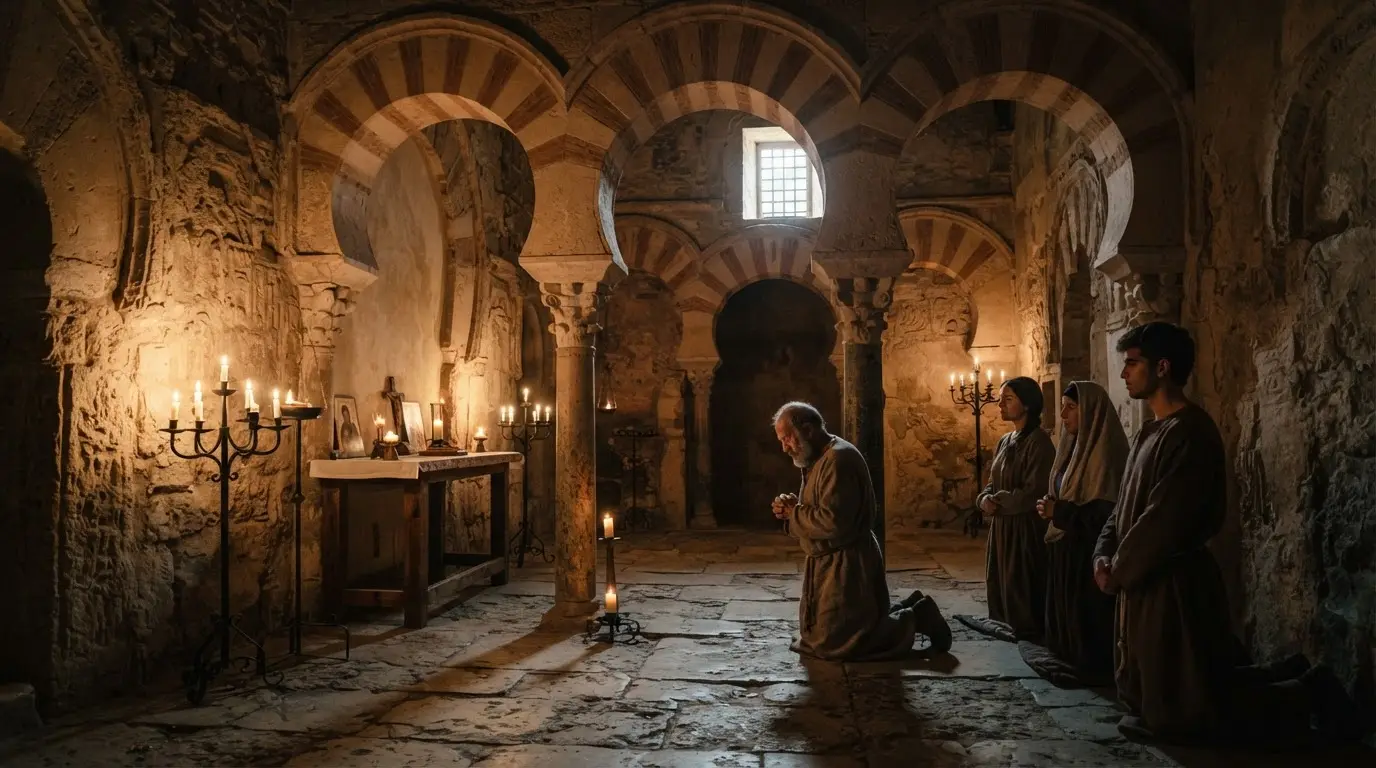
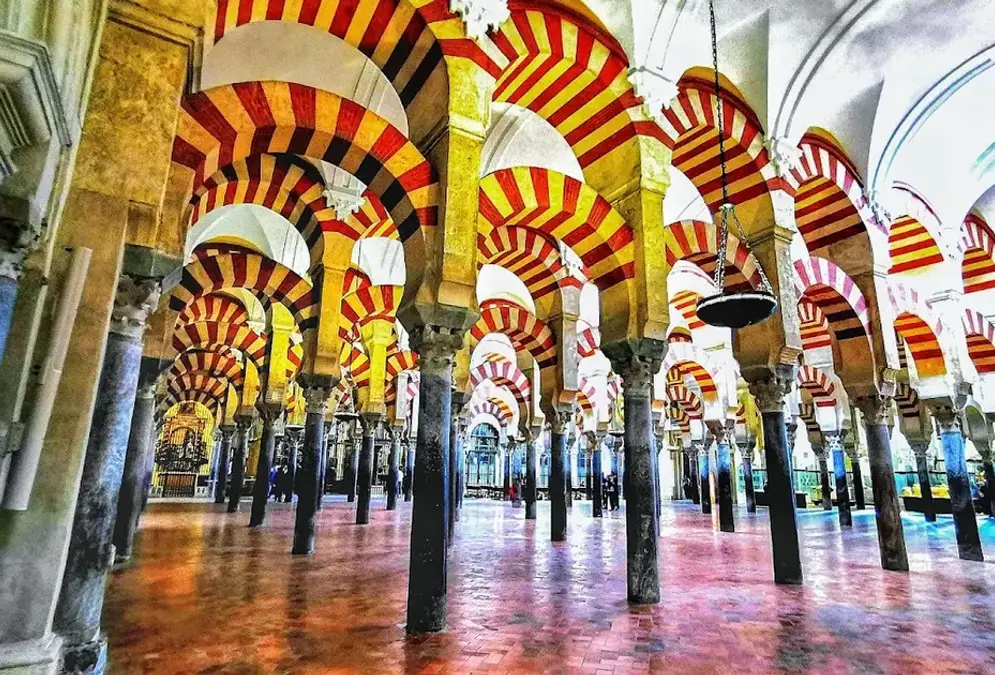
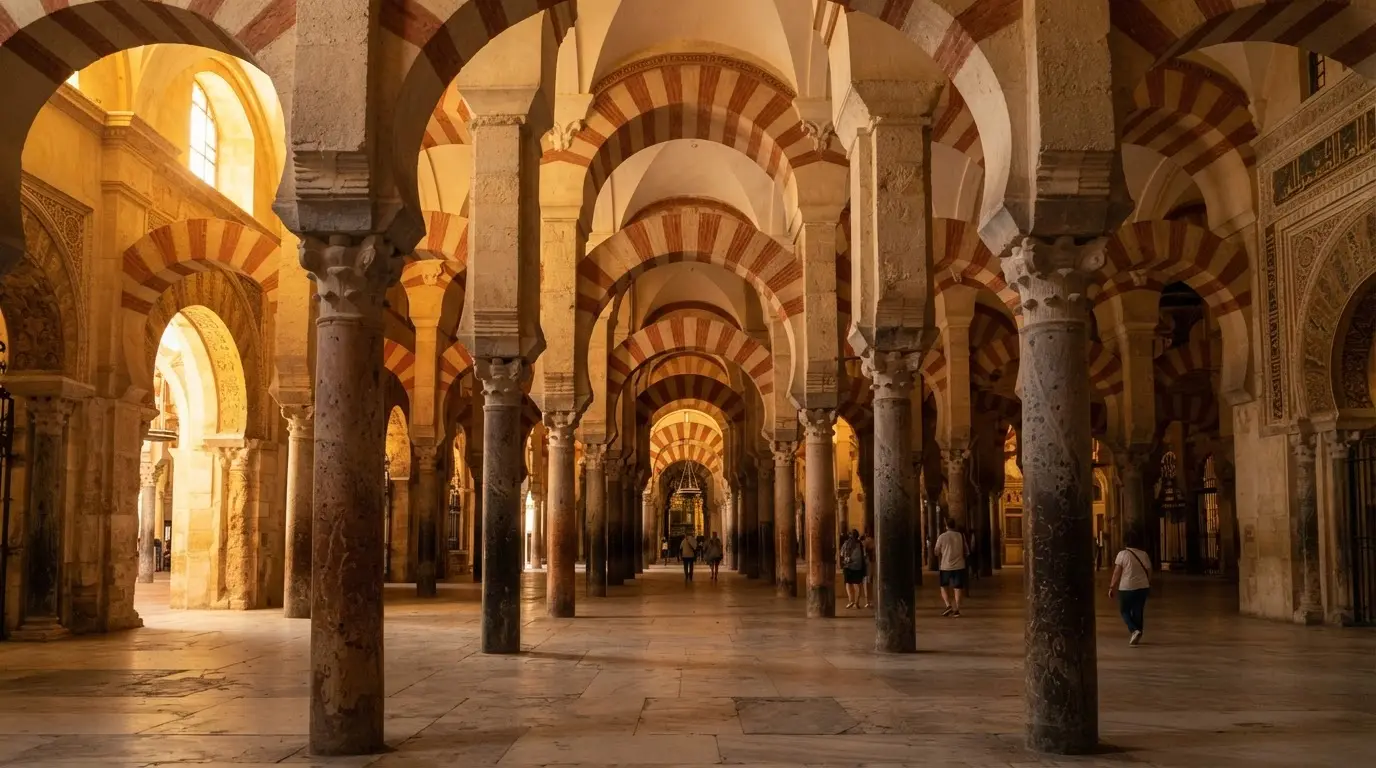
Eulogius of Córdoba was born before 819.[2] He studied at the Monastery of San Zoilo, one of the Christian institutions operating inside the city under Umayyad permission. His teacher was Abbot Speraindeo, and his fellow student was Paul Alvarus, who would become his lifelong intellectual partner and eventual biographer. The monastery sat in a Córdoba before the Mezquita that was already one of the largest and most sophisticated cities on the peninsula — a city that would, within a century, claim the title of largest in western Europe — its libraries stocked with Greek and Persian philosophy, its markets selling goods from Baghdad and North Africa.
Eulogius was not isolated from this world. In 848, three years before Isaac's execution, he had travelled north to monasteries in the Pyrenean foothills and returned to Córdoba with manuscripts of Augustine, Horace, Juvenal, and Virgil.[2] That journey tells you something about the cultural anxieties already circulating before the martyrdom movement began. Collecting Latin texts in a city where educated Christians increasingly read and wrote in Arabic rather than their ancestral language was itself a quiet act of resistance.
What Eulogius saw around him, as a Christian scholar in 850, was a community in rapid transformation. Christians were converting to Islam in significant numbers. The Arabic language was displacing Latin even in liturgy. His contemporary Paul Alvarus wrote bitterly in the Indiculus luminosus that young Córdoban Christians could barely read a Latin letter while reciting Arabic poetry with pleasure.[4] The assimilation was not forced. It was the rational adaptation of a minority community to the dominant culture of the most sophisticated city on the peninsula.
For Eulogius, this was the real emergency. Not legal persecution: Christians could still attend Mass, maintain monasteries, and conduct their internal affairs. The threat was the quiet dissolution of a community into something that was no longer itself. When Isaac walked into the qadi's court in 851, Eulogius saw not a dangerous fanatic but a man doing what the situation required.
The theology of provocation: what the Memoriale Sanctorum argued
Eulogius wrote the Memoriale Sanctorum in three books, documenting each martyr's life and death as a hagiographical defense of voluntary martyrdom.[4] The work is precise, legalistic, and argumentative. It is not the output of a man swept up in religious hysteria, but of a theologian building a case against opponents within his own church.
The central theological problem was this: classical martyrdom had always been understood as dying for refusing to apostatize under compulsion. The Roman persecutions that produced the Church's original martyrs worked by arresting Christians and demanding sacrifice to the imperial gods. The Mozarab martyrs faced no such compulsion. Under the dhimmi system, Christians were legally free to practice their faith privately. The Umayyad authorities were not demanding they convert or die. The martyrs had gone to the courts voluntarily and engineered their own executions.
Eulogius's counter-argument was that the dhimmi system itself was the persecution.[3] The jizya tax, the prohibition on constructing new churches, the formal legal subordination that made a Christian's testimony worth less than a Muslim's in court, the cultural pressure toward assimilation: all of these, he argued, constituted a coercive environment that met the theological threshold for genuine persecution. Voluntary martyrdom was the appropriate response to slow suffocation, not only to direct violence.
Eulogius's counter-argument was that the dhimmi system itself was the persecution. The jizya tax, the prohibition on constructing new churches, the formal legal subordination that made a Christian's testimony worth less than a Muslim's in court, the cultural pressure toward assimilation: all of these, he argued, constituted a coercive environment that met the theological threshold for genuine persecution.
He also pressed a theological claim about Islam specifically: that it was not merely a political enemy but a doctrinal heresy demanding active confrontation. Paul Alvarus amplified this in the Indiculus luminosus, identifying Muhammad with the Antichrist from Revelation.[1] Both men were drawing on a tradition of confrontational theology that predated al-Andalus, but they were applying it in a context that most Christian authorities in Córdoba found dangerously inappropriate.
Recommended tours
Tours are selected for quality, not commission. We earn a small fee if you book — at no extra cost to you.
The Memoriale Sanctorum also functioned as community record-keeping. Eulogius gathered testimony from surviving family and fellow monks, cross-checked accounts, and organized the material to meet the formal criteria of passio, the genre of martyrdom narrative developed in the early Church. He was building a dossier, not just a devotional text.
The community split: Bishop Reccafred versus Eulogius
The Umayyad authorities' first response was not mass execution. Abd al-Rahman II (r. 822-852) — the emir who built the Albolafia waterwheel and expanded the Mezquita, whose full reign is covered in Albolafia Waterwheel: Abd al-Rahman II's Islamic Legacy, and who had only recently organised the military response to the 844 Norse raid on the Guadalquivir — had Córdoba's Christian clergy arrested, including Eulogius, as pressure on the community to manage its own dissenters.[1] The message was clear: stop this, or we will stop it for you.
A faction of the Mozarab hierarchy was willing. Bishop Reccafred of Córdoba sided with the Muslim authorities and convened a council in 852 that formally condemned the voluntary martyrdom movement as theologically illegitimate.[3] The council's position rested on three objections:
Christians in Córdoba faced no genuine persecution. They could attend Mass, maintain monasteries, and practice their faith privately. The dhimmi protections were real. Provoking executions was not martyrdom under these conditions: it was suicide, which the Church condemned.
The martyrs produced no miracles. The classical passio tradition required supernatural confirmation of a martyr's status. Without them, the formal criterion was unmet.
Islam was not paganism. The Roman martyrs had died rather than worship false gods. Islam recognized Abraham, Moses, and Jesus. The theological framework justifying death rather than apostatizing to polytheism did not transfer to refusal of Islamic political supremacy.
These were not frivolous objections. Reccafred was making a case that Convivencia, the tolerated coexistence of communities under Islamic rule, was sustainable, and that the martyrs were destroying it out of vainglory rather than genuine faith. He had a point about the practical consequences: every execution weakened the community's negotiating position with the Umayyad state.
Eulogius was released from prison in time to attend the 852 council and fight the ruling in person. His response in the Memoriale Sanctorum took on each objection in turn. On persecution: structural inequality was coercion whether or not soldiers were breaking down church doors. On miracles: the early Roman martyrs had also faced critics who denied their authenticity in real time. On Islam-as-monotheism: Islam denied the Trinity and the divinity of Christ, which made it heretical, not simply non-Christian.
The council condemned the movement anyway. Abd al-Rahman II died that same year, 852, and his successor Muhammad I (r. 852-886) took a harder line: Christian officials were dismissed from court positions and enforcement against the community intensified.[1] The 852 council's condemnation had no practical effect on the executions.
Eulogius elected Archbishop of Toledo, then arrested
By 858, Eulogius had written the Documentum Martyriale and the Apologeticus Martyrum alongside the Memoriale Sanctorum. This body of work constitutes the most detailed primary source on the crisis from the Christian side. He had become the movement's chronicler, theologian, and chief defender, and his writing had given the forty-seven martyrs who preceded him a lasting historical record.
In 858 or early 859, the ecclesiastical province of Toledo elected Eulogius as Archbishop of Toledo, the most senior Christian position in the Iberian Peninsula.[2] The election acknowledged his scholarly standing and the authority he had accumulated through the martyrdom crisis. He could not be consecrated. He was arrested before the ceremony took place.
The immediate cause was his sheltering of Leocritia, a young woman from a Muslim family who had converted to Christianity.[1] Under Islamic law, apostasy from Islam was a capital offence. A Christian who concealed a convert from Islam was also liable. Eulogius knew this when he opened his door to her.
He was brought before the qadi and the officials of Muhammad I's court. By the accounts that survive, he behaved at his own interrogation as Isaac had behaved at his in 851: refusing to recant, speaking plainly about his beliefs, making no effort to escape the outcome. He and Leocritia were executed on 11 March 859.[2]
Timeline
850
Perfectus executed
The first martyr: a Córdoban priest executed for insulting Muhammad during a private conversation that was then reported to the authorities.[1]
851
Isaac walks into court
Isaac, former Umayyad palace official turned monk, presents himself to a qadi, denounces Muhammad, and is beheaded. His act triggers the voluntary martyrdom movement.[1]
851
Clergy imprisoned
Abd al-Rahman II has Córdoba's Christian clergy arrested, including Eulogius, as pressure on the community to control its own dissenters.[1]
852
Council condemns the movement
Bishop Reccafred convenes a council that formally declares the voluntary martyrdoms theologically illegitimate: no real persecution, no miracles, Islam is not paganism.[3]
852
Muhammad I takes power
Abd al-Rahman II dies. His successor Muhammad I dismisses Christian officials from court positions and intensifies enforcement.[1]
858-859
Eulogius elected Archbishop
The ecclesiastical province of Toledo elects Eulogius Archbishop, the senior Christian position on the peninsula. He is arrested before consecration.[2]
11 March 859
Eulogius and Leocritia executed
Eulogius beheaded for sheltering Leocritia, a convert from Islam. He is the forty-eighth and last of the Martyrs of Córdoba.[2]
Eulogius was the forty-eighth of the martyrs of Córdoba. He is venerated as a saint in both the Catholic and Orthodox Churches; his feast day falls on 11 March. His relics were moved to Oviedo in the northern kingdom of Asturias in 884, beyond the reach of the Umayyad state, where they remain in the Cathedral of San Salvador.[2]
What scholars make of it now: the assimilation-panic reading
For over a millennium, the Martyrs of Córdoba were straightforwardly saints: Christians who died for their faith under Muslim tyranny. The medieval Church accepted Eulogius's framing. The Catholic Church canonized all forty-eight. The modern scholarly picture is more complicated.
Jessica A. Coope's 1995 monograph The Martyrs of Córdoba reframed the movement as social protest against assimilation rather than a coordinated religious campaign.[5] Coope's argument is that the martyrs were not primarily motivated by theological conviction about Islam's heretical status. They were motivated by existential anxiety about their community's disappearance. The Mozarab world of 850 was one in which Christians were converting to Islam at accelerating rates, adopting Arabic names, language, and customs, sliding out of any recognizable Christian identity within a generation or two. The voluntary martyrs were performing extreme acts of communal self-definition: we exist, we are distinct, and our distinctness is worth dying for.
Kenneth Baxter Wolf developed a parallel analysis, also emphasizing identity assertion over pure theology.[5] Both scholars are working with the same primary sources: Eulogius's own writings, Paul Alvarus's biography, and the Arabic chronicles of the Umayyad state. Both find in them a community under the kind of pressure that produces desperate responses, not a persecution of the kind the Roman martyrs faced.
The reading has critics. Theologians point out that Eulogius's arguments in the Memoriale Sanctorum are genuinely sophisticated, not post-hoc rationalizations for social panic. Taking his ideas seriously means engaging with the logic of the dhimmi system as a form of structural coercion, not dismissing it as special pleading. There is also the fact that the martyrs died. Whatever mix of theology and identity panic drove them into the courts, the outcome was real.
What the scholarly debate makes clear is that the martyrs of Córdoba occupy an unresolved intersection of questions: when does accommodation become capitulation, when does resistance become self-destruction, and who gets to decide. The Córdoba of 850 did not answer these questions.
For visitors today, the monastery where Eulogius studied, San Zoilo, still exists, incorporated into a later church complex near the city centre. The medieval synagogue on Calle Judíos and the surviving fragments of the Mozarab world sit a short walk apart in what was, in 850, the most ethnically and religiously layered city in western Europe. The physical city retains almost nothing from the 9th century. The arguments Eulogius made in it have not gone away. For the later chapter of Córdoba's Christian community, once the city's rulers changed again, this guide to Christian Córdoba picks up the story.
Frequently asked questions
Who were the Martyrs of Córdoba?
The Martyrs of Córdoba were 48 Mozarabic Christians, Arabic-speaking Christians living under Muslim rule, executed in Córdoba between 850 and 859 AD for publicly denouncing Islam before Muslim courts. A significant number were voluntary: they presented themselves to the authorities rather than being arrested for private Christian practice. The group included monks, nuns, priests, and laypeople. Their chronicler and eventual fellow martyr was Eulogius of Córdoba, a priest who documented their lives in the Memoriale Sanctorum.
Why did Christians seek martyrdom in al-Andalus?
The motivations were theological and social. Eulogius and Paul Alvarus argued that dhimmi conditions — the jizya tax, formal legal subordination, restrictions on church construction, and accelerating cultural assimilation — constituted a genuine form of persecution justifying the martyrdom response. At the community level, the movement was a reaction to alarming rates of Christian conversion to Islam. Critics within the church rejected this framing, arguing that Christians could still worship privately and that the martyrs were driven by vainglory rather than sincere faith. Modern scholars Jessica A. Coope and Kenneth Baxter Wolf read the movement as an identity protest against assimilation.
Who was Eulogius of Córdoba?
Eulogius (born before 819, died 11 March 859) was a priest and scholar who became the central figure of the Martyrs of Córdoba movement. He studied at the Monastery of San Zoilo under Abbot Speraindeo alongside his lifelong partner Paul Alvarus. When the voluntary martyrdom movement began in 851, he became its chief defender, writing the Memoriale Sanctorum in three books. He was elected Archbishop of Toledo but arrested before consecration. On 11 March 859, he was executed for sheltering Leocritia, a convert from Islam, making him the forty-eighth and last of the martyrs.
Why did the Christian community itself oppose the martyrdom movement?
Bishop Reccafred of Córdoba convened a council in 852 that condemned the voluntary martyrdoms on three grounds: Christians faced no real persecution since they could still worship privately under dhimmi protections; the deaths produced no miracles, which classical martyrdom theology required; and Islam was a monotheistic religion, not paganism, so the framework justifying death rather than apostatizing to false gods did not apply. Reccafred believed the martyrs were destroying the community's protected legal status through pride rather than genuine faith.
What happened to Córdoba's Christians after the martyrdom crisis?
Muhammad I (r. 852-886), who took power after Abd al-Rahman II's death in 852, removed Christian officials from court positions and intensified enforcement. The movement produced its last martyr in 859 with Eulogius's execution. The Mozarab community continued to exist in Córdoba under dhimmi status, but the movement had demonstrated the fragility of that arrangement. The broader Islamisation of al-Andalus continued through the 9th and 10th centuries, and the Christian community in Córdoba gradually declined in relative size and cultural influence.