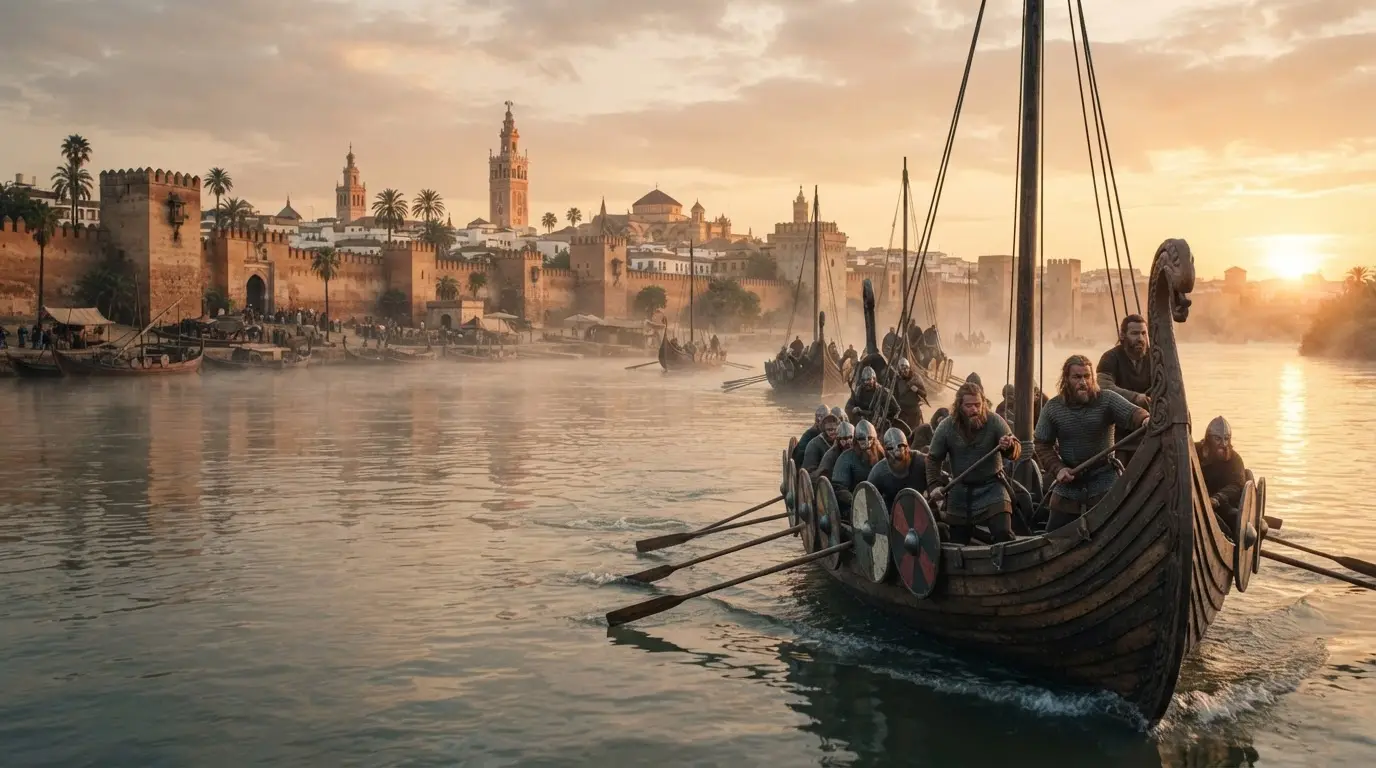

How a Norse fleet reached the Guadalquivir in 844
The Vikings who arrived on the Iberian coast in 844 were not on a reconnaissance mission. They had already raided the Asturian coast in northwestern Spain and sacked Lisbon before turning south. Medieval Muslim chronicles recorded the fleet as 80 ships carrying approximately 16,000 men, though modern historians treat those figures with caution; other accounts in the same tradition cite as few as 54 longships.[1][3] What the sources agree on is the date: the fleet entered the Guadalquivir estuary on 25 September 844.
The Guadalquivir, al-wadi al-kabir in Arabic ("the great river"), runs 657 kilometres from the Sierra de Cazorla in the east to the Atlantic at Sanlúcar de Barrameda. In the 9th century its lower reaches were navigable for oceangoing vessels, and the Norse ships drew far less water than a Roman merchantman. Nothing stopped them sailing directly to Seville.
25 Sept 844
Córdoba sat 120 kilometres upstream, well beyond any practical raiding distance. The Emirate of Córdoba at this point was the dominant power in the Iberian Peninsula, a Muslim state governing roughly two-thirds of the peninsula from its capital on the Guadalquivir. Its ruler, Abd al-Rahman II, was in the middle of a reign that would last thirty years (822–852). He was a sophisticated administrator, a builder, a patron of scholarship. He was about to discover he had no navy worth the name.
Six weeks in Seville: what the occupation looked like
Seville fell on 1 October 844 (some sources give the 3rd), a few days after the fleet entered the river.[1] The city had walls, but no garrison capable of holding them against a force of this size arriving by water. The Norse raiders occupied the city and used it as a base for raiding the surrounding region for roughly six to seven weeks.
For the population, the weeks that followed were brutal. The sources record killing, enslavement, and the destruction of churches and neighbourhoods outside the walls. The Banu Qasi, a powerful Muladí dynasty descended from the Hispano-Roman nobleman Count Cassius and controlling the upper Ebro valley, were among the forces Abd al-Rahman II would eventually call on, but they were far away and could not reach Seville quickly enough to prevent the occupation.
Abd al-Rahman II's immediate response was to mobilise what troops he could and send them south. The hajib (chief minister) Isa ibn Shuhayd took command of the land forces. The problem was tactical: infantry on the riverbank could not easily engage longships on the water, and the Norse raiding parties could strike the surrounding villages at will, retreating to their ships before any organised response arrived. The emirate's forces won some skirmishes during the occupation, killing several hundred raiders according to the chronicles, but could not dislodge the main fleet.
Explore nearby · Monument
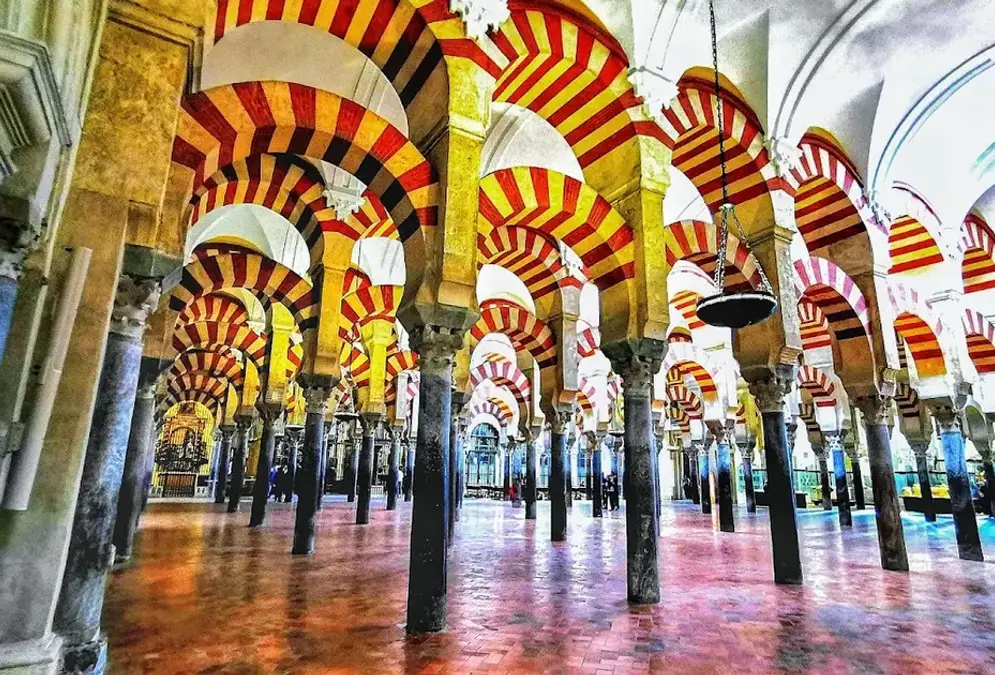
Mezquita-Catedral de Córdoba
856 columns, 1,300 years of Islamic and Christian history. UNESCO monument in Córdoba, Andalusia. Red-and-white arches, Byzantine mosaics, a Renaissance nave.
What eventually shifted the military equation was not numbers but fire.
The Battle of Talyata: Greek fire and the Norse retreat
The decisive engagement came in November 844, at a site medieval sources call Talyata, identified with the plain of Tablada on the Guadalquivir immediately south of Seville.[1] The Muslim forces had acquired or improvised incendiary weapons: what the sources describe in terms consistent with Greek fire, an incendiary liquid projected by catapult or siphon that burns on contact with water. They used it to set the Norse ships alight while they were anchored.
The tactic worked. 30 Viking ships burned in the battle or its immediate aftermath.[1] Between 500 and 1,000 Norse fighters died, and at least 400 were captured. The captives were hanged, the chronicles are consistent on this detail, some from palm trees along the riverbank. The surviving ships withdrew downriver and left the Guadalquivir.
The Norse fleet had arrived expecting the same kind of target they had found in Galicia and Portugal: coastal settlements, monasteries, cities with walls that mattered more symbolically than militarily. What they found instead was a large, organised, wealthy state that could absorb six weeks of shock and still field a force capable of burning their ships. The departure date from the sources is either 11 or 17 November 844 (the exact day varies by manuscript), but by late November the Guadalquivir was empty of longships.
The military commanders who organised the response are named in the Muslim chronicles but almost entirely absent from popular accounts of the raid: Isa ibn Shuhayd, Musa ibn Musa of the Banu Qasi, Muhammad ibn Rustam, and the eunuch military officer Nasr. They ran the actual campaign while Abd al-Rahman II directed from Córdoba.
Recommended tours
Tours are selected for quality, not commission. We earn a small fee if you book — at no extra cost to you.


The naval arsenal: how Abd al-Rahman II built a fleet that never existed before
The raid had exposed a gap that Abd al-Rahman II could not ignore. The Emirate of Córdoba controlled most of the Iberian Peninsula but had no navy and no coastal defence infrastructure. The Guadalquivir, the same river that gave Seville access to Atlantic trade, had just demonstrated that it also gave Atlantic raiders access to Seville. The emir moved quickly.
At Seville, on the riverbank, his engineers began construction of a dar al-sina'a, the Arabic term from which the English word arsenal derives, literally house of manufacture.[2] The installation served three purposes: it built and maintained warships, manufactured weapons, and trained sailors and marines. Seville was the right location precisely because the raid had demonstrated it was the strategic chokepoint: any ship entering the Guadalquivir from the Atlantic had to pass through or near it.
Along with the naval arsenal, Abd al-Rahman II ordered walls built around Seville (the city had been inadequately defended in 844) and established messenger relay networks along the coast and up the river, so that any future fleet sighting would reach Córdoba before the ships did.[1] The early-warning system is easy to underestimate. In 844, Seville had fallen partly because no one had time to organise a coherent response before the city was already surrounded. A courier network that could carry intelligence from the Atlantic coast to the Alcázar de los Reyes Cristianos in under 48 hours changed that calculation entirely.
Deep dive · Article
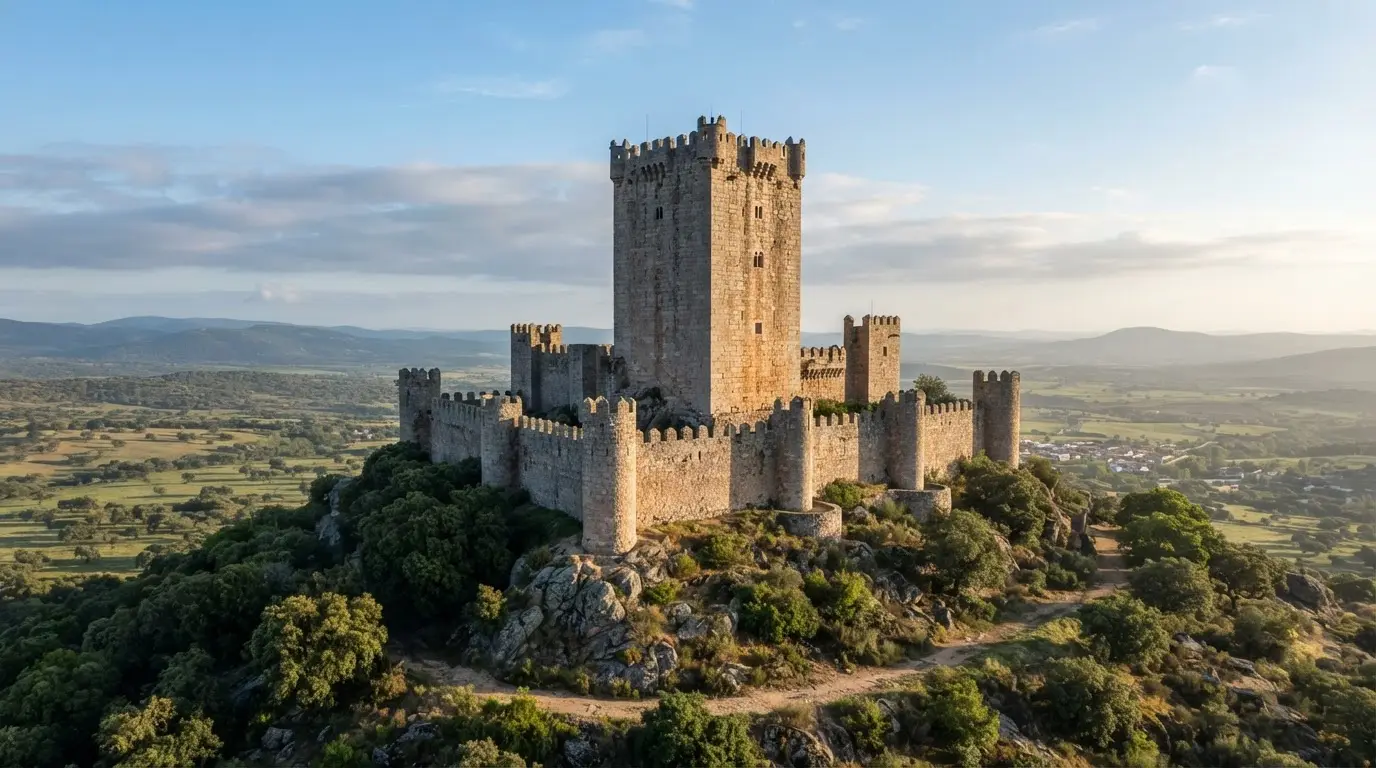
47 Metres Tall and Almost Unknown: Spain's Tallest Keep
Belalcázar Castle's 47 m keep is listed by the Junta de Andalucía as Spain's tallest. How it grew, what to see inside and how to book the free guided visit.
The new fleet was not built for conquest. Abd al-Rahman II had no interest in projecting naval power into the Atlantic. The ships he commissioned were defensive: stationed on the lower Guadalquivir and on the southern coast, designed to intercept raiders before they could reach inland cities. This is the origin of what historians of al-Andalus call the Andalusian naval tradition, a defensive maritime strategy oriented toward the Guadalquivir watershed rather than Mediterranean expansion.
Did the Vikings send ambassadors to Córdoba?
Some historians suggest that what followed the 844 raid was not only military consolidation but diplomatic contact. The argument runs as follows: Norse leaders, impressed by the scale of the Emirate of Córdoba and its ability to repel their fleet, sent an embassy to Abd al-Rahman II's court. The emir, in turn, sent a counter-embassy north to whatever Norse king the ships had originated from.
The figure at the centre of this exchange, if it happened, was Yahya ibn al-Hakam, known by his nickname al-Ghazal ("the Gazelle"), a renowned court poet and diplomat from Jaén. The episode survives in a single medieval Arabic source, the 13th-century writer Ibn Diḥya, who claimed to draw on a now-lost account by al-Ghazal's contemporary Tammām ibn ʿAlḳama. It describes al-Ghazal travelling to the court of a "king of the Majus" (the Arabic term for Norse/pagan northerners) and making an impression on the king's wife with his wit and composure.[1] The story involves flattery, a philosophical conversation about God, and al-Ghazal insisting he was too dignified to prostrate himself before a foreign king.
The problem is sourcing. Most modern historians treat the al-Ghazal embassy as contested at best. The primary Arabic accounts were written 150 to 200 years after the events they describe. The location of the Norse king's court is variously identified as Ireland, Denmark, or the Atlantic Norse settlements; scholars cannot agree on which. Some researchers accept the embassy as historical; others read it as a literary set piece, a flattering story about a court poet who charmed barbarians, inserted into a historical record that was already many generations removed from the original events.[3]
What is not in dispute is that Abd al-Rahman II's court was interested in the people who had just attacked his southern capital. Whether that interest took the form of formal diplomacy or merely intelligence-gathering is harder to establish.
Most modern historians treat the al-Ghazal embassy as contested at best.
The raids that never came: 859 and 966
The real measure of what Abd al-Rahman II built is what happened next. In 859, a large Norse fleet did reach the Iberian coast and attempted to penetrate the Guadalquivir again.[1] The fleet was intercepted and defeated near the river mouth. The new ships, the new coastal defences, and the relay networks worked. The raiders turned east and attacked the Mediterranean coast instead, bypassing al-Andalus.
In 966, another Norse expedition arrived on the Andalusian coast. By then the emirate had become the Caliphate of Córdoba under Abd al-Rahman III, who had declared himself caliph in 929 and built the palace city of Medina Azahara outside Córdoba. The 966 incursion was turned back without reaching Seville.[1]
The 844 raid never repeated at the scale that had made it so alarming. The coastal watch system that Abd al-Rahman II established was extended and improved by his successors. The dar al-sina'a at Seville continued building and maintaining warships. Each emir and caliph who came after him inherited both the threat model and the infrastructure designed to counter it: Norse raiders from the Atlantic, warships to stop them on the river.
For visitors in Córdoba today, none of this left an obvious physical trace in the city itself. The raid happened in Seville, the battle at Tablada just south of it, the arsenal on the Seville riverbank. What happened in Córdoba was administrative and strategic: the decisions, the funding, the dispatch of forces, the planning of what to build afterward. Abd al-Rahman II governed the response from this city, and the Mezquita-Catedral de Córdoba he was simultaneously expanding stands as the physical counterpart to that naval programme: the same reign, the same ambition, expressed in stone on one hand and in ships on the other. The guide to Moorish Córdoba covers that surviving legacy for visitors today.