Córdoba's Alcázar as Inquisition HQ — 339 Years of Dark History
The Alcázar de los Reyes Cristianos was headquarters of the alcazar cordoba inquisition for 339 years. What happened inside, and what remains visible today.
Art history background with eight years writing interpretive content on Córdoba's Caliphal heritage.
Updated Published
history-buffsarchitecturephotographers
In 1482, Ferdinand and Isabella handed the Alcázar de los Reyes Cristianos to the Spanish Inquisition, making it one of the first permanent tribunal seats in Spain. For the next 339 years, sentences were read in its halls, detainees held in its lower chambers, and autos-da-fé announced from its towers. Most visitors today walk the lush gardens and admire the Moorish baths without knowing any of this.
In this article
Jump to a section
⌄
The 1482 transfer: how Ferdinand and Isabella handed the Alcázar to the Inquisition
The Spanish Inquisition was formally established in 1478 under a papal bull from Sixtus IV, at the request of Ferdinand and Isabella[4]. Its initial focus was Castile, and specifically conversos: Jewish converts to Christianity suspected of secretly maintaining Jewish practice. Within four years, the Crown needed permanent tribunal seats, not ad hoc proceedings.
In 1482, the Alcázar de los Reyes Cristianos was ceded to the Inquisition as its Córdoba headquarters[1]. The choice was deliberate. The Alcázar was a royal fortress built by Alfonso XI in the 14th century on Roman, Visigothic, and caliphal foundations, already a building layered with administrative authority. Handing it to the Inquisition gave the tribunal the symbolic weight of royal architecture and the practical infrastructure of a fortified compound: secure gates, thick walls, and existing detention spaces in the lower levels.
The Córdoba tribunal was one of the first permanent seats established after 1478, ahead of most other Spanish cities[3]. This was not coincidental. Córdoba had a substantial converso population, many descended from the forced conversions following the 1391 pogroms that swept Castile and Aragon. The city's economic life was threaded through converted Jewish merchant families, physicians, and municipal officials, precisely the community the Inquisition was constituted to scrutinize.
This is the founding context that the Alcázar's current signage largely omits. The same fortress where Isabella famously received Columbus in 1486 was already three years into its function as a tribunal of religious enforcement when that meeting took place[1]. The two uses coexisted without apparent contradiction to the Crown.
Arab baths converted to detention spaces: the physical evidence
The Alcázar's lower level contains the Baños de Doña Leonor, Mudéjar-style baths built in the 14th century under Alfonso XI, with star-shaped skylights cut through vaulted ceilings to admit light and regulate steam. Modeled directly on the Islamic hammam tradition, these baths postdate Córdoba's caliphate by more than three centuries — the genuinely 10th-century Umayyad baths, the Baños Califales, survive separately across the Campo Santo de los Mártires and are ticketed as their own museum.
After 1482, these spaces served a different function. The vaulted chambers became holding areas for those under investigation; the thick stone walls and limited access points made them practical detention spaces without requiring significant modification. Physical conversion of the baths was minimal: the architecture already provided isolation, controlled entry, and the thermal mass that kept spaces cool in summer and cold in winter.
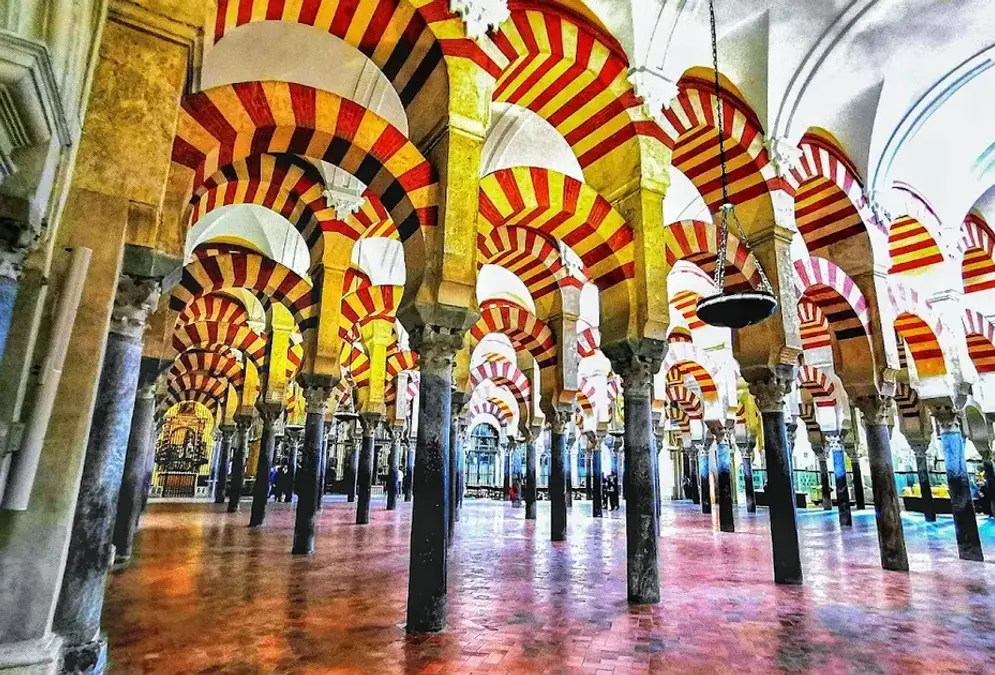
The evidence for this repurposing is architectural rather than documentary. Inquisition tribunals kept detailed procedural records (trial transcripts, sentence registers, abjuration lists), but inventories of physical space were rarely made. What survives is the structural logic: a vaulted, subterranean chamber with a single entry point serves detention as effectively as it serves bathing. The parallel story of the Mezquita's own transformation runs alongside this one. The Mezquita's conversion in 1236 shows how systematically Islamic-era architecture was repurposed under Christian rule across Córdoba.
14th century
The Baños de Doña Leonor beneath the Alcázar are Mudéjar baths built under Alfonso XI, with star-shaped skylights and vaulted ceilings modeled on the Islamic hammam tradition. After 1482, the same chambers served as detention spaces for those under Inquisition investigation — the architecture required no structural modification.
The star-shaped skylights in the bath vaults are still visible to visitors today. They remain one of the most precise pieces of Mudéjar decorative engineering in the city, and they sit directly above what functioned, for three centuries, as part of the Inquisition's physical infrastructure. The Tower of the Inquisition at the Alcázar held the tribunal's archive across these same centuries[1], a paper record that shadowed the physical one below.
Diego Rodríguez Lucero "El Tenebroso": Córdoba's most feared inquisitor
On September 7, 1499, Grand Inquisitor Diego Deza appointed Diego Rodríguez Lucero as Córdoba's inquisitor[2]. He became known as El Tenebroso, the Dark One. In the five years that followed, Lucero built one of the most extreme prosecutorial records of any Inquisition tribunal in Spain.
His methods drew accusations even from within the Inquisition's own hierarchy. Family members of the detained documented charges that appeared sexually and financially motivated rather than theologically grounded. By 1506, Lucero had more than 400 people detained simultaneously[2], a caseload that strained the Alcázar's detention capacity and prompted protests from Córdoba's city council and the families of the accused.
Recommended tours
Tours are selected for quality, not commission. We earn a small fee if you book — at no extra cost to you.
The full account of Lucero's tenure, his eventual arrest in 1508 by Grand Inquisitor Cisneros, and his death in Seville in 1534, is covered in a separate article: Lucero. What matters here is that his appointment at the Alcázar was the institutional product of the same tribunal structure established in 1482.
The 1504 auto-da-fé and the 1506 uprising
On December 22, 1504, Córdoba held one of the largest autos-da-fé in Inquisition history. Approximately 267 people were sentenced, of whom 107 were burned at the stake. The sentences covered the full range of Inquisition penalties: reconciliation with penance, wearing of the sambenito, property confiscation, imprisonment, and relaxation to the secular arm for burning. The ceremony was public and deliberate, staged to communicate the tribunal's reach to the city as a whole.
The auto-da-fé was not held inside the Alcázar itself, but publicly, in a space accessible to the city's population. Surviving accounts do not agree on the exact site, so this article does not name one. The Alcázar was the administrative origin of the sentencing; the public ceremony beyond its walls was the civic theatre.
The crisis broke into open violence on November 9, 1506. A crowd of Córdoba's citizens, furious over Lucero's prosecutions and the swelling number of detainees, stormed the Alcázar's own prison. They broke it open, freed more than 400 prisoners held inside, and went hunting for Lucero with the intent to lynch him[2]. He escaped the mob, but the assault on the fortress itself was a direct, physical uprising against the tribunal's authority, not a petition process or a paperwork grievance.
In the aftermath, Córdoba's municipal officials and the families of the accused also pursued formal channels, submitting written complaints to the Suprema, the Inquisition's governing council in Madrid. But it was the uprising, not the paperwork, that forced the Crown and the Inquisition's hierarchy to finally act. Lucero continued in post until 1508, when Cisneros ordered his arrest and investigation[2]. He was never convicted, and he died in Seville in 1534.
Timeline
1478
Spanish Inquisition established
Papal bull from Sixtus IV authorizes the Inquisition in Castile at Ferdinand and Isabella's request[4].
1482
Alcázar ceded to the Inquisition
Ferdinand and Isabella hand the Alcázar de los Reyes Cristianos to the Córdoba tribunal, one of Spain's first permanent Inquisition seats[1].
September 7, 1499
Lucero appointed
Diego Rodríguez Lucero takes charge of the Córdoba tribunal, appointed by Grand Inquisitor Diego Deza[2].
December 22, 1504
Mass auto-da-fé
One of the largest autos-da-fé in Inquisition history: approximately 267 sentenced, 107 burned at the stake in a single day.
November 9, 1506
Armed uprising at the Alcázar
A crowd storms the Alcázar's prison, frees more than 400 detainees, and attempts to lynch Inquisitor Lucero[2].
1508
Lucero arrested
Grand Inquisitor Cisneros orders Lucero's arrest and investigation following documented institutional complaints[2].
1821
Inquisition dissolved at the Alcázar
The tribunal is definitively dissolved after 339 years at the Alcázar[1]; the building becomes a civil and military prison, a role it holds until 1931[1].
1834
Spanish Inquisition abolished nationally
Regent Maria Cristina signs the institution's final, permanent national abolition, acting for the infant Isabella II — by then the Alcázar itself had been out of tribunal use for over a decade[4].
Three centuries of institutional enforcement: 1482 to abolition
The years 1499 to 1508 were the most intense of the Córdoba tribunal's history, but they were not representative of it. The Inquisition operated at the Alcázar from 1482 until its dissolution in 1821[1], 339 years of continuous operation, after which the building passed into civil and military prison use until 1931[1]. The Spanish Inquisition as a national institution was not permanently abolished until 1834[4], but by then the Alcázar itself had already been repurposed for over a decade. Most of the intervening span was administrative routine: annual interrogations, periodic autos, the slow bureaucratic machinery of a permanent institution.
The categories of investigation shifted over time. The early decades focused on conversos (Jewish converts), in line with the Inquisition's founding mandate[3]. By the mid-16th century, attention had broadened to moriscos, Muslim converts, as well as Lutherans, bigamists, and practitioners of magic. For moriscos specifically, attendance at a hammam was one of the behaviours the Inquisition tracked as evidence of continued Islamic practice. The very bathhouses that had made Córdoba the most extensively bathed city in medieval Europe, as the history of Islamic hammam culture in Córdoba documents, became instruments of surveillance after the Reconquista. Each category left its own layer of documentation in the archive that the Tower of the Inquisition held[1].
The concept of limpieza de sangre, blood purity, ran through the entire period. To hold municipal office, enter a religious order, or join certain guilds in Córdoba required certification that no Jewish or Moorish ancestry existed within a specified number of generations. The Alcázar's tribunal was the institutional mechanism that enforced and verified these claims, making it relevant not just to accused heretics but to the ordinary civic ambitions of the city's population across three centuries.
Córdoba's golden age and subsequent civil conflicts track a parallel history: the city that had been the intellectual capital of medieval Europe under the Umayyad caliphate was, by the 16th century, a provincial city managing decline under the weight of exactly this kind of institutional apparatus. The Inquisition did not cause Córdoba's economic contraction, but the expulsion of Jewish and Moorish populations, enforced partly through the Alcázar's tribunal, removed communities that had been central to the city's commercial and intellectual life. The Mozarab Christians who had navigated Umayyad rule under the dhimmi system, the same community that produced the Martyrs of Córdoba in 850 (48 people executed for publicly denouncing Islam), had long since dissolved into the converted population the Inquisition was now scrutinising in reverse.
Napoleon's suppression decree of December 1808 (the Decrees of Chamartín) brought the Inquisition's first national suspension. French forces then occupied Córdoba from 1810, garrisoning the Alcázar itself. Ferdinand VII briefly restored the Inquisition after Napoleon's defeat, but the tribunal was definitively dissolved in 1821[1], ending the Alcázar's 339-year role as an Inquisition headquarters. The building then became a civil and military prison, a function it held until 1931[1]. The national institution took over a decade longer to die everywhere else: regent Maria Cristina signed the Spanish Inquisition's final, permanent abolition in 1834[4], acting for the infant Isabella II, by which point the Alcázar had long since passed out of tribunal use. The Alcázar then passed through its later institutional uses (prison, military barracks) before opening to the public as a monument in the 20th century.
What visitors see today — and what remains hidden
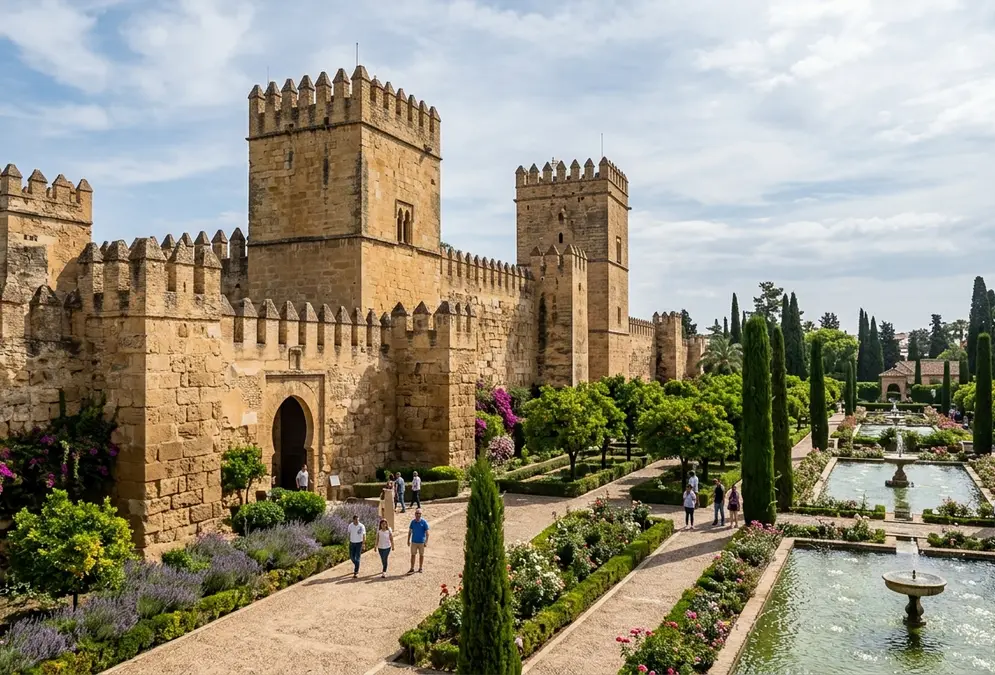
The Alcázar de los Reyes Cristianos opens daily except Monday. Ticket prices change periodically and are best checked on the official ticketing page before visiting rather than quoted here. The terraced gardens are the main draw for most visitors: citrus trees, water channels, hedgerows cut to geometric patterns, and a long reflecting pool that catches the light in the late afternoon. From the towers, the view takes in the Roman bridge and the Guadalquivir to the south.
The baths are accessible on the lower level: the Baños de Doña Leonor, Mudéjar baths built under Alfonso XI in the 14th century, with star-shaped skylights and vaulted ceilings. These are among the best-preserved examples of Mudéjar bath architecture in Córdoba — not to be confused with the genuinely 10th-century Baños Califales, which sit as a separate, independently-ticketed museum across the Campo Santo de los Mártires. The interpretive panels describe their construction and hydraulic system. They do not describe what the chambers were used for after 1482.
Signage on the Inquisition's 339-year presence at the Alcázar is thin. There is a general historical panel at the entrance that mentions the tribunal in passing. The Tower of the Inquisition is named but not explained. Visitors who know what to look for (the lower chambers, the thick-walled tower that served as archive, the structural logic of the detention spaces) can read the building against its own silences. Most do not.
This is not unusual for Alcázar sites across Spain. The buildings tend to be presented through their most photogenic historical moment: in Córdoba's case, the meeting between Columbus and the Catholic Monarchs. The three-and-a-half centuries of institutional terror that preceded and followed that meeting in the same rooms receive less emphasis.
The gardens are genuinely worth the visit. Go in the morning before 10:00, when the tour groups have not yet arrived and the orange trees still hold the night's coolness. Walk to the lower level and find the bath vaults. Look up at the star-shaped skylights: they are exactly as precise as they were in the 14th century. Then consider what happened in those rooms between 1482 and 1821. The Alcázar does not tell that story directly. But the architecture holds it.
FAQ about alcazar cordoba inquisition
When did the Alcázar become the headquarters of the Córdoba Inquisition?
In 1482, Ferdinand and Isabella ceded the Alcázar de los Reyes Cristianos to the Spanish Inquisition as its Córdoba headquarters, one of the first permanent tribunal seats established after the Inquisition's formal founding in 1478. The tribunal operated from the Alcázar until the Inquisition was dissolved in 1821, a span of 339 years, after which the building became a civil and military prison until 1931. The Spanish Inquisition survived as a national institution for over a decade longer, until its final abolition in 1834.
What happened at the Alcázar during the 1504 auto-da-fé?
On December 22, 1504, the Córdoba tribunal sentenced approximately 267 people in a single day, 107 of whom were burned at the stake, making it one of the largest autos-da-fé in Inquisition history. Sentences ranged from public penance and property confiscation to relaxation to the secular arm for burning. The ceremonies were held at public spaces accessible to the city, with the Alcázar serving as the administrative origin of the proceedings.
Who was Diego Rodríguez Lucero and why is he significant to the Alcázar cordoba inquisition history?
Diego Rodríguez Lucero was appointed Córdoba's inquisitor on September 7, 1499, by Grand Inquisitor Diego Deza. Known as El Tenebroso (the Dark One), he built one of the most extreme prosecutorial records in Inquisition history. By 1506, he had more than 400 people detained simultaneously at the Alcázar. Formal complaints from Córdoba's city council and detained prisoners' families eventually led to his arrest in 1508 on orders from Grand Inquisitor Cisneros. He died in Seville in 1534.
Are the baths at the Alcázar connected to the Inquisition's use of the building?
The Alcázar's lower level holds the Baños de Doña Leonor, Mudéjar baths built in the 14th century under Alfonso XI with star-shaped skylights and vaulted ceilings — not the genuinely caliphal baths, which are a separate, independently-ticketed museum across the Campo Santo de los Mártires. The Alcázar's own baths were repurposed as detention and holding spaces after the Inquisition took over in 1482; the thick walls and limited entry points made them structurally suited for this use without modification. They are open to visitors today and are well-interpreted as medieval architecture, but the interpretive panels do not address their post-1482 function.
When was the Spanish Inquisition at the Alcázar finally abolished?
The Inquisition's tenure at the Alcázar itself ended in 1821, when the tribunal was definitively dissolved after 339 years of operation there — the building then passed into use as a civil and military prison until 1931. Nationally, the institution survived a little longer: there had been an earlier suspension under Napoleon's 1808 decree (French forces occupied Córdoba from 1810) and a brief restoration under Ferdinand VII, before regent Maria Cristina signed the Spanish Inquisition's final, permanent abolition in 1834 (Isabella II was only 3 years old). By that date, the Alcázar had already been out of tribunal use for over a decade.
Can you visit the Inquisition-related spaces at the Alcázar today?
Yes, the Alcázar de los Reyes Cristianos is open to visitors (closed Mondays). Ticket prices change periodically, so check current pricing on the official ticketing page before visiting. The Baños de Doña Leonor (14th-century Mudéjar baths) in the lower level are accessible and well-preserved. The Tower of the Inquisition, which held the tribunal's archive for centuries, is visible from the grounds. However, interpretive signage on the Inquisition's three-century presence is minimal — the building's history as a tribunal is not the focus of the current museum presentation. Morning visits before 10:00 are quieter.
What happened in Córdoba during the 1506 uprising against Inquisitor Lucero?
On November 9, 1506, an armed crowd stormed the Alcázar's prison, freeing more than 400 people Inquisitor Lucero had detained, and attempted to lynch Lucero himself. He escaped, but the uprising exposed the scale of his prosecutorial excess and the accusations that many cases were fabricated or motivated by the seizure of converso property rather than genuine heresy. Córdoba's city council and the families of the accused also pursued formal complaints to the Suprema, the Inquisition's governing council in Madrid. Lucero remained in post until 1508, when Grand Inquisitor Cisneros ordered his arrest.