Inquisitor Lucero El Tenebroso: Córdoba's Feared Judge
Lucero El Tenebroso jailed 400+ people and staged Córdoba's largest auto-da-fé in 1504 — one of few Spanish inquisitors formally removed for abuse of authority.
Art history background with eight years writing interpretive content on Córdoba's Caliphal heritage.
Updated Published
history-buffs
In September 1499, a canon from Seville named Diego Rodríguez Lucero arrived in Córdoba as its new inquisitor and began roughly seven years of prosecutions, until his 1506 flight after a prison break, so extreme that the Inquisition eventually put him on trial. He is one of the very few Spanish inquisitors formally tried and removed from office for abuse of authority. His case reveals what happened when the institution's own machinery briefly turned inward.
In this article
Jump to a section
⌄
From Moguer to Córdoba: who appointed Lucero and why
Diego Rodríguez Lucero came from Moguer, a small Andalusian town near Huelva. He held a canonry at Seville Cathedral before entering the Inquisition's service, which was the typical career path for tribunal personnel — ecclesiastical positions first, then transfer into the institutional structure of the Santo Oficio.
On September 7, 1499, Grand Inquisitor Diego Deza appointed Lucero as Córdoba's inquisitor[1]. Deza was himself a controversial figure: an ally of the Borgia papacy, confessor to Queen Isabella, and a man whose aggressive approach to converso prosecution had already drawn criticism from within the Spanish church. His choice of Lucero for Córdoba was consistent with that approach.
Córdoba in 1499 had a substantial converso population, the legacy of forced conversions following the 1391 pogrom and the 1492 expulsion of those who refused baptism. The city's merchant class, municipal administration, and professional guilds included many families of converso descent. The Inquisition's founding mandate targeted precisely this population: Jewish converts suspected of maintaining crypto-Jewish practice in secret. Lucero arrived in a city where the tribunal had institutional purpose, an existing caseload, and a ready-made suspect community.
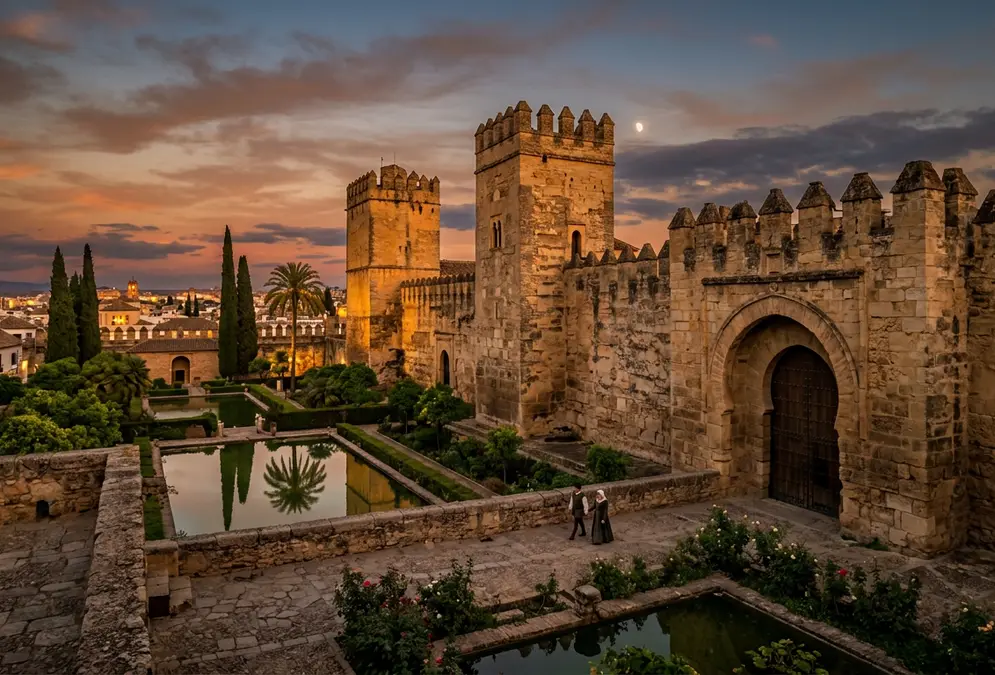
The nickname El Tenebroso, meaning the Dark One or the Shadowy One, did not come from his enemies alone[1]. It spread through Córdoba among people who had nothing to do with the converso community, including Old Christian families who watched their neighbours disappear into the Alcázar de los Reyes Cristianos on charges that seemed fabricated from the start.
Lucero's accusation methods departed from Inquisition procedure in two specific ways that contemporaries documented. He targeted people whose guilt would have been difficult to establish under normal interrogation, including elderly conversos with no credible accusation against them. He also brought charges that frequently carried property confiscation as a consequence. Inquisition tribunals were partly self-financing through the assets of the condemned, and critics both inside and outside the institution observed that Lucero's prosecutorial targets tended to be wealthy[2].
Families submitted written complaints documenting specific accusations: that Lucero had detained women on false pretexts; that charges were extracted under torture rather than supported by witnesses; that victims who proclaimed their innocence at sentencing ceremonies were gagged or beaten before they could speak[5]. These were not anonymous pamphlets. They were formal legal filings addressed directly to King Ferdinand. That such complaints were filed at all tells you something about how extreme the situation had become, since challenging an inquisitor through official channels required both resources and courage.
400+
The number of people Lucero held simultaneously in Córdoba's Inquisition prison by 1506[2]. The Alcázar's detention capacity was built for dozens, not hundreds. The overflow prompted formal protests from the city council and families of the accused.
December 1504: the largest auto-da-fé in Córdoba's history
On December 22, 1504, Córdoba held one of the largest autos-da-fé in Inquisition history: 107 people were burned at the stake in a single ceremony[1]. This was five years into Lucero's tenure, and the scale was a direct product of his prosecutorial pace. A tribunal that condemned 107 people to burning in a single day had been accumulating cases for years.
The auto-da-fé covered the full range of Inquisition penalties:
Reconciliación — public penance with the wearing of a sambenito, a penitential garment that marked the family name across generations
Property confiscation — stripping the condemned of assets that partly funded the tribunal itself
Imprisonment
Relajación al brazo secular — handing the condemned to civil authorities for burning
Formal complaints describe condemned prisoners being silenced at the stake before they could proclaim their innocence. The clearest surviving account of this comes from a 1507 complaint addressed directly to King Ferdinand, which put the cumulative toll at roughly 500 prisoners under Lucero, some 150 of them burned and gagged so they could not speak[5].
Recommended tours
Tours are selected for quality, not commission. We earn a small fee if you book — at no extra cost to you.
This detail is documented rather than anecdotal, even if it cannot be pinned to the single December 1504 ceremony rather than to the broader pattern the 1507 complaint describes. Defendants were entitled, under Inquisition procedure, to make a final statement before execution, so silencing them was not just cruel; it was irregular. The December 1504 auto remains the largest single event of Lucero's tenure, and it is the one most frequently cited in later complaints against him.
1506: 400 detainees, a prison uprising, and Lucero's flight
By early 1506, Lucero had filled the Alcázar's detention spaces beyond any defensible capacity. Contemporary accounts place the number of simultaneous detainees at more than 400[2]. To put that in context: the Alcázar had been adapted from a 14th-century royal fortress; its lower chambers, including the Mudéjar-era Baños de Doña Leonor (built centuries after the caliphate and distinct from the separately-ticketed Baños Califales), were not designed as a mass prison. Detainees included conversos, Old Christians, and members of families whose only connection to heresy was a relative who had already been sentenced.
The breaking point came in 1506. The Count of Cabra and the Marquis of Priego, two powerful Andalusian nobles with no particular sympathy for conversos but with deep objections to Lucero's disregard for due process, acted. The Count of Cabra and the Marquis of Priego organised a rescue. Their men stormed the Inquisition prison at the Alcázar, released all detained prisoners, and dispersed them before Lucero could intervene[1]. Lucero fled via an underground tunnel to avoid capture.
The nobles' intervention was not philanthropy. Both had family connections to people detained under Lucero, and both had reason to fear that his reach could extend to Old Christian families of standing. What they did was illegal by any Inquisition standard: breaking into a tribunal prison and releasing detainees was a direct assault on royal authority. They did it anyway, and the Crown answered in kind: King Ferdinand had the Marquis of Priego's castle at Montilla destroyed in 1508[1], a reminder that even a raid aimed at Lucero's abuses could not go unpunished once royal authority had been defied.
Lucero fled Córdoba after the prison break. He did not return to his post.
Burgos 1508: Lucero's formal trial and removal
Grand Inquisitor Francisco Jiménez de Cisneros took over from Deza in 1507. He had inherited not just a poisoned institutional reputation but a live political crisis: the Marquis of Priego's action at the Alcázar had embarrassed the Crown, and formal complaints about Lucero had accumulated for years in the Suprema's files. Cisneros moved quickly. He ordered Lucero's arrest and initiated a formal investigation[2].
The trial ran from June to August 1508 in Burgos[2]. This was unusual. Inquisitors were not tried by civil courts; they could only be investigated by the Inquisition's own hierarchy. The fact that Cisneros convened a formal proceeding against one of the institution's own officers was without precedent in Spanish Inquisition history up to that point. Witnesses included families of the detained, surviving prisoners, and members of Córdoba's clergy who had documented Lucero's methods.
The outcome: Lucero was formally removed from office[2]. His case is among the very few in Spanish Inquisition history where a serving inquisitor was formally tried and dismissed for abuse of authority — his own patron, Grand Inquisitor Diego Deza, was pushed out of that post around the same time, though through a different process. Lucero was not executed. Cisneros had him imprisoned[1][4]. He lost his position and, in practice, his power. The Inquisition's own internal review, slow as it had been, eventually produced a result.
Removing Lucero was not the whole of the 1508 reckoning. A general assembly, the Católica y Venerable Congregación, convened in Burgos that year specifically to address the fallout: it catalogued the false witnesses behind Lucero's cases, freed the prisoners still held, and formally restored the honor and reputation of the living victims who had been falsely accused[6]. That rehabilitation did not extend to the executed dead: the same 1508 proceedings recorded the contemporary attitude that those burned were rightly burned, and the Congregación never revisited or condemned those sentences. For Lucero's living victims, 1508 brought a real remedy. For those already executed, there was none.
After the trial: Seville, death, and what his case reveals
Imprisoned during the 1508 proceedings[1][4], Lucero eventually returned to ecclesiastical life. He held a canonry in Seville, the same institutional role he had occupied before entering the Inquisition's service[1]. He died in Seville on December 28, 1534, having spent his final decades as a cathedral cleric in the city where his career had begun — the same regional hub whose institutional weight also dwarfed Córdoba's own, thinly documented slave trade.
The trajectory is unsettling in a specific way. He was not executed, not exiled, not stripped of his priestly status. Once his imprisonment ended, the Inquisition left the rest of his ecclesiastical life intact. For Lucero personally, 1508 amounted to a demotion, not a punishment. His living victims fared better than that alone would suggest: the same year, the Católica y Venerable Congregación, a general assembly convened in Burgos, catalogued the false witnesses behind his prosecutions, freed remaining prisoners, and formally restored the honor and reputation of the falsely accused who were still alive[6]. It stopped there. The executed were never rehabilitated: contemporaries recorded the attitude that those burned were rightly burned, and the Congregación left the December 1504 sentences standing. For them, 1508 changed nothing.
His case surfaces in discussions of the Inquisition's internal accountability for one reason: it is the exception that proves the rule[3]. The institution had mechanisms for investigating and removing its own personnel. Those mechanisms worked, once, in Córdoba, in 1508, after seven years of documented abuse and a prison break by armed nobles. The broader history of the Alcázar's 330 years as Inquisition headquarters shows what the institution looked like when those mechanisms did not engage. Lucero's removal was the anomaly. Routine institutional operation, decade after decade, was the norm.
The Cambridge study of his trial notes that the documentation generated during the 1508 Burgos proceedings provides unusually detailed evidence of how a 16th-century Inquisition tribunal actually functioned: what witnesses said, how charges were constructed, which procedural rules were broken and which were followed[2]. In that sense, Lucero's trial is more historically informative than the hundreds of unchallenged cases that left only sentence registers behind.
Timeline
September 7, 1499
Lucero appointed
Grand Inquisitor Diego Deza appoints Diego Rodríguez Lucero as inquisitor of Córdoba[1].
December 22, 1504
107 burned at the stake
One of the largest autos-da-fé in Inquisition history: 107 people burned at the stake in a single day[1].
1506
400+ detainees; prison break
Lucero holds more than 400 prisoners simultaneously[2]. The Count of Cabra and Marquis of Priego storm the Alcázar prison, release all detainees. Lucero flees via tunnel[1].
1507
Cisneros takes over
Francisco Jiménez de Cisneros replaces Deza as Grand Inquisitor and initiates a formal investigation into Lucero[2]. That year, a complaint addressed to King Ferdinand described roughly 500 prisoners under Lucero, 150 of them burned and gagged[5].
June–August 1508
Trial in Burgos
Lucero tried by the Inquisition's own hierarchy in Burgos. Formally removed from office after a rare formal trial for abuse of authority[2].
December 28, 1534
Death in Seville
Lucero dies in Seville on December 28, 1534, where he held a canonry at the cathedral in the years after his removal[1].
FAQ about inquisitor lucero cordoba
Who was Diego Rodríguez Lucero?
Diego Rodríguez Lucero was a Spanish inquisitor appointed to Córdoba on September 7, 1499, by Grand Inquisitor Diego Deza. Originally a canon of Seville Cathedral from Moguer, he served as Córdoba's inquisitor for roughly seven years and became known as El Tenebroso (the Dark One) for methods that included fabricated charges, torture, and silencing condemned prisoners at the stake. He is one of the very few Spanish inquisitors formally tried and removed from office for abuse of authority.
What happened at the December 1504 auto-da-fé in Córdoba?
On December 22, 1504, Lucero staged one of the largest autos-da-fé in Inquisition history: 107 people burned at the stake in a single day. Penalties ranged from public penance and property confiscation to execution by burning. Formal complaints later addressed directly to King Ferdinand described condemned prisoners across Lucero's tenure being gagged at the stake to stop them proclaiming innocence — a pattern documented in a 1507 complaint covering roughly 500 prisoners, rather than tied specifically to this one ceremony.
How did the 1506 prison uprising happen?
By 1506, Lucero held more than 400 people simultaneously in the Alcázar's detention spaces — far beyond the fortress's capacity. The Count of Cabra and the Marquis of Priego, two powerful Andalusian nobles with family connections among the detained, organised an armed raid on the Inquisition prison. Their men broke in, released all prisoners, and dispersed them. Lucero escaped through an underground tunnel and never returned to his post in Córdoba.
Why was Lucero formally removed from office?
The Inquisition had internal mechanisms to investigate its own personnel, but these were rarely used because doing so required both documented evidence and political will from the top. Lucero's case accumulated both: years of formal complaints from families and city officials, a spectacular prison break by nobles, and a change in grand inquisitor. When Cisneros replaced Deza in 1507, he convened a formal trial in Burgos (June–August 1508) and removed Lucero from office. Formal removal for abuse of authority was rare among Spanish inquisitors — Deza himself lost the post of Grand Inquisitor around the same time, though through a different process.
What happened to Lucero after his removal?
Lucero was imprisoned during the 1508 proceedings, and eventually returned to ecclesiastical life. He held a canonry at Seville Cathedral, the same kind of position he had before his Inquisition appointment. He died in Seville on December 28, 1534. He was not executed. That same year, a general assembly in Burgos, the Católica y Venerable Congregación, freed his remaining prisoners and formally restored the honor of the living victims who had been falsely accused. It did not extend that rehabilitation to those already executed: the Congregación left their sentences standing, reflecting the contemporary view that those burned were rightly burned.
Where did Lucero operate in Córdoba?
Lucero's tribunal was based at the Alcázar de los Reyes Cristianos, which served as the Córdoba Inquisition's headquarters from the late 15th century onwards. The fortress's lower chambers, including the repurposed Mudéjar-era Baños de Doña Leonor (not the separate, genuinely 10th-century Baños Califales), functioned as detention spaces. The December 1504 auto-da-fé and other public sentencing ceremonies were held at Córdoba's public spaces rather than at the Alcázar itself.
Were Lucero's victims ever exonerated?
Only the survivors. The 1508 proceedings in Burgos did more than remove Lucero from office: a general assembly known as the Católica y Venerable Congregación convened that year, catalogued the false witnesses behind his cases, freed the prisoners still held, and formally restored the honor and reputation of the living victims who had been falsely accused. It did not do the same for those already executed. The Congregación left the December 1504 sentences standing, and contemporaries recorded the attitude that those burned were rightly burned: no acknowledgment of wrongdoing ever reached Lucero's dead victims.
What makes Lucero's case historically significant for understanding the inquisitor lucero cordoba period?
Lucero's 1508 trial in Burgos generated unusually detailed documentation of how a working Inquisition tribunal functioned: testimony from witnesses, evidence of how charges were constructed, and records of which procedural rules were violated. Most Inquisition cases survive only as sentence registers. Because Lucero was himself put on trial, the proceedings against him produced a different kind of record — a paper trail that shows both the abuses and the institution's capacity to recognise and respond to them, however slowly.