Al-Zahrawi Córdoba: the surgeon who invented the scalpel
Al-Zahrawi, the father of modern surgery, was born near Córdoba in 936 CE. He invented the scalpel and catgut sutures, and shaped surgery for 500 years.
Art history background with eight years writing interpretive content on Córdoba's Caliphal heritage.
Updated Published
history-buffsarchitecture
Eight kilometres northwest of Córdoba, at the ruins of Medina Azahara, a physician named Abu al-Qasim al-Zahrawi spent his working life inventing tools that surgeons still use today. He was born around 936 CE[1] in Madinat al-Zahra, served as court physician to Caliph Al-Hakam II, and by the time he died in 1013 CE had completed a 30-volume medical encyclopedia that dominated European surgical training for nearly five centuries. Most visitors to Medina Azahara spend their time photographing the reconstructed columns. Al-Zahrawi lived there.
In this article
Jump to a section
⌄
Born at a palace city: Al-Zahrawi's Córdoba
Al-Zahrawi's full name was Abu al-Qasim Khalaf ibn Abbas Al-Zahrawi, known in Latin Europe as Abulcasis or Albucasis[1]. He was born around 936 CE in Madinat al-Zahra, the palace city Abd al-Rahman III had begun building 8 km northwest of Córdoba in 936 CE[3]. The name al-Zahrawi means, simply, "from al-Zahra" — the man carried his birthplace in his name for the rest of his life.
Córdoba in the 10th century was one of the largest cities in Europe. Medieval chronicles put the caliphal library at a reported 400,000 volumes[9] under Al-Hakam II — the same caliph Al-Zahrawi served as court physician. Running that library as chief secretary was the mathematician-librarian Lubna, an enslaved mathematician and multilingual scholar whose work on Arabic translations of Archimedes and Euclid drew on exactly the Greek scientific sources Al-Zahrawi's own medical training relied on. This was not a provincial posting. It put him at the center of a translation and scholarship network that stretched from Baghdad to Toledo, and gave him access to every Greek, Persian, and Arab medical text that had survived into the Islamic world.
He worked in that environment for most of his adult life. The Medina Azahara palace complex where he was born and practiced no longer exists as a functioning city — Abd al-Rahman III's creation was sacked and looted during the Berber revolt of 1010 CE, just three years before Al-Zahrawi died[4]. He lived long enough to see the place he came from destroyed.
Al-Tasrif: 30 volumes and the first illustrated surgical manual
Al-Zahrawi spent decades assembling Al-Tasrif li-man 'Ajiza 'an al-Ta'lif — a 30-volume medical encyclopedia completed around 1000 CE[1]. The title translates roughly as The Method of Medicine. The first 29 volumes cover pharmacy, pathology, diet, and general medicine. Volume 30 is the surgical treatise that changed European practice.
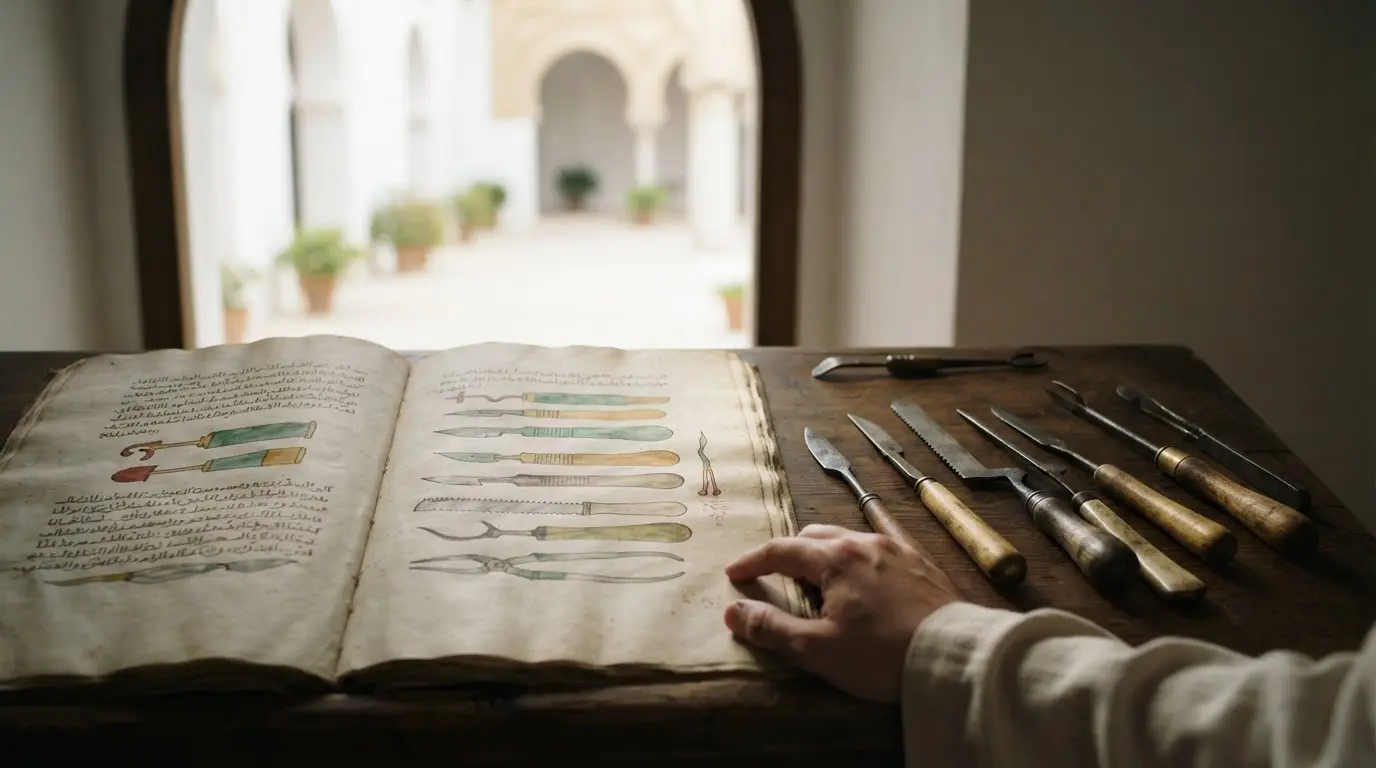
What made Book 30 different from every prior surgical text was the illustrations[5]. Al-Zahrawi drew his instruments — over 200 of them — in precise detail, with annotations explaining their use. The drawings were not decorative. They were training documents, meant to allow an apprentice to identify a tool, understand its function, and reproduce it if necessary. No physician before him had done this systematically.
The instrument list covers the full range of operative surgery as it existed in the 10th century:
Cautery irons for stopping bleeding and treating wounds
Obstetric forceps for difficult deliveries
Specula for examining internal cavities
Scalpels, retractors, and bone saws for general procedures
Dental tools for extractions and replantation
200+
Al-Zahrawi illustrated more than 200 surgical instruments in Al-Tasrif[5], making it the first illustrated surgical textbook in history. The drawings let apprentices identify and reproduce tools without a master present — a training method that was genuinely new.
He also documented the catgut ligature — using the dried intestine of animals to tie off blood vessels during surgery. Catgut sutures remained in clinical use into the 20th century. His spongia somnifera (the "soporific sponge") combined opium, mandrake, and other sedatives soaked into a sponge held under a patient's nose to induce unconsciousness before procedures[4] — an early form of inhalation anesthesia.
Al-Tasrif was not a theoretical text. Al-Zahrawi drew on direct clinical experience and was explicit about cases where he had seen other physicians cause harm through ignorance of anatomy. His frustration with inadequate surgical training runs through the book.
What Al-Zahrawi actually invented: the specific list
The phrase "father of operative surgery" gets used a lot[3]. What it actually means is worth unpacking, because the specific inventions are more interesting than the title.
Catgut ligature. Before Al-Zahrawi, surgeons typically cauterized blood vessels or applied pressure to stop bleeding during procedures. He described and systematized the use of twisted animal intestine to tie off vessels — a technique that allowed cleaner closures and reduced post-operative bleeding. Surgeons were still using catgut sutures in the 1990s.
The soporific sponge. Al-Zahrawi documented a mixture of opium, hyoscyamine, mandrake root, and other sedatives applied to a sponge and held under the patient's nose to induce unconsciousness[4]. The procedure had precedents in earlier Arabic medicine, but Al-Zahrawi's written description of dosage and method made it reproducible.
Dental replantation with wire. He described stabilizing loose teeth and reimplanting extracted ones using gold or silver wire to bind them to adjacent teeth[1]. The principle of splinting teeth with wire is still used in modern dental trauma practice.
Obstetric forceps. He described early forceps-like delivery instruments intended for use when a normal birth was not possible[5]. The instrument type he described, refined over subsequent centuries, eventually became the obstetric forceps that transformed childbirth survival rates in the 17th and 18th centuries.
Recommended tours
Tours are selected for quality, not commission. We earn a small fee if you book — at no extra cost to you.
Surgical cautery as a controlled technique. Rather than treating cauterization as a last resort, Al-Zahrawi devoted a dedicated chapter of Al-Tasrif to cautery as a primary surgical technique[8], setting out when to use it across a range of procedures rather than reserving it as an emergency measure.
He also performed procedures his predecessors considered too dangerous: surgeries on the spine, the removal of thyroid tumors, and tracheotomies. Several of the cases he documented in Al-Tasrif had no known prior written description.
How Al-Tasrif ran European medical schools for five centuries
Al-Zahrawi died in 1013 CE, probably in or near Córdoba, as the caliphate collapsed around him[1]. His work survived the collapse because manuscripts traveled faster than armies.
Gerard of Cremona translated Al-Tasrif into Latin in 1187 CE in Toledo[3]. The translation circulated through the major medical schools of Europe — Salerno, Montpellier, Bologna, Paris — and remained standard reading for surgical students for generations. At least 10 printed Latin editions were produced between 1497 and 1544, meaning it was still being commercially published 500 years after it was written.
Timeline
c. 936 CE
Al-Zahrawi born at Madinat al-Zahra
Born in the palace city Abd al-Rahman III founded 8 km northwest of Córdoba[1].
c. 961 CE
Appointed court physician to Al-Hakam II
Serves the caliph whose library medieval chronicles put at 400,000 volumes[9].
c. 1000 CE
Al-Tasrif completed
The 30-volume medical encyclopedia, including Book 30 on surgery, is finished[1].
1010 CE
Medina Azahara sacked
The palace city is destroyed during the Berber revolt. Al-Zahrawi outlives his birthplace by three years[4].
1013 CE
Al-Zahrawi dies
Dies near Córdoba as the caliphate fragments into taifa kingdoms[3].
1187 CE
Gerard of Cremona's Latin translation
Al-Tasrif translated in Toledo; begins its circulation through European medical schools[3].
1363 CE
Guy de Chauliac cites Al-Tasrif 200+ times
The most influential European surgical manual of the medieval period draws heavily on Al-Zahrawi[6].
1497–1544
Ten Latin printed editions
Al-Tasrif is commercially printed at least 10 times across Europe, 500 years after it was written.
The surgeon Guy de Chauliac wrote Chirurgia Magna ("Great Surgery") in 1363, which became the most influential European surgical text of the later medieval period. He cited Al-Tasrif more than 200 times[6]. The Italian surgeon Pietro Argallata (d. 1423) called Al-Zahrawi "the chief of all surgeons" in his Chirurgia, published posthumously from 1480.
The practical reach of this influence is hard to overstate. When a 15th-century European surgeon performed a procedure, there was a meaningful probability that the technique he used, the instrument he held, and the suture material he employed had all been described first in a book written by a man born in a palace city outside Córdoba. The Al-Hakam II library that housed those original manuscripts was already gone by then, burned and scattered during the fitna. The copies in Toledo and Bologna outlasted the original collection by centuries.
Why Al-Zahrawi is almost invisible in Córdoba today
Walk around Córdoba for a week and you will find statues of Seneca near the Puerta de Almodóvar, a large bronze of Averroes outside the old Jewish quarter, and Maimonides immortalized in stone in the plaza that carries his name. Al-Zahrawi gets a street name in a residential area and a small square near the old medical faculty. That is roughly it.
The disparity is partly about source survival. We know what Seneca and Lucan looked like from Roman busts; we have extensive biographical detail on Maimonides from his own letters and those of his contemporaries. Al-Zahrawi left almost nothing personal. Al-Tasrif has a brief autobiographical preface, and there are scattered mentions in later Arabic medical biographies, but no portrait, no correspondence, no confirmed burial site[1]. He is a set of surgical techniques attached to a name.
There is also the question of what gets commemorated and why. Córdoba's tourist infrastructure is built around the Mezquita, the Jewish quarter, and the Roman legacy. The Umayyad medical tradition sits slightly outside all three frames. Al-Zahrawi was neither a philosopher like Averroes nor a religious figure; he was a surgeon, and surgery has always occupied an awkward status in the history of medicine, below physicians in the social hierarchy even as it did more of the practical work. The same underrepresentation applies to the court scientist behind Córdoba's earliest glass and astronomical instruments, whose 9th-century inventions predate Al-Zahrawi's own surgical instruments by more than a century — another practical inventor overshadowed by the city's philosophers.
The result is that the physician who contributed more to the daily practice of European surgery than any other medieval figure is significantly underrepresented in the city where he worked. The convivencia period that made his career possible gets more attention than the specific outputs it produced.
This is not a complaint about Córdoba's priorities, exactly. The Mezquita deserves the crowds it gets. But if you want to understand what the caliphate's scholarship actually produced in practical terms, Al-Zahrawi's instruments are a more concrete answer than most of what the tourist circuit offers.
Medina Azahara is 8 km northwest of Córdoba's old city[4]. The Bus Diario a Medina Azahara, operated by Autocares Bravo, departs from the Glorieta de la Cruz Roja (Paseo de la Victoria) Tuesday to Sunday; the journey takes about 25 minutes. By car, take the A-431 toward Palma del Río and follow signs for Yacimiento Arqueológico Madinat al-Zahra. There is parking at the site.
Entrance is free for EU/EEA citizens, with a modest fee for other nationalities; young children enter free, and students receive a discounted rate rather than free entry. The museum at the foot of the site is closed Mondays, with an extended summer schedule. Hours change seasonally — check the Junta de Andalucía website for the current schedule before visiting, since the bus timetable is tied to opening times.
The archaeological zone covers the upper terrace (Abd al-Rahman III's reception halls), the middle terrace (administrative buildings), and the lower town, though only a fraction has been excavated. The famous Salon Rico (Rich Hall), with its marble paneling and horseshoe arches, is the most complete surviving space — the columns were imported from North Africa and the eastern Mediterranean[4]. It is genuinely impressive.
What the site does not tell you directly is that Al-Zahrawi was born here and worked here. There is a small display in the museum covering Umayyad science and learning, but it is brief and Al-Zahrawi's name does not appear prominently in the signage. You have to bring that context yourself.
One practical note: the site is exposed limestone and gets brutal between July and September. Go before 10:00 or after 17:00 if you visit in summer. Bring water — the cafe at the visitor center is basic. The walk from the museum to the Salon Rico is about 400 metres uphill on uneven terrain; wear shoes you would actually walk in.
The view from the upper terrace, looking back toward Córdoba across the Guadalquivir plain, is the same view Al-Zahrawi had from the palace he grew up in. The city in the distance is larger now, and the palace is rubble. But the distance, the heat, and the angle of light in the afternoon are unchanged.
Frequently asked questions
Who was Al-Zahrawi and why is he connected to Córdoba?
Al-Zahrawi (full name Abu al-Qasim Khalaf ibn Abbas Al-Zahrawi, known in Europe as Abulcasis) was born around 936 CE in Madinat al-Zahra, the palace city 8 km northwest of Córdoba. He served as court physician to Caliph Al-Hakam II and spent his career in the Córdoba caliphate, completing his 30-volume medical encyclopedia Al-Tasrif around 1000 CE before dying in 1013 CE.
What did Al-Zahrawi actually invent?
Al-Zahrawi documented and systematized numerous techniques and instruments that became standard in European surgery: the catgut ligature for tying off blood vessels (used into the 20th century), the soporific sponge for inducing unconsciousness before procedures, obstetric forceps for difficult deliveries, dental replantation using gold or silver wire, and cautery irons for wound treatment. He also illustrated over 200 surgical instruments in Al-Tasrif — the first illustrated surgical textbook in history.
What is Al-Tasrif and why was it important?
Al-Tasrif is Al-Zahrawi's 30-volume medical encyclopedia, completed around 1000 CE in Córdoba. Book 30, the surgical treatise, was the first illustrated surgical manual ever written — it included precise drawings of over 200 instruments, which allowed apprentices to identify and reproduce tools without needing a master present. Gerard of Cremona translated it into Latin in 1187; at least 10 printed Latin editions were produced between 1497 and 1544. Guy de Chauliac's Great Surgery (1363), the most influential European surgical text of the medieval period, cited Al-Tasrif more than 200 times.
Where can you visit Al-Zahrawi's birthplace near Córdoba?
Al-Zahrawi was born at Madinat al-Zahra, now the Medina Azahara archaeological site 8 km northwest of Córdoba. The Bus Diario a Medina Azahara, operated by Autocares Bravo, departs from Glorieta de la Cruz Roja (Paseo de la Victoria) Tuesday to Sunday (about 25 minutes). Entrance is free for EU/EEA citizens, with a modest fee for other nationalities. Opening hours vary seasonally; check the Junta de Andalucía website for the current schedule. The reconstructed Salon Rico is the most complete surviving space. Al-Zahrawi is not prominently featured in the site's signage, but the museum has a section on Umayyad science and learning.
Why is Al-Zahrawi called the father of operative surgery?
The title reflects the scope and originality of Al-Tasrif Book 30. Before Al-Zahrawi, surgical techniques were transmitted primarily through oral instruction and general medical texts that rarely described procedures in reproducible detail. Al-Zahrawi was the first to produce a systematic, illustrated surgical manual covering dozens of operations, with specific instrument descriptions that allowed the knowledge to travel without a practitioner present. Pietro Argallata (d. 1423) called him "the chief of all surgeons" — his Chirurgia was written before 1423 and published posthumously from 1480.
Was Al-Zahrawi alive when Medina Azahara was destroyed?
Yes. Al-Zahrawi was born around 936 CE at Madinat al-Zahra and died around 1013 CE. The palace city was sacked during the Berber revolt of 1010 CE, during the civil war that destroyed the Umayyad caliphate. Al-Zahrawi outlived the destruction of his birthplace by approximately three years, dying as the caliphate fragmented into competing taifa kingdoms.
How did Al-Zahrawi's work reach Europe?
Gerard of Cremona translated Al-Tasrif from Arabic into Latin in Toledo in 1187 CE. From there, it spread through the major European medical schools: Salerno, Montpellier, Bologna, and Paris all used it. It became standard reading for surgical students and remained influential through the 16th century — at least 10 printed Latin editions were produced between 1497 and 1544. Guy de Chauliac's Great Surgery (1363), the dominant European surgical text of the late medieval period, cited Al-Tasrif more than 200 times.
Is Al-Zahrawi commemorated anywhere in Córdoba?
Modestly. There is a street named after him in a residential area and a small square near the old medical faculty. Unlike Averroes, Maimonides, and Seneca — all of whom have prominent statues in the historic centre — Al-Zahrawi has no major monument in Córdoba. The Medina Azahara site, where he was born, does not feature him prominently in its signage.