Medina Azahara: The Palace-City Buried for a Thousand Years
Built by Abd al-Rahman III in 936 CE, sacked in 1010, and buried for nine centuries, Medina Azahara is now roughly 9% excavated and UNESCO listed since 2018.
Art history background with eight years writing interpretive content on Córdoba's Caliphal heritage.
Updated Published
history-buffsarchitecture
In 936 CE, the most powerful ruler in the western Islamic world decided to build a new capital from scratch on a hillside 8 km west of Córdoba, and to do it fast. Medina Azahara took nearly four decades, housed perhaps 25,000 people at its peak, and was destroyed so completely within a century that it became a legend — a lost city whispered about in medieval texts but invisible on the ground. The story of its history, discovery, and excavation is one of the stranger episodes in Spanish archaeology: a place that was enormous, that everyone knew had existed, and that no one went looking for until 1911.
In this article
Jump to a section
⌄
Why Abd al-Rahman III built a new city
Abd al-Rahman III had declared himself Caliph in 929 CE, the first ruler in al-Andalus to claim that title. It was a political statement aimed at Baghdad and at the Fatimid Caliphs rising in North Africa. A Caliph needed a court worthy of the title, and the existing Umayyad palace complex inside Córdoba, expanded incrementally since Abd al-Rahman I founded the emirate in 756 CE, was not it.
The decision to build outside the city rather than expand within it was also practical. Córdoba in the mid-10th century had perhaps 100,000 inhabitants[4]; some estimates go higher. Clearing enough space for a palace complex of the scale Abd al-Rahman envisioned would have required demolishing large sections of the existing fabric. The western hillside had none of those constraints. It had slopes for terracing, a reliable water supply from the Sierra de Córdoba, views north and south, and nothing on it that needed moving.
112 hectares
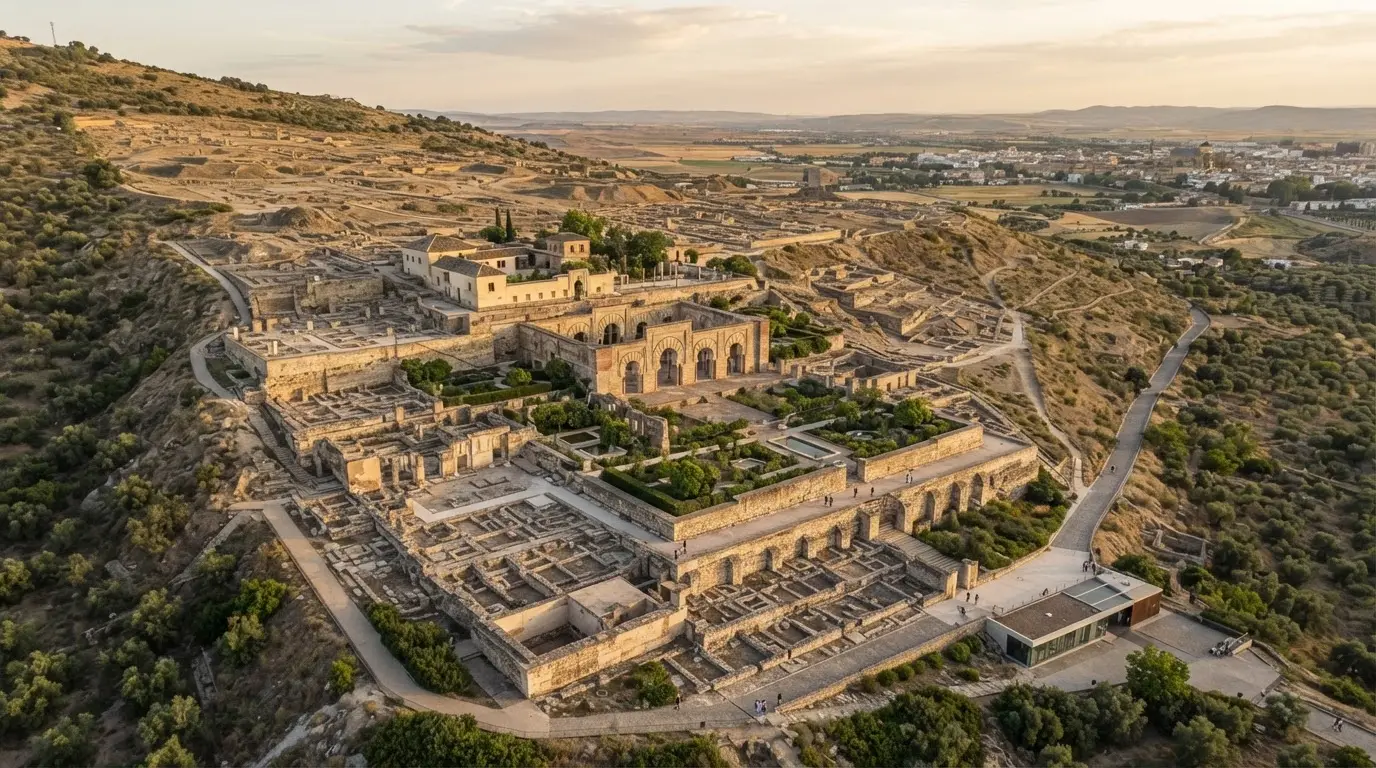
The total footprint of Medina Azahara at its peak: 1.5 km long, 0.75 km wide, spread across three terraces on the Sierra de Córdoba hillside. Of those 112 hectares, roughly 10 have been excavated since 1911. That is about 9%.
Commissioned around 936–940 CE, Medina Azahara was designed as a functioning city, not merely a palace. Its programme included:
government offices
barracks
workshops
a grand mosque
markets and formal gardens
housing for workers and administrators
By 945 CE, Abd al-Rahman III had moved in; by 947 CE, he had transferred the mint and the state apparatus, the full machinery of the Caliphate, from Córdoba to the new city.[1] Córdoba remained the metropolis. Medina Azahara was its political brain.
Building Medina Azahara: four decades on a hillside
The scale of the construction was deliberate and visible from Córdoba. Over 10,000 workers[5], supervised by the master builder Maslama ben Abdallah, reshaped a hillside into three ascending terraces. The uppermost held the royal apartments and the reception halls; the middle terrace held the administrative quarters and the mosque; the lowest terrace held the markets, workshops, and housing for the urban population.
Materials came from across the Mediterranean. Córdoban marble provided much of the base stone. North African limestone and Byzantine carved capitals were imported and integrated into structures that drew on Roman engineering, Byzantine ornament, and Eastern Islamic spatial logic simultaneously. The building programme required solving non-trivial logistical problems: stone had to be transported up the slope, a water supply system had to be engineered from the Sierra, and the three terraces had to be levelled and retained with walls massive enough to last.[2]
Construction continued under Al-Hakam II (961–976 CE), Abd al-Rahman III's son and successor, who added to the mosque and embellished the reception halls. The city was not considered finished until around 976 CE, approximately forty years after the first stones were laid. After al-Hakam II's death that year, Medina Azahara remained the seat of caliphal ceremony under the regency of Subh of Córdoba, the Basque concubine who governed in the name of her young son Hisham II until Almanzor displaced her from power in the late 990s. A generation of workers spent their entire working lives on this site. It was also during Al-Hakam II's reign that Al-Zahrawi (Abulcasis) worked here as court physician, writing the surgical encyclopedia that would shape European medicine for centuries. At the same court, Lubna of Córdoba — an enslaved mathematician who became al-Hakam II's chief secretary — worked on Al-Hakam II's caliphal library catalogue, reportedly numbering over 600,000 volumes[8], and produced Arabic translations of Archimedes and Euclid.
Timeline
929 CE
Abd al-Rahman III declares Caliphate
Breaking from the emirate title, Abd al-Rahman III proclaims himself Caliph, a direct challenge to the Abbasids in Baghdad and the rising Fatimids in North Africa.
936–940 CE
Construction begins
Over 10,000 workers begin reshaping the hillside 8 km west of Córdoba under master builder Maslama ben Abdallah. Materials sourced from across the Mediterranean.
945 CE
Abd al-Rahman III moves in
The Caliph takes up residence. The city functions as political headquarters of the Caliphate alongside Córdoba.
947 CE
State apparatus transferred
The mint and government machinery relocate to Medina Azahara. Córdoba remains the city; Medina Azahara is the court.
961–976 CE
Al-Hakam II continues construction
Abd al-Rahman III's successor expands the mosque and embellishes reception halls. The Salón Rico reaches its final form.
1009–1010 CE
Sacked and destroyed
Berber mercenaries systematically demolish the city during the Fitna civil war. Within weeks, forty years of construction lies in ruins.
1911 CE
Excavations begin
Spanish architect Ricardo Velázquez Bosco initiates the first systematic excavations. The Salón Rico is gradually revealed over decades of fieldwork.
2018 CE
UNESCO inscription
Medina Azahara inscribed as 'Caliphate City of Medina Azahara' on 1 July 2018, the culmination of a century of excavation and interpretation.
The pace of completion also tells you something about the Caliphate's resources. No European kingdom of the same period could have sustained a construction project of this scale for four decades. 10th-century Córdoba was one of the largest cities in Europe, rivaled only by Constantinople, and Medina Azahara was the physical proof of that scale.
The Salón Rico: what caliphal power looked like
The Salón Rico was the reception chamber where the Caliph received ambassadors, delegations, and petitioners. It was the room in which caliphal authority was performed, and everything about it was designed for that function.
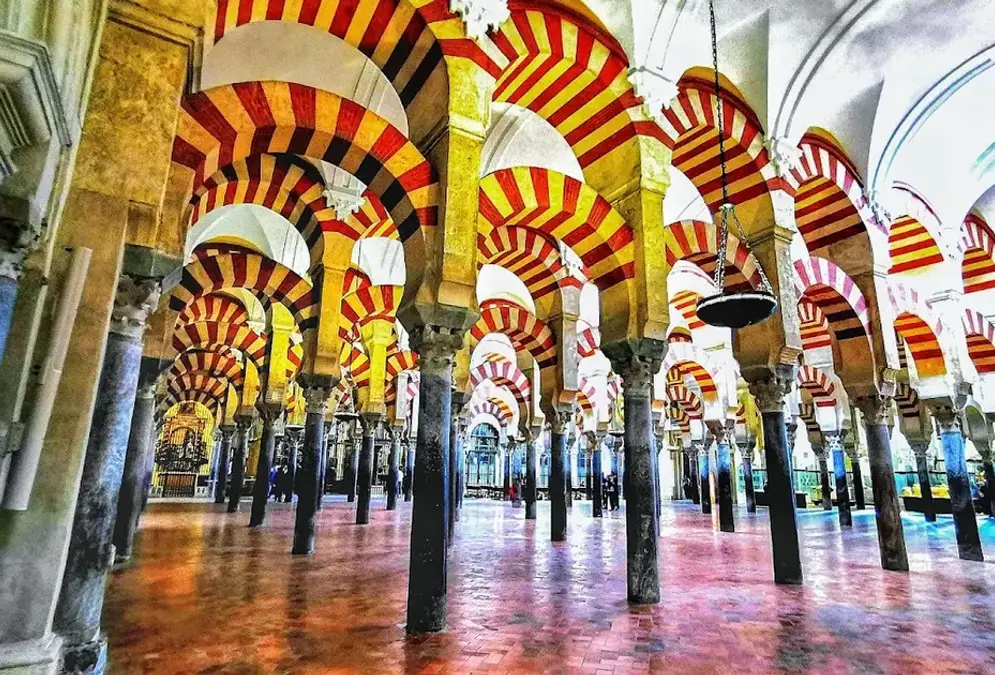
The hall's arches are polychrome: alternating bands of pink marble and white stone create a visual rhythm that is difficult to look away from. The columns, most salvaged from earlier Roman and Byzantine structures and shipped to the site, carry capitals carved with a density of foliated ornament that stonecutters must have worked on for months each. The walls between the arches were carved in shallow relief with geometric and floral panels; light from the north-facing windows would have moved across them through the day, changing what you saw depending on where you stood and when you arrived. The horseshoe form itself was already becoming Córdoba's architectural signature — see the horseshoe arch story for how the shape spread from the Great Mosque to palaces like this one.
Contemporary sources describe water features in the hall: channels running through the floor, a mercury pool positioned to catch and throw light across the carved surfaces when the sun hit it at the right angle. Whether the mercury detail is literal or a later elaboration is debated. What is clear from the excavated structure is that the hydraulic engineering was deliberate and sophisticated — the water supply system for the entire city ran under the palace terraces, with specific channels fed into the reception areas.[3] The Medina Azahara night visits — running Friday and Saturday evenings from October through May — are the best opportunity to see how the palace's water and light systems were designed to work together after dark.
Above the entrance, a dedicatory inscription in Arabic Kufic script recorded Abd al-Rahman III's name and the construction date. This place was made by a specific man, at a specific moment of political ascendancy, and the inscription made sure no visitor missed that. Not every reception-hall plan survived intact, either: the judge Mundhir al-Ballūṭī reportedly talked Abd al-Rahman III out of gilding one of the hall's ceilings in gold and silver, calling the expense a temptation the Caliph shouldn't indulge.
Recommended tours
Tours are selected for quality, not commission. We earn a small fee if you book — at no extra cost to you.
Al-Mansur (Almanzor), the military strongman who had effectively seized power from the last Umayyad caliphs, died in 1002 CE. His death unravelled the order that had kept the Caliphate functioning despite its weakened legitimate rulers. What followed was the Fitna: a series of coups, counter-coups, and factional conflicts that ran through the first decade of the 11th century.
Berber mercenaries who had been the military backbone of Al-Mansur's campaigns found themselves without reliable pay and without a clear employer. In 1009–1010 CE, they sacked Medina Azahara. Contemporary accounts describe systematic destruction rather than opportunistic looting: marble columns pulled down, vaults deliberately broken, the aqueducts that fed the hydraulic system dismantled, fires set in the wooden roofing structures. The archaeological excavation revealed a violent destruction layer dateable to the early 11th century, a single catastrophic event rather than a long decline.[1]
The stone then became a quarry. Marble columns and carved capitals from Medina Azahara appear in buildings across Andalusia for centuries afterward. Some were reused in churches across the Córdoba region; others traveled further, into buildings across Andalusia and beyond. The carving style was distinctive, identifiable, but the material traveled far from the hillside it had come from. By 1031 CE, the Umayyad Caliphate had dissolved into approximately twenty-five taifas. There was no institution left with any interest in preserving the ruins.
For the next nine centuries, the site was agricultural land. The Mezquita-Catedral survived because it was consecrated as a church. Medina Azahara had no such protector.
How was Medina Azahara rediscovered?
The medieval Arabic chronicles never forgot it. Al-Maqqari, writing in the 17th century, compiled earlier sources describing the palace's opulence in terms that were clearly second- and third-hand but detailed enough to suggest genuine historical memory. European scholars aware of those texts knew approximately where to look. What they lacked was funding, political will, and an institutional framework to act.
Ricardo Velázquez Bosco, a Spanish architect who had worked on the restoration of the Mezquita, began systematic excavations at the site in 1911 CE.[7] His teams exposed the Salón Rico and the basic layout of the upper palace terrace over the following years. The finds were substantial and unexpected: not scattered traces but intact architectural sequences, carved stone in situ, the outline of entire rooms. The site was clearly far larger than the visible surface suggested.[1]
Excavation has continued with interruptions ever since. The Spanish Civil War and the Franco period slowed work; systematic large-scale excavation resumed in earnest in the 1980s. Each campaign raises new questions faster than it answers them. As of 2026, approximately 10 hectares have been excavated out of 112, just under 9%.[1] Entire terrace levels remain unexcavated. The street grid of the lower city is known only in outline. The mosque, which medieval sources describe in detail, has been partially exposed but not fully understood.
The Museo Arqueológico de Medina Azahara, designed by architects Fuensanta Nieto and Enrique Sobejano[6] and opened in 2009[1], was built partly underground to minimise its visual impact on the landscape. The museum itself, not the archaeological site, won the Aga Khan Award for Architecture in the 2008–2010 cycle (ceremony held 2010)[6] and the European Museum of the Year Award in 2012, an unusual double for a site museum. UNESCO inscribed Medina Azahara as the "Caliphate City of Medina Azahara" on 1 July 2018.[1]
The UNESCO recognition changed the site's visibility more than its archaeology. The physical discovery happened in 1911 and is still ongoing.[1] What 2018 added was the international institutional framework that makes the long-term excavation sustainable.[1]
Frequently asked questions
What engineering challenge did building Medina Azahara's terraces pose?
Master builder Maslama ben Abdallah supervised the reshaping of a hillside into three ascending terraces, each requiring retaining walls massive enough to hold once levelled. Stone had to be hauled up the slope, and a water supply system had to be engineered from the Sierra de Córdoba to reach reception halls, mosque, and housing alike. Materials came from across the Mediterranean: Córdoban marble formed the base stone, while North African limestone and reused Byzantine capitals were integrated into structures blending Roman engineering, Byzantine ornament, and Eastern Islamic spatial logic simultaneously.
What makes Medina Azahara's site museum an unusual double award-winner?
Designed by architects Fuensanta Nieto and Enrique Sobejano and opened in 2009, the museum was built partly underground specifically to minimise its visual impact on the landscape. That design won the Aga Khan Award for Architecture in the 2008–2010 cycle and the European Museum of the Year Award in 2012 — an unusual double for a site museum.
What happened to Medina Azahara's marble and carved capitals after it was sacked?
Contemporary accounts describe systematic destruction during the 1009–1010 sack, with marble columns pulled down and vaults deliberately broken. The stone then became a quarry for decades afterward: marble columns and carved capitals from Medina Azahara have been traced to churches across the Córdoba region and to buildings as far away as Morocco, identifiable by their distinctive 10th-century Córdoban carving style. Some of that dispersal is still being mapped.
Why was Medina Azahara forgotten for nine centuries before its rediscovery?
Medieval Arabic chronicles, compiled by writers like Al-Maqqari in the 17th century, never forgot the palace existed, but by 1031 CE the Umayyad Caliphate had dissolved into roughly twenty-five taifas and no institution had any interest in preserving the ruins. The site became agricultural land until the Spanish architect Ricardo Velázquez Bosco began systematic excavations in 1911, finally exposing the Salón Rico and the outline of the upper palace terrace.
What did UNESCO inscription in 2018 actually change?
The inscription as 'Caliphate City of Medina Azahara' formalised Spain's commitment to long-term conservation and ongoing excavation. It also increased international awareness and visitor numbers significantly. What it did not change: the pace of archaeological excavation, which is determined by funding and personnel rather than UNESCO status. The inscription is an institutional endorsement, not an archaeological accelerant.