
Born into the palace: slavery at Medina Azahara
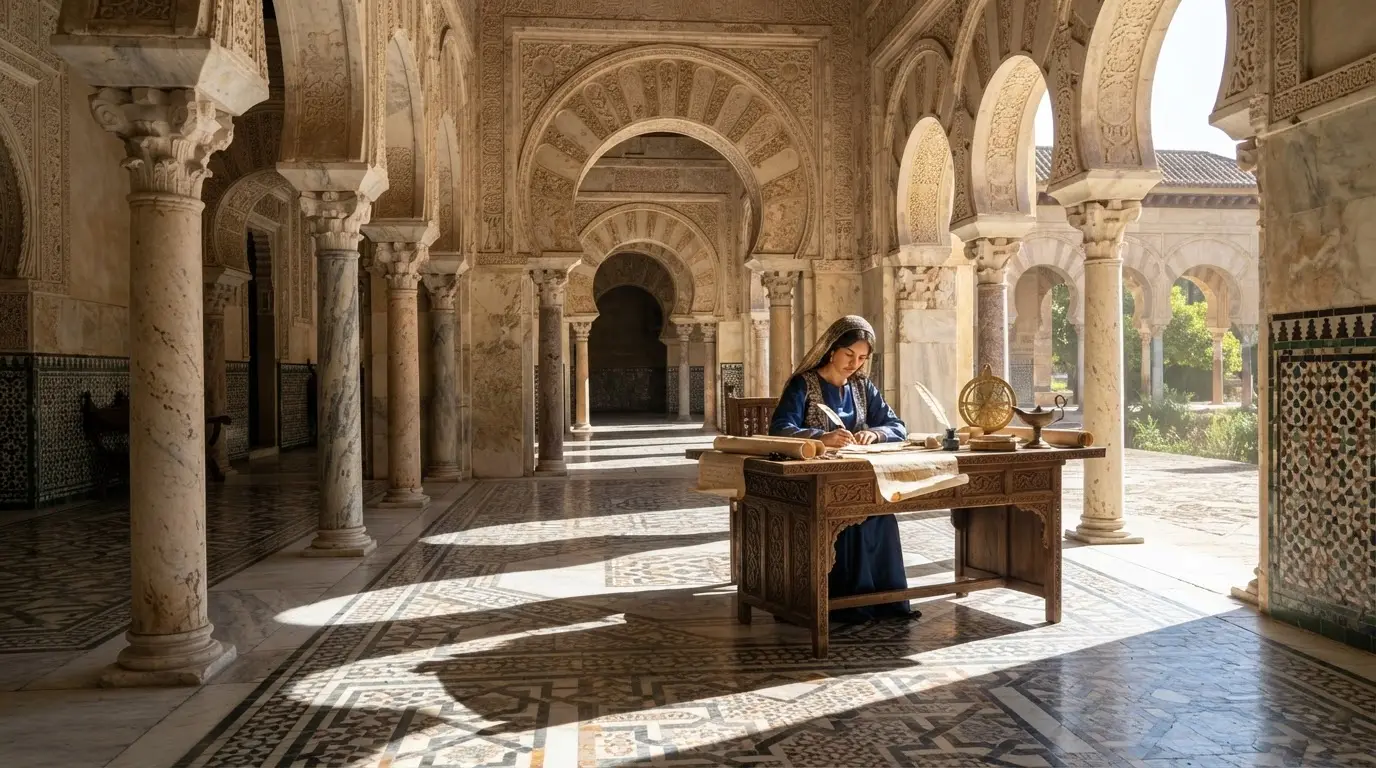
She was probably born somewhere between 929 and 950 CE, inside Madinat al-Zahra, the vast palace-city Abd al-Rahman III had built 8 km west of Córdoba on the lower slopes of the Sierra Morena.[1] Most medieval sources call her Lubna al-Katib (Lubna the Scribe) or Lubna al-Qurtubiyya (Lubna of Córdoba). That second name tells you something: she was associated enough with the city itself that her biography stuck to it.
Her legal status on birth was enslaved. This is not a euphemism or a modern interpretive frame — the Arabic sources are explicit. One scholarly hypothesis, put forward by José Miguel Puerta Vílchez of the University of Granada, proposes she may have been a daughter of Abd al-Rahman III by an enslaved concubine, which would make her origin both royal and legally unfree simultaneously.[1] The sources record only two daughters of Abd al-Rahman III by name, and Lubna is not among them. The hypothesis is unconfirmed. What is confirmed is that she grew up inside the palace compound, which meant something specific in 10th-century Córdoba.
The Medina Azahara household ran on a formalised system of enslaved labour that was not, by the standards of medieval Europe, uniform in its conditions. Palace-raised enslaved people of evident talent received instruction — in languages, in letters, in the disciplines useful to a court that administered a caliphate. This was not generosity. It was rational investment. A household secretary who could read Greek, write Arabic, and compose diplomatic correspondence was worth more than one who could not. Lubna's abilities placed her at the far end of that spectrum, but the mechanism that produced those abilities was institutional, not exceptional.
Explore nearby · Monument
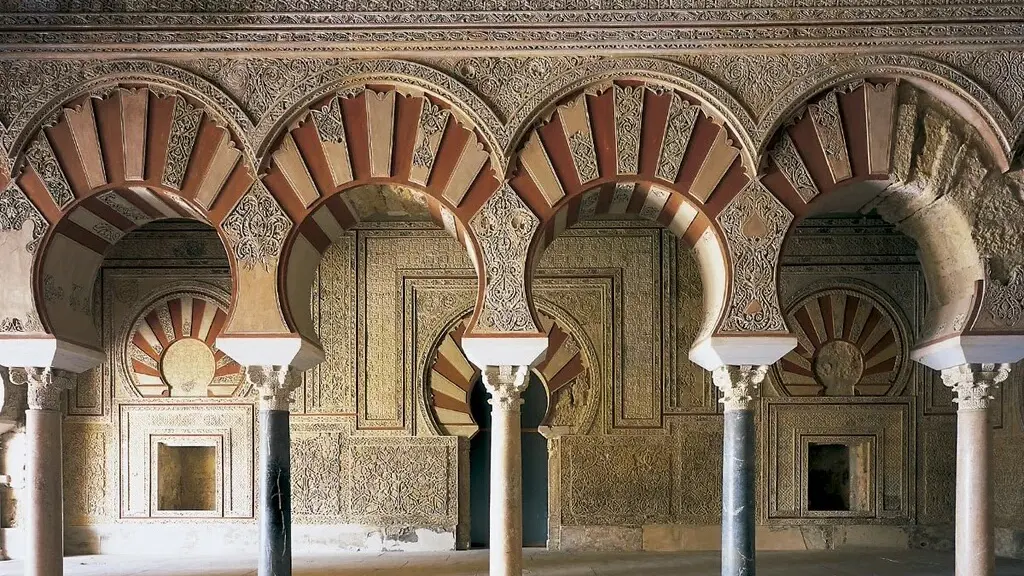
Medina Azahara
Medina Azahara is Córdoba's UNESCO listed Caliphate City: a 10th century palace 8 km from town, with the Salón Rico and award-winning museum. Plan your visit.
What she knew: grammar, mathematics, and four languages
The primary medieval source for Lubna's life is Ibn Bashkuwal, a Córdoban biographer who died in 1183 CE — roughly two centuries after her. His Kitab al-Sila fi Tarikh Aymmat al-Andalus (Book of Connection in the History of the Leaders of al-Andalus) describes her in terms rarely used for any person of her era, enslaved or free, male or female.[2]
His summary: she was a wise writer, grammarian, poetess, adept in arithmetic, whose talents were equal to the solution of the most complicated geometric and algebraic problems known in her time.[2] That last phrase is worth sitting with. He is not saying she was educated for a woman. He is saying she was exceptional by the standard of her age, full stop.
4 languages
Breaking down the skills Ibn Bashkuwal lists:
- Grammar and rhetoric: the foundation of any scribal career in the Arabic tradition; a secretary who composed clumsy sentences could not draft royal correspondence
- Poetry: not decoration — in 10th-century courtly culture, the ability to compose verse was intellectual currency, a sign of genuine command over the language
- Arithmetic, geometry, and algebra: the applied mathematical sciences; her work on manuscripts by Archimedes and Euclid required more than copying ability — it required comprehension
- Languages: Arabic (primary), Latin, Greek, and Hebrew[3]
That last list is where her position becomes structurally unusual. Medieval Córdoba was genuinely multilingual — the court employed Arab Muslims, Mozarab Christians who wrote in Arabic, and Jewish scholars who moved between Hebrew, Arabic, and Latin. But the combination of all four in a single person was rare enough to be operationally significant. It placed Lubna at the centre of the translation project that al-Hakam II ran from the palace: someone who could assess a Greek original against its Arabic translation, or verify a Latin medical text against its Arabised version, without requiring an intermediary. The scholars, translators, and physicians she worked alongside are covered in our guide to Córdoba's Islamic Golden Age.
Secretary to the caliph: running a library of 600,000 books
Al-Hakam II came to power in 961 CE as the most bibliophilic ruler the western medieval world had produced.[4] He dispatched agents to Damascus, Baghdad, Constantinople, Cairo, Mecca, Medina, Kufa, and Basra with standing orders to acquire manuscripts before they reached general circulation. The library they built at Medina Azahara grew to a scale medieval chroniclers struggled to express credibly: the catalogue alone ran to 44 volumes.[4] The collection is usually cited at 600,000 manuscripts[4]; other sources put the figure closer to 400,000.[1] Both numbers involve rhetorical amplification alongside real scale — the actual collection was certainly immense, certainly the largest in the western world.
Lubna's title within this enterprise was katiba (secretary), a role she continued to hold after her emancipation.[1] The distinction matters. A copyist transcribes. A secretary drafts, classifies, assesses, and corresponds. She was not a production worker in the manuscript workshop — she was managing the intellectual infrastructure of the whole operation.
In practice, her documented responsibilities included:
- Transcribing and annotating manuscripts for the royal collection
- Classifying acquisitions within the catalogue
- Writing official royal correspondence and diplomatic letters for al-Hakam II
- Collaborating with Hasdai ibn Shaprut, the Jewish physician and diplomat at the caliphal court, on acquisition strategies and manuscript provenance
- Working on Arabic translations of Archimedes and Euclid, which required mathematical fluency, not just linguistic skill[3]
Hasdai ibn Shaprut is worth noting here. He ran diplomatic channels between Córdoba and Byzantine Constantinople, and used his access to identify texts unavailable through commercial routes. His partnership with Lubna — a freed enslaved woman and a Jewish physician operating together at the heart of the most powerful court in the western world — captures the specific character of al-Hakam II's library better than any general description of Córdoba's tolerance can.
Recommended tours
Tours are selected for quality, not commission. We earn a small fee if you book — at no extra cost to you.
The acquisition network also fed a translation committee: joint teams of Muwallad Muslims (Iberian converts) and Mozarab Catholics worked together to render Latin and Greek texts into Arabic. The surgeon known as Abulcasis, the court physician who was inventing surgical procedures in the same complex during the same decades, drew on exactly these Greek medical sources. Lubna's multilingual abilities put her at the intersection of every part of this system.
Emancipation and what it meant: the mawla in Umayyad society
Al-Hakam II freed Lubna, along with at least 99 other members of his household, as part of a documented practice of emancipation.[1] In Islamic law, the freed person (mawla) retained a bond of loyalty to the person who had freed them, and often rose to positions of considerable trust. Being freed by the caliph personally was a specific form of social elevation.
Her role after emancipation stayed within the palace, but her standing changed. As the caliph's secretary she was drafting official letters and diplomatic communications — the documents through which the caliphate conducted foreign relations. In a court where written communication carried the full weight of state authority, the person who drafted those communications was not a functionary. She was choosing words that would travel to Baghdad and Constantinople bearing the caliph's name.
Some sources report that she also tutored children informally in mathematics near the library — accounts describe children following her through the streets as she recited multiplication tables aloud, an itinerant form of teaching rather than a formal institution.[3] The primary sourcing for this detail is thinner than for her palace role; it does not appear in Ibn Bashkuwal directly, but informal instruction of this kind by palace-attached scholars was documented elsewhere in the Umayyad court system.
The modern question about whether Lubna was truly empowered or merely a more privileged form of constrained is worth addressing directly. Her emancipation was real and its social consequences were real. She was not simply a slave who did exceptional work. But the system that produced her career was not designed to liberate people like her — it was designed to extract talent from people like her, and she navigated it with extraordinary results. Subh of Córdoba, the concubine who would become regent a decade after Lubna's career peaked, represents a parallel trajectory in political power. What both women shared was the specific capacity of the Umayyad court to absorb and elevate talent from people it had acquired as property.
But the system that produced her career was not designed to liberate people like her — it was designed to extract talent from people like her, and she navigated it with extraordinary results.
Lubna died around 984 CE, placing her entire career within the caliphate's peak decades.[1] The primary basis for that date in accessible secondary sources is not fully traced to a medieval primary text — it is worth knowing that the precision is borrowed, not confirmed.
One among 170: female scribes in 10th-century Córdoba
Lubna was exceptional, but she was not alone.
Al-Maqqari, the 17th-century Andalusian historian who compiled extensive earlier sources in his Nafh al-Tib, records that more than 170 women worked in the eastern suburbs of Córdoba as copyists of the Quran and other manuscripts.[5] These were not palace workers. They were professional scribes employed by the manuscript trade — a working women's quarter with collective craft standards, supplying the enormous demand for texts that a city of Córdoba's literacy generated. That trade ran on a material input of its own, papermaking in al-Andalus: imported rag paper, since no mill existed yet anywhere on the peninsula to make it locally.
That figure of 170 reflects something structural about Córdoba's economy and education — in a city where Paris at the same moment was a fraction of Córdoba's size and most western European cities had no manuscript trade of comparable scale at all. Demand for manuscripts was outpacing the supply of male copyists. Pragmatism, not ideology, opened the profession to women.
Lubna stood apart from this group in specific ways. She was not a neighbourhood copyist. She worked inside the palace, under the direct authority of the caliph, on the most sensitive documents the caliphate produced. Her mathematical and philosophical literacy went well beyond what the manuscript trade required. Averroes, writing two centuries later, would describe Córdoba's intellectual culture as one in which the boundaries between disciplines (medicine, philosophy, mathematics, law) were permeable in ways that generated the period's most original thought. Lubna operated across all of those boundaries.
Other female scholars of al-Andalus are documented from later periods: poets, physicians, and at least one female legal scholar are on record. But the 10th century leaves thin sources, and the sources it does leave are mostly biographical dictionaries written by men whose default assumption was that notable women were exceptional rather than representative. Lubna appears in those dictionaries not as a curiosity but as a competent professional evaluated on technical grounds.
What the sources say — and what they don't
The honest summary: we know Lubna existed, we know broadly what she did, we know how her contemporaries and near-contemporaries assessed her. We do not have a single word she wrote.
Ibn Bashkuwal, the principal source, was born in 1101 — roughly 120 years after Lubna's likely death around 984 CE.[2] He compiled biographies from earlier sources now largely lost. His account of Lubna is brief but specific: it names her skills, her institutional role, and her intellectual reputation with enough precision to suggest he was working from documented earlier material rather than transmitting folklore. Medieval biographical dictionaries of this type were more like professional registers than hagiographies — they had formal criteria and excluded people who did not meet them.
The name variants in the sources (Labna, Libana, Labona, Lubna al-Katib, Lubna al-Qurtubiyya) have fed a scholarly debate about whether the sources are actually describing one person or two.
Modern scholar Kamila Shamsie has proposed that Lubna may represent two distinct women whose records were merged by a chronicler unable to credit multiple female intellectuals simultaneously.[1] The hypothesis is not universally accepted, and the evidence for it is circumstantial. It is worth knowing because it illustrates the methodological problem: we are reading medieval men writing about medieval women through the assumptions of their own time, and those assumptions bent toward compression and toward treating educated women as singular exceptions.
Deep dive · Article
Game of Thrones' Dorne: Córdoba's Real Architecture
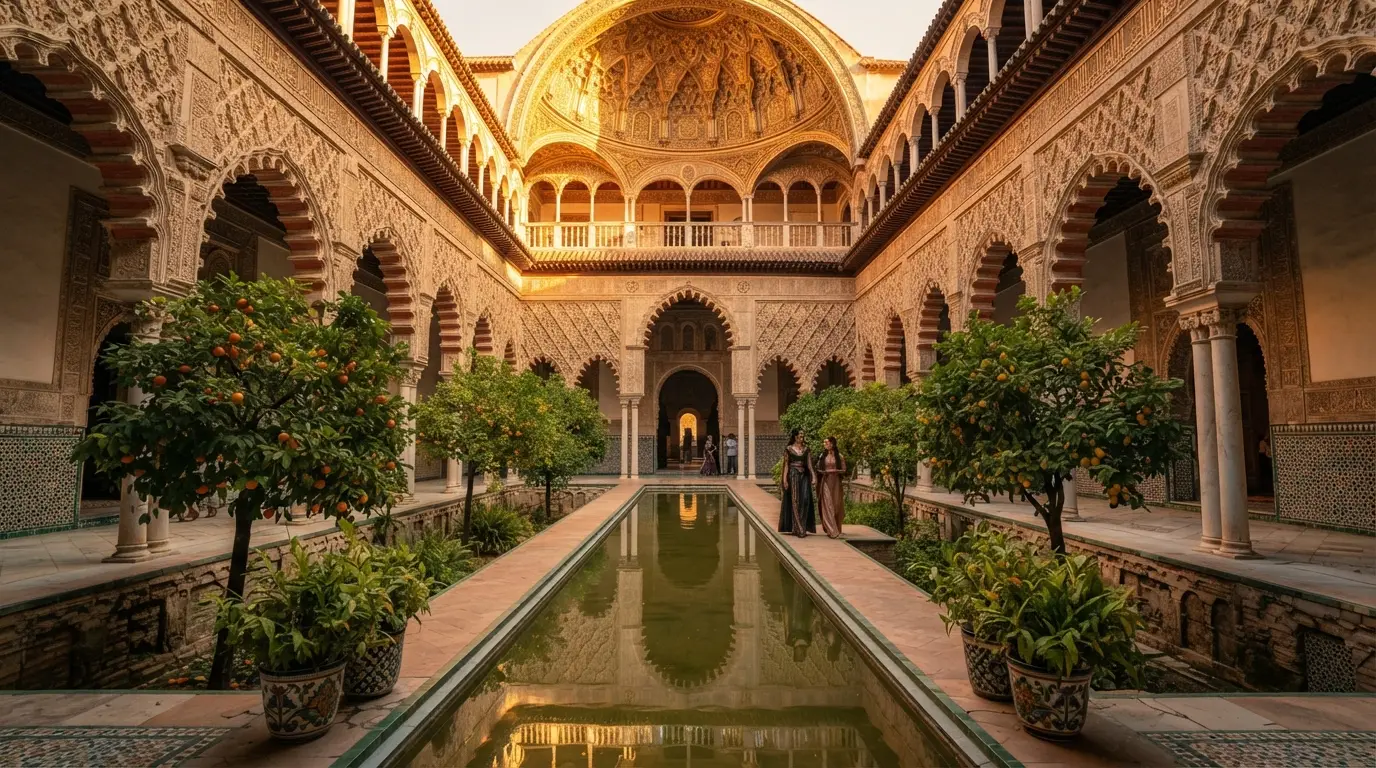
HBO's Game of Thrones built Dorne's look from medieval Córdoba's Umayyad architecture: horseshoe arches, muqarnas domes, though filming happened in Seville.
What the sources cannot give us is her inner life, her own reasoning, her account of what it felt like to work at the centre of the largest book collection in the western world. The condition of most women's history from this period is exactly this: the facts of a public career, documented by external observers; the person who inhabited it, absent.
Her library did not survive her long. Almanzor, the regent who seized control after al-Hakam II's death in 976, burned the philosophy and science sections to appease conservative religious opinion. The civil war of the early 11th century finished the rest. What Lubna helped build was dispersed within a generation of her death. That is a different story — told in detail elsewhere — but it is worth knowing as the ending.