Art history background with eight years writing interpretive content on Córdoba's Caliphal heritage.
Updated Published
history-buffscouplesarchitecture
Subh of Córdoba — born Aurora in the Basque country, renamed dawn in Arabic — ran the most powerful caliphate in western Europe for years without a throne or an army, only a dead caliph's seal and the loyalty of one man she should never have trusted.[1] This is not a story about Almanzor. He comes later. He is the thing she built, and the thing she could not unmake.
In this article
Jump to a section
⌄
A Basque girl sold into the palace of light
Her Arabic name meant dawn.[1] She was born around 940 CE, a girl from the Basque Country or Navarre, and was later taken as a young girl into the slave trade that fed the Umayyad court with concubines, musicians, and domestic workers from the Christian north.[4]
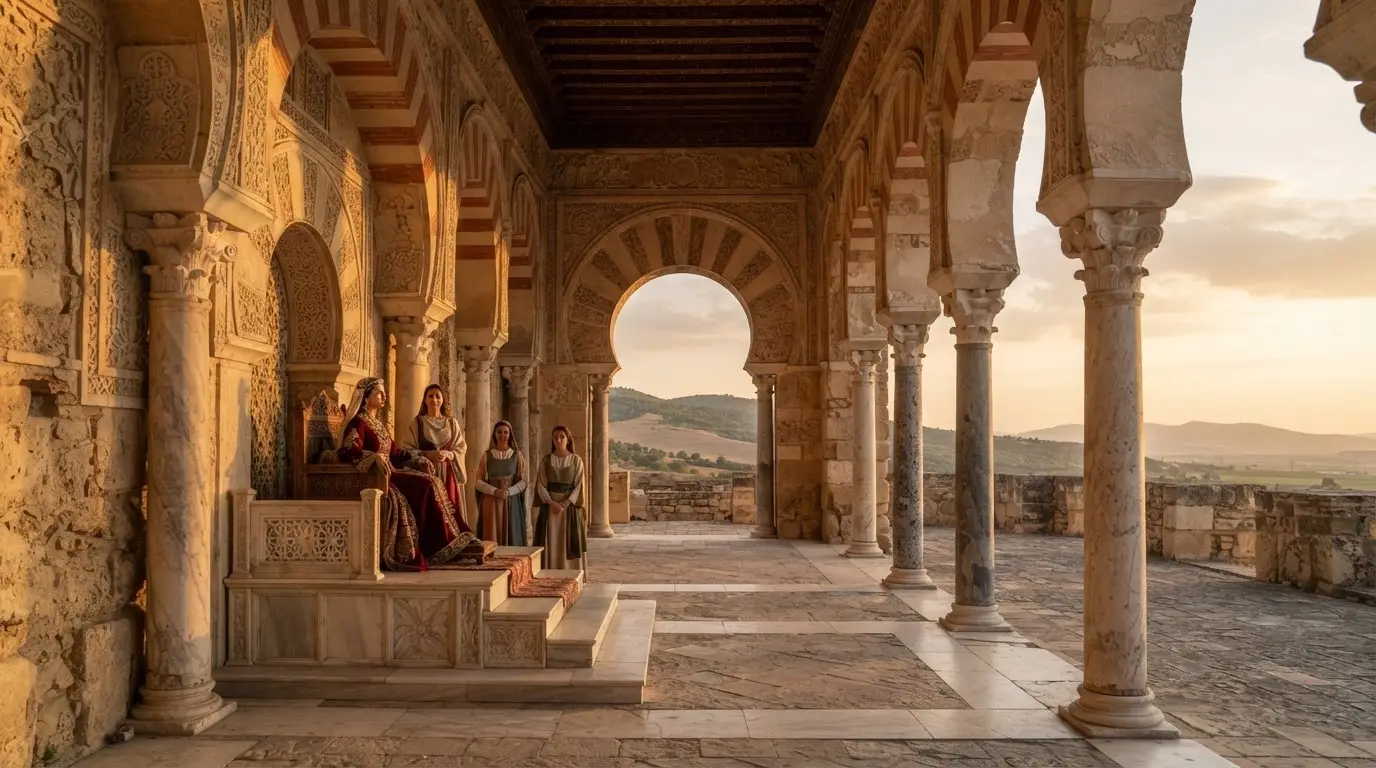
The court she entered was Medina Azahara, the palace-city Abd al-Rahman III had built 8 km west of Córdoba on the lower slopes of the Sierra Morena, with its white marble terraces, its imported peacocks, and its throne hall designed to dazzle foreign ambassadors into immediate submission. She would spend much of her life there.[6]
Her trajectory from slave to umm walad followed a path the Umayyad court had formalised over generations. A concubine who bore the caliph's son acquired a legally protected status: she could not be sold, she became entitled to maintenance, and upon the caliph's death she gained her freedom automatically.[1] The institution was pragmatic rather than romantic, but its consequences were real.
Subh bore al-Hakam II two sons: Abd al-Rahman, born in 962, who died around 970 at roughly eight years old,[1] and Hisham, born in 966 CE,[2] who would become the last effective Umayyad caliph. With Hisham's birth, Subh moved from concubine to the most politically significant woman in the caliphate. Al-Hakam was in his fifties, had no other surviving sons, and was reportedly infatuated with her.[1] She had secured her son's succession, and with it, her own future.
Favourite of al-Hakam II: power dressed as beauty
Al-Hakam II's reign (961-976) was the intellectual apex of the Córdoba Caliphate.[6] He assembled what was probably the largest library in the western world — reportedly as many as 400,000 manuscripts, a figure widely repeated but never substantiated by contemporary sources[7] — employed agents across Baghdad, Constantinople, and Cairo to acquire texts, and ran a court where poets and physicians had as much access as generals. His chief secretary and librarian during this same period was Lubna of Córdoba, an enslaved woman who managed the palace library's catalogue and drafted royal correspondence — a parallel example of the court's capacity to elevate talent from the most constrained social positions. Subh moved through this court not as a passive ornament but as a woman who had educated herself within it.
Contemporary sources note her command of Arabic literature, music, and poetry, attainments that mattered in a court where intellectual performance was expected.[1] She was not merely beautiful; she was someone al-Hakam could talk to. Ibn Hayyan and later chroniclers record that she dressed in male court attire at the caliph's request and adopted a male nickname, Jafar, a detail that has attracted various interpretations. The least interesting reading is that it was a quirk. The more plausible one is that a ruler who found women excluded from certain court spaces was solving a practical problem.[4]
What this period built was access and trust. Subh managed her own household finances with caliphal approval. She received petitioners. She participated in decisions that would ordinarily have passed through the hajib's office. When al-Hakam II needed an administrator for her personal accounts and those of the young heir apparent, he approved a man she trusted: a quick-scripted notary and minor court functionary named Muhammad ibn Abi Amir, later known as Almanzor.[1]
She appointed him her secretary around 966 CE.[1] She had read him correctly as ambitious, capable, and loyal to her interests. The mistake was not in the reading. The mistake was in not accounting for what ten years of proximity to the caliphate's money and machinery would produce in a man with no dynasty to stop him.
966 CE
The year Subh appointed Ibn Abi Amir as her secretary, roughly a decade before he became the most powerful man in al-Andalus.[1] He spent those ten years managing her finances, then her son's finances, then the state's.
Regent of the caliphate: the years she actually ruled
Al-Hakam II died in October 976. His son Hisham was ten or eleven years old.[2]
The succession was not automatic. Al-Hakam had a brother, al-Mughira — the same prince for whom the caliphal workshop had carved the Pyxis of al-Mughira eight years earlier — who was of age and had supporters in the court. Al-Mushafi, the existing hajib, moved quickly to eliminate him. Ibn Abi Amir reportedly participated in al-Mughira's murder, his entry fee into the inner circle.[3] What survived was Hisham on the throne, Subh as regent, and a power structure that had just demonstrated it was willing to kill to remain intact.
Subh held the regency alongside the hajib al-Mushafi and the general Ghalib al-Nasiri, who would later become Ibn Abi Amir's own father-in-law when Ibn Abi Amir married his daughter Asma in 978.[3] The arrangement looked like a council. It functioned like a competition. Al-Mushafi controlled formal state correspondence; Ghalib commanded the army; Subh held the most important asset: the legitimacy of the minor caliph, and the daily access to him that came with being his mother.
For the first two years after al-Hakam's death, she held de facto control over the household administration, authorised expenditure from the treasury, and directed appointments — al-Hakam had, in effect, left the day-to-day management of the caliphate's affairs to her.[4] No formal title registered this authority. It was the informal power of indispensability: everyone who needed access to Hisham had to pass through her, and access to Hisham was access to the caliphate itself.
Recommended tours
Tours are selected for quality, not commission. We earn a small fee if you book — at no extra cost to you.
Ibn Abi Amir understood this better than anyone. He had spent a decade watching how caliphal power was actually distributed, and he had positioned himself exactly where the flows of money and documentation intersected. Subh continued to advance him. She arranged military commands for him, gave him access to caliphal funds, and endorsed his moves against al-Mushafi.[1] By 978 CE, Ibn Abi Amir held the position of hajib, the highest administrative post in the caliphate, formerly al-Mushafi's.[3] She had cleared the board for him.
The question of why is not mysterious. She needed a strong administrator loyal to her rather than to a rival faction. Ibn Abi Amir was not from a powerful Arab family that might use the position to advance a clan's interests. He had no base except the one she had given him. He owed her everything.
What she could not predict was that everything would compound.
How she made Almanzor, and what she made
By 981 CE, Ghalib, Subh's own ally and the caliphate's senior general, was dead after the Battle of Torrevicente — found without signs of violence, likely from natural causes given his advanced age, though his corpse was mutilated afterward on Ibn Abi Amir's orders to prove the death to the troops.[3] Ibn Abi Amir then named himself al-Mansur billah (the Victorious by the grace of God).[3] The title he chose was divine rather than caliphal, a careful fiction that kept Hisham nominally on the throne while making clear where the actual authority resided.
Subh was still in the picture. The partnership held through the early 980s. She retained access to caliphal funds and continued to be treated as a significant figure at court. But the direction of power had reversed. Through the period when she had been advancing him, she was the patron and he the client. After 981, the positions had swapped without either of them marking it formally.
Almanzor's military campaigns accelerated through this period: Barcelona fell in 985,[3] León in 988,[3] Santiago de Compostela in 997.[3] Each campaign returned to Córdoba with prisoners, tribute, and the theatrical spectacle of victory processions through the city. Each campaign deepened his relationship with the Berber mercenary army that was now the real force in the caliphate, paid directly from military revenues he controlled.
Medina Azahara, the palace where Subh lived and the physical seat of Umayyad legitimacy, became increasingly ceremonial.[6] The real court had moved to Medina Alzahira, the palace-city Almanzor built east of Córdoba, which received petitioners, foreign embassies, and the day-to-day machinery of government. Hisham II, kept in the western palace, was a signature on documents he did not draft, a face on coins struck by a mint he did not control.[2]
Subh remained at Medina Azahara with her nominal son-caliph. She had extraordinary comfort, genuine ceremonial status, and no real power left.
The failed rebellion: when she tried to take it back
By the mid-990s, Subh had been watching Almanzor consolidate for roughly fifteen years. What changed her from passive observer to active opponent is not recorded in detail, but the shape of her strategy is clear from the sources.
She introduced rival male favourites to the caliphal court with the explicit intention of creating an alternative power centre that might compete with Almanzor's influence.[1] This was not naïve. She had watched Ibn Abi Amir build his position from a secretary's desk, and she understood that court proximity to a young, malleable caliph could be leveraged into administrative authority. What she was attempting, in effect, was to recreate the conditions of 966 with different material.
In 996, she made a direct move: she attempted to withdraw substantial funds from the caliphal treasury in her own name.[1] The act was a declaration. An independent financial base meant independent political action; she was signalling that she intended to act as a genuine counterweight rather than a ceremonial widow.
Almanzor moved faster than she had. She was confined, her movements restricted, her access to the treasury blocked, her political network cut off.[1] The rival favourites she had introduced were marginalised or removed. In 998, she tried again, and the attempt failed as completely as the first.[1]
Hisham II, the person this entire structure was nominally designed to protect, apparently did nothing. He was in his early thirties by now, had never governed, had never commanded, had never spent a night outside the palace except on ceremonially supervised occasions. Whatever maternal bond remained between them, he was not capable of intervening against the man who had run his caliphate since he was eleven years old.
Subh died around 999 CE.[1] She had been isolated for at least three years, possibly longer. The caliph she had made, and tried to unmake, outlived her by ten years, a figurehead through all of it, finally deposed in 1009 when Almanzor's sons triggered the civil war that destroyed the caliphate both she and Almanzor had spent their lives operating.[2]
Visiting Córdoba — walking Subh's world
Most of the physical spaces where Subh exercised power are still accessible.
Timeline
c. 940
Born Aurora in the Basque Country or Navarre.[4] Brought to Córdoba as an enslaved concubine of the Umayyad court.
Her Basque origins are documented in multiple medieval sources; the exact region varies by account.
c. 966
Appoints Ibn Abi Amir as her personal secretary.[1] He manages her accounts, then those of the heir apparent.
This appointment sets the trajectory of the next three decades.
966
Bears Hisham, al-Hakam II's son and heir.[2] Gains umm walad status: legally protected, to be freed on the caliph's death.
976
Al-Hakam II dies. Hisham II accedes aged roughly ten.[2] Subh becomes regent alongside hajib al-Mushafi and General Ghalib al-Nasiri.[1]
978
Ibn Abi Amir becomes hajib, the caliphate's chief administrative officer.[3] Subh has effectively cleared the path for him.
981
Ghalib dies after the Battle of Torrevicente, likely of natural causes.[3] Ibn Abi Amir takes the title al-Mansur billah.[3] Power has definitively shifted away from Subh.
c. 986-996
Almanzor's military campaigns peak. Subh's authority at court diminishes steadily as Almanzor's personal army and palace city consolidate his position.[3]
996
Subh attempts to withdraw funds from the caliphal treasury independently.[1] Almanzor confines her and blocks the move.
Subh dies, isolated.[1] Almanzor continues as de facto ruler until his death in 1002.[3]
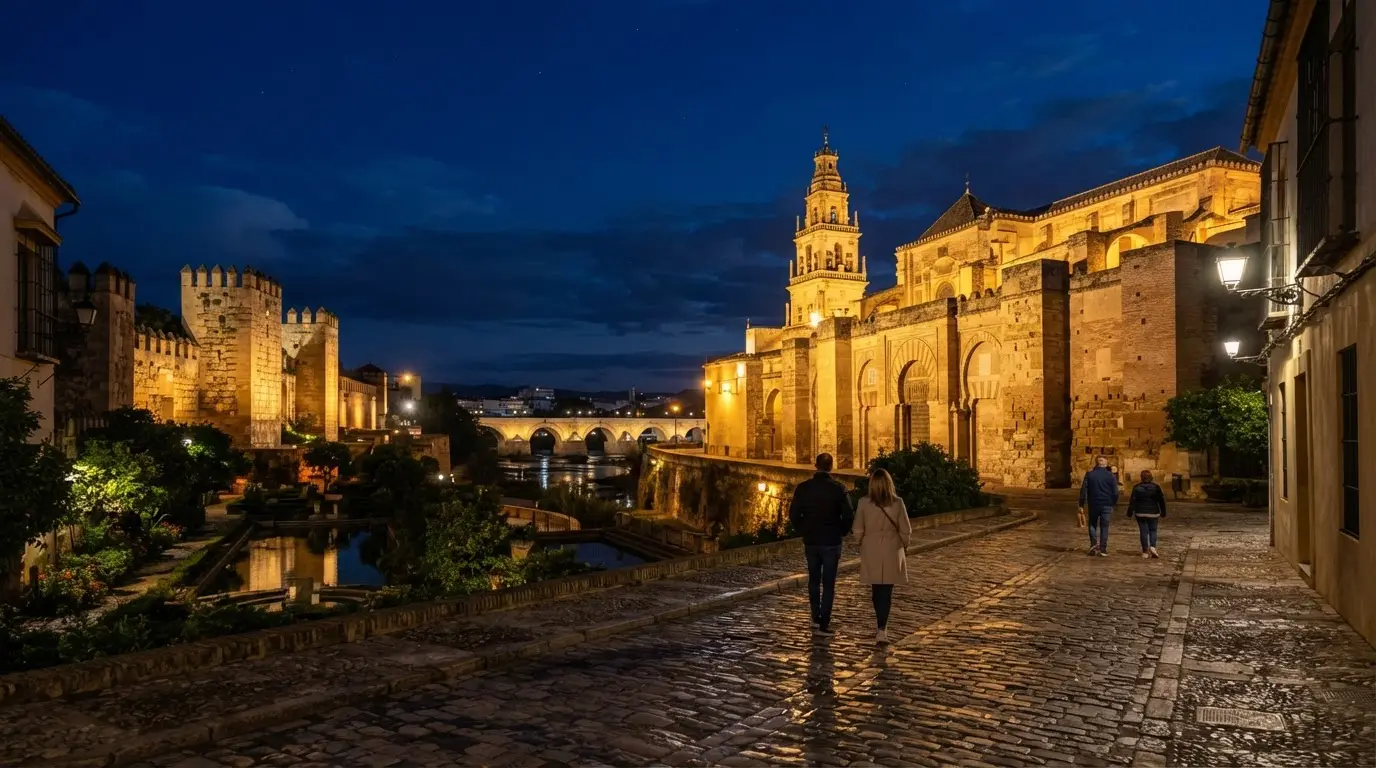
Medina Azahara is the essential stop. The palace-city 8 km west of central Córdoba where she lived, governed, and was eventually confined: partially excavated, partially reconstructed, with the throne reception hall (the Salon Rico) restored enough to understand the scale of what she occupied. The site museum has exhibits on the caliphal period that cover the court structure within which she operated. Bus service runs from the old city; allow at least two hours. The light in the excavated terraces is best in the late afternoon.[6]
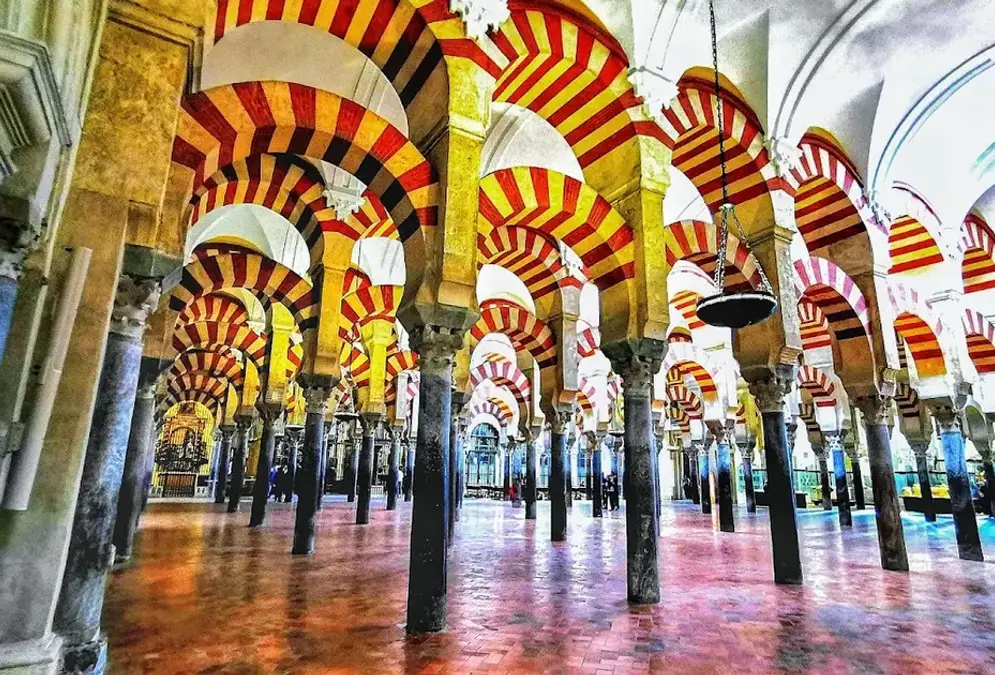
The Mezquita connects directly to her story. Al-Hakam II's additions, the maqsura and the mihrab chamber with its Byzantine mosaics, were built during the years she was his concubine and confidante. Almanzor's eastern expansion, the eight naves added in 987, was funded from the military revenues he controlled partly through the foundations she had built. The mosque is a layered document of exactly the power struggles she was involved in.
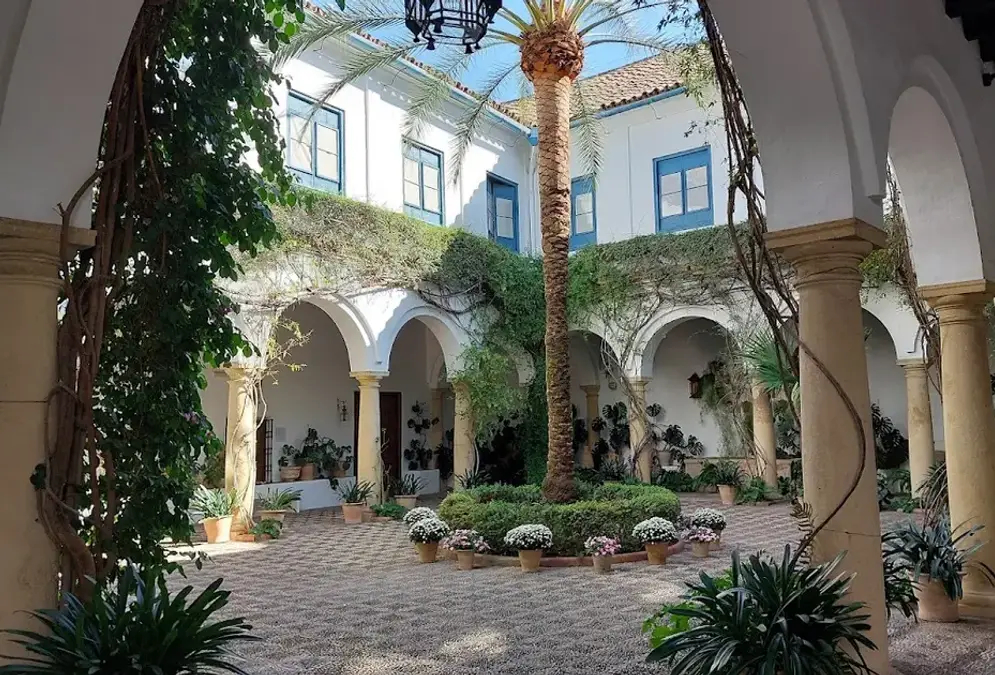
The Judería quarter, the old Jewish neighbourhood near the Mezquita, preserves the street scale of 10th-century Córdoba better than anywhere else in the city. The houses here are small, the streets angled to catch shade, the patios open in May for the festival. None of these patios are Umayyad, but the spatial logic is the same: cool interiors, street-facing walls without windows, architecture organised around water.
For the historical context, the article on al-Hakam II's library gives the clearest picture of the court Subh navigated at its height. The Almanzor article covers the military campaigns from his perspective, useful as counterpoint to reading her story from hers.
Frequently asked questions
Who was Subh of Córdoba?
Subh (born Aurora, c. 940-999) was a Basque slave concubine who became the favourite of Caliph al-Hakam II of Córdoba, bore his heir Hisham II, and served as regent of the caliphate after al-Hakam's death in 976.[1] She appointed Ibn Abi Amir (later Almanzor) as her secretary in the 960s, funded his rise to the position of hajib, and then spent the 990s unsuccessfully trying to reclaim the power she had delegated to him.[1] She died around 999, confined and politically isolated.
Was Subh from the Basque Country?
Yes. Multiple medieval sources identify Subh as Basque or Navarrese — from the Christian north of the Iberian Peninsula.[4] She was brought to Córdoba as an enslaved concubine, adopted the Arabic name Subh (dawn), and became proficient in Arabic literature, music, and court culture.[1] Her Basque origins are noted explicitly in Arabic biographical sources and are considered historically well-established.[5]
How did Subh and Almanzor fall out?
The break was gradual rather than sudden. Subh had appointed Ibn Abi Amir as her secretary around 966 and promoted him steadily; by 978 he was hajib.[1] After General Ghalib died in 981 following the Battle of Torrevicente and Ibn Abi Amir consolidated military command, his power began to eclipse hers.[3] By the mid-990s she was attempting to introduce rival male favourites at court and independently access the treasury to fund opposition to him.[1] In 996, Almanzor blocked her treasury withdrawal and confined her. She tried again in 998 and failed again.[1]
Who really ruled the Caliphate of Córdoba?
From 976 to approximately 986, the answer is complicated: Subh as regent held significant practical authority alongside the hajib and senior military commanders.[1] From roughly 978 onwards, Ibn Abi Amir (Almanzor) accumulated administrative and military control progressively, and after 981 he was the effective ruler.[3] The caliph Hisham II remained on the throne as a ceremonial figure throughout his reign (976-1013), and Almanzor never formally claimed the caliphal title.[2] The Caliphate of Córdoba was a theatre of legitimacy for most of this period, with real power held by whoever controlled the army and the treasury.[6]
What happened to Subh after Almanzor took power?
She remained at Medina Azahara with the nominal caliph Hisham II, retaining ceremonial status but losing real authority progressively through the 980s.[1] In 996 she made a direct bid for financial independence by attempting to withdraw caliphal treasury funds; Almanzor moved quickly to confine her and block the attempt.[1] A second attempt in 998 also failed. She died around 999, isolated from power and from any effective means of opposing Almanzor, who outlived her by three years.[3]
How did a slave become regent of Córdoba?
Through the umm walad institution in Islamic law: a concubine who bore the caliph's son could not be sold, was entitled to maintenance, and was automatically freed on the caliph's death.[1] When Subh bore al-Hakam II's son Hisham in 966, she gained this protected status. When al-Hakam died in 976 with no adult male heir, she was freed and became the natural regent for her ten-year-old son.[2] Her decade of political access under al-Hakam, managing finances and administering the household, had given her the skills and contacts to function as an effective regent immediately. The legal structure made it possible; she had prepared for it.