Hisham II of Córdoba: The Boy Caliph Who Lost an Empire
Hisham II became caliph of Córdoba at ten, ruled as a puppet for Almanzor, vanished during the 1013 sack, and taifa kings still invoked his name in 1082.
Art history background with eight years writing interpretive content on Córdoba's Caliphal heritage.
Updated Published
history-buffs
Hisham II became caliph of Córdoba in 976 at age ten, and he did not rule a single day of the thirty-seven years his name sat on the throne.[1] First his mother Subh, then the hajib Almanzor, then Almanzor's own son held the actual power, keeping the boy caliph inside his palace while his signature moved money and his face moved coin.[2] By the time Córdoba tore itself apart in the Fitna civil war, Hisham had been deposed, declared dead using someone else's body, freed, restored, deposed again, and finally lost in the 1013 sack of the city so completely that taifa kings kept invoking his name as a legitimizing fiction for seventy more years afterward.
In this article
Jump to a section
⌄
A ten-year-old inherits an empire he cannot rule
Córdoba's caliphate ran for decades on a fiction almost everyone at court understood and few ever said aloud: the man on the throne barely mattered.
Hisham II was born in Córdoba in 966[1], the son of the scholar-caliph al-Hakam II, a ruler whose personal library reportedly held some 600,000 volumes[5], a collection that dwarfed anything in Christian Europe at the time. When al-Hakam died in October 976, Hisham inherited the caliphate at ten years old[1]. A court faction tried to bypass the boy entirely in favour of his uncle al-Mughira, the prince for whom Madinat al-Zahra's workshop had carved the Pyxis of al-Mughira eight years earlier — an ivory box whose carved medallions read as a coded argument for exactly the Umayyad legitimacy the two rivals were now contesting. Islamic law set no formal minimum age for a caliph, but everyone in the palace understood the practical problem anyway: a ten-year-old cannot chair a council of generals, negotiate with a rebellious governor, or lead an army into Castile.
The Umayyad dynasty of Córdoba had built its authority on two things that had nothing to do with administrative competence: descent from the Prophet's own tribe, and four generations of ceremonial continuity at court. That inheritance could sit on a child's shoulders without anyone challenging his right to the title. What it could not do was teach him statecraft, or protect him from the adults who would run the state in his stead. The caliphate needed Hisham on the throne far more than it needed him to actually govern from it.
So others did it for him. His Basque-born mother held the regency alongside the sitting hajib, Ja'far al-Mushafi[2], in an arrangement that lasted barely two years before a court secretary named Muhammad ibn Abi Amir out-maneuvered them both. That secretary took the title al-Mansur, Almanzor to history, and ran Córdoba in Hisham's name for the next twenty-four years. Hisham signed what he was told to sign. He would keep doing exactly that, in one form or another, for the rest of his life.
By 978, Almanzor held the title of hajib and functioned as the caliphate's de facto ruler for the next twenty-four years[1]. He never deposed Hisham. Deposing him would have destroyed the only thing the whole arrangement rested on: descent from the Prophet's tribe, the aura of the caliphal office itself. Almanzor needed the throne occupied. He needed it occupied by someone who could never use it.
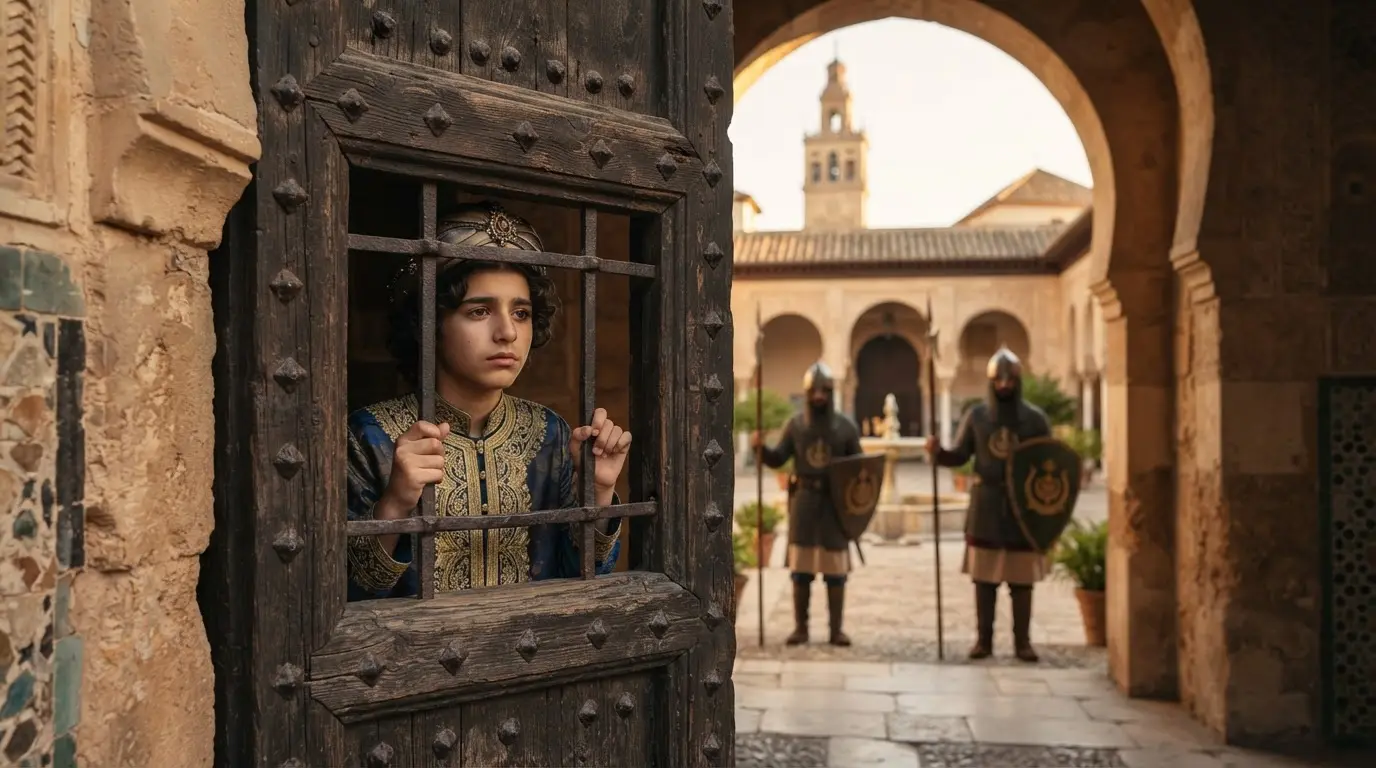
The method was physical as much as political. Almanzor walled offthe caliphal residence west of the city, dug a moat around it, stationed his own guards at the gates, and forbade Hisham from appearing in public[2]. A caliph who cannot be seen cannot build a following among the people who might restore him to real power. A caliph who cannot leave his rooms cannot conspire with a general.
This was not simple cruelty. Almanzor had spent a decade learning exactly how caliphal authority worked from the inside, first as Subh's secretary, then as the young caliph's own administrator, and he understood better than anyone which levers actually mattered. Removing Hisham from view did not require removing him from the throne. It only required controlling every channel through which the throne's authority could reach the outside world:
The mint, so no coin moved without his approval
The army payroll, so no soldier's loyalty ran to anyone else
The diplomatic correspondence, so no foreign court heard from Hisham directly
The physical distance between the caliph and anyone who might petition him
For most of the next two decades, Hisham II's entire caliphal existence came down to three things[1]:
His name struck on coinage minted in a treasury he never touched
A ritual mention at the Friday khutba, with no substance behind it
The bare title of caliph, held but never exercised
He passed through his twenties and into his thirties this way: a name on money he did not mint, a formula recited in mosques he did not visit, and a man he barely saw making every decision that mattered in his own empire.
Abd al-Malik, a coup, and a corpse that wasn't his
Almanzor's son, Abd al-Malik al-Muzaffar, inherited the hajib title on his father's death in 1002 and kept the machine running competently for six years, until his own death in October 1008[1]. Whatever stability the Amirid family had built died with him. Within three months, the fiction that had held Córdoba together for thirty years came apart in public.
On 16 January 1009, an Umayyad prince named Muhammad ibn Hisham forced his way to power, deposed Hisham II outright, and declared himself caliph the following day under the title Muhammad II al-Mahdi[2]. This broke the old pattern completely. Almanzor and his sons had ruled through Hisham, never instead of him. Al-Mahdi ruled in his own name, and a living deposed caliph was a standing invitation for someone else to restore him. Al-Mahdi needed Hisham gone, permanently and visibly.
He could not quite manage that. In April 1009, al-Mahdi announced that Hisham had died, and produced a body: a Christian or Jewish man who happened to resemble the deposed caliph closely enough to pass in front of a crowd that had rarely, if ever, seen Hisham's actual face[2]. A stranger's corpse became, for a few months, the official end of a caliph who was very much alive. Hisham himself remained in al-Mahdi's custody, out of public view.
Recommended tours
Tours are selected for quality, not commission. We earn a small fee if you book — at no extra cost to you.
It remains one of the odder footnotes in Córdoba's history, and also one of the more revealing ones. A caliph who had been kept invisible for most of his reign, precisely so that no one could rally around him, was now declared dead using someone else's face, precisely because almost nobody in Córdoba could have told the difference. Almanzor's isolation strategy had solved one problem for al-Mahdi and created another: the population had no living memory of what their caliph actually looked like, which made him easy to erase on paper and, as it turned out, just as easy to produce again later.
A stranger's corpse became, for a few months, the official end of a caliph who was very much alive.
Freed, restored, deposed again
What happened next shows how fast the fiction was fraying. Sulayman ibn al-Hakam, another Umayyad claimant, freed Hisham from imprisonment in November 1009 and briefly restored him to the throne, before setting him aside again and taking the caliphate for himself[1]. Córdoba had now had three different men claim the title inside a single year, with the original one passed between them as a hostage of legitimacy rather than removed for good.
The Amirid loyalists had not disappeared either. The mawali, freedmen and dependents of Almanzor's own household, revolted against al-Mahdi's faction, stormed the palace, and killed him[2]. They then did what every faction in the Fitna eventually did: freed Hisham II from confinement and installed him as caliph a second time, in the middle of 1010[2].
Timeline
16 Jan 1009
Muhammad ibn Hisham deposes Hisham II and declares himself caliph as Muhammad II al-Mahdi the next day.
April 1009
Al-Mahdi announces Hisham's death, using the body of a man who resembled him.
Nov 1009
Sulayman ibn al-Hakam frees Hisham, briefly restores him, then takes the throne himself.
Mid-1010
Amirid mawali kill al-Mahdi and restore Hisham II as caliph a second time.
Notice what every single faction in this sequence chose to do with Hisham rather than to him. Sulayman freed him before deposing him again. The mawali freed him and put him back on the throne. Nobody killed the caliph, even when killing him would have been simpler than managing him. His body, immobile and largely irrelevant for thirty years, had become the one object every faction in the Fitna needed physical custody of before it could claim to rule legitimately at all.
It changed nothing that mattered. Hisham's second reign carried the same title and the same absence of power as the first[1]. Whoever controlled the palace guard controlled the caliph. The caliph himself controlled nothing at all.
The sack of Córdoba, and an ending nobody agrees on
The end came from outside the palace walls entirely. Berber factions loyal to a rival claimant, Sulayman al-Musta'in, besieged Córdoba through the worst stretch of the Fitna, and on 10 and 11 May 1013 they broke the city's defense in a decisive battle and sacked it[2]. Córdoba, the wealthiest city in western Europe a generation earlier, burned.
Hisham II disappears from reliable record at almost exactly this point, and what happened to him next is genuinely disputed rather than merely unclear. One tradition holds that al-Musta'in imprisoned him and eventually had him killed through his own son, Muhammad ibn Sulayman[2]. A second, equally old tradition claims Hisham escaped the sack, fled south, and lived out his life in hiding near Almería, dying quietly rather than violently[2]. Medieval chroniclers on either side of the Fitna had reasons to prefer one version over the other, and neither account can be checked against the other.
Both versions share the same underlying truth, which is that by 1013 nobody in Córdoba had enough reliable information about the caliph's whereabouts to settle the question, and nobody with power left had much reason to try. Whichever version is true, the caliph who spent most of his reign as a name on a coin ended his life as something closer to a rumor than a recorded fact. The same civil war that erased Hisham also flattened the palace-city where he had spent his confinement.
The caliph who wouldn't stay dead: taifa Spain's borrowed legitimacy
Hisham II's most useful years came after he vanished.
An uncertain fate turned out to be politically perfect. In 1035, more than two decades after the sack of Córdoba, Abu al-Qasim Muhammad ibn Abbad, ruler of the Taifa of Seville, announced that Hisham II had reappeared[1] and publicly declared his allegiance to him. The caliphate itself was long gone, dissolved into competing taifa kingdoms with no Umayyad authority left to confer legitimacy on anyone, and Ibn Abbad needed exactly that kind of legitimacy for his own expanding power in Seville. A man was produced, presented at court as the returned Hisham II, and treated as the caliph he claimed to be.
It worked well enough to spread. As Seville's influence extended over neighbouring taifas in the years that followed, those rulers fell in line and recognized the reappeared 'Hisham' too[1], not because anyone seriously believed a caliph missing for over twenty years had resurfaced, but because acknowledging him let a new ruler borrow Umayyad legitimacy without inventing a dynasty from nothing. The convenient fiction Almanzor had once maintained by force, taifa Spain now maintained by consensus, because everyone with a throne to protect benefited from pretending it was true.
The arrangement tells you something about how legitimacy actually worked in eleventh-century al-Andalus. It was never really about whether Hisham II was alive. Almanzor had proved thirty years earlier that a caliph's living presence and a caliph's political function were entirely separable things: you could keep one and discard the other, or, as the taifa kings discovered, discard the man and keep only the function, running it on borrowed authority indefinitely.
The impostor reportedly died in 1044. Abbad II al-Mu'tadid, who by then ruled Seville, did not announce it. He kept using Hisham's name and authority as a source of legitimacy without a living body behind it, and did not publicly acknowledge the death until 1060, sixteen years after the fact and without naming any successor[1]. The fiction had outlived its own usefulness, and still nobody had bothered to retire it.
Even that was not the end. Hisham II's name kept appearing as a legitimizing formula on the coinage of the Taifa of Zaragoza as late as 1082 or 1083[1], nearly seventy years after the sack of Córdoba and probably decades after anyone alive had actually seen the man. Hisham II's own father, al-Hakam II, had spent his reign building a personal library reportedly running to 600,000 volumes[5], a collection that dwarfed anything in Christian Europe at the time; his son ended his own reign as a name still worth borrowing, decades after anyone could confirm he was alive.
Frequently asked questions
Who was Hisham II of Córdoba?
Hisham II (born 966, disappeared 1013) was the caliph of Córdoba from 976 until the sack of the city, though he held real power for almost none of that time. He inherited the throne at age ten and spent his reign as a figurehead controlled first by his mother Subh, then by the hajib Almanzor and Almanzor's son, then by a succession of rival claimants during the Fitna civil war. His fate after 1013 is disputed among historians.
How old was Hisham II when he became caliph?
He was ten years old. His father, al-Hakam II, died in October 976, and Hisham inherited the Caliphate of Córdoba as a minor, too young to govern independently. Regents and administrators ran the state in his name for essentially his entire reign.
Why was Hisham II considered a puppet ruler?
Because Almanzor physically confined him. Almanzor walled off the caliphal palace, posted his own guards, and forbade Hisham from appearing in public. For most of his reign, Hisham's presence as caliph consisted of his name on coinage, a ritual mention at Friday prayer, and the bare title itself, with no independent authority attached to any of it.
What role did Almanzor play in Hisham II's reign?
Almanzor (Muhammad ibn Abi Amir) became hajib, or chamberlain, in 978 and ruled the caliphate in Hisham's name until his own death in 1002. He and his son Abd al-Malik between them controlled Córdoba for roughly thirty years while Hisham remained formally on the throne. Almanzor's full career, including his military campaigns, is covered in a separate article on his life and administration.
What was the Fitna of al-Andalus?
The Fitna was the civil war that broke the Caliphate of Córdoba apart, beginning with Hisham's deposition in January 1009 and continuing for roughly two decades. Rival claimants, Amirid loyalists, and Berber factions fought for control of Córdoba and the caliphal title itself, and the conflict ended with al-Andalus fragmented into dozens of independent taifa kingdoms.
How and when did Hisham II die?
This is genuinely disputed. Córdoba was besieged and sacked on 10 and 11 May 1013 during the Fitna, and Hisham disappears from reliable record around that point. One tradition says the rival claimant Sulayman al-Musta'in imprisoned him and later had him killed. A separate tradition claims he escaped the sack and lived out his life in hiding near Almería. Neither account can be independently confirmed.
Why did taifa kings in the 11th century claim Hisham II was still alive?
Because the Umayyad caliphal title still carried legitimacy that the new taifa kingdoms lacked. In 1035, the ruler of the Taifa of Seville announced that Hisham II had reappeared and declared allegiance to him, a claim that let Seville and its allied taifas invoke Umayyad authority without founding a new dynasty from nothing.
Who was the impostor who claimed to be Caliph Hisham II?
His identity before 1035 is not well documented in the historical record. What is recorded is his political function: the ruler of Seville presented him at court as the returned Hisham II, and multiple taifas allied to Seville recognized him. He reportedly died in 1044, though Seville did not publicly acknowledge his death until 1060.
How long did rulers keep invoking Hisham II's name after his disappearance?
Remarkably long. Beyond the 1035 Seville claim, Hisham II's name continued to appear as a legitimizing formula on coinage minted by the Taifa of Zaragoza as late as 1082 or 1083, nearly seventy years after the sack of Córdoba in 1013.